The Best AI Marketing Tools in 2026: 11 Picks, Real Prices
By Toy Wen Da, Co-Founder · Updated · 11 min read · scored 95/100
The best AI marketing tools in 2026 depend on what you need to fix first. SearchBlueprint fits organic search without hiring a writer, and Jasper fits high-volume copy across channels. Below are both, plus nine more, with the prices each vendor lists and the limits you should know about.

How we chose these AI marketing tools
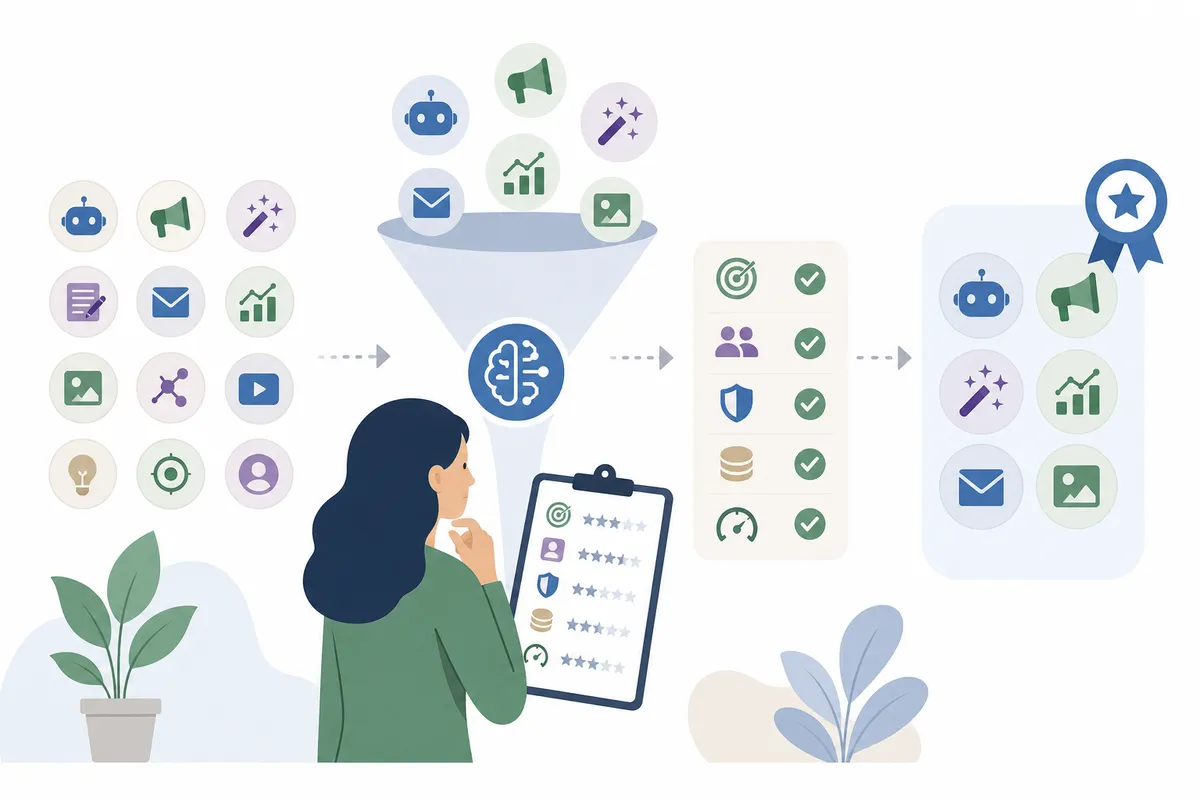
This comparison is built from each product's own website, pricing page and public documentation. For each tool we looked at whether a free plan exists, what it does well, its starting price and where it falls short.
We left out tools that mention AI in their marketing copy but ship no AI feature you can use today. We also wanted every major category represented (content writing, SEO, social, automation, CRM and lead capture) so the list isn't stacked with near-duplicates. If you'd rather match a tool to one specific job, this guide to choosing AI SEO tools job by job walks through the process.
The 11 best AI marketing tools in 2026
1. SearchBlueprint: best for small businesses and agencies that need SEO content on autopilot
SearchBlueprint builds an SEO plan that maps each target search to a specific page on your site. It runs on-page audits as well as technical and schema ones to find what's holding rankings back. It also does keyword research and competitor analysis, tracks rankings and AI search visibility, and writes articles that publish weekly to WordPress, Shopify, Wix or Webflow once you approve them. For agencies it refreshes aging content, suggests internal links and generates white-label client reports.
Starting price: free to start, then paid Base or Agency plans. See their pricing page for current rates (as of October 2026). Free plan: yes, with 60+ free SEO tools and a free SEO Academy.
Before committing, you can compare it against other AI tools built specifically for small business. Its way of grouping related searches overlaps with what dedicated keyword clustering tools do, though SearchBlueprint folds that step into the wider SEO plan instead of selling it alone.
Pick it if you want keyword research, content and publishing handled in one place, with a human approving every article before it goes live. Skip it if you need paid ad management, email automation or social scheduling, because it focuses on organic search and AI search visibility.
2. Jasper: best for teams that need high-volume marketing copy
Jasper is an AI writing assistant built for scale. It uses templates for blog posts, ad copy and social captions, and lets you set a brand voice so output stays consistent across writers. It also offers basic SEO keyword suggestions while you write and supports more than 25 languages for global campaigns.
Starting price: $39/month, with a free trial available (as of October 2026). Free plan: no ongoing free tier; trial only.
If you're building a full content calendar rather than one-off posts, see how it stacks up against other AI content writing tools built for similar volume.
Pick it if your team needs a lot of first-draft copy quickly and has editors to shape it afterward. Skip it if you want content researched, fact-checked and published without a writer in the loop, since Jasper drafts but doesn't run the whole pipeline.
3. Surfer SEO: best for on-page content optimization
Surfer SEO analyzes top-ranking pages for a given keyword and gives you real-time suggestions as you write: word count targets, headings and related terms to include. Its SERP analyzer compares your draft against competitors, and its topical maps suggest internal linking structures.
Starting price: $79/month, with a free demo available (as of October 2026). Free plan: no ongoing free tier; demo only.
It pairs well with anything built for SEO professionals managing multiple sites, because it only optimizes text you already have.
Pick it if writers are already producing content and you want a data-driven second pass before publishing. Skip it if you need content written from scratch or rankings tracked afterward, since Surfer stops at the optimization step.
4. Copy.ai: best for short-form ad and social copy
Copy.ai is a writing assistant tuned for shorter formats such as ad variations, email subject lines and social captions. You define a brand voice once and generate many variations of the same message, which helps when you're testing angles for paid campaigns.
Starting price: see their pricing page for current rates. Free plan: Copy.ai offers a limited free plan; check their pricing page for current details.
If short-form copy is one piece of a larger calendar, a dedicated content planning tool helps keep campaigns organized across channels.
Pick it if you run many ad variations and want quick options to A/B test. Skip it if you need long-form pieces like blog posts or landing pages, because it is built for speed on short copy.
5. HubSpot Marketing Hub: best for an all-in-one CRM and marketing platform
HubSpot ties email marketing, landing pages, SEO recommendations, blogging and analytics to its CRM, so lead data flows into the same system as your campaigns. Its AI features personalize email content and automate follow-ups based on how a lead behaves on your site.
Starting price: see their pricing page for current rates. Free plan: HubSpot offers free CRM tools and a limited free tier of Marketing Hub; check their pricing page for exact limits.
Teams rebuilding their site around a new CRM often tackle both at once, and an AI website builder guide is worth a look before you migrate.
Pick it if you want marketing, sales and CRM data behind one login instead of stitching tools together. Skip it if you're a small team without budget for a full platform, since the value shows up once you run several campaigns and channels at once.
6. Zapier: best for connecting your existing marketing stack
Zapier doesn't create content or run campaigns. It connects the tools you already use (over 7,000 apps, by its own count) so an action in one triggers a response in another. A new lead in your form tool can create a CRM record and send a follow-up email automatically.
Starting price: see their pricing page for current rates. Free plan: Zapier offers a free plan with limited monthly tasks; check their pricing page for current limits.
Pick it if your marketing tools don't talk to each other yet and manual data entry is eating your team's time. Skip it if you want a tool that creates or analyzes content, because Zapier is plumbing rather than a marketing engine.

7. Sprout Social: best for social media management and listening
Sprout Social schedules posts, tracks engagement and uses AI to suggest optimal posting times. Its social listening tracks brand mentions and sentiment across platforms, which matters more than it used to. Sprout Social's own 2023 State of Social Media report, conducted with The Harris Poll, found that 80% of business leaders expect their company's social media budget to grow over the next three years, and 44% of those expect the increase to exceed 50%.
Starting price: see their pricing page for current rates. Free plan: no ongoing free tier; trial only.
Pick it if you manage multiple social accounts and want scheduling, analytics and listening in one dashboard. Skip it if social isn't your main channel, because the price is hard to justify for occasional posting.
8. Tidio: best for turning website visitors into leads with chat
Tidio combines live chat with an AI agent (Lyro) that answers common questions instantly, trained on your own knowledge base. Human agents can step in for anything more complex, and chat interactions can feed into email follow-up sequences.
Starting price: see their pricing page for current rates. Free plan: Tidio offers a free plan with limited conversations; check their pricing page for current caps.
It is a common add-on for small e-commerce and service sites, and for those on WordPress it helps to read up on WordPress SEO tools so the traffic your chat converts actually finds the site first.
Pick it if you want after-hours lead capture without hiring overnight support staff. Skip it if your traffic is low, since a chat widget with no visitors has no one to talk to.
9. Salesforce Marketing Cloud: best for enterprise-scale personalization
Salesforce Marketing Cloud, powered by its Einstein AI, unifies customer data across channels and automates complex, multi-step customer journeys across email, mobile, social and web. It is built for organizations with large volumes of customer data that need every touchpoint personalized automatically.
Starting price: see their pricing page for current rates. Free plan: no free plan; enterprise, custom-quoted pricing.
Pick it if you're a larger organization running highly personalized, multi-channel campaigns at real scale. Skip it if you're a small team, because the complexity and cost are built for enterprise marketing departments rather than solo marketers.
10. Predis.ai: best for AI-generated social media visuals
Predis.ai generates images and video for social posts from a prompt, suggests content ideas, and analyzes competitor posts to flag what's working in your industry. It is aimed squarely at the visual-content bottleneck that slows down social teams.
Starting price: see their pricing page for current rates. Free plan: Predis.ai offers a limited free plan; check their pricing page for current details.
Pick it if your bottleneck is visual content for social rather than copy or strategy. Skip it if you also need scheduling, listening or analytics, because Predis.ai focuses on creation and leaves the rest of the social workflow alone.
11. Vendasta: best for agencies managing many clients under one brand
Vendasta is a white-label platform built on local business data. It combines CRM, reputation management, content and social tools so an agency can run every client's marketing from one login, under the agency's own brand instead of the vendor's.
Starting price: see their pricing page for current rates. Free plan: no public free plan; demo-based onboarding.
Pick it if you're an agency reselling marketing services to many local business clients and want one white-labeled dashboard. Skip it if you're an in-house team marketing a single brand, because the multi-client design is overkill for one company.
Comparison table: the best AI marketing tools at a glance
Here's how the 11 tools in this roundup compare side by side.
| Tool | Best for | Free plan | Starting price (Oct 2026) | Main limit |
|---|---|---|---|---|
| SearchBlueprint | Small businesses, agencies needing SEO content | Yes, free tier + 60+ free tools | Free, then Base/Agency (see pricing page) | No ads, email, or social scheduling |
| Jasper | High-volume marketing copy | Trial only | $39/month | No built-in publishing or SEO audits |
| Surfer SEO | On-page content optimization | Demo only | $79/month | Optimizes content, doesn't write or publish it |
| Copy.ai | Short-form ad and social copy | Limited free plan | See pricing page | Not built for long-form content |
| HubSpot Marketing Hub | All-in-one CRM + marketing | Limited free tier | See pricing page | Full value needs the paid tiers |
| Zapier | Connecting marketing tools | Limited free plan | See pricing page | Automates, doesn't create content |
| Sprout Social | Social media management | Trial only | See pricing page | Costly if social isn't your main channel |
| Tidio | Website chat and lead capture | Limited free plan | See pricing page | Needs existing traffic to be worth it |
| Salesforce Marketing Cloud | Enterprise personalization | None | See pricing page | Complexity built for large teams |
| Predis.ai | AI-generated social visuals | Limited free plan | See pricing page | No scheduling or analytics included |
| Vendasta | Agencies with many clients | None | See pricing page | Overkill for a single in-house brand |
How we compared
We checked each vendor's public pricing and feature pages, along with the review sites listed in Sources. We did not open paid accounts or test any tool ourselves, so every limit above comes from published material. Where a vendor doesn't publish a clear starting price, we point you to its pricing page rather than guess.

When the free option is enough, and when it isn't

When a free plan covers you
If you're a solo marketer or a very small business testing the water, free tiers can carry you further than you'd expect. SearchBlueprint's free plan plus its 60+ free SEO tools can cover keyword research, meta descriptions and basic audits without a subscription. Zapier's and Tidio's free tiers handle light automation and occasional chat volume at low traffic.
When you need to upgrade
Once you publish on a schedule, track rankings over time or manage more than a couple of campaigns, free tiers start to show their caps. That's when rank tracker tools and paid content tools earn their keep, because you need consistency rather than a one-time check. The shift toward AI-assisted search also means your content strategy has to account for how AI answer engines surface results, which this playbook on SEO best practices for AI-driven growth covers in more depth.
| Situation | Free plan likely enough? | Why |
|---|---|---|
| Solo marketer testing one channel | Yes | Low volume fits within free limits |
| Small business publishing weekly content | Often not | Needs consistent writing and tracking, not a one-off tool |
| Agency managing multiple clients | No | Needs white-label reporting and higher usage caps |
| Enterprise with multi-channel campaigns | No | Needs integration depth and dedicated support |
FAQs
What is the best free AI marketing tool?
It depends on the task. For SEO, SearchBlueprint's free plan and its 60+ free tools cover keyword research and basic audits at no cost. For automation, Zapier's free plan handles light task volume. No single free tool replaces a full paid stack once you run multiple campaigns.
Can AI marketing tools really replace a marketing team?
No. They speed up research, drafting, scheduling and reporting, but a person still has to set strategy, approve output and make any call that depends on knowing your brand or customers. Every tool on this list is built to support a marketer, not replace one.
How much do AI marketing tools cost?
Pricing varies widely by category. Content tools like Jasper start around $39/month and SEO optimization tools like Surfer SEO start around $79/month, both as of October 2026. Many platform-level products, such as CRM suites, enterprise marketing clouds and agency platforms, use custom or quote-based pricing, so check each pricing page for current numbers.
What's the difference between AI marketing tools and marketing automation?
AI marketing tools use machine learning to create or improve something, for example by writing copy, suggesting keywords or generating images. Marketing automation moves data and triggers actions between tools without a person doing it by hand, as Zapier and the automation features inside HubSpot do. Many platforms now combine both.
Which AI marketing tool is best for SEO specifically?
For a complete, hands-off pipeline that covers keyword research, content writing, publishing and rank tracking, SearchBlueprint covers the most ground on this list. If you already have writers and only need optimization guidance on their drafts, Surfer SEO is the narrower option.
Pick one and start this week
Match the tool to the job you have open right now rather than the longest feature list. That is how you land on the best AI marketing tools for your situation instead of the most popular ones. If the job is organic search traffic without hiring a writer, start with the free plan and see what a real SEO plan for your site looks like. You can also talk to the team and get a sample report built around your own pages.
Sources
About the author
SearchBlueprint researched, wrote and scored this article with the content pipeline our customers run on their own sites. The score in the byline is what our content engine gave this page before it published. Nothing here is reviewed by hand, which is the point: it is the product's output, published where anyone can check it.