Every comparison names what we lose.
Capability by capability, against SearchBlueprint. Each page carries the rows the other tool wins, and the section that says when it is the better buy.
Each page prints the date its vendor's pricing was read.
What our column is counting
Four numbers behind our side of every row, each read from the file that enforces it.
A comparison is worth what the scope behind it is worth. None of these four is rounded and none of them counts customers.
- 94markets keyword and position data resolves in, from one list the whole product reads
- 500pages one audit crawls at its ceiling, 200 of them by default
- 9platforms an article publishes to directly, plus a signed webhook for the rest
- 86capability rows across these comparisons, 23 of them called for the other tool
The tools we get compared to
Same table on every page: capability, entry price, and the rows we lose.
SearchBlueprint vs SE Ranking
SE Ranking is a deep, mature all-in-one SEO suite. SearchBlueprint is built AI-search-first — GEO/AEO strategy and AI Overview citation tracking are the core of the product, not a paid add-on.
Entry price. SearchBlueprint: Free, then $99/mo (Starter). SE Ranking: $103/mo (Core, billed annually).
The table. 11 capability rows, 2 of them called for SE Ranking, and 4 jobs listed where SE Ranking is the smarter buy.
The SE Ranking comparisonSearchBlueprint vs SEOptimer
SEOptimer is a fast, affordable website-audit and white-label reporting tool. SearchBlueprint is a full SEO + AI-search platform — the graded audit is where it starts, not where it stops.
Entry price. SearchBlueprint: Free, then $99/mo (Starter). SEOptimer: $19/mo (DIY), embedding from ~$59/mo.
The table. 9 capability rows, 2 of them called for SEOptimer, and 3 jobs listed where SEOptimer is the smarter buy.
The SEOptimer comparisonSearchBlueprint vs BabyLoveGrowth
BabyLoveGrowth writes, publishes and link-builds for you on autopilot. SearchBlueprint measures your AI-search presence, hands you the strategy, and keeps you in the loop on every article that ships.
Entry price. SearchBlueprint: Free, then $99/mo (Starter). BabyLoveGrowth: $99/mo (Grow, billed monthly).
The table. 12 capability rows, 4 of them called for BabyLoveGrowth, and 4 jobs listed where BabyLoveGrowth is the smarter buy.
The BabyLoveGrowth comparisonSearchBlueprint vs Outrank
Outrank publishes 30 articles a month for you on one flat plan. SearchBlueprint starts with an audit and a keyword map, measures your AI-search presence, and writes content you steer.
Entry price. SearchBlueprint: Free, then $99/mo (Starter). Outrank: $99/mo (All-in-One).
The table. 10 capability rows, 3 of them called for Outrank, and 4 jobs listed where Outrank is the smarter buy.
The Outrank comparisonSearchBlueprint vs SEObot
SEObot fills your blog from a URL and a credit card. SearchBlueprint audits the site first, plans the content against a keyword map, and measures what the articles earn in rankings and AI answers.
Entry price. SearchBlueprint: Free, then $99/mo (Starter). SEObot: From $49/mo.
The table. 11 capability rows, 3 of them called for SEObot, and 3 jobs listed where SEObot is the smarter buy.
The SEObot comparisonSearchBlueprint vs Writesonic
Writesonic leads with AI visibility tracking: prompts checked daily across ChatGPT, Gemini and Google. SearchBlueprint leads with the work itself: audit, strategy, content and the measurements that come with them.
Entry price. SearchBlueprint: Free, then $99/mo (Starter). Writesonic: $79/mo (Starter, billed annually).
The table. 11 capability rows, 3 of them called for Writesonic, and 4 jobs listed where Writesonic is the smarter buy.
The Writesonic comparisonSearchBlueprint vs Surfer
Surfer is the editor you optimize documents in. SearchBlueprint is the run that decides which documents to write, grades the site they live on, and measures what they earn in rankings and AI answers.
Entry price. SearchBlueprint: Free, then $99/mo (Starter). Surfer: $49/mo (Discovery, billed yearly).
The table. 11 capability rows, 3 of them called for Surfer, and 4 jobs listed where Surfer is the smarter buy.
The Surfer comparisonSearchBlueprint vs Frase
Frase is a research-to-draft workflow at a low entry price. SearchBlueprint wraps the content work in the rest of the job: graded audits, rank tracking, AI-search measurement and a lead-gen funnel.
Entry price. SearchBlueprint: Free, then $99/mo (Starter). Frase: $39/mo (Starter, billed yearly).
The table. 11 capability rows, 3 of them called for Frase, and 4 jobs listed where Frase is the smarter buy.
The Frase comparison
Where the other tool wins
Lifted from the same tables. These rows are theirs.
Nothing below is written twice. Each line is a row from that tool's own comparison page, marked in the data as theirs, so a capability cannot be conceded in one place and claimed in another.
SE Ranking
Backlink index & monitoring. SE Ranking: yes. SearchBlueprint: Not a focus. SE Ranking has a large backlink database — a real strength we don't try to match.
Site audits at 250k–2M+ pages. SE Ranking: yes. SearchBlueprint: Fair-use audits.
SEOptimer
White-label PDF reports. SEOptimer: Full white-label, 15 languages. SearchBlueprint: Branded (logo/colours). Full white-label is SEOptimer's core strength; SearchBlueprint reports are branded, not fully white-labelled.
Entry price. SEOptimer: $19/mo (DIY). SearchBlueprint: Free, then $99/mo (Starter). SEOptimer's DIY tier is cheaper if a branded audit is all you need.
BabyLoveGrowth
AI citation tracking on ChatGPT, Perplexity and Gemini. BabyLoveGrowth: Included, per their pricing page. SearchBlueprint: Gated: tiles show labeled sample data. Our per-assistant tiles stay labeled as samples until the data feed earns its cost. Google's AI surfaces are what we measure for real today.
Backlink exchange network. BabyLoveGrowth: $800+/mo in backlinks from 4,000+ partner sites, per their pricing page. SearchBlueprint: no. We do not build, exchange or index links. Their exchange is live.
Fixes implemented on your site without you. BabyLoveGrowth: Yes, per their AI SEO Agent page. SearchBlueprint: No. Audits return prioritized repairs; you apply them.
Hands-off article volume. BabyLoveGrowth: 30 articles/mo written and published for you (Grow). SearchBlueprint: Auto-write works your calendar at midnight on each date; bulk queue takes 20 keywords a batch. If unattended volume is the goal, their model does more of it.
Outrank
Hands-off article volume. Outrank: 30 articles/mo on autopilot; 60 or 90 with add-ons, per their pricing page. SearchBlueprint: Auto-write on the calendar plus a 20-keyword bulk queue.
Backlink exchange. Outrank: Included, with premium credits from $199/mo, per their pricing page. SearchBlueprint: no. We do not build or exchange links at all.
Content languages. Outrank: 150+ languages, per their pricing page. SearchBlueprint: Follows the market you pick.
SEObot
Zero-touch setup to published articles. SEObot: Enter your URL and press go, per their homepage. SearchBlueprint: A wizard run first: audit, keyword map, plan; then the auto-writer.
Entry price. SEObot: From $49/mo, per their homepage. SearchBlueprint: Free, then $99/mo (Starter). Ours starts free, but their cheapest paid month is about half of ours.
Content languages. SEObot: 50+ languages, per their homepage. SearchBlueprint: Follows the market you pick.
Writesonic
Per-assistant answer tracking (ChatGPT, Gemini), refreshed daily. Writesonic: 50 to 200 prompts tracked daily by plan, per their pricing page. SearchBlueprint: Gated: tiles show labeled sample data. Our per-assistant tiles are labeled samples until the data feed is enabled, so their prompt tracking wins this row outright.
Audit crawl size. Writesonic: 100 to 2,500 pages per audit by plan, per their pricing page. SearchBlueprint: 200 pages per run by default, 500 at the ceiling.
Fixes executed for you. Writesonic: Action Center trial on Growth: 5 off-page and 5 on-page actions/mo, per their pricing page. SearchBlueprint: No. Repairs are listed and prioritized; you apply them.
Surfer
AI prompt tracking across ChatGPT, Perplexity and Gemini. Surfer: 25 to 100 prompts by plan, daily refresh from Pro, per their pricing page. SearchBlueprint: Gated: tiles show labeled sample data. Our per-assistant tiles are labeled samples today; Google's AI surfaces are what we measure live.
Optimizing existing pages, document by document. Surfer: The core product: SERP-driven guidelines per document. SearchBlueprint: Content score, on-page checks and a page editor. Document-level optimization is Surfer's home turf, and this row is theirs.
Entry price. Surfer: $49/mo, billed yearly. SearchBlueprint: Free, then $99/mo (Starter). Their Discovery tier is cheaper if the editor is all you need; ours starts free and bills monthly.
Frase
Hosted blog at your own domain. Frase: FraseCMS hosting with a free tier on all plans, per their pricing page. SearchBlueprint: Built but gated; rolling out. Our blog hosting exists behind a gate while it rolls out; theirs is on their pricing page today.
White-label client portals. Frase: On their Enterprise tier, per their pricing page. SearchBlueprint: Branded reports and share links; a full white-label portal is not built.
Entry price. Frase: $39/mo, billed yearly. SearchBlueprint: Free, then $99/mo (Starter). Their Starter is the cheapest paid plan on this page; ours starts free and bills monthly.
Four ways to get this job done
Mechanism, not a verdict.
No row in this table names a vendor. What it compares is how the work gets done, so a row cannot go stale the week somebody repackages their plans.
| Approach | How it works | SearchBlueprint |
|---|---|---|
| Buy the pieces separately | How it worksA keyword tool, a crawler, a rank tracker and a writer, each with its own login, export and invoice. The joins between them are yours to keep in a spreadsheet. | SearchBlueprintOne run crawls the site, maps keywords onto its URLs and plans the content against that same crawl, so the plan already knows what the audit found. |
| Buy the audit alone | How it worksA grade and a report, fast and cheap. What to do about it is a separate decision, taken somewhere else and usually by hand. | SearchBlueprintThe graded report opens the run instead of ending it. The same crawl continues into the keyword map, the site structure and the content plan. |
| Buy an agency's time | How it worksA person researches the site monthly and sends a document. It is accurate on the day it lands, and re-measuring it costs another month. | SearchBlueprintPut the site on a weekly or monthly schedule. Every run stays in its history, so a regression reads as a diff between two runs rather than a feeling. |
| Run the free scanners | How it worksOne page, one score, one signup form. Anything the scanner could not reach tends to arrive in the report as a failure. | SearchBlueprintA check that could not be verified is listed as unverified and left out of the score, so a grade only ever divides by what was measured. |
What a row resolves to
Three rows from the tables above, shown as the screen they produce.
The graded report behind the audit rows
Every table carries rows about audits. This is what one returns: a score out of 100, a letter grade, and the pass, warn and fail counts the score divides by, with the repairs listed underneath in the order the crawl found them worth doing. The run below is 51 out of 100 from 21 checks: 9 passed, 3 warnings, 9 fails.
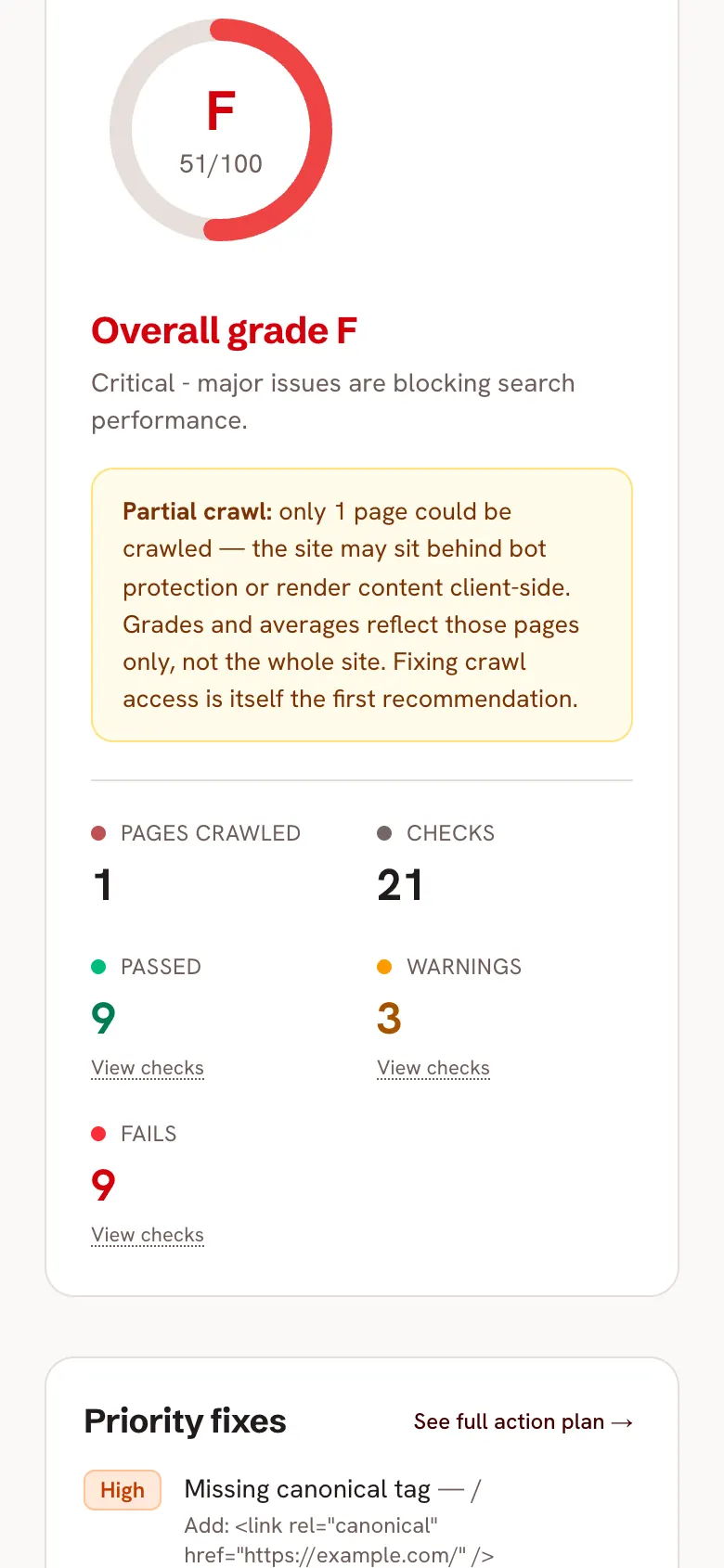
The grade leads and the crawl note sits directly under it, so a report built from one reachable page says so before it says anything else. Every average below divides by those pages only. AI search, where the tables diverge first
The top row of each comparison is AI search. It is not a separate dashboard here and not a separate invoice: the same crawl scores the AI-search signals alongside the technical ones, and a failing row names the file or the markup that is missing.
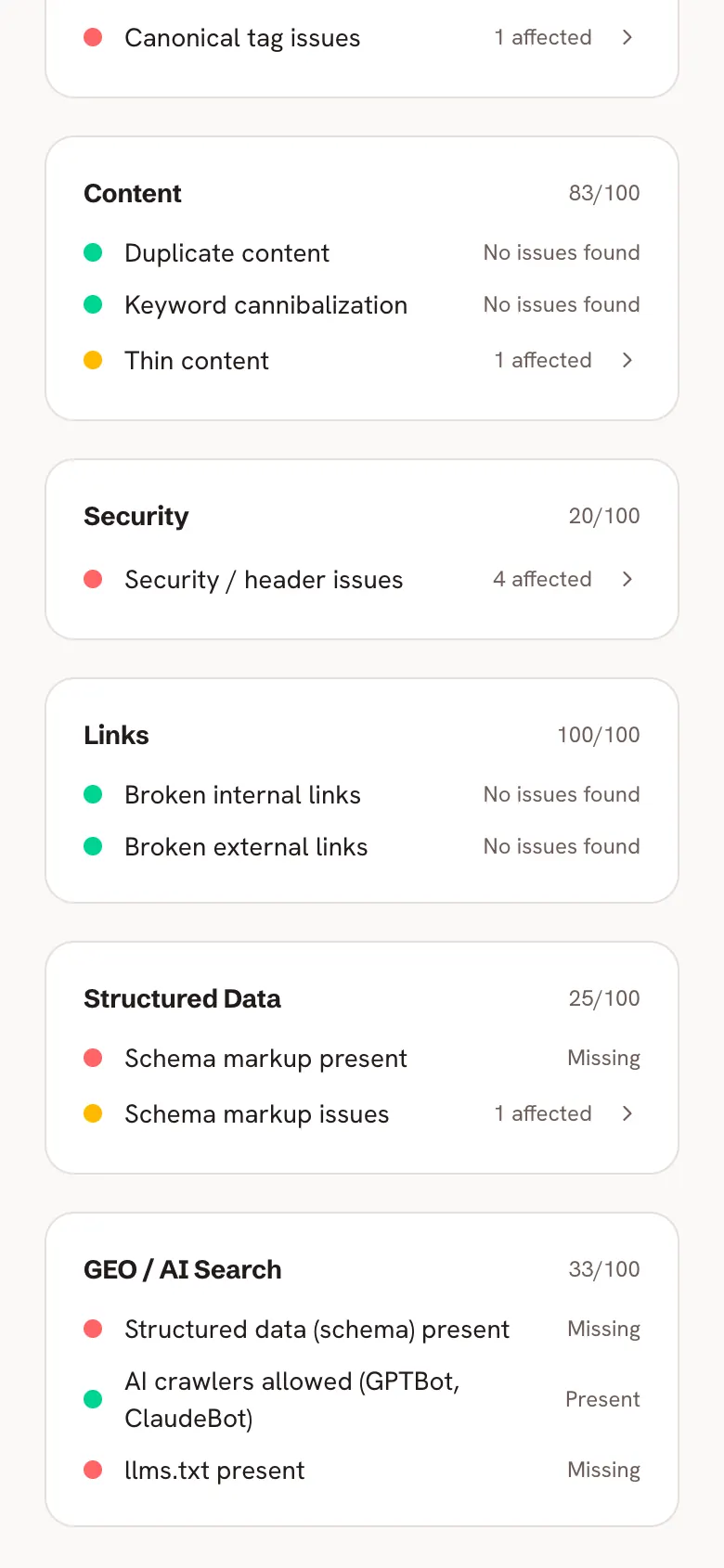
Each signal is named and marked present or missing, so a failed line already states the file to add instead of a score to worry about. The file a client actually opens
Reporting is a row we lose. What does ship is this: a read-only link that opens the strategy with no login and none of the app around it.
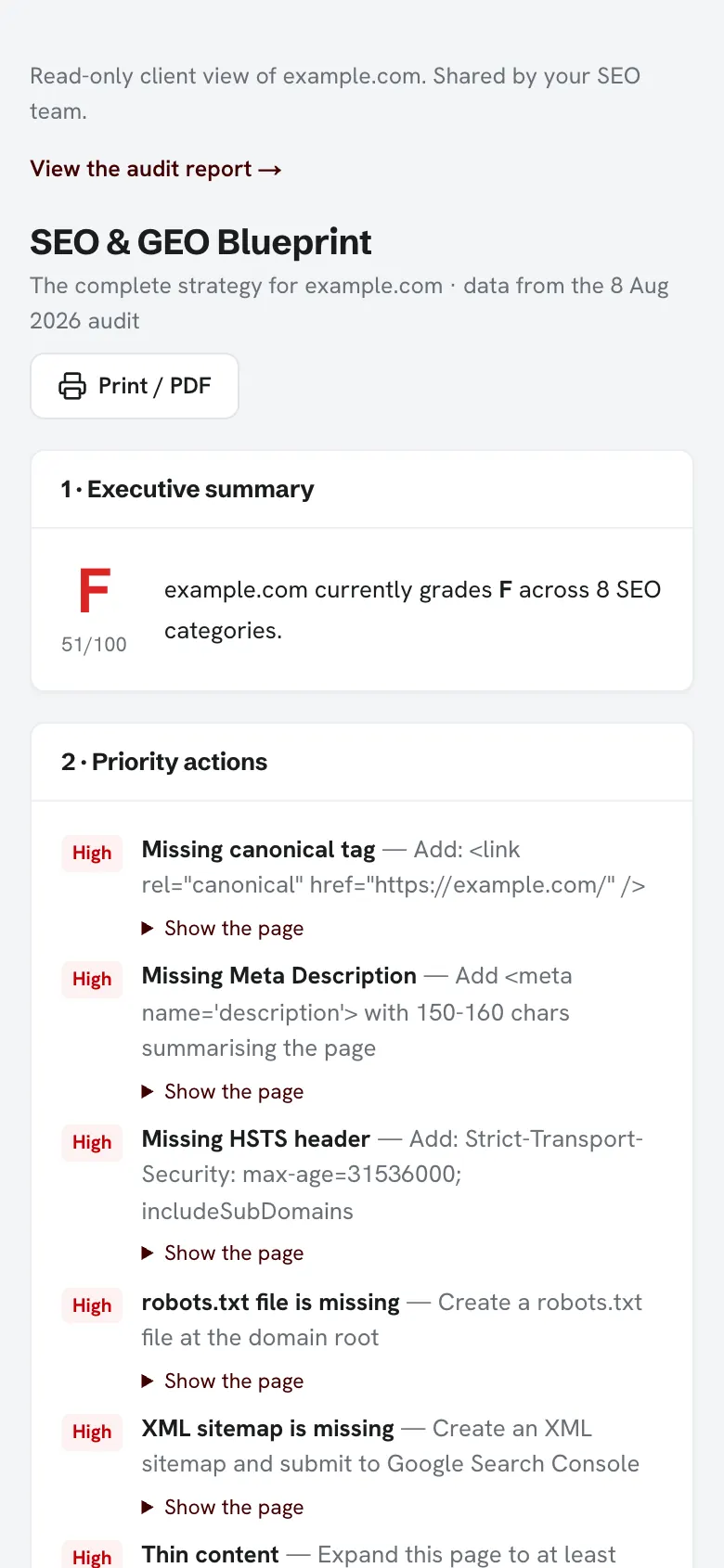
The client gets the strategy and a print button, and nothing else of the workspace it came out of.


Which of these comparisons is yours
The same tables read differently depending on the seat you are in.
You run an agency
Client sites on one cadence, a report per client that carries your branding, and a lead widget on your own site. Read the reporting row first, because that is the row we hand to the other tool.
How agencies run thisYou are the only SEO in the company
One subscription instead of four, and a plan that outlives the person who wrote it. The capability set is documented page by page, 13 of them, so a shortlist can be checked without booking a call.
The capability setYou own the business and the site
You want to know what is broken and what to do about it on Monday. Entry price and a free first run decide more here than seat counts do, so the entry-price row on every page is the one to start from.
What to fix first
Before you switch
Seven questions, including the three where the answer goes the other way.
- Do you have a backlink index?
- No. There is no link index here and no link monitoring, and every table that meets one gives that row away rather than working around it. If link data is the centre of your week, buy the tool that builds an index and keep this for the rest of the job.
- How large a site can one crawl cover?
- 200 pages per run by default and 500 at the ceiling, with anything above that clamped rather than refused. Larger sites get audited in sections. Crawling at a far bigger scale is a row we lose, and the SE Ranking table says so in its own words.
- Can I bring my rank history with me?
- No. Tracking starts at the first check run here, and the change and trend columns stay empty until a second check exists rather than filling with an estimate. Nothing back-fills the months before you arrived, so keep the old tool running for as long as you need the overlap.
- What happens to a check the crawler could not verify?
- It is listed as unverified and kept out of the score. A blocked fetch, a timeout or a page behind a login is a coverage gap, not a pass and not a fail, so the grade only ever divides by the checks that were actually measured.
- Will this work outside the United States?
- In 94 markets, each paired with the language that market searches in, from the one list every picker in the product derives from. If yours is not one of the 94, the research will not resolve, which is worth checking before you pay rather than after.
- Does anything publish to my site without me?
- Only after you connect a destination and switch it on. Publishing goes through a connector you set up yourself, and the overnight queue drafts nothing while the auto-write switch is off. Until then a planned item sits where it was planned.
- Are the reports white-labelled?
- Branded, which is not the same word. Your logo and colours go on the report and the client opens a read-only link with no login. Full white-label is a row SEOptimer wins, and it is in the table under its own name.
How these pages are written
Five rules, applied to every comparison here.
Every row names who wins it. The edge on a row is set in the page's own data, one of ours, theirs or even. A table cannot quietly tilt every line one way, because every line had to be called.
Every page carries their case. A named list of the jobs the other tool is the smarter buy for, written into the page rather than left implied.
Prices carry a date. Plan prices were read from each vendor's public pricing, and every comparison page prints the date its vendor's pages were read. Check their own page before you buy, because ours is not the copy that bills you.
We concede what we do not build. No backlink index, and no crawls at hundreds of thousands to millions of pages. Where a tool has one, the row says so and we do not claim to match it.
A name gets a page only when it can be sourced. A comparison gets written when every row can be checked against that vendor's own public pages, and a row that cannot be is omitted or marked as not stated. One vendor was researched and dropped in August 2026 because half its rows would have rested on assumption. Entries that hold up are worth more than entries that read well.
Run it on the site you own.
One free audit returns the graded report, the keyword map and the content plan for the site you actually own. No card to start.