Every job in the SEO week.
Audit the site, pick the keywords, write and publish, then prove what moved. 13 feature pages below, each naming the free tools that run its job first. All 42 of those tools and all 111 academy lessons work without an account.
No card to start.
One URL starts the whole loop
Paste a domain and the agent runs the loop the other twelve pages describe.
How the loop runs
Paste your URL. Setup is seven screens in about three minutes, pre-filled from your live site, with no account until the analysis starts.
Approve the strategy. The analysis takes three to five minutes, then you pick keywords, pick AI prompts and confirm the keyword map.
Let the loop run. Turn on auto-write and planned items draft overnight, rankings refresh weekly, and a re-run diffs the new grade against the last.

The four jobs the week runs on
Everything else on this page attaches to one of these four. They are listed in the order the week actually happens.
Audit the site
The audit that ends in a fix list
One crawl grades your site A+ to F across eight categories and turns every failure into a fix with its URLs attached.
Up to 200 pages per crawl, 500 at the ceiling, one credit per completed run. A check the crawler could not verify is listed as unverified and kept out of the score.
Technical SEO audit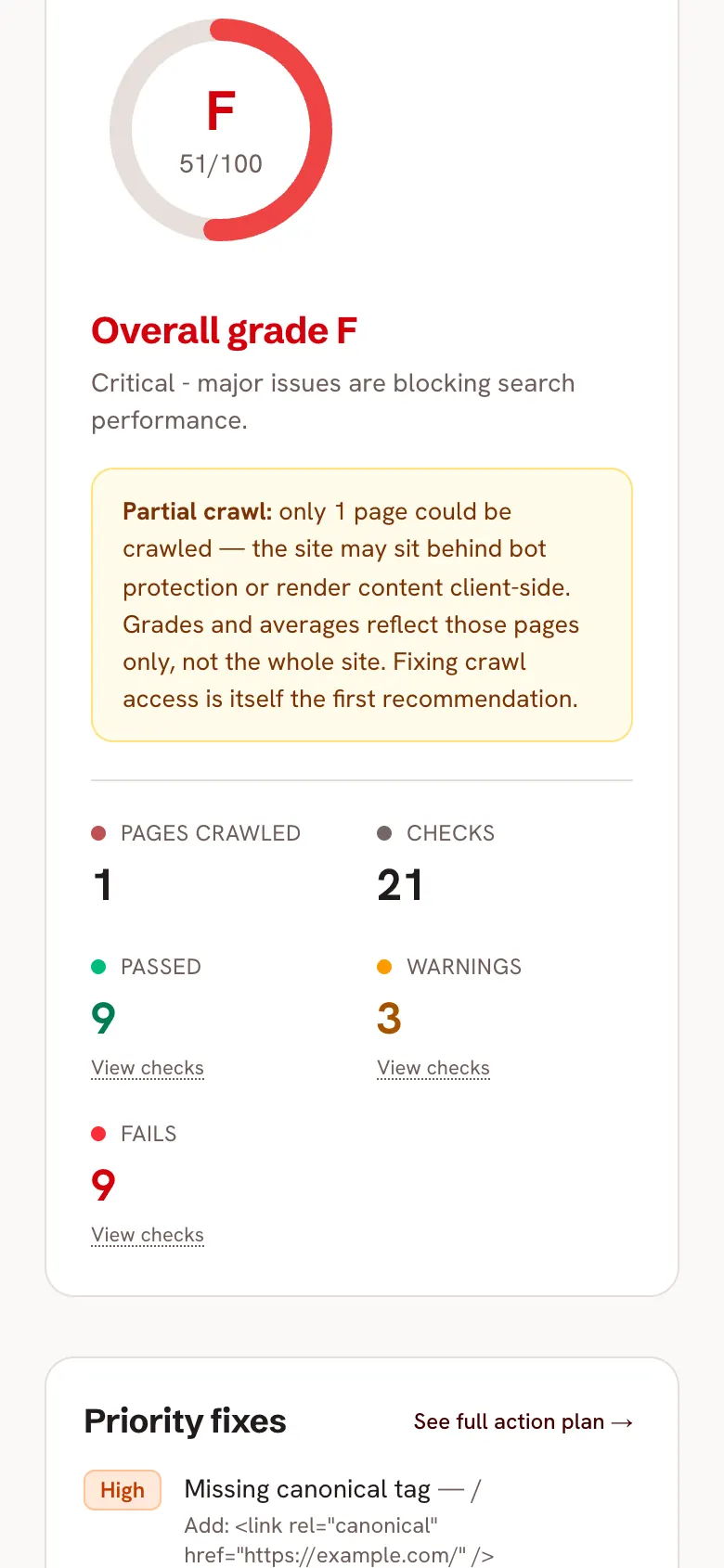
Pick the keywords
Give every keyword a page
Live ranking data and an AI pass over your site build the list. The keyword map then assigns every confirmed term to the page that should rank.
Volume, difficulty and intent come from a search data provider for the market you picked, and every recommendation names the page it belongs to before anything gets written.
Keyword research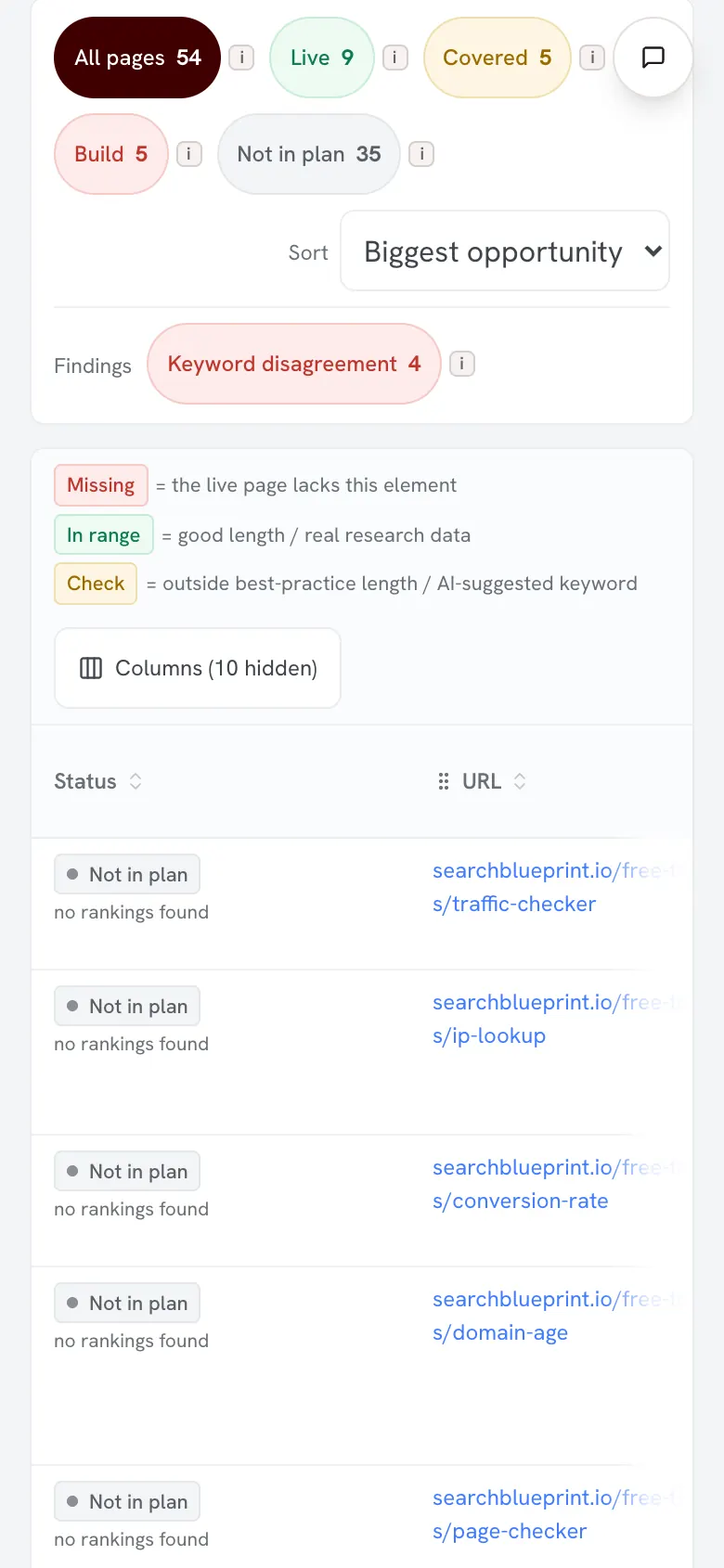
Write and publish
Articles scored by the audit engine
Give it a keyword. It researches, drafts with internal links and images, then scores the result on the same 36 checks that grade audited pages.
Each draft is scored by the same engine that grades your site and revised until it clears the bar. Below the bar you get the best draft and its real score, not a pass.
AI article writer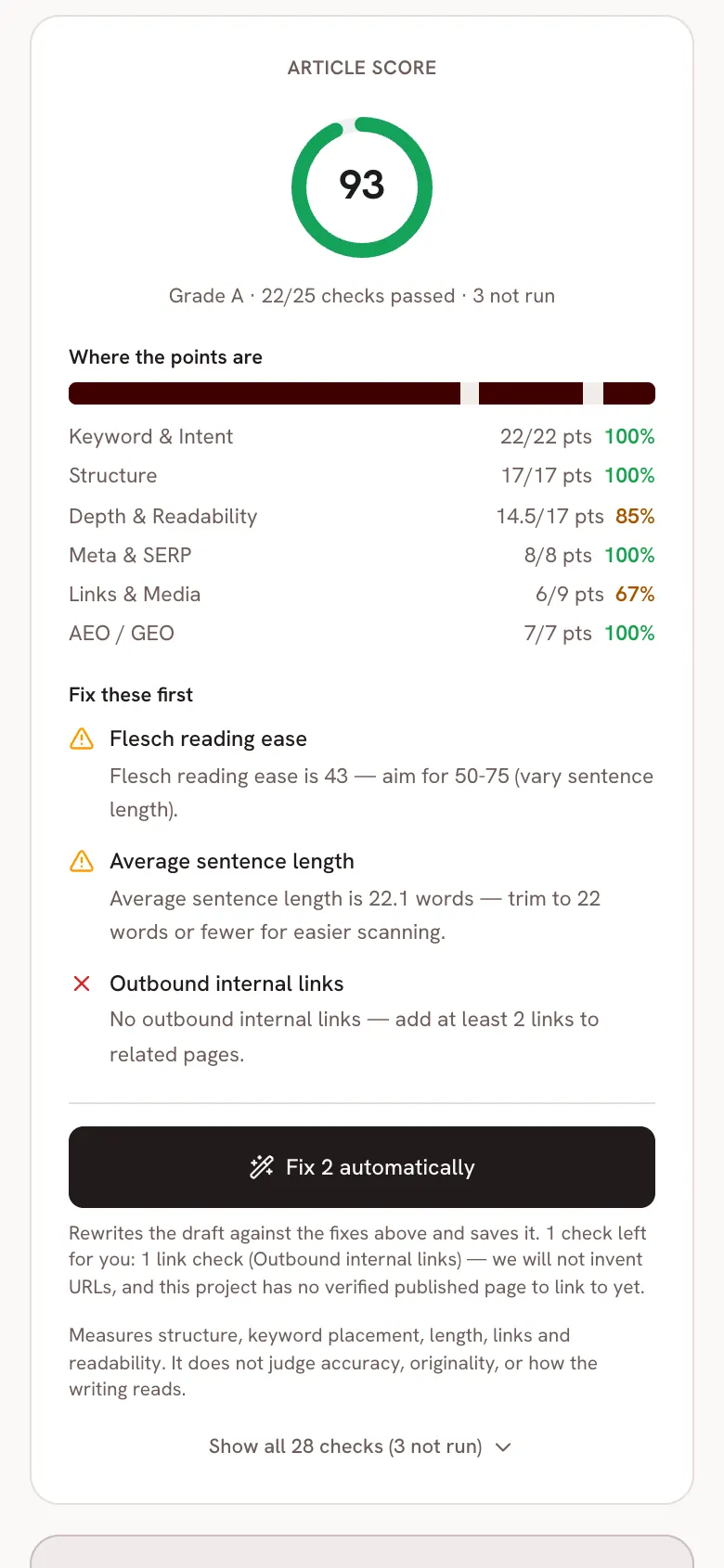
Start the series
Positions kept as history
Positions refresh weekly, per domain and market. Each keyword builds a series from its first check, so you read drift rather than one reading.
One snapshot per audit plus a weekly refresh. Change and trend stay empty until a second check exists rather than being filled with an estimate.
Rank tracking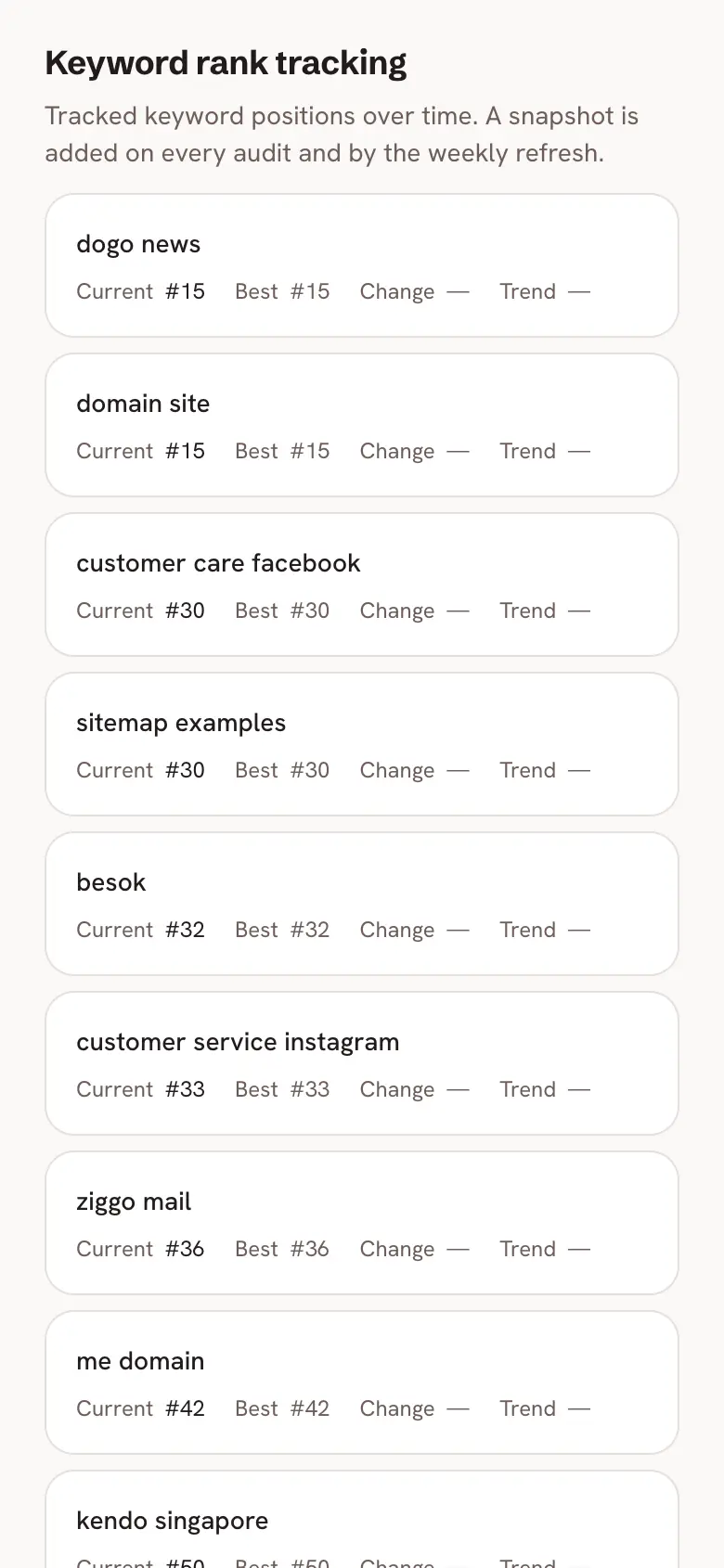


What a first run leaves behind
One URL and one credit. Six artifacts that stay in the workspace, each of them re-openable for free.
A graded report
One score out of 100 and a letter grade, built from eight scored categories rolled into four disciplines. Every check is listed whether it passed or not.
A fix list in repair order
Each failure carries the URLs it was found on and the tag, header or file to add, ordered by what moves the grade rather than alphabetically.
A keyword map
One row per URL, covering the pages you have and the pages the plan adds, each with the search it should answer.
On-page fixes as text to paste
A meta title, meta description and H1 per page, each shown beside the current value. Nothing is written to your site.
A dated content plan
Every planned article and page rewrite on the day it is due, with the keyword it answers.
A link the client can open
A read-only URL that shows the strategy with no login and none of the app around it.

8 more, grouped by the problem they solve
Narrower jobs. Open the group that matches the thing you are stuck on rather than reading all of them.
Content that keeps running
The two that turn one article into a publishing habit.
- Autoblog
Plan a month of posts. Auto-write drafts each at midnight on its calendar date through the same researched pipeline you run by hand, and every publish is checked at the public URL.
- Internal linking
Generated articles pick their internal links from your site's last audit crawl. You set the count from 1 to 6, and that count is enforced after generation.
Getting named by AI answers
What assistants retrieve before they answer, and how to be in it.
- Generative engine optimization
Audits probe Google's AI Overview and AI Mode for your top keywords and record the cited URLs. The tracker keeps that as history.
- Answer engine optimization
Score how ready a page is for an engine to lift and cite, cover the sub-questions assistants split your topic into, then check Google's live AI surfaces.
Built for your kind of site
A store and a shopfront need different pages, so they get different pages.
- E-commerce SEO
Researched articles link to your real collections and products, then publish into your Shopify or BigCommerce blog. For store owners and the agencies that run their stores.
- Local SEO
A geo grid checks your map-pack rank across the service area, a generator writes the location pages, and the academy teaches the rest. For businesses customers find on a map.
Running SEO for clients
What an agency needs once the work is somebody else's brand.
- White-label reports
Branded PDF reports, branded share pages, and client logins scoped to one project. For agencies that sell SEO under their own name.
- Integrations
Connect WordPress, Shopify, BigCommerce, Webflow, Wix, Ghost, GoHighLevel, Snapps or a git repository. Every publish is verified by fetching the public URL.
The other ways teams assemble this
Four things people already do instead, and what each one does differently. How they work, never who wins.
| Approach | How it works | Here |
|---|---|---|
| Point tools and a spreadsheet | How it worksA crawler, a keyword tool, a rank tracker and a writer, each with its own account and its own export. Someone joins the tabs by hand, and the sheet is current on the day it was built. | HereOne website record holds the audit history, the keyword map and the tracking series, and each refreshes on its own schedule. |
| A monthly retainer | How it worksA specialist reads the site, writes the plan and books the next call. The judgement is real, and the cadence is whatever the retainer bought. | HereThe same sequence runs on the schedule you set, and the graded report is the deliverable rather than the meeting. |
| An SEO plugin in your CMS | How it worksIt grades the page open in the editor, on the platform it was built for, one page at a time. | HereOne crawl reads up to 200 live URLs on any stack, and each check scores in proportion to how much of the site it affects. |
| A general AI writer | How it worksIt drafts from a prompt. The internal links it adds are paths it invented, and nothing measures the draft once it exists. | HereLink targets come from your own site's crawl, and every draft is scored by the same engine that grades the site. |
Start from where you are
The same engine, entered from three different doors.
You run the site yourself
One free audit grades the site A+ to F, the keyword map says which page each search belongs to, and the writer drafts against it. Nothing generates before you confirm the strategy.
For business ownersYou run SEO for clients
Every project is separate: its own audit history, its own calendar, its own branded report, and a client login scoped to one website.
For agenciesYou would rather try it first
The free tools run the same jobs on one page or one keyword, with no account. Every feature page names the tools that match it.
Free SEO tools

Questions people ask before they start
The ones that decide it. Each answer opens on the verdict, then says how it works.
- Is the free audit a teaser for the real one?
- No. The graded report, the fix list and the keyword map are the output, and re-opening them later costs nothing. A paid plan raises how many runs you get, not how much of a run you see.
- How is this different from asking an AI assistant to audit my site?
- It stores what it produced. Each stage writes an artifact with a URL, so the grade you read next month came from a recorded run rather than from whatever a model could reach during one conversation.
- What does a run actually cost?
- One credit per completed audit, one per article draft and two for a Skyscraper one. A run that fails before finishing charges nothing, a multi-leg crawl still charges once, and reading a stored result is free.
- Do I need a developer to act on any of it?
- For part of the fix list. Titles, meta and content sit with whoever edits the site; redirects, canonicals and security headers usually want a developer, and the workbook hands them the URLs.
- Will it publish or change anything without me?
- Only what you switch on. Nothing generates before you confirm the strategy, and Auto-write is off until you turn it on. Auto-publish is on by default for a connected site, so articles written by the calendar on their date go live — switch it off on the calendar or the Publishing tab to hold them for Publish. Everything else arrives as a draft until you change that per connection.
- Does it work outside the United States?
- Yes. Keyword research, rank checks and the local grid run against whichever market you pick, and that choice is stored with the website so every later run reads the same one.
- What happens to my reports if I leave?
- They go when you do. Deleting your account removes the workspaces you own with their projects and audits, share links into them stop resolving, and none of it is recoverable.
Every job, run on your own site.
One free audit returns the graded report, the keyword map and the content plan for the site you actually own. No card to start.