The Best Keyword Clustering Tools, From Free to Premium
SearchBlueprint · · 13 min read · scored 94/100

Keyword clustering tools group your keyword list into topic-based clusters by comparing search intent. Most use Google's actual top-10 results rather than just shared words. The best ones turn a spreadsheet of hundreds of keywords into a handful of clear content briefs. Each one maps to a single page instead of ten competing pages.
How Keyword Clustering Actually Works (Before You Pick a Tool)

Every clustering tool does the same basic job. It takes a messy list of keywords and sorts it into groups that belong on the same page. How it decides what "belongs together" is where tools diverge. That difference is the single biggest factor in whether the output is useful or useless.
There are four broad approaches, and they produce noticeably different quality. A widely cited testing series ran 17 clustering tools against the same 216-keyword dataset. Scores ranged from 9 out of 100 to 95 out of 100. That gap is wide enough to make the method you choose matter more than the tool's brand name.
Pattern-Based Clustering
Pattern-based tools group keywords that share words. "Content marketing strategy" and "content marketing tips" get bundled because they both contain "content marketing." It sounds reasonable, but Google often shows completely different results for the two, meaning they need separate pages, not one. In that same testing round, pattern-matching tools averaged 11 to 35 out of 100. That is the weakest method on the market, and it is also the cheapest to build. That is why so many free tools still use it.
Semantic and AI/LLM Clustering
Semantic and NLP-based tools use language models to understand meaning rather than just matching words. They can tell that "buy running shoes online" and "purchase sneakers on the web" mean the same thing, with no overlapping vocabulary. AI/LLM-based clustering works the same way, just with a larger model behind it. Both are fast and useful for early-stage brainstorming, but neither checks what Google is actually ranking. So both can group keywords that read as similar but return completely different search results. In the same dataset, semantic and NLP tools scored 33 to 47 out of 100, and AI/LLM-based tools scored 42 to 50. If you want to see how this matching operates under the hood, our guide on AI-powered keyword discovery has more detail.
SERP-Based Clustering
SERP-based clustering checks Google's actual top-10 results for each keyword and groups terms that share a set number of those URLs. Two keywords with enough shared results, often 3 or more of the top 10, can usually be targeted on one page. Two keywords with almost no overlap probably need separate content. This method scored 70 to 89 out of 100 in the same testing round, well ahead of every other approach. It is grounded in what search engines are actually doing, not what the keywords look like on paper. It is also the method most premium clustering tools default to today.
Why Clustering Keywords Changes Your Content Results
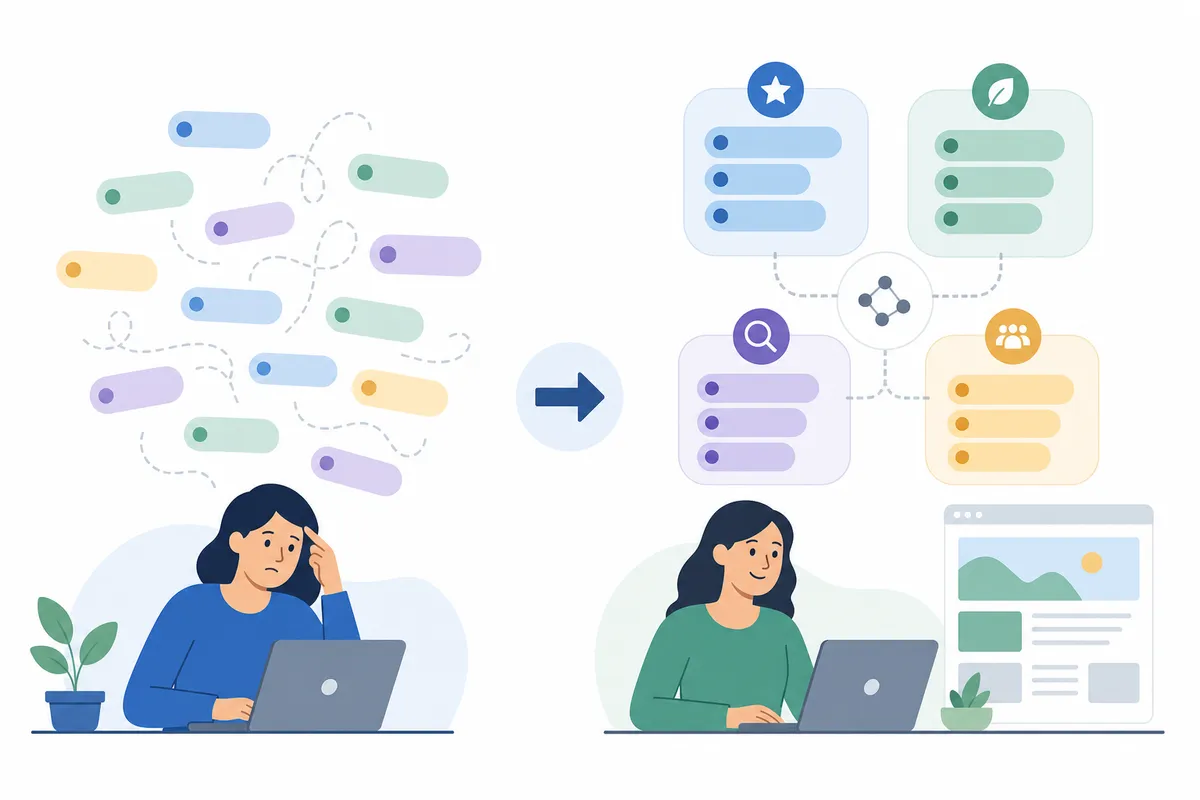
Skipping clustering usually means one of two outcomes. Either you publish a thin page per keyword and dilute your rankings, or you publish overlapping pages that compete against each other. That is a problem known as keyword cannibalization. Neither helps you rank.
Clustering keywords first fixes both. It shows you which searches genuinely need separate pages and which ones a single, comprehensive page can answer. That single page then has a real shot at ranking for dozens of related queries instead of one. It fully answers the topic rather than a sliver of it. Google's own Search Essentials guidance reflects this directly. It rewards content that is organized and comprehensive on a topic, not content that simply exists in higher volume.
It also fixes planning. A raw keyword list of 500 terms is overwhelming. The same 500 terms sorted into 20 to 40 clusters is a content calendar with clear priorities. Each cluster shows you its combined search volume and how many pages you actually need to write. Clustered keywords share intent, so they naturally suggest strong internal linking between related pages. That is part of why SearchBlueprint's own traffic case study leaned on clustering as a foundation step rather than an afterthought. It is detailed in how we grew our traffic 347% using our own tool.
Free vs. Paid Keyword Clustering Tools: When Is the Upgrade Worth It?
Free and paid clustering tools are not the same product at a different price. They tend to differ in method, scale, and how much of the workflow they cover, not just in what they charge.
| Feature | Typical free plan | Typical paid plan |
|---|---|---|
| Keywords per batch | Roughly 50 to 500 | 2,000 to 20,000+ |
| Clustering method | Often pattern-matching or basic semantic | Usually SERP-based, sometimes AI-refined |
| Search intent labels | Rarely included | Common on mid-tier and up |
| Re-clustering / history | One-off runs, no saved history | Instant re-clustering, saved account history |
| Starting price | $0 | Roughly $19 to $25/month, scaling to $79 to $119+/month |
A free SERP-based tool, for example, can cluster up to 200 keywords per run at no cost. That is genuinely enough for a small site planning its first content cluster. Its paid tier moves to 50,000 keyword credits a month. It clusters up to 20,000 keywords in a single batch, on a faster algorithm. Pricing starts around €19.90 a month.
LowFruits sits at a similar entry point. Subscriptions start at $21 a month, and pay-as-you-go SERP credits start at $25 for 2,000 credits. Surfer's Topical Map, aimed more at planning whole content hubs than raw clustering, starts at $79 a month. One long-running tool-comparison guide frames the upgrade decision around time, not sticker price. A pricier tool that saves 10 hours of manual cleanup a week can beat a cheaper one that keeps needing your attention.
The honest answer on when to upgrade: if you are clustering under a few hundred keywords occasionally, a free tool is enough. Once you are running clusters weekly, need intent labels, or are pulling from lists in the thousands, that changes. The paid tiers pay for themselves in time saved. You can see the full range of no-cost options, including clustering, in our roundup of 25 free SEO tools that cost nothing.

The Best Keyword Clustering Tools Compared

Independent testing across the market gives a useful reality check on which tools actually deliver. The table below draws on a published comparison that scored 17 tools, free and paid, against the same keyword set. It measures cluster quality, coverage, and processing speed.
| Tool | Method | Reported score | Starting price | Best for |
|---|---|---|---|---|
| Keyword Insights (Pro) | SERP-based | 95/100 | $58+ (usage-based) | Full clustering and content workflow |
| Keyword Insights (trial) | SERP-based | 89/100 | $1 trial | Testing SERP-based clustering cheaply |
| Ahrefs Keywords Explorer | SERP-based | 81/100 | $99+/month | Fast clustering at scale |
| Keyword Cupid (trial) | SERP-based | 70/100 | $1 trial | Accuracy on a small budget |
| Writersonic | AI/LLM-based | 61/100 | $19+/month | Clustering tied to content generation |
| SEMrush Strategy Builder | AI/LLM-based | 52/100 | $119+/month | Teams already on an all-in-one platform |
| LowFruits | SERP-based | 51/100 | $25 + PAYG | Budget SERP-based clustering |
| ChatGPT (manual prompting) | AI/LLM-based | 47/100 | Free | Quick, rough semantic grouping |
| SEO Scout | Semantic/NLP | 35/100 | Free | Basic pattern identification |
| Serpstat | Semantic/NLP | 30/100 | $69+/month | Existing Serpstat users only |
The gap in the table is the point. A $1 SERP-based trial scored higher than tools charging over $100 a month, because method mattered more than price. If you are still building the keyword list this clustering starts from, our step-by-step keyword research guide covers that groundwork first.
SERP-based tools worth paying for
The tools that lead this table, Keyword Insights, Ahrefs, Keyword Cupid, and LowFruits, all share one trait. They cluster by checking real Google results rather than word patterns. That is the method with the highest tested accuracy, and it shows in the coverage numbers. Several of these hit 100% coverage in testing. Every keyword in the batch landed in a usable cluster instead of being dropped.
Free and low-cost options
If budget is the constraint, a manual ChatGPT prompt scored 47 out of 100, ahead of several paid tools. It still lacks any SERP checking, though, so treat its output as a rough first pass rather than a final plan. A free SERP-based clustering tool that caps at 200 keywords is the stronger free option when accuracy matters more than volume. It uses the higher-scoring method at zero cost.
How to Choose a Keyword Clustering Tool for Your Workflow
The right tool depends less on your budget and more on what you are actually trying to produce. Use this as a starting filter.
| Your situation | What to look for | Why |
|---|---|---|
| Small site, occasional clustering | A free SERP-based tool | Enough volume for a single content cluster, no wasted spend |
| Agency clustering for multiple clients | A tool with saved history and bulk export | Repeat runs and client reporting need a paper trail |
| Need speed over precision | An AI/LLM-based tool | Fast rough groupings for early brainstorming |
| Building a full content workflow | An SERP-based tool with intent labels | Clusters feed directly into briefs, not just a spreadsheet |
| Already paying for Ahrefs, SEMrush, or Serpstat | The clustering feature built into that platform | Avoids paying twice for overlapping keyword data |
Two other filters matter more than most buying guides mention. First, check whether the tool lets you adjust the clustering threshold, sometimes called minimum SERP overlap. That way tighter or broader clusters are a setting rather than a full re-run. Second, check what happens to keywords the tool cannot confidently place. Some tools drop them silently; the stronger ones flag them for manual review instead. A tool that quietly discards 30% of your list is not actually saving you time.
If you are unsure whether a keyword belongs with the terms around it, run it through a free keyword intent checker first. That can settle the question before you commit a whole content brief to it.
How to Test Clustering Accuracy Before You Commit to a Tool
Every clustering tool looks convincing in a demo. The way to find out if one actually works for your site is to test it on keywords you already understand.
- Pick 30 to 50 keywords you know well. Ideally terms you have already researched manually, so you already know which ones share intent.
- Run them through the tool exactly as you would in production. Do not clean the list first. A tool that only performs on a tidy input is not testing anything useful.
- Check three or four clusters by hand. For each one, search the seed keyword and glance at the top 10 results. Do the other keywords in that cluster genuinely fit the same page?
- Look at what got left out. A tool that silently drops 15% of a clean keyword list is quietly making decisions you never approved.
- Time the whole run. In that testing round, processing times for the same task ranged from about 1 minute to over 40 minutes across tools. That gap matters if you cluster lists weekly.
This kind of check takes 20 minutes and tells you more than any feature comparison chart. If a tool's clusters make sense on keywords you already know, trust it more on the ones you do not.
Does It Integrate With Your Existing SEO Stack?
Clustering keywords is one step in a longer process. A tool that produces a great cluster but exports it nowhere useful just creates a new manual task. Before committing to a tool, check three things. Does it export to a format your content calendar actually uses (CSV is the safe baseline)? Does it connect to the keyword research and rank tracking you already run? And do clusters carry over into your content briefs without a copy-paste step?
This is also why standalone clustering tools and full SEO platforms solve different problems. A dedicated clustering tool is often faster and cheaper for the clustering step alone. A platform where keyword research and clustering share the same data avoids the export-and-reimport cycle entirely. Every keyword is already mapped to a page before clustering even runs. Whichever route you take, check the tool's own feature list against your actual workflow rather than its marketing page. The gap between the two is usually where the wasted subscription hides.
Turning Keyword Clusters Into a Content Calendar
A finished cluster is not content yet. It is a decision about which keywords belong on one page and roughly how much search volume that page could capture. Turning that into an actual calendar takes three more steps.
First, rank your clusters by combined search volume and by how closely they match buying intent. A cluster full of commercial searches usually deserves a publishing slot ahead of a purely informational one. Our guide on targeting keywords that actually drive sales covers how to make that call without guessing.
Second, assign one cluster to one page. Resist the urge to split a cluster across two pieces just because it is long. Splitting a cluster recreates the exact cannibalization problem clustering was supposed to prevent.
Third, use the cluster's secondary keywords as your subheading map. If a cluster contains "content marketing strategy," "content marketing plan," and "content marketing framework," those become natural H2 candidates inside one page. They do not need three separate URLs. This is also the point where solid original keyword research pays off. A cluster built on thin keyword data produces thin subheadings. If you have not locked down that foundation, effective keyword research that actually ranks is worth reading before your next batch.
FAQs
What is the best keyword clustering tool?
There is no single best tool for everyone. SERP-based tools scored highest in independent testing because they group keywords by what Google actually ranks, not by shared words. Among those, budget and how much of the content workflow you want in one platform are the deciding factors. Clustering quality alone is not.
Are free keyword clustering tools worth using?
Yes, for small or occasional runs. A free SERP-based tool that caps at 200 keywords is usually more accurate than a free pattern-matching tool with no cap. The method matters more than the volume limit. Free tools become a bottleneck once you are clustering thousands of keywords regularly.
How many keywords should I cluster at once?
It depends on the tool and the site. A single content cluster for one page rarely needs more than a few dozen keywords. For planning a whole content calendar, batches of a few hundred to a few thousand keywords are typical. That is where paid tiers with higher keyword limits start to matter.
Can I use ChatGPT instead of a dedicated clustering tool?
You can, and it works reasonably well for a fast first pass, scoring competitively against some paid tools in independent testing. The limitation is that it clusters by meaning, not by checking Google's actual search results. It can group keywords that read as similar but rank completely differently. Treat its output as a draft to verify, not a final cluster.
What is SERP overlap, and why does it matter for clustering?
SERP overlap is the number of shared URLs between two keywords' top-10 Google results. High overlap, often three or more shared results out of ten, suggests the keywords can be targeted on one page. Low overlap suggests they need separate pages. It is the core signal behind SERP-based clustering, the method that scored highest in independent testing.
See What a Clustered Keyword Strategy Looks Like in Practice
Picking one of these keyword clustering tools is only useful once the clusters turn into a working content plan. See how that looks in practice: look at a sample SEO report, from grouped keywords to a prioritized content calendar.
Resources / References
Sources
About the author
SearchBlueprint researched, wrote and scored this article with the content pipeline our customers run on their own sites. The score in the byline is what our content engine gave this page before it published. Nothing here is reviewed by hand, which is the point: it is the product's output, published where anyone can check it.