AI Keyword Clustering: Why Most Teams Get It Wrong
SearchBlueprint · · 11 min read · scored 94/100
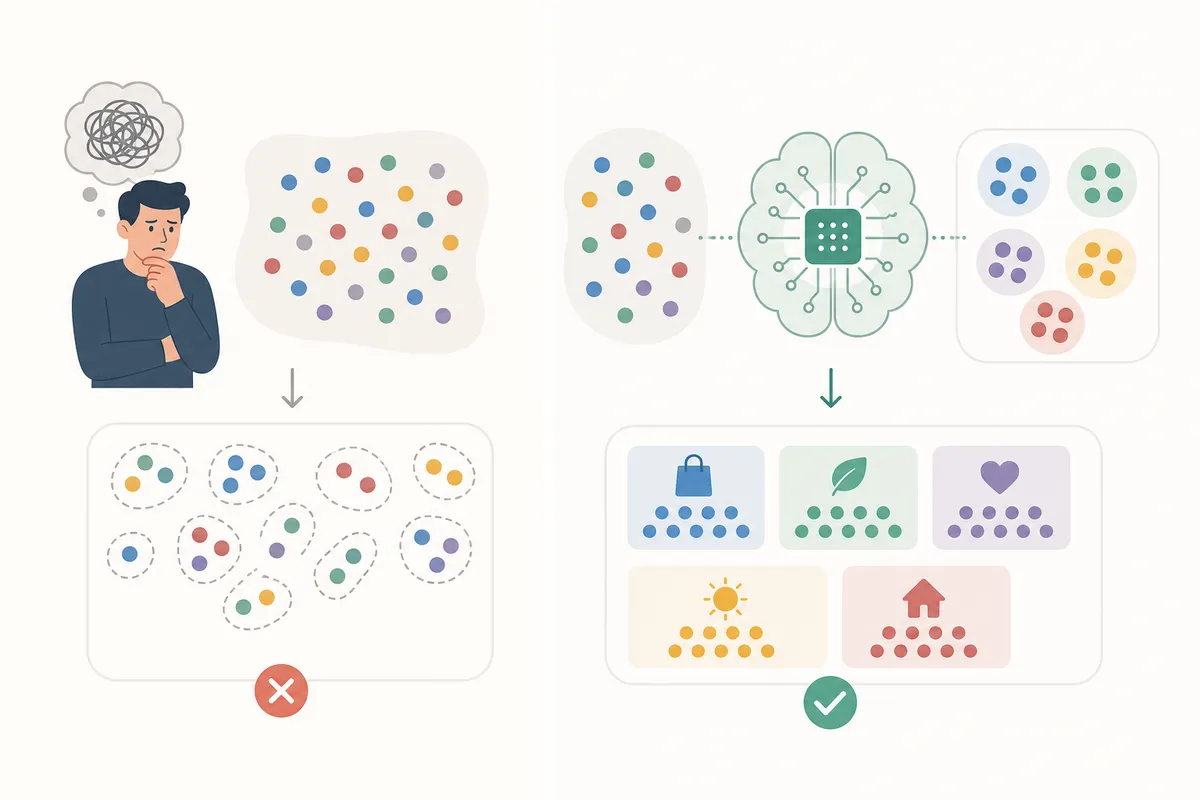
AI keyword clustering groups search terms by shared meaning or shared search results. One page can then target dozens of related queries instead of just one. Done well, it turns a messy keyword list into a lean site structure. Done badly, it either mashes unrelated terms together or splits one topic across pages that end up competing with each other.
What Is AI Keyword Clustering?

A keyword is just a search term. A keyword cluster is a set of keywords that a searcher would accept the same answer for. AI keyword clustering is the process of sorting a large keyword list into those clusters automatically. It uses machine learning instead of someone manually eyeballing a spreadsheet.
The value shows up fastest at scale. Grouping 30 keywords by hand is tedious but doable. Grouping 3,000 by hand is not realistic, and that's exactly the size of list most sites end up with after real keyword research. AI clustering takes that list and, in minutes, tells you which terms belong on the same page and which need their own.
This matters for a simple reason: one well-targeted page usually outranks five thin pages chasing overlapping terms. If you haven't pulled a full keyword list yet, start there. A keyword research workflow that tags search volume and intent up front makes the clustering step far more accurate. The clustering engine simply has more signal to work with.
How Does AI Keyword Clustering Work?
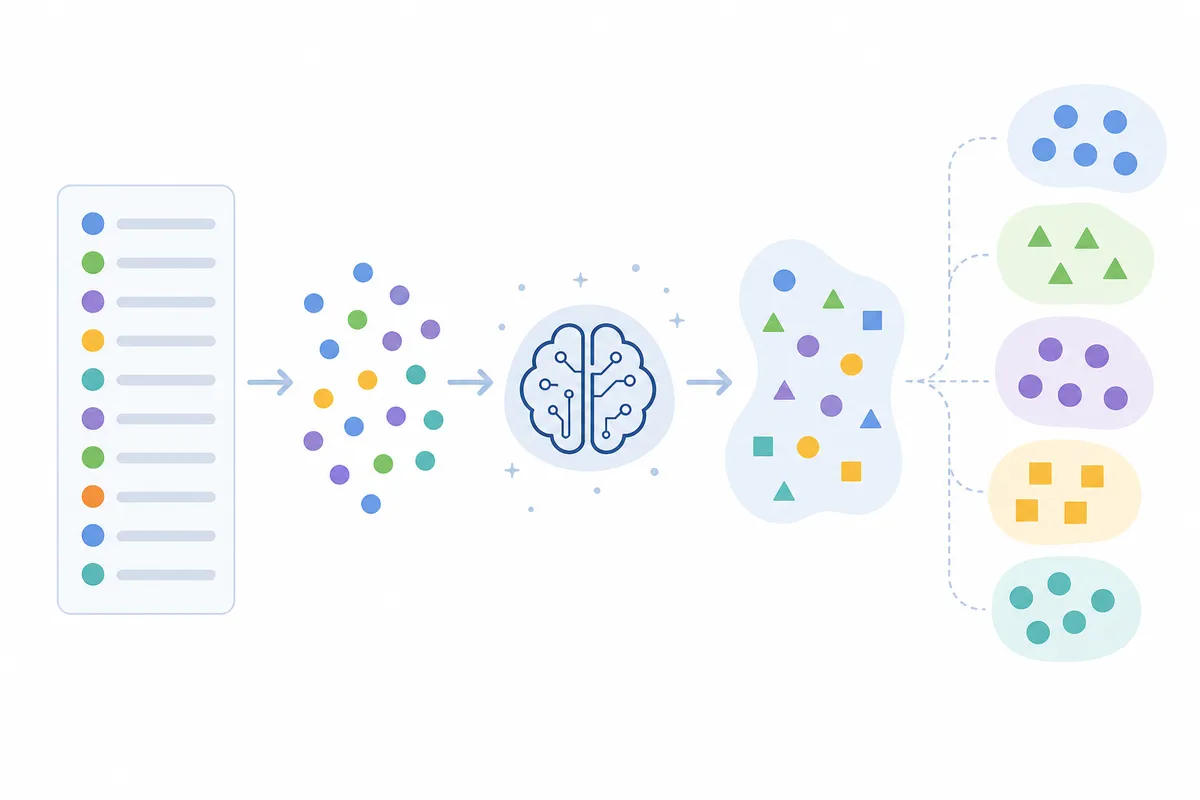
Every AI keyword clustering tool uses one of three underlying methods, and knowing which one you're using changes how much you should trust the output.
Morphological (word-based) clustering
This is the oldest and cheapest method. It groups keywords that share a root word or stem, "running shoes," "runners," and "run fast" get bundled because they all contain "run." It costs nothing to compute and runs instantly, but it has no idea what the searcher actually wants. It will happily group "apple pie recipe" with "apple computer" because both contain "apple," even though the intent behind each is completely different.
SERP-based clustering
SERP-based clustering queries Google directly and compares the top 10 results for each keyword. If two keywords return mostly the same ranking URLs, the tool treats them as one cluster, on the logic that Google has already decided they share intent. This is slower and costs money, since it means an API call per keyword. But it reflects how search engines are actually behaving right now rather than how the words are spelled.
The overlap threshold is usually adjustable. A commonly used default sits around 30% URL overlap for broader, more inclusive clusters. Some tools let you tighten that to 70% overlap for narrower, more precise groupings. The tradeoff: a looser threshold catches more related terms but risks lumping in keywords that don't really belong together. A tighter one is more accurate but can leave genuinely related keywords sitting outside any cluster.
Semantic and knowledge-graph clustering
Semantic clustering uses natural language processing to compare what keywords mean, not just what URLs rank for them or what letters they share. Knowledge-graph approaches take this further, mapping how keywords and entities co-occur across a market's search results. They visualize the relationships as a network, which can surface non-obvious groupings that a table of clusters would hide. This is the same underlying idea behind semantic SEO, where topics and entities matter more than exact phrase matches.
| Method | How It Groups Keywords | Speed & Cost | Best For | Main Limitation |
|---|---|---|---|---|
| Morphological | Shared root words or stems | Instant, free | Quick first pass on a small list | Ignores search intent entirely |
| SERP-based | Overlapping URLs in live Google results | Slower, costs per API call | Reflecting current ranking behavior | Shifts as rankings change; rate-limited on large lists |
| Semantic / knowledge graph | Meaning and entity co-occurrence via NLP | Moderate speed, varies by tool | Finding non-obvious topic relationships | Needs a large enough dataset to be reliable |
SERP-Based Clustering vs. Semantic Clustering: Which Should You Use?

Neither method is universally "better." SERP-based clustering tells you what Google is doing right now. That makes it the safer choice when you're deciding whether two keywords need separate pages or one combined page. Semantic clustering is better at spotting the broader topic map around a subject, including gaps your current content doesn't cover at all.
| If Your Situation Is... | Lean Toward... | Why |
|---|---|---|
| Deciding whether to merge or split two specific pages | SERP-based | Shows what's actually ranking today for each term |
| Planning a brand-new content hub from scratch | Semantic / knowledge graph | Surfaces the full topic landscape, not just existing rankings |
| Working with a very large list (thousands of keywords) | A hybrid tool | Live SERP checks on every keyword get expensive and slow at scale |
| Working in a niche with thin or volatile SERPs | Semantic | Rankings shift too often for SERP overlap to stay reliable |
Google's own documentation on search quality emphasizes covering a topic thoroughly for real users rather than publishing near-duplicate pages chasing similar phrases (see Google Search Essentials). Either clustering method, used honestly, points you toward that same outcome: fewer, more complete pages instead of many thin ones.
The Keyword Clustering Workflow: From List to Live Pages
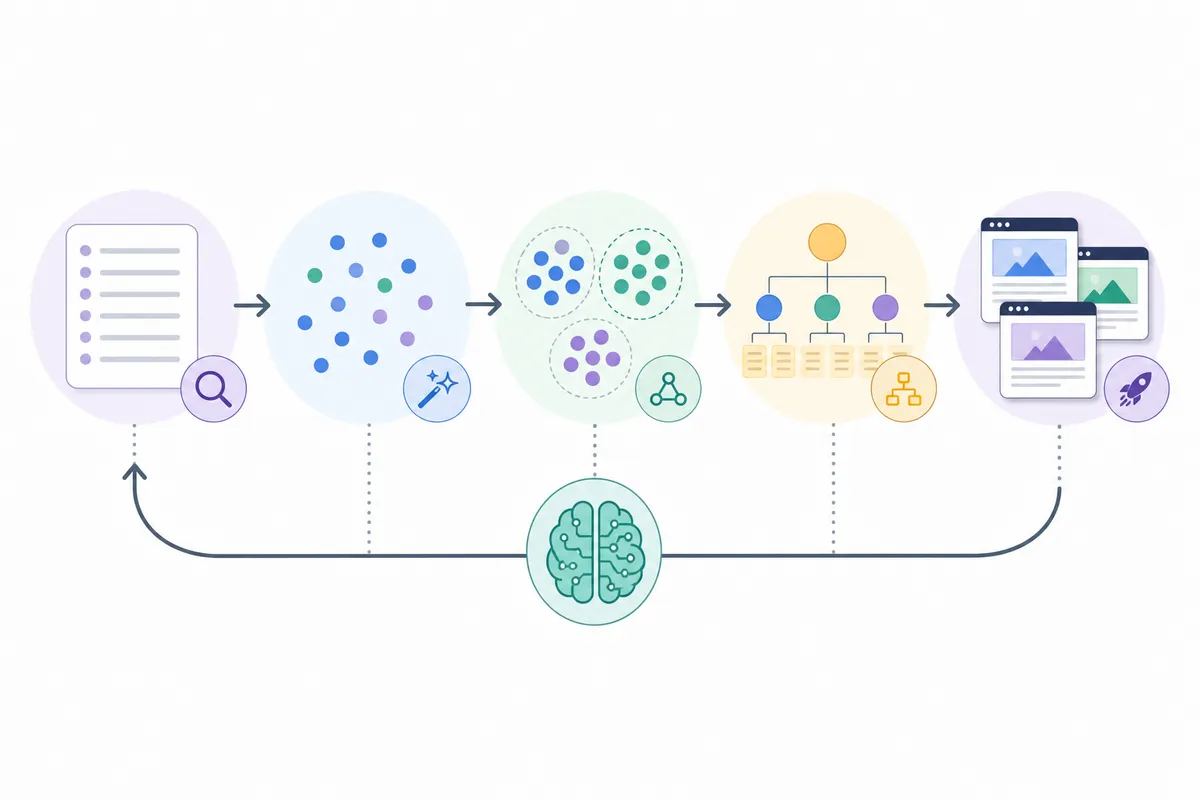
Clustering is a step in a process, not the end of one. Skipping the steps around it is how a clean set of clusters turns into pages that never get built. It's also how pages never get linked to each other.
1. Gather and clean the keyword list
Pull keywords from research tools, Google Search Console, and competitor analysis before you cluster anything. A messier input list, with duplicates and near-identical variants left in, produces messier clusters. This is also the point to tag rough search volume and intent if your source data has it. That context carries through into prioritization later.
2. Run the clustering pass
Feed the cleaned list into your clustering method of choice. A free keyword clustering tool is enough for a first pass on a smaller list. It shows whether your terms fall into a handful of clusters or scatter into dozens of tiny ones. That alone tells you a lot about how deep the topic actually goes.
3. Map each cluster to one page
This is the step most guides skip, and it's where clustering actually pays off. Every cluster needs exactly one destination page, never zero and never more than one. Assigning a cluster to a URL, rather than leaving it as an abstract group, is what keyword-to-page mapping is for. It's the difference between having a spreadsheet of clusters and having an actual content plan.
4. Prioritize by opportunity
Not every cluster deserves a page right away. Rank clusters by combined search volume, estimated difficulty, and how directly they connect to something you sell or publish. A cluster with modest volume but clear buying intent usually outranks a bigger, vaguer one in business value. That holds even if it looks smaller on a report.
5. Build and interlink the pages
Publish the pillar page for the highest-value cluster first, then the supporting pages for related clusters. Link them back to the pillar and to each other where the topics genuinely connect. The graph structure of your clusters is a reasonable blueprint for this. Keywords that cluster tightly together should produce pages that link to each other. Keywords in loosely related clusters don't need to force a link.
How Do You Know If Your Keyword Clusters Are Actually Good?
A cluster passes the test when you can answer these plainly:
- One page, one intent. Every keyword in the cluster would accept roughly the same answer. If two keywords need genuinely different content to satisfy the searcher, they belong in separate clusters, even if the words look similar.
- The cluster isn't too big to write well. A cluster with 200 loosely related keywords usually means the overlap threshold was set too loose, or two topics got merged that shouldn't have been.
- The cluster isn't too small to matter. A cluster of one or two long-tail keywords with negligible combined volume rarely justifies its own page. It's often better folded into a related, larger cluster instead.
- It doesn't already compete with an existing page on your site. Before publishing, check whether a cluster's terms overlap with a page you've already built. If they do, that's a sign to merge the content rather than add a competing page.
- The ranking pages for it (if you check SERP data) look like content you can realistically match or beat. A cluster dominated by major retailers or government sites needs a different content angle than one dominated by blog posts and forum threads.
Mistakes to Avoid When Clustering Keywords at Scale
The failures below show up repeatedly once a keyword list gets into the thousands. Each one is avoidable with a quick check before you commit to a content calendar.
| Mistake | Why It Hurts | Fix |
|---|---|---|
| Clustering purely on shared words | Groups keywords with different intent just because they share a stem | Use SERP-based or semantic clustering, not morphological alone |
| Setting overlap thresholds too loose | Produces bloated clusters that force one page to answer several different questions | Tighten the threshold and re-run; check a sample cluster manually |
| Skipping the intent check per cluster | Leads straight to keyword cannibalization between your own pages | Confirm every keyword in a cluster shares the same searcher goal before publishing |
| Treating clustering as the finish line | Clusters that never get mapped to a page or a content calendar produce nothing | Assign every cluster a URL and a priority before moving on |
| Clustering once and never revisiting it | Rankings and search behavior shift, so a cluster valid a year ago may have split or merged since | Re-check clusters periodically, especially after a content refresh |
What Should You Look for in an AI Keyword Clustering Tool?
The clustering tool market ranges from free, no-login web tools to paid platforms built around live SERP data. What separates them:
| Capability | Why It Matters | What You'll See in the Market |
|---|---|---|
| Live SERP data vs. NLP-only | SERP-based clustering reflects current rankings; NLP-only tools are faster but intent-blind | Some platforms process tens of thousands of keywords using live, country-specific SERP data; others run purely on text similarity |
| Adjustable overlap threshold | Lets you trade broader clusters for tighter, more precise ones depending on the niche | Overlap settings commonly range from around 30% (broad) to 70% (tight) |
| Scale limits | A tool capped at a few hundred keywords per run won't handle a full-site audit | Free web tools often cap usage per hour on the free tier; paid platforms are built to handle far larger lists in one pass, with some advertising support for up to roughly 200,000 keywords per project |
| Pricing model transparency | Credit-based pricing can get expensive fast on large lists if you don't check the per-keyword cost | Some platforms list a low-cost short trial (for example, a $1 trial for about a week) before switching to credit-based plans billed per keyword clustered |
| Language support | Matters immediately if you publish outside English | Free tools vary widely here, some cover a couple of dozen languages, others 70 or more |
| Output that plugs into your workflow | A cluster list with no path to a content plan just becomes another spreadsheet | Look for a platform that treats clustering as one step in a bigger content and keyword workflow, rather than an isolated report |
Free tools are worth using to sanity-check a small list or test a concept before you commit budget. SearchBlueprint's other free SEO and AI-search tools are useful for that same kind of quick check. Use one on the page you eventually build from a cluster, once it's live.
FAQs
What is the difference between AI keyword clustering and manual keyword grouping?
Manual grouping relies on a person's judgment about which keywords look related, which doesn't scale past a few hundred terms and misses non-obvious overlaps. AI keyword clustering applies a consistent method, either comparing live search results or the meaning behind each term, across an entire list at once.
Is SERP-based or semantic clustering more accurate?
Neither is more accurate in every case. SERP-based clustering is more accurate for deciding whether two specific keywords need separate pages, since it reflects what's actually ranking today. Semantic clustering is more useful for mapping a whole topic's landscape, especially for planning content that doesn't exist yet.
How many keywords can AI clustering tools handle at once?
It depends heavily on the tool. Free web-based tools are often limited to a handful of runs per hour and a few hundred keywords per batch. Paid, SERP-based platforms are built for scale, with some supporting up to roughly 200,000 keywords in a single project.
Does keyword clustering help with AI search results like ChatGPT or AI Overviews?
Yes, indirectly. Clustering pushes you toward fewer, more complete pages that answer a topic fully instead of many thin pages that each answer part of it. That kind of comprehensive, self-contained content is exactly what gets pulled into AI-generated answers and overviews.
Can I cluster keywords for free?
Yes, for smaller lists. Free tools handle a quick pass on a few dozen to a few hundred keywords well. Once your list runs into the thousands, or you need live SERP data behind the clusters, a paid platform becomes worth the cost.
See What a Clustered Keyword Strategy Looks Like in Practice
AI keyword clustering only pays off once the clusters turn into published, interlinked pages, not when they sit in a spreadsheet. See what that structure looks like once it's built out in a sample SEO report.
Resources / References
Sources
About the author
SearchBlueprint researched, wrote and scored this article with the content pipeline our customers run on their own sites. The score in the byline is what our content engine gave this page before it published. Nothing here is reviewed by hand, which is the point: it is the product's output, published where anyone can check it.