What Is Semantic SEO? How Topics Beat Keywords in Search
SearchBlueprint · · 10 min read · scored 92/100

What is semantic SEO? It is the practice of optimizing a page for a whole topic and the intent behind a search, rather than a single keyword string. Search engines now read meaning through entities and their relationships, so the pages that win are the ones that cover a subject completely and answer the questions surrounding it.
What semantic SEO actually means
For most of Google's history, ranking meant repetition. If you wanted a page to rank for a phrase, you used that phrase in the title, the headings, and throughout the copy, and the page that repeated it most convincingly tended to win. Semantic SEO replaces that model. Instead of optimizing for a string of characters, you optimize for the subject the searcher cares about: the questions around it, the entities involved, and the outcome the person actually wants.

From matching words to understanding meaning
Type a question into Google today and you rarely need a second click. The engine interprets your whole phrase, works out the intent behind it, and often answers directly in a featured snippet or an AI Overview. That only works because Google stopped reading pages word by word and started mapping them to meaning. Your job is to make that mapping easy.
Entities are the units of meaning
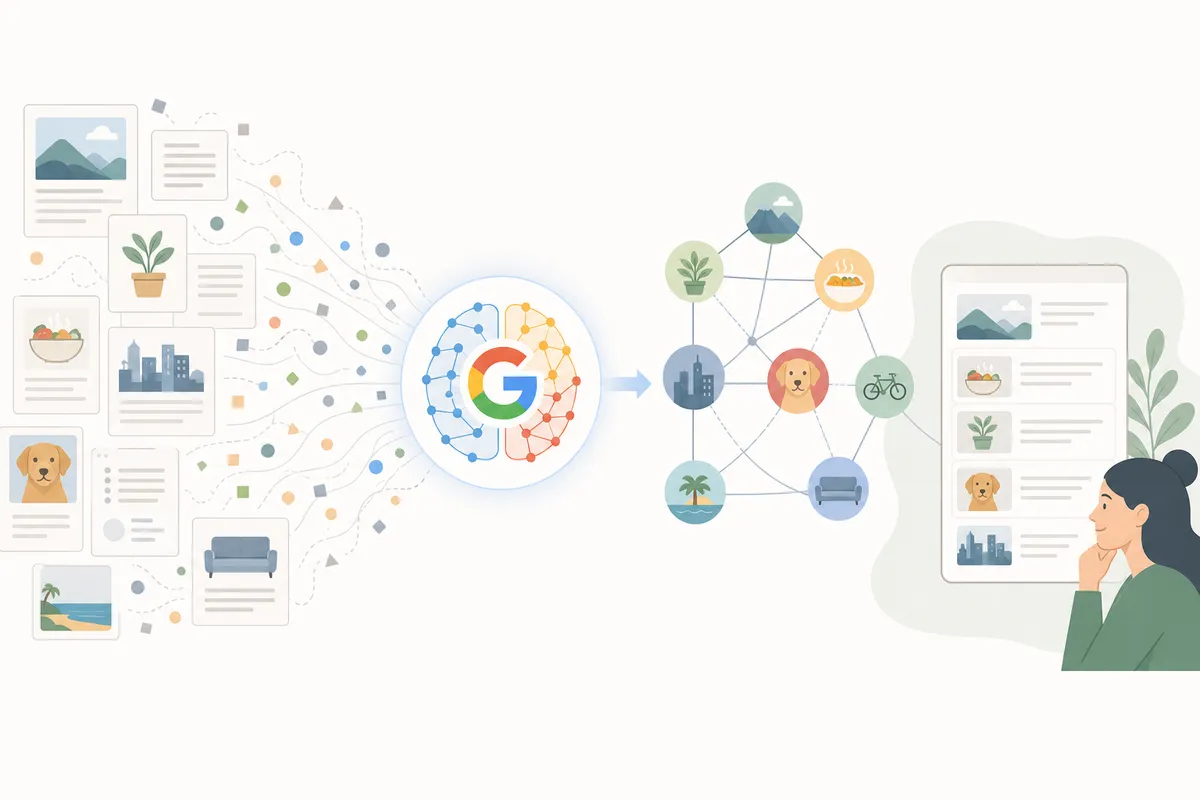
An entity is anything a search engine can identify as a distinct thing: a person, a place, a company, a product, a concept. Entities let Google tell "apple" the fruit from "Apple" the company by reading the context around the word. Google organizes entities and their relationships in the Knowledge Graph, which Search Engine Journal describes as a large, sophisticated knowledge base that helps crawlers understand how concepts relate. For a deeper look at how this shapes rankings, read our guide to knowledge graphs in SEO and why entities decide AI visibility. The practical point is simple: pages that name the right entities, and connect them the way the real world does, are easier for machines to trust.
Here is how the two mindsets compare in practice:
| Question | Traditional keyword SEO | Semantic SEO |
|---|---|---|
| What does a page target? | One exact keyword, repeated across the page | A whole topic, plus the related questions around it |
| How does Google judge relevance? | By matching words on the page to words in the query | By reading entities, context, and the intent behind the search |
| How many pages per variation? | One page per phrasing, such as "best cookie recipe" and "best cookies recipe" | One page that ranks for many phrasings at once |
| What wins the ranking? | Keyword placement and repetition | Topical depth, clear structure, and complete coverage |
How Google learned to read meaning
Before 2013, Google scored topical relevance largely through keywords. Backlinko's Brian Dean describes the old logic bluntly: use "Paleo diet" all over a page and Google concluded the page must be about the Paleo diet. The Hummingbird update in 2013 changed that. Google began reading a page's overall topic much the way a person would, instead of relying on exact matches. RankBrain followed in 2015, applying machine learning to interpret the intent behind queries Google had never seen before.
| Google system | What it does | What it changed for your content |
|---|---|---|
| Knowledge Graph | Google's database of entities and the relationships between them | Pages are understood through the real-world things they mention, not just the words they use |
| Hummingbird (2013) | Reads the meaning of a whole query instead of scoring individual keywords | One thorough page can rank for many phrasings of the same question |
| RankBrain (2015) | Machine learning that interprets the intent behind unfamiliar queries | Content that satisfies intent outranks content that merely matches words |
None of these systems killed keywords. They changed what keywords are for. A keyword is now a signal that helps the engine place your page inside a topic, not the score itself.
Why AI search raises the stakes
One question becomes many
AI search does not match a query to a page. Ask an assistant how to lose weight safely and it quietly expands the question into related ones about diet, exercise, and lifestyle, then builds a single answer from several sources. SE Ranking calls this query fan-out. It rewards sites that are credible across a web of related questions, not sites that own one isolated phrase. Semantic SEO is the discipline of becoming that kind of source.
The measurable payoff
SE Ranking's research puts numbers on it. Pages with FAQ blocks integrated into the main content averaged 4.9 AI citations versus 4.4 for pages without them, and pages whose meta descriptions aligned semantically with their content earned up to 4.7 citations against 4.1 for weak alignment. Those margins look small until you remember an AI answer only has a handful of citation slots to give. Voice queries push in the same direction: Backlinko cites Google data showing 41% of US adults perform at least one voice search per day, and spoken questions are conversational by nature, which is exactly what semantic systems are built to parse.
If your pages read well to humans but you suspect machines are skipping them, start with these 10 signs your content isn't AI search ready.

How to do semantic SEO in six steps
You do not need new tools to practice semantic SEO, just a different order of operations. Work through these steps for every topic you want to own.

1. Classify intent before you look at volume
Every query carries an intent: to learn, to compare, to buy, or to reach a specific site. A page built for the wrong intent will not rank no matter how well it is written, because Google can see what searchers actually click. Before committing to a topic, run your main terms through a free keyword intent checker and let the intent decide the format: guide, comparison, product page, or tool.
2. Group keywords into topic clusters
List every phrasing, question, and long-tail variant around your subject, then group the ones that mean the same thing. One cluster becomes one page. Brian Dean's YouTube SEO guide is the classic example: rather than separate posts for each phrasing of the term, he optimized one post for both, and Google ranked it for both because it understood the topic. His keyword research page ranks for 330 different keywords, according to Semrush, from a single medium-tail target. Our walkthrough of cluster analysis for SEO shows how to turn a raw keyword list into that structure.
3. Outline the whole topic before you write
Backlinko's correlation study, which analyzed over 11 million search results, found topically relevant content to be one of its most surprising ranking signals. The reliable way to produce it is a topic outline: list every subtopic a genuinely complete resource would cover, then write to the outline. Depth usually means length, and that is fine. What it never means is padding. Every section has to answer something a reader would actually ask, or it is filler wearing a heading.
4. Answer the questions people also ask
Google's People Also Ask boxes are a free research feed for this. One study of 2.5 million search queries found PAA now appears for 48.4% of all searches, often above the first organic result, and pages can win those slots even when their blue link sits on page two. Pull the questions for your topic, answer each one directly in a sentence or two, then expand. A dedicated FAQ section does double duty here: it targets PAA boxes and it gives AI systems clean, quotable answers.
5. Link related pages with anchors that carry meaning
Internal links are how you show a search engine that your pages form a topic rather than a pile. Link your hub page to its subpages with descriptive anchors, the way a running shoes guide would point to "trail running shoes for beginners" instead of "read more". Vary the phrasing naturally. The anchor is context for the destination page, not a ritual.
6. Add structured data where it genuinely fits
Structured data, written with the Schema.org vocabulary and usually in the JSON-LD format Google recommends, turns your content into machine-readable statements: this is a product, this is its price, this event happens on this date. Be honest about what it does. Backlinko's study found no correlation between schema use and rankings, but markup helps search engines resolve entities and makes pages eligible for rich results. Use it to state facts your page already contains, never to claim things it does not.
Common semantic SEO mistakes
Abandoning keywords entirely
"Optimize for topics, not keywords" gets repeated as if keywords were dead. They are not. Google's own documentation at Google Search Central still encourages using the words your readers would actually search for. The change is arithmetic, not existential: one page now covers a cluster of related terms instead of needing a page per variation.
Building a page for every long-tail phrase
Similar long-tail keywords now collapse into the same topic, so "link building tips" and "link building techniques" return near-identical results. Separate pages for each split your authority and end up competing with each other. Target one primary term per page, at a medium level of specificity, and let the long tail come to you.
Polishing content on a broken foundation
Semantic work assumes Google can crawl, render, and index your pages in the first place. If the technical base is shaky, meaning is beside the point. Our breakdown of the different types of SEO and what to fix first helps you sequence the work so the clever part is not wasted.
FAQs
What is semantic SEO in simple terms?
It is writing for the meaning of a search instead of the exact words. You choose a topic, cover it fully, answer the questions around it, and let Google connect your page to the many ways people phrase the same need.
How is semantic SEO different from traditional SEO?
Traditional SEO optimized one page for one keyword and leaned on repetition to prove relevance. Semantic SEO optimizes for topics, entities, and intent, so a single strong page can rank for hundreds of related queries instead of one.
Do keywords still matter in semantic SEO?
Yes. Google still recommends using the words your audience actually types. What has changed is that one page can now target a whole cluster of related terms, so you no longer need a separate page for every variation.
What are LSI keywords?
"LSI keywords" is a loose label for terms and phrases semantically related to your main topic. The name borrows from an outdated retrieval technique, but the habit behind it is sound: use related words naturally in your copy and search engines get a clearer picture of your subject.
Does semantic SEO help with ChatGPT, Perplexity, and AI Overviews?
Yes. AI systems expand a question into several related queries and assemble one answer from pages that address them clearly. Well-structured pages with direct answers, FAQ sections, and metadata that matches the content are the ones that earn citations.
Put your own pages through a semantic audit
So, what is semantic SEO in practice? It rewards the site that understands its topics better than its rivals do, and the quickest way to find your gaps is to have them measured. Browse a sample SEO report to see how topic coverage, entities, and intent gaps show up in practice, then talk to the team about mapping yours.
Resources / References
- Knowledge Graph
- Hummingbird update in 2013
- Backlinko's correlation study
- schema.org
- JSON-LD
- eligible for rich results
- Google Search Central
Sources
- Semantic SEO Strategy for AI and Classic Search Engines
- Does anyone know what Semantic SEO is????..
- What is Semantic SEO? Definition, Benefits & Case Studies
- Semantic SEO: What It Is and Why It Matters
- 7 Ways To Use Semantic SEO For Higher Rankings
Disclaimer: This article is general information about rules and figures that applied when it was written, not personalised financial, tax or investment advice. It does not take account of your income, obligations, risk tolerance or goals, and rates and thresholds change. Verify the current position with the relevant authority, and speak to a licensed adviser or a qualified accountant before acting.
About the author
SearchBlueprint researched, wrote and scored this article with the content pipeline our customers run on their own sites. The score in the byline is what our content engine gave this page before it published. Nothing here is reviewed by hand, which is the point: it is the product's output, published where anyone can check it.