Mastering Different Types of SEO: What to Fix First and Why
SearchBlueprint · · 15 min read · scored 89/100

Mastering different types of SEO starts with a diagnosis, not a checklist. On-page SEO fixes weak content, technical SEO fixes crawling and speed, off-page SEO builds authority, and local SEO wins map results. Match the type to the problem your site actually has, and the rest of the work gets much easier.
Key Takeaways
- SEO splits into four main types: on-page, off-page, technical, and local. Each one solves a different failure, so the right starting point depends on your site's symptoms, not on a generic playbook.
- Content and on-page work usually move rankings more than anything else, but only after technical SEO stops blocking crawlers.
- Google says changes can take anywhere from a few hours to several months to show in results, so judge each fix over weeks, not days.
- AI search has added a new layer. The same clear, self-contained writing that ranks in Google is what gets you cited by ChatGPT, Perplexity, and AI Overviews.
What Are the Different Types of SEO?
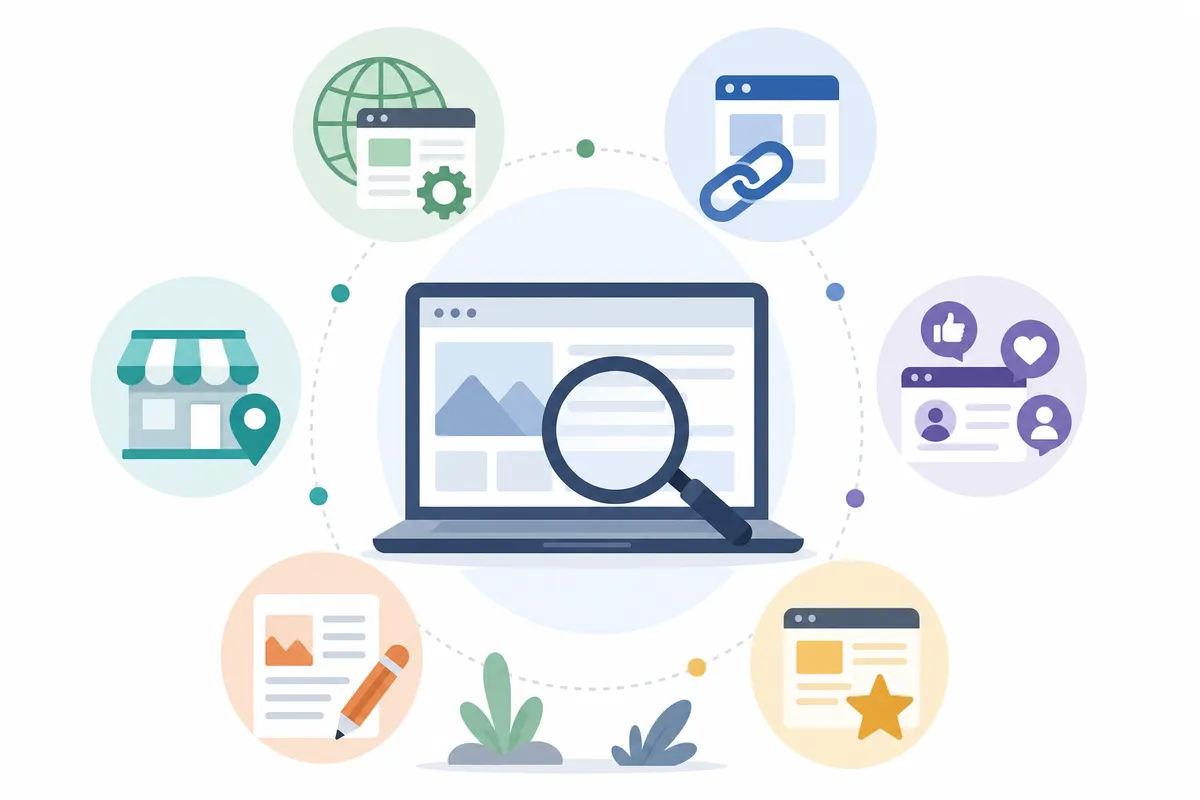
Search engine optimization is one goal, getting found, pursued through several distinct kinds of work. Most practitioners group that work into four main types, with a set of specialized branches on top: e-commerce, video, image, mobile, international, and now AI search optimization.
Here is what each of the four core types covers and how to recognize when your site needs it.
| Type | What it covers | Core tasks | Signs you need it |
|---|---|---|---|
| On-page SEO | The content and HTML on pages you control | Keyword targeting, titles, headings, internal links, content quality | Pages get impressions but few clicks, or rank on page two for topics you cover |
| Technical SEO | The backend factors that let search engines crawl, render, and index your site | Site speed, sitemaps, robots.txt, canonicals, mobile rendering, structured data | Pages missing from Google entirely, slow load times, duplicate URL versions |
| Off-page SEO | Signals from other sites and platforms about your authority | Earning backlinks, digital PR, brand mentions, reviews | Your content is solid but consistently outranked by better-known competitors |
| Local SEO | Visibility in map results and location-based searches | Google Business Profile, NAP consistency, citations, local pages | Customers search "near me" terms and competitors fill the Map Pack instead of you |
These types are not competing philosophies. They are layers of one system, and a site that ignores any layer leaks visibility through it. If you want the foundational version of this comparison first, start with this plain-English breakdown of on-page, off-page, and technical SEO, then come back here for the full map.
On-Page SEO: The Work You Control Directly
On-page SEO is everything you can change on the page itself: the words, the structure, the tags, and the links between pages. It is the highest-leverage type for most sites because search engines rank pages, not domains, and the page is where intent gets satisfied or missed.

Match Content to Search Intent First
Every query carries an intent: learn something, compare options, buy something, or find a place. Google's own guidance is blunt about this. Creating content people find compelling and useful will likely influence your presence in search results more than any other single change, according to the SEO starter guide from Google Search Central.
Practically, that means one page targets one primary query, and the page answers it fully. A page about "how to clean marble floors" that pivots into a sales pitch in paragraph two fails the intent test. Pick the keyword, answer its question, and let the sales pages do the selling.
Choosing those keywords well is its own discipline. Different situations call for different approaches, and this guide to the main types of keyword research and when to use each walks through how to pick targets you can actually win.
Get the Mechanical Elements Right
The mechanical layer of on-page SEO is small, learnable, and frequently botched:
- Title tags: unique per page, descriptive, and generally under 60 characters so they display in full. The title is both a ranking signal and your ad in the results.
- Meta descriptions: not a direct ranking factor, but they drive clicks. Keep them under 160 characters and state a clear reason to visit.
- Heading structure: one H1, then H2s and H3s that break the topic into scannable sections. Search engines and readers both use headings to understand the page.
- URLs: descriptive words, not random identifiers. Google notes that words in URLs can appear as breadcrumbs in results and help users judge relevance.
- Image alt text: describe what the image shows. It serves accessibility and image search at once.
Internal Links Distribute Your Authority
Internal links tell search engines which pages matter and how topics relate. A strong article with no internal links pointing at it is nearly invisible to crawlers discovering your site through link paths. Link from your high-traffic pages to the pages you want to lift, and vary the anchor text naturally. Repeating one exact-match anchor across dozens of links reads as manipulation to modern spam systems.
Technical SEO: Making Your Site Crawlable and Fast
Technical SEO covers the infrastructure that lets search engines find, render, and index your pages. It rarely wins rankings on its own, but broken technical SEO caps everything else. The best content ever written earns nothing if Google cannot crawl the page it sits on.
Check Indexing Before Anything Else
Start with the simplest test there is: search Google for site:yourdomain.com. If your important pages appear, you are in the index. If they do not, no amount of content or link work will help until that is fixed.
The usual culprits are mundane. A robots.txt rule blocking a directory. A stray noindex tag left over from staging. JavaScript that hides the main content from crawlers. An XML sitemap that lists dead URLs. Google finds most pages through links from pages it has already crawled, so a page orphaned from your internal link structure may simply never be discovered.
Set expectations honestly here. Google states that changes can take anywhere from a few hours to several months to be reflected in search results, and recommends waiting a few weeks before judging whether a change helped. Technical fixes are not instant wins; they are removed ceilings.
Speed, Mobile, and Core Web Vitals
Search engines favor fast sites because users do. The work here is concrete: compress images, trim unused scripts and CSS, enable caching, and measure against Core Web Vitals, Google's set of loading, interactivity, and visual-stability metrics.
Mobile is not a separate consideration anymore. Google uses mobile-first indexing, meaning the phone version of your page is the version that gets evaluated. If your site renders poorly at phone width, that broken rendering is what Google ranks.
Duplicates, Canonicals, and Structured Data
Many sites serve the same content at multiple URLs: with and without "www," with tracking parameters, in paginated variants. Search engines pick one canonical version per piece of content, and you can either guide that choice with redirects and rel="canonical" tags or leave it to chance. Guiding it is better. Duplicate URLs waste crawl attention and split whatever link value the content earns.
Structured data is the other technical layer worth learning. Using the vocabulary defined at Schema.org, you can mark up products, articles, FAQs, and local business details in a machine-readable format. It does not boost rankings directly, but it makes your pages eligible for richer result displays and easier for AI systems to interpret accurately.
Off-Page SEO: Authority You Earn, Not Build
Off-page SEO is everything that happens away from your website that still shapes how much search engines trust it. Backlinks dominate this category, but reviews, brand mentions, and digital PR all contribute. You cannot fully control off-page signals, which is exactly why they carry weight.
Backlinks: Quality Beats Quantity Every Time
A backlink is another site linking to yours, and search engines read it as a vote of confidence. But the votes are weighted heavily. One editorial link from a respected, relevant publication can outweigh dozens from thin directories. Understanding what role backlinks actually play in rankings keeps you from spending months chasing links that move nothing.
Not all link sources are worth the same effort. A rough hierarchy:
| Link source | Typical value | Why |
|---|---|---|
| Editorial links from relevant, authoritative sites | High | Earned on merit, from pages search engines already trust on your topic |
| Guest posts on reputable industry sites | Moderate | Useful when the content genuinely helps that audience, diluted when mass-produced |
| Directory and citation links | Situational | Matter for local SEO consistency, contribute little general authority |
| Paid or spammy link networks | Low to negative | Violate Google's spam policies and risk manual penalties |
For a fuller ranking of what to pursue and what to skip, this guide to the types of backlinks ranked by value breaks down fourteen link categories from best to worst.
Earning Links Without Buying Trouble
The reliable link tactics all share one trait: they give the linking site a reason beyond your request.
- Original research and data: publish numbers nobody else has, and writers cite you because they need the figure.
- Genuinely useful resources: comprehensive guides, calculators, and templates attract references over time.
- Digital PR: pitch journalists and industry writers something newsworthy, not a request for coverage.
- Broken link replacement: find dead links on relevant pages and offer your working resource as the fix.
Beyond Links: Mentions, Reviews, and Reputation
Unlinked brand mentions, review volume and sentiment, and social discussion all feed your off-page profile. None of these are direct ranking levers you can pull on demand. They accumulate as a byproduct of being worth talking about, which is why off-page SEO rewards patience and punishes shortcuts.
Local SEO: Winning the Map Pack
Local SEO is the type that puts a business in front of people searching nearby: "dentist near me," "bakery open now," "plumber in Austin." For any business with a physical location or service area, it is often the fastest route from search to revenue, because local searchers are frequently ready to buy today.
The core work:
- Google Business Profile: claim it, complete every field, choose accurate categories, add photos, and answer reviews. This profile largely determines whether you appear in the Map Pack, the block of map results above the standard listings.
- NAP consistency: your Name, Address, and Phone number must match everywhere they appear, on your site, your profile, and every directory. Conflicting details erode the confidence search engines need to display you.
- Citations: listings in relevant directories reinforce that your business exists where you say it does.
- Local content: pages that speak to specific locations and services, with genuinely local detail rather than a city name swapped into a template.
- Reviews: volume, recency, and your responses all influence local visibility and, just as importantly, whether searchers choose you once they see you.
Local SEO also stacks with everything above it. A local business still needs crawlable pages, sound on-page targeting, and some authority. For small operations wondering whether the effort pays, the evidence collected in these benefits of SEO for small businesses makes the case with real outcomes rather than promises.
Specialized Types of SEO Worth Knowing
Beyond the four core types sit specialized branches. Most sites need one or two of them, not all. Treat this list as a menu, and order only what matches your business model.
| Specialized type | Best for | What it involves | A sensible first step |
|---|---|---|---|
| E-commerce SEO | Online stores | Optimizing product and category pages, product structured data, faceted navigation control | Add product markup so prices and ratings can show in results |
| Mobile SEO | Everyone, given mobile-first indexing | Fast, usable pages on phones; mobile-specific keyword behavior | Test your key pages at phone width and fix overflow and tiny tap targets |
| Video SEO | Brands producing video | Optimized titles, descriptions, tags, and video structured data for key moments | Write descriptive titles and add transcripts to existing videos |
| Image SEO | Visual products and portfolios | Descriptive filenames, alt text, and relevant surrounding text | Rename generic image files and fill in missing alt text |
| International SEO | Sites serving multiple countries or languages | Hreflang tags signaling language and region targeting to search engines | Audit whether the right country version appears in each market |
| Enterprise SEO | Sites with thousands to millions of pages | Template-level optimization, crawl budget management, cross-team process | Fix issues at the template level so one change improves thousands of pages |
| Voice SEO | Question-heavy, local-heavy niches | Natural-language phrasing and direct FAQ-style answers | Add concise answers to the questions customers actually ask aloud |
| Content SEO | Publishers and content-led brands | Topic strategy, content production, and refreshing what already ranks | Update your highest-impression pages before writing anything new |
Mobile deserves particular emphasis. A popular study by BankMyCell found over 83% of the world owns a smartphone, and search behavior reflects it. If your pages frustrate phone users, you are frustrating the majority of your potential visitors before any ranking factor gets a say.
AI Search Optimization: The Newest Type of SEO
The newest branch goes by several names: generative engine optimization (GEO), answer engine optimization (AEO), or AI SEO. Whatever the label, the job is the same. Get your content cited when ChatGPT, Claude, Perplexity, or Google's AI Overviews answer a question, because a growing share of answers now happens without a traditional click.
The encouraging news is that this work overlaps heavily with classic on-page SEO. AI systems favor:
- Direct answers up front: a self-contained paragraph that resolves the question before the background begins.
- Quotable, standalone passages: a paragraph that still makes sense lifted out of context is a paragraph an AI can cite cleanly.
- Specificity: concrete figures, named steps, and clear definitions get quoted; vague generalities do not.
- Clean structure: descriptive headings, lists, and tables give answer engines extractable units.
For agencies and in-house teams, AI cuts the other way too, as a production tool. The advantages of AI SEO for agencies and professionals show up mostly in speed: research, auditing, and drafting that used to take days compress into hours. The catch is tool sprawl. There are now whole categories of assistants, and this guide to the types of AI content tools and which you actually need helps you avoid paying for six tools that do the same job.
One caution: AI visibility is built on the older layers. An AI engine cannot cite a page it cannot crawl, and it will not cite a page that never says anything concrete. GEO is a reason to do the fundamentals better, not a replacement for them.
How to Decide Which Type of SEO You Need First
You do not need to master every type of SEO at once. You need to find the layer that is currently failing and fix that one. Your site's symptoms point to the diagnosis.
| Symptom | Likely type needed | First check | What to do |
|---|---|---|---|
| Pages are missing from Google entirely | Technical SEO | Run a site: search and inspect key URLs in Search Console |
Fix crawl blocks, noindex tags, and orphaned pages before anything else |
| Pages rank on page two or three but never break through | On-page SEO | Compare your page against the current top five for depth and intent match | Expand and restructure the content to answer the query more fully |
| Content is strong but better-known competitors always outrank it | Off-page SEO | Compare backlink profiles between your page and theirs | Invest in linkable assets and digital PR to close the authority gap |
| Local competitors fill the Map Pack while you sit below it | Local SEO | Audit your Google Business Profile completeness and NAP consistency | Complete the profile, reconcile citations, and build review volume |
| Traffic is fine but AI assistants never mention you | AI search optimization | Ask the major AI engines your key customer questions and note who gets cited | Rewrite key pages with direct, quotable, front-loaded answers |
| High impressions, low clicks | On-page SEO | Review titles and meta descriptions for the affected queries | Rewrite them to state a specific, compelling reason to click |
Can You Do This Yourself?
Honestly: much of it, yes. On-page fundamentals, Google Business Profile management, and content improvement are learnable by any motivated operator, and free tools like Google Search Console surface most of the data you need. Technical SEO is more mixed. Reading a crawl report is learnable; restructuring a JavaScript rendering problem usually needs a developer.
Off-page is where DIY gets expensive in time. Earning real links means producing genuinely reference-worthy material and pitching it, which is a job in itself.
If you hire instead, know what you are buying. A 2021 Search Engine Journal survey of most-requested digital marketing services found demand concentrated in exactly the areas above: link building, web design and development, and content marketing. Before signing anything, read this breakdown of what hiring an SEO agency really costs, and learn to spot the hidden costs some agencies bury in their retainers, from ownership traps on content to reporting that hides non-performance.
Mastering Different Types of SEO as One System
The sites that win treat the types as one system with a deliberate order of operations:
- Technical first, because it caps everything. Confirm your pages are indexed, fast, and mobile-usable.
- On-page second, because content is the biggest lever. Match pages to intent and fix the mechanical elements.
- Off-page third, because authority compounds slowly. Start earning links early, but expect results in quarters.
- Local and specialized types as your business model demands, layered onto the foundation rather than substituted for it.
- AI optimization throughout, since answer-first writing serves both Google and the answer engines at once.
The interplay matters more than any single tactic. A technical fix makes a content page crawlable; the content earns a link; the link lifts every page it connects to internally. If you want the mechanics of that flywheel spelled out, this explanation of how effective SEO actually works in practice traces cause to effect, and this companion piece on doing on-page and off-page SEO together shows how to run both tracks in the same quarter without either stalling.
FAQs
What are the four main types of SEO?
The four main types are on-page SEO (optimizing content and HTML on your pages), off-page SEO (earning backlinks and authority signals from other sites), technical SEO (making your site crawlable, fast, and indexable), and local SEO (winning map results and location-based searches). Most other types, like e-commerce or video SEO, are specialized applications of these four.
Which type of SEO should I learn first?
Start with on-page SEO. It teaches you how search intent, keywords, and page structure work, which is the foundation every other type builds on. Pair it with a basic technical check, confirming your pages are indexed via a site: search, so your on-page work is not wasted on pages Google cannot see.
How long does SEO take to show results?
Google states that changes can take anywhere from a few hours to several months to be reflected in search results, and suggests waiting a few weeks before judging whether a change helped. Technical fixes tend to register faster; authority building through off-page work is typically measured in months.
What is the difference between on-page SEO and technical SEO?
On-page SEO optimizes what readers see on a page: the content, titles, headings, and internal links. Technical SEO optimizes what machines encounter: crawlability, site speed, mobile rendering, canonical URLs, and structured data. A rough test: if a copywriter can fix it, it is on-page; if it needs a developer or server access, it is technical.
Do I still need traditional SEO if AI search is taking over?
Yes. AI engines cite pages they can crawl, understand, and trust, which means the technical, on-page, and authority work of traditional SEO is exactly what earns AI citations. Optimizing for AI answers is an extension of good SEO, not an escape from it.
Put Your Own Site Through an Audit
Pick the weakest layer you spotted while reading and fix that one first; mastering different types of SEO happens one honest diagnosis at a time. To see what a full diagnosis looks like across every layer at once, browse this sample SEO report covering technical, on-page, off-page, and local findings in a single document, then talk to the team about running the same audit on your site.
Resources / References
Sources
- 4 Types of SEO Every Small Business Should Understand
- Search Engine Optimization (SEO) Starter Guide
- Types of SEO: 2026 Guide With Tactics and Examples
- Types of SEO: What Does Your Site Need to Succeed?
- Mastering Different Types of SEO: Simple Strategies to ...
Disclaimer: This article is general information about rules and figures that applied when it was written, not personalised financial, tax or investment advice. It does not take account of your income, obligations, risk tolerance or goals, and rates and thresholds change. Verify the current position with the relevant authority, and speak to a licensed adviser or a qualified accountant before acting.
About the author
SearchBlueprint researched, wrote and scored this article with the content pipeline our customers run on their own sites. The score in the byline is what our content engine gave this page before it published. Nothing here is reviewed by hand, which is the point: it is the product's output, published where anyone can check it.