AI-driven keyword mapping: how to give every keyword a page
SearchBlueprint · · 13 min read · scored 95/100

AI-driven keyword mapping uses machine learning to group your keywords by meaning and search intent, then assign each group to exactly one page on your site. It collapses weeks of spreadsheet work into hours and catches pages that compete with each other before rankings suffer. What you keep is a plan a whole team can follow.
The speed gets the attention, but the plan is the part that matters: a keyword map decides which page owns which search, and every content decision downstream inherits its quality. This guide explains how the AI version works, gives you a workflow you can run this week, and is plain about the checks a model still cannot make for you.
What AI-driven keyword mapping actually does
Keyword mapping is the practice of assigning target keywords to specific URLs and writing the assignment down. Each page gets one primary keyword, a handful of secondary terms, an intent label, and a status. The map becomes the record of which page owns which search, and everyone who touches the site plans against it.
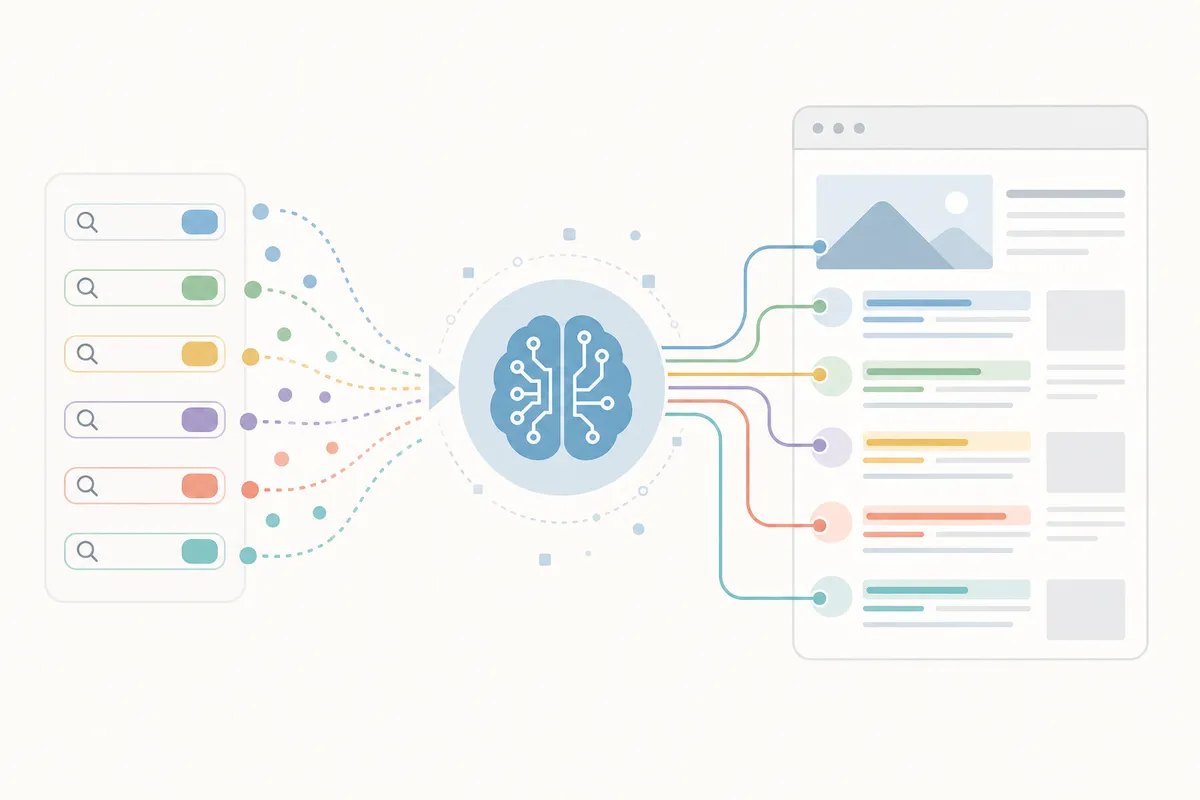
AI changes who does the assigning, and that is all it changes. Instead of a person reading thousands of spreadsheet rows and sorting them by feel, a model groups keywords by what they mean, checks which ones share the same live search results, labels the intent behind each group, and proposes a page for every cluster. Keyword research that ends with every keyword assigned to a page is the finished form of the job. A list of terms with no owner is research left half done.
Mapping is not keyword research
The two get conflated, and the confusion costs real money. Research finds terms and sizes them by demand and difficulty. Mapping decides which page will answer each of them. You can do excellent research and still publish three blog posts chasing the same query, which is how sites end up outranked by competitors with half the content.
One page per intent
Search engines do not treat "keyword mapping template" and "keyword map spreadsheet" as different topics, and neither should your site. Google's own documentation at Google Search Central describes ranking systems built to establish the meaning behind a query rather than match its exact words. A good map assigns a cluster of same-intent terms to one page instead of spinning up a thin page per phrase.
Why the map decides who gets the click
Position is where the traffic math gets brutal. Click studies cited across the industry put about 54.4% of all clicks on the top three organic results, while only about 0.63% of users click through to the second page. A page stuck on page two is out of the market for practical purposes, and mapping exists to stop your own site from putting pages there.
Cannibalization splits authority you cannot spare
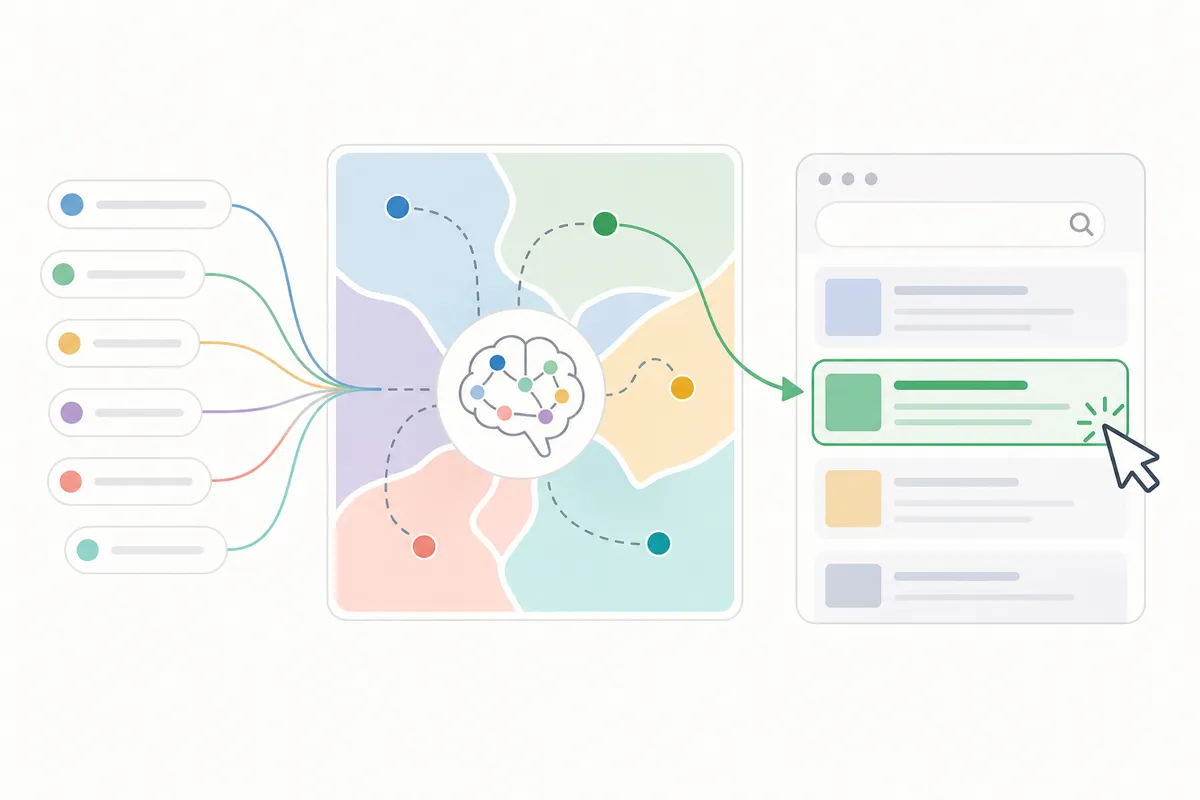
When two pages target the same keyword, three things go wrong at once. Search engines cannot tell which page to surface, so both rank worse than one would. Links that should stack on a single URL split across two. And AI answer engines, which try to pick one canonical source per topic from your site, get two half answers instead of one full one. A map prevents this by construction: if the primary keyword column already holds the term, the new page needs a different job or should not be built.
Structure that machines can read
A finished map draws your site's hierarchy for you. Broad terms become pillar pages; specific variations become supporting pages that link up to their pillar. Turning a flat list into that shape is its own discipline, and cluster analysis is how a keyword list becomes a set of rankings instead of a longer list.
Where the spreadsheet method breaks down
The classic workflow still works at small scale. Export your pages, pull queries from Google Search Console, pick a primary keyword per page, and sort the rest into groups by eye; for a 40-page site with one owner, that remains an honest toolkit and nothing in this article should talk you out of it. It breaks as the site grows.
The first break is scale. Clustering 2,000 keywords by hand takes days, and the finished groups mostly reflect whoever sorted them that afternoon. The second break is freshness: one 2026 guide to AI keyword research estimates that 15% of daily searches are brand new queries with no historical data, which means a map sorted purely by last year's volumes ages faster than anyone reviews it. The third break is the long tail. Published keyword-data analyses put 94.74% of keywords at monthly search volumes of 10 or fewer, a human sorter cuts those rows for time, and in aggregate the quiet rows are often where the buyers are: the same analyses find purely transactional searches make up only about 0.69% of queries while just over half are informational, so most of the mapping judgment lives in the middle of the funnel.
The audience reading the results has also changed shape. The same 2026 guide puts ChatGPT above 800 million weekly users. Answer engines now quote pages the way search engines rank them, and they favor sites where one page clearly owns each topic.
| Stage | By hand | With AI | What changes |
|---|---|---|---|
| Clustering 1,000 keywords | Days of sorting spreadsheet rows | Semantic and SERP clustering in one pass | Groups follow meaning and live results instead of alphabetical order |
| Intent classification | One person's judgment, row by row | Published workflows report about 1,000 keywords tagged in roughly 15 minutes | Every keyword carries an intent label before any content is planned |
| Cannibalization checks | Found after two pages already compete | Flagged when two clusters resolve to the same intent | Conflicts surface before a page is written |
| Long-tail coverage | Cut for time; high-volume terms win | The whole set is mapped, near-zero-volume terms included | The 94.74% of keywords with volumes of 10 or fewer stay in the plan |
| Refresh cadence | Quarterly, if ever | Re-run whenever rankings move | The map keeps up with the estimated 15% of searches that are new each day |
The compressed version of this exists end to end: automated keyword research can go from a seed term to a site plan in minutes, with the mapping step built in.

How AI-driven keyword mapping works
Three layers do the work, and each one replaces a task that used to eat a week of somebody's time.
Layer 1: cluster by meaning, confirm by SERP
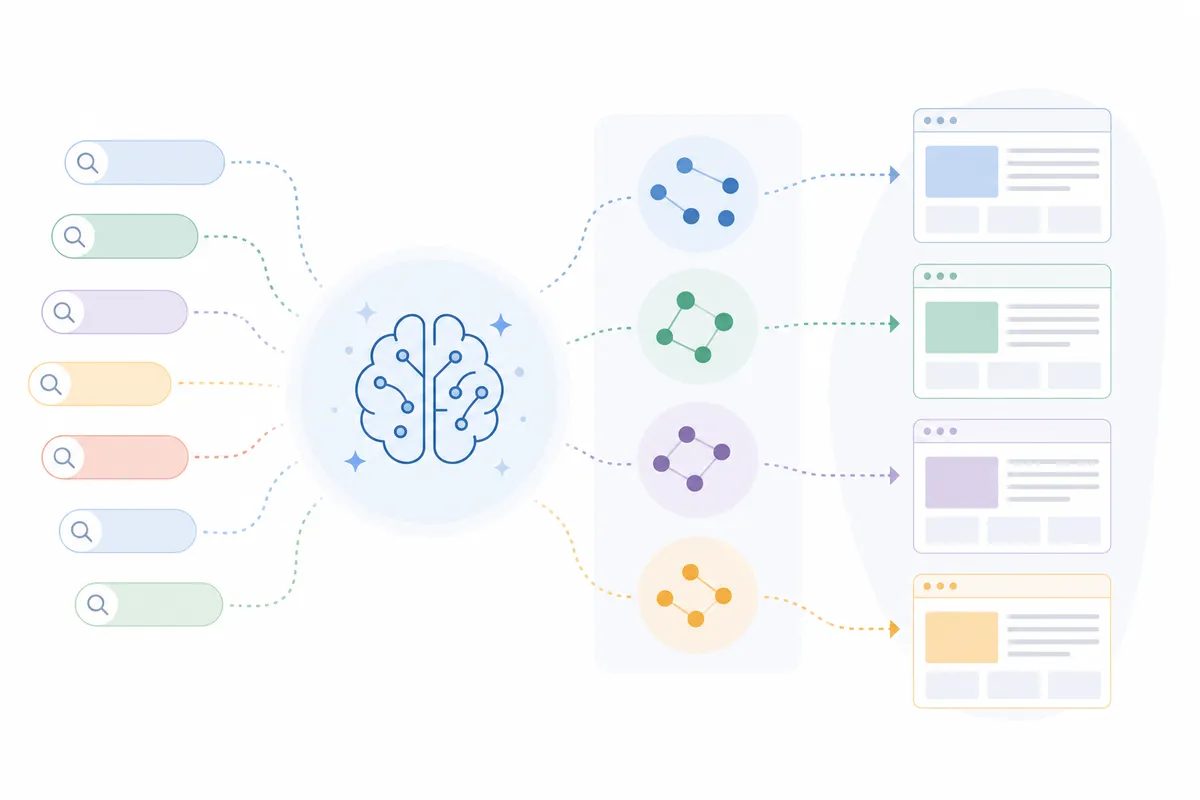
Semantic clustering groups terms that mean the same thing even when they share no words. SERP clustering then checks the model's homework: if two keywords produce mostly the same top ten results, search engines treat them as one intent and they belong on one page. If the results differ, the keywords need separate pages no matter how similar they read. Running both is the difference between a tidy list and a reliable one. You can group a batch of keywords by topic with a free clustering tool and watch how your own terms fall into clusters before committing to anything.
Layer 2: classify intent at scale
Every keyword gets one of four labels: informational, navigational, commercial, or transactional. The label then drives the format, so a "how to" query gets a guide while a "best" query gets a comparison page. This is where AI clearly outruns manual work: one published workflow describes a model processing 1,000 keywords against their live search results and tagging every one in about 15 minutes, a task that used to be a week of open browser tabs. You can check the search intent of a keyword list for free and read the classifications yourself before trusting them at scale.
Layer 3: match the intent to a format
This is the layer most teams skip, and it decides more rankings than either of the others. A well-written page in the wrong format loses to an average page in the right one, because format is itself an intent signal. If the live results for your target term are all comparison tables and you publish an essay, the essay loses. So the mapping step checks what actually ranks for each cluster and records the winning format next to the intent label: guide, comparison, product page, calculator, or direct answer.
A workflow you can run this week
Six steps take you from nothing to a working map. None of them requires a big budget, and the order matters.
- Start with an inventory of every indexable URL from your CMS or a crawler: product pages, service pages, posts, and guides. Leave out tag archives and other filler; the map covers the pages that carry weight.
- Build the full keyword set from seeds, competitor terms, question searches, and long-tail variations. Serious campaigns work from thousands of rows; one published agency process expands a market into a 6,000-plus keyword dataset before mapping begins.
- Run semantic and SERP clustering over the set, then classify intent. A typical cluster holds one primary keyword and five to ten secondaries that share its intent.
- Assign each cluster to a URL. An existing page that fits gets the status "optimize"; a cluster with no page gets "create". When you name new URLs, keep the keyword's words in the path: one published analysis found URLs that include words related to the keyword earn a 45% higher click-through rate than URLs that do not.
- Take the low-difficulty, high-relevance clusters before any head terms. Head terms look ambitious on a content calendar, and chasing them first can leave you ranking nowhere for 12 months while adjacent low-difficulty wins would have compounded.
- Review the map monthly so it stays alive. Volumes shift and new queries appear; a "create" row that shipped needs its status flipped, and a map nobody updates decays into a snapshot of last quarter.
The document itself stays small enough to read in one sitting. These columns cover what a working map needs:
| Column | What it records | Why it earns its place |
|---|---|---|
| Target URL | The existing or planned page | One row per page keeps ownership unambiguous |
| Primary keyword | The single term the page is optimized for | Two rows sharing this value is cannibalization caught before it costs anything |
| Secondary keywords | Five to ten supporting terms with the same intent | Rounds out the topic without splitting focus across pages |
| Search intent | Informational, navigational, commercial, or transactional | Decides the content format before a word is written |
| Content status | Published, needs optimization, or to be created | Turns the map into a work queue anyone can pick up |
| Last updated | Date of the most recent review | Old dates here mean the plan has expired |
What a finished map earns you
One published case study is worth studying because it starts from nothing. An SEO agency took on a consumer compensation-claims client in late 2024 with a single-page website holding 15 organic keyword positions. The map they built centered on low-competition, high-intent claim clusters, with the final target list averaging just 3.64 keyword difficulty. Sixteen months later the site held 1,102 positions, 96 of them in the top three, a 7,247% increase in keyword coverage, along with citations across Google AI Overviews, ChatGPT, Gemini, and Copilot.
The mechanism behind numbers like that is ordinary compounding. Low-difficulty clusters rank quickly. Those early rankings build topical authority, which makes the next cluster cheaper to win, and the loop repeats until the head terms are within reach. The same loop is how SearchBlueprint grew its own organic traffic 347% by running its tool on itself: map, publish, measure, remap.
Where AI keyword mapping still needs you
The failure modes are predictable, which makes them cheap to catch. Ignoring them is how a fast map becomes a fast mistake.
What models get wrong
- They invent keywords that read plausibly and have never been searched. A language model will happily generate 50 long-tail variations, and models have no access to real search volume, so every generated list needs validating against a real data source. AI keyword expansion is useful and it breaks in specific, known places.
- They misread intent in niche industries, where jargon carries signals a general model was not trained on. A "spec sheet" query can look informational to a model when, in your market, it is a late-stage buying signal.
- They average away what makes your site different. Trained on the whole web, a model's default clusters mirror the biggest players in a market, which is exactly the structure a smaller site should avoid copying.
- They know nothing about your margins or your capacity. A model will faithfully map a cluster for a service you barely offer or a product that loses money on every sale. Relevance to search and relevance to revenue are different columns, and only one of them comes from a tool.
The human pass before you build
Budget a short review before any page gets written:
- Spot-check ten clusters against live results. Do the grouped terms really share a page?
- Verify volumes for the money terms in a real data source; the model's number is a guess.
- Read the live results for every commercial cluster and confirm the format the map proposes.
- Delete clusters you cannot serve, however good their numbers look.
Can you run this yourself?
Honestly, sometimes yes. The right setup depends on how many pages you are mapping and how often the map has to change.
| Approach | Cost | Best fit | The catch |
|---|---|---|---|
| Spreadsheet plus Google Search Console | Free | Sites under about 50 pages with one owner | Clustering by eye, and intent is one person's judgment call |
| Free point tools for clustering and intent | Free | Validating batches of keywords before committing to a build | You still stitch the separate outputs into one map yourself |
| A platform with an AI agent running the loop | Paid | Hundreds of pages, agencies, multi-market sites | It costs money, and the human pass is still yours to make |
For a small site, the free route is a fine answer, and nothing in this article stops working in a spreadsheet. Once the map spans hundreds of pages or several markets, tooling earns its keep: SearchBlueprint's features are organized job by job, and an AI SEO agent can run the whole loop from one URL while the judgment calls stay with you.
FAQs
What is the difference between keyword research and keyword mapping?
Research finds terms and sizes them by demand and difficulty; mapping assigns each term to one page and records the assignment where the whole team can see it. Skip the second half and keywords are left with no owner, which is how cannibalization starts.
How many keywords should one page target?
One primary keyword plus five to ten secondary terms that share the same intent, the cluster size most published agency templates use. If a secondary term's live results look different from the primary's, it belongs on its own page.
How often should a keyword map be updated?
A monthly review is the common recommendation, plus a re-run whenever rankings move sharply. With an estimated 15% of daily searches being brand new, a map left alone for a year describes a market that no longer exists.
Does AI-driven keyword mapping work for a brand-new website?
Yes, and often better than for established sites, because there is nothing to untangle. The strongest published case started from a single-page site with 15 keyword positions and reached 1,102 in sixteen months by mapping low-difficulty clusters first.
Does a keyword map help with AI answers in ChatGPT and Google AI Overviews?
Yes. Answer engines try to select one canonical source per topic from a site, and a map gives them exactly that: one page that clearly owns each question. Sites with overlapping pages hand the engines two half answers to choose between, and often get skipped.
Talk to the team
The fastest way to judge AI-driven keyword mapping is to look at a finished map for a real domain rather than read another description of one. Open the sample SEO report to see how clusters and pages line up in practice, then talk to the team about running the same process on your site.
Resources / References
Sources
About the author
SearchBlueprint researched, wrote and scored this article with the content pipeline our customers run on their own sites. The score in the byline is what our content engine gave this page before it published. Nothing here is reviewed by hand, which is the point: it is the product's output, published where anyone can check it.