Ahrefs vs Semrush: The Real Cost Difference in 2026
By Toy Wen Da, Co-Founder · Updated · 10 min read · scored 97/100
Ahrefs vs Semrush comes down to budget and workflow, and neither tool wins outright. Ahrefs' cheapest full-featured plan, Lite, is listed at $129 a month and suits link building and competitor research. Semrush's comparable Starter plan is listed at $199 a month and suits teams that also want content, paid search and social tools in one account.

This comparison draws on each vendor's own website, pricing pages and documentation, plus the review sites listed under Sources. Where a price or feature couldn't be confirmed against a current pricing page, we say so.
Ahrefs vs Semrush at a glance
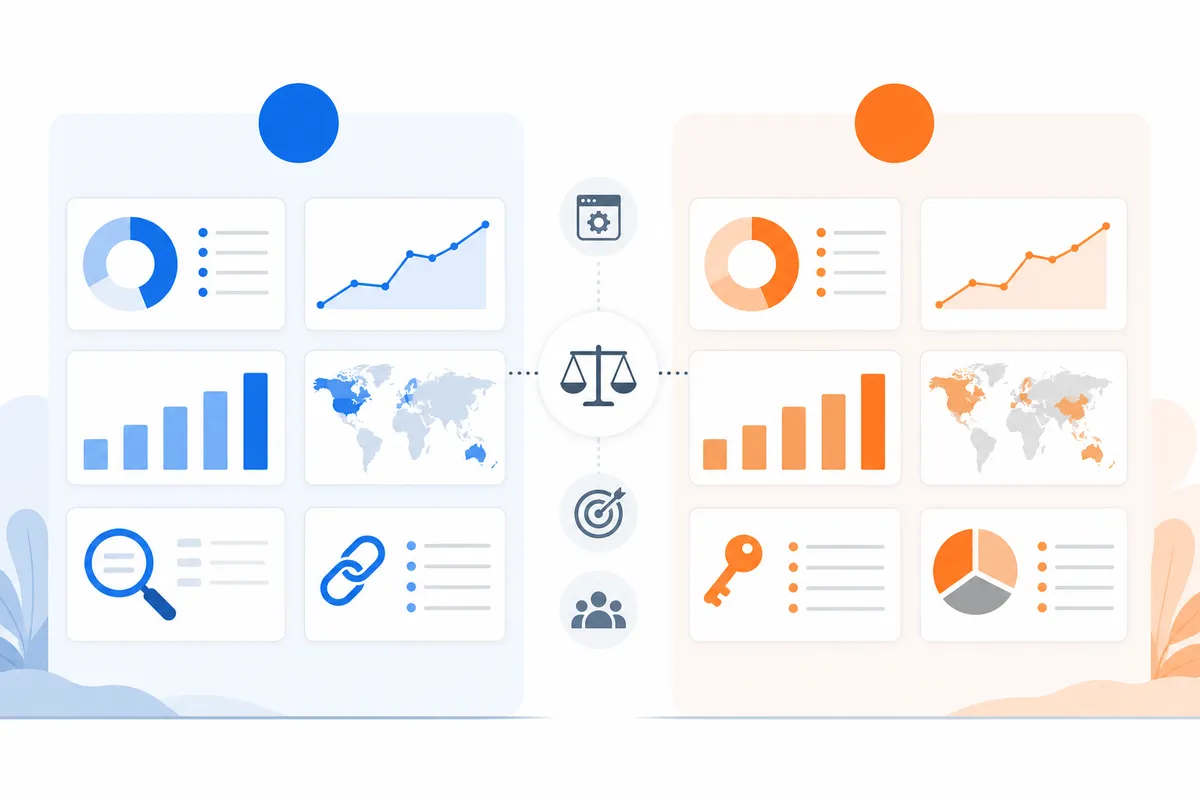
Here is how the two line up on the points most buyers check first.
| Starting Price | Free Plan | Best For | Standout Features | Main Limits | |
|---|---|---|---|---|---|
| Ahrefs | $29/mo (Starter, research-only) or $129/mo for the full Lite plan | Ahrefs Webmaster Tools, for sites you've verified ownership of | Backlink analysis, competitor and keyword research | Large link index, Keywords Explorer click data, Brand Radar AI-visibility tracking | Credit-based usage can run out mid-project; content tools are thinner than Semrush's |
| Semrush | $139/mo (SEO plan, SEO only) or $199/mo for the Starter plan with AI Search | $0/mo, 1 project and 10 reports a day | All-in-one marketing: SEO, paid search, content and social from one account | Keyword Magic Tool, SEO Writing Assistant, Position Tracking, white-label agency reporting | Pricier entry point for SEO-only use; project and keyword caps tighten fast below the mid tier |
The tier-by-tier math is in this Ahrefs vs Semrush breakdown and the pricing section below.
How we compared
We read each vendor's public pricing and feature pages and cross-checked them against the review sites listed under Sources. We did not open paid accounts or run either tool ourselves, so every judgment about interface and day-to-day use comes from those published descriptions. Database sizes are the vendors' own claims.
Pricing: what you'll actually pay in 2026
Pricing is where comparisons get misleading, because the two vendors don't structure their tiers the same way.
Entry-level plans
Ahrefs' $29/month Starter tier is built for research, meaning keyword and competitor lookups. It doesn't cover full site management. The first genuinely full-featured plan, Lite, is listed at $129/month as of October 2026.
Semrush's cheapest tier, the SEO plan, runs $139/month and covers SEO tools only, with a 7-day free trial. Add the AI Search features and the comparable Starter plan rises to $199/month. Ahrefs lists no trial of its own, and its free access is limited to data on verified sites.
Mid-tier and agency plans
| Tier | Ahrefs | Semrush | What You Get |
|---|---|---|---|
| Entry (full-featured) | Lite, $129/mo | Starter, $199/mo | Core SEO toolset for one user, limited projects and tracked keywords |
| Mid | Standard, $249/mo, 20 projects, 2,000 tracked keywords | Pro+, $299/mo, 15 sites, 1,500 tracked keywords | Expanded tracking limits and deeper historical data |
| Top / Agency | Advanced, $449/mo, 40 sites, 5,000 keywords | Advanced, $549/mo, 40 sites, 5,000 keywords, API access included | Multi-client capacity, API access, white-label reporting |
| Enterprise | Enterprise, custom (one tracker lists roughly $1,499/mo) | Business/Enterprise, see their pricing page | Negotiated seats and dedicated support |
Annual billing changes the math. Industry pricing trackers put the discount for paying a year upfront at roughly 30-50% off the monthly rate, which can bring an entry-tier plan down to an effective $80-95 a month on either platform. Check it before defaulting to month-to-month.
Database sizes are a related trap. Trackers quote slightly different numbers for the same vendor, usually because they copied the vendor's marketing pages at different times, so any single figure is a rough signal.
Winner on pricing: Ahrefs, if your work is SEO-only, since it's cheaper at every comparable tier. Semrush can come out ahead once you count what you'd otherwise pay for separate paid-search, content and social scheduling tools.

Features that matter most
Price tells half the story. The rest is how each tool handles the work itself.
Keyword research
Semrush's keyword database is listed at 27.3 billion keywords across 142 locations, a vendor-claimed figure. Ahrefs doesn't publish a single comparable number. Its Keywords Explorer leans on click data, the share of searches that actually produce a click, and uses a keyword-difficulty score tied to the backlinks needed to rank. If neither platform fits your budget yet, Long Tail Pro vs Semrush shows how a lighter keyword tool stacks up.
Winner: Semrush for breadth across markets and languages; Ahrefs for click accuracy on competitive, high-value terms.
Backlink analysis
Ahrefs reports roughly 35 trillion links across 500 million referring domains. Semrush reports more raw links, 43 trillion, but fewer referring domains at 390 million. Referring domains are the distinct sites that link to you, and they matter more than raw link count for link building because one domain can host thousands of links. Ahrefs is generally credited with deeper historical link data and faster discovery of new links, which helps when you're checking whether an outreach campaign landed.
Google's own SEO Starter Guide still treats reputable, relevant backlinks as one of the clearer trust signals search engines weigh, which is why both vendors compete hard here. Each tool also has its own authority metric, and Moz DA vs Ahrefs DR explains how those compare with the familiar Moz score.
Winner: Ahrefs, for dedicated link building and competitive backlink research.
Content tools
Semrush has the deeper content stack: an SEO Writing Assistant that plugs into Google Docs and WordPress, a Topic Research tool that builds content briefs, and a Content Marketplace for commissioned writing. Ahrefs has Content Explorer, which surfaces content that has already earned links and traffic, but its in-document writing guidance is lighter. If content optimization decides it for you, Surfer SEO vs Semrush and Surfer SEO vs Ahrefs cover how a dedicated content tool compares with either platform's built-in version.
Winner: Semrush, for in-house content teams publishing on a regular schedule.
Technical SEO and site audit
Semrush's Site Audit produces longer reports across more issue categories, with Core Web Vitals signals among them. Ahrefs' Site Audit is cleaner and faster to read but covers fewer issue types, closer to a snapshot than a deep dive.
Winner: Semrush for teams that want exhaustive technical reporting; Ahrefs for a quick read on a smaller site.
Rank tracking and AI search visibility
| Metric | Ahrefs (vendor-claimed) | Semrush (vendor-claimed) | Why It Matters |
|---|---|---|---|
| Backlink index | 35 trillion links / 500M referring domains | 43 trillion links / 390M referring domains | Referring-domain count matters more than raw link count for link-building |
| Keyword database | Not published as one consistent figure | 27.3 billion keywords across 142 locations | Useful for content teams expanding into new markets |
| AI search visibility | Brand Radar included from the $129/mo Lite plan | AI Toolkit available as a paid upgrade from the $199/mo Starter plan | Matters if you track citations in ChatGPT, Gemini or Perplexity |
| Rank tracking cadence | Weekly or bi-weekly updates on lower tiers | Daily updates on paid tiers | Daily data helps in fast-moving or seasonal niches |
Semrush's tracking also supports city-level locations, which Ahrefs' does not, so local businesses should weigh that.
Winner: Ahrefs bundles AI-visibility tracking earlier in its pricing ladder, while Semrush updates rankings more often by default. Choose by which gap would cost you more.
Traffic and competitive analysis
Both tools estimate a competitor's traffic and keyword footprint, but neither measures your own site's visitors. The numbers are modeled data and don't replace analytics. If competitor traffic estimates are your main job, Semrush vs Similarweb shows how a dedicated traffic-intelligence tool compares. And if you've been using either platform's numbers in place of your own site data, Semrush vs Google Analytics explains why modeled competitor estimates and first-party analytics answer different questions.
Winner: Semrush, mainly because its traffic data connects to its advertising tools.

Ease of use and support

Ahrefs' interface is generally described as the easier one to pick up, especially for keyword and backlink lookups, because the tool does less outside SEO. Semrush's breadth is also its learning curve. It has a separate toolkit for each channel, and new users often take longer to find the report they want.
Support is broadly similar, with help centers and live chat on both. Phone support shows up more consistently on higher Semrush tiers in vendor comparison tables, while Ahrefs leans on documentation and chat.
For WordPress and CMS workflows
If your site runs on WordPress, the research platform is only half the stack, since the on-page plugin matters just as much day to day. 7 best WordPress SEO tools shows where Ahrefs and Semrush fit alongside plugin-level tools. If you're weighing a plugin first and a research platform second, All in One SEO vs Yoast is the more specific question.
Winner: Ahrefs for solo users and beginners who want fewer menus; Semrush for teams already trained across its toolkits, where the learning curve is a one-time cost.
1. Ahrefs: best if backlinks drive your work
Ahrefs earns its place for link builders, solo researchers and anyone who wants a cleaner interface and the cheaper full plan. Pick it if competitor and backlink research is most of your week. Skip it if you need paid-search or social tools in the same account, or if credit limits would interrupt long projects.
2. Semrush: best if SEO is only one of your channels
Semrush suits agencies, in-house content teams and marketers who want search, content and advertising data behind one login. Pick it if you manage many client accounts or need white-label reporting and city-level tracking. Skip it if you only do SEO and the $199/month entry point for the full plan is more than your workload needs.
Common mistakes when choosing between Ahrefs and Semrush
- Comparing sticker price only. Ahrefs' credit-based usage can run out mid-project on lower tiers, which changes the real cost of a plan that looked cheaper on paper.
- Assuming the free plan replaces a paid one. Semrush's free tier caps out at one project and 10 reports a day, and Ahrefs' free access only covers sites you've verified ownership of.
- Treating backlink or keyword counts as exact. They are vendor-claimed figures that drift between trackers, useful for scale but poor as a tiebreaker.
- Buying the top tier for a one-person operation. Most solo SEOs and small agencies never hit the project or keyword caps on the entry or mid tier.
- Skipping the annual-billing math. The 30-50% discount for paying a year upfront can turn a $129-199/month plan into an effective $80-95/month.
- Trusting an affiliate-driven review. Much comparison content earns a commission on whichever tool it recommends, so check whether a guide discloses that before accepting its verdict.
FAQs
Is Ahrefs cheaper than Semrush?
On list price, yes, for comparable tiers. Ahrefs' full-featured Lite plan is listed at $129/month against Semrush's Starter plan at $199/month, as of October 2026. Semrush's SEO-only plan at $139/month is closer in price, but it excludes the AI Search tools bundled into the higher Starter tier.
Which has the bigger backlink index?
Both vendors publish trillion-link indexes that aren't independently audited. Ahrefs reports roughly 35 trillion links and 500 million referring domains, and Semrush reports roughly 43 trillion links and 390 million referring domains. Treat both as vendor-claimed estimates.
Can I use the free version of either tool for real SEO work?
Only for narrow tasks. Semrush's free plan allows one project and 10 reports a day, and Ahrefs' free access is limited to data on a site you've verified ownership of. Neither replaces a paid plan for ongoing keyword or backlink research.
Do agencies prefer Ahrefs or Semrush?
Semrush's top tiers bundle white-label reporting and API access in a way that suits agencies managing 20 or more client accounts. Ahrefs' credit-based model scales more predictably for teams with uneven monthly usage. Check the vendors' pricing pages for current agency add-ons before committing.
Should I subscribe to both?
Most people don't need to. Pick the tool that fits the bulk of your work: Ahrefs for link and competitor research, Semrush for keyword and content-led programs. Use the other's lowest tier or a trial only when a specific project calls for it.
Price out your own workload before you subscribe
Map your actual workflow against the tables above before committing to a year of either platform. Count how many sites you manage and how many keywords you track, and decide whether backlink depth or content tooling matters more. Vendor pricing pages change, so confirm current numbers there before you buy, whichever way this Ahrefs vs Semrush comparison points you. If you'd like to see what a tool tuned to your own site turns up before paying for a new subscription, talk to the team and look at a sample SEO report built from real site data.
Resources / References
Sources
- Semrush vs Ahrefs: Complete Comparison Guide (2026)
- Semrush vs Ahrefs: What SEO tool is best for your use?
- [Semrush vs. Ahrefs 2026 ): Which Is The Better Tool?
- SEMrush vs Ahrefs: Find the Best SEO Tool for Your Needs
- Semrush vs Ahrefs: Which SEO Tool to Buy in 2026
Disclaimer: This article is general information about rules and figures that applied when it was written, not personalised financial, tax or investment advice. It does not take account of your income, obligations, risk tolerance or goals, and rates and thresholds change. Verify the current position with the relevant authority, and speak to a licensed adviser or a qualified accountant before acting.
About the author
SearchBlueprint researched, wrote and scored this article with the content pipeline our customers run on their own sites. The score in the byline is what our content engine gave this page before it published. Nothing here is reviewed by hand, which is the point: it is the product's output, published where anyone can check it.