Ubersuggest vs Semrush: The 2026 Verdict for Every Budget
By Toy Wen Da, Co-Founder · · 9 min read · scored 98/100
Ubersuggest vs Semrush comes down to budget and scale. Ubersuggest is the better pick for beginners, solo marketers and bloggers who want an affordable, simple tool, starting around $29 a month. Semrush is the better pick for agencies and growing businesses needing deeper data and a wider toolkit, starting around $139.95 a month, per each vendor's own pricing page.

Ubersuggest vs Semrush at a Glance
| Ubersuggest | Semrush | |
|---|---|---|
| Starting price | $29/month, or $290 as a one-time lifetime purchase (as of October 2026) | $139.95/month, or roughly $117.33/month billed annually (as of October 2026) |
| Free plan | Limited free daily searches; no full free tier | No permanent free plan; a free trial is offered, see their pricing page for the current length |
| Best for | Beginners, solopreneurs, bloggers, tight budgets | Agencies, in-house marketing teams, larger sites |
| Standout feature | Lifetime pricing option and a simple, linear dashboard | Keyword Magic Tool and a backlink index reviewers put at over 43 trillion links |
| Main limit | Smaller keyword database and lighter competitor data | Steep learning curve and the highest price point among mainstream SEO suites |

If you're also weighing cheaper alternatives, it's worth reading how Ubersuggest stacks up against Ahrefs on price before you commit to either plan here.
What Each Tool Actually Is
Ubersuggest: The Budget-Friendly Starter Tool
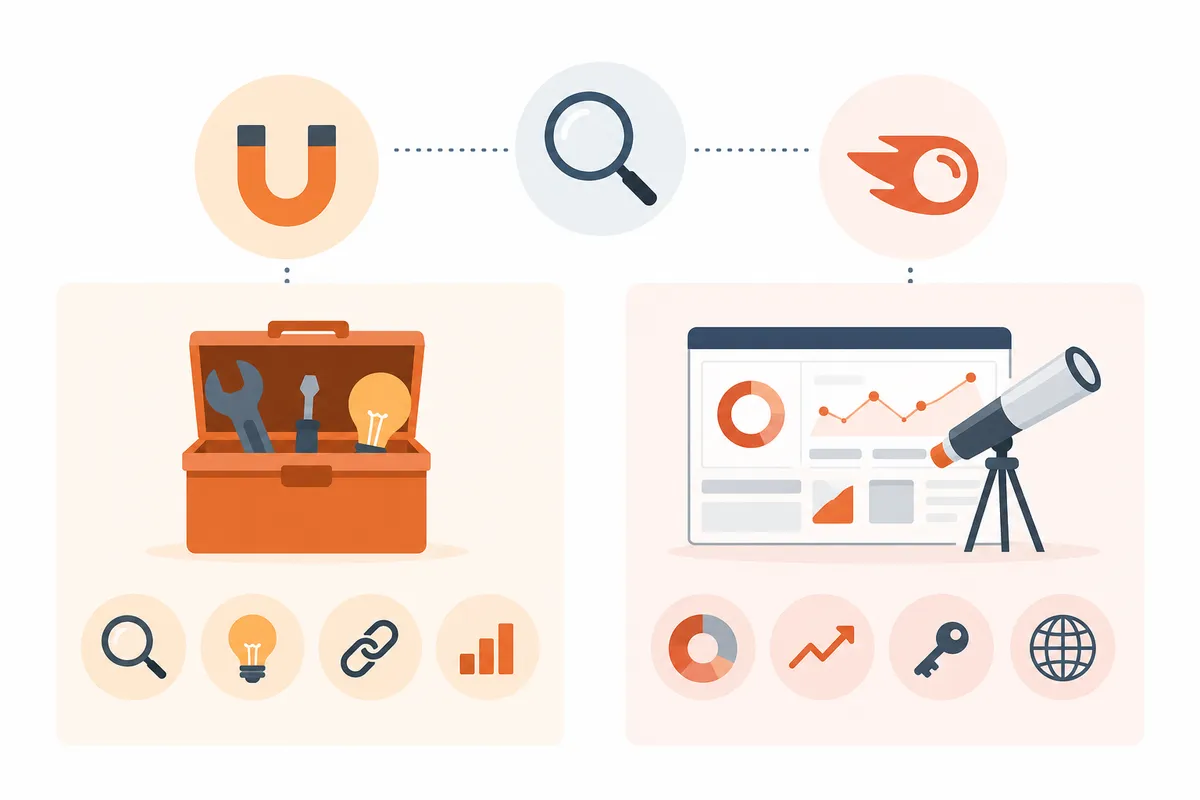
Ubersuggest began as a free keyword suggestion tool and grew into a fuller SEO suite after Neil Patel acquired it in 2017. It covers keyword research, a site audit, backlink checks, rank tracking and content ideas. The interface is intentionally simple: one project, one clean dashboard, one data table at a time. That makes it a reasonable entry point if you've never used an SEO tool before.
Semrush: The Full-Suite Platform for Professionals
Semrush launched in 2008, making it one of the longest-running SEO platforms still in wide use. It built its reputation on competitive research, seeing a competitor's rankings, traffic estimates and backlink profile in one place, and has since added content marketing, PPC research, social tracking and local SEO modules. It's a platform built to be the single login for an entire marketing team, which is also why it costs more.
Features: Where the Real Gap Shows Up

Feature depth is where Ubersuggest and Semrush separate most clearly. Semrush was built to answer almost any SEO question with a dedicated module; Ubersuggest covers the essentials and little beyond them.
Keyword Research
Semrush's Keyword Magic Tool draws on a database some reviewers size at close to 28.9 billion keywords across more than 140 geographies, with roughly 3.6 billion of those tied to the United States alone. From a single seed keyword, reviewers report it can surface around 20 million keyword ideas, each tagged with search intent, informational, commercial or navigational.
Ubersuggest's keyword database is smaller, with reviewers citing a figure near 1 billion keywords and around 1 million keyword ideas per seed term. You still get search volume, CPC and an SEO difficulty score, but you won't get the same depth of intent classification or geographic filtering.
Site Audits and Technical SEO
Semrush's site audit reportedly crawls up to 100,000 pages on its higher plans and flags over 120 issue types, from broken links to duplicate content, with specific fix suggestions attached to each one. Ubersuggest's audit tops out at around 10,000 crawled pages and lists issues and warnings without the same level of prescriptive detail. For anything beyond a small site, that crawl-depth gap matters. (For general technical SEO fundamentals independent of either tool, Google's own Search Central documentation is a solid reference point.)
Backlink Analysis
Semrush's backlink index is commonly cited at more than 43 trillion links, refreshed frequently enough that reviewers describe near-real-time alerts on new or lost links. Ubersuggest's backlink tool is more basic, useful for a quick competitor check, but it won't support the kind of link-prospecting workflow an agency needs. If backlink depth is your priority, it's worth comparing Semrush directly against a link-focused specialist like in this Semrush vs Similarweb breakdown, which looks at traffic and audience data rather than SEO basics alone.
Content and Competitor Tools
Semrush bundles a Topic Research tool, an SEO Writing Assistant and content-tracking features that Ubersuggest simply doesn't match. Ubersuggest's content ideas feature is useful for a quick brainstorm, but it stops short of a full content workflow. If you're specifically weighing all-in-one suites against each other, the way Moz compares to Semrush is a useful parallel read, since Moz sits in a similar middle ground on features.
Winner: Semrush, for anyone who needs keyword depth, technical audit scale or a built-in content workflow. Ubersuggest is fine for basic keyword and audit checks but isn't built for heavier SEO work.
Ease of Use: Where Ubersuggest Pulls Ahead

Ubersuggest's dashboard is linear by design. You open a report and scroll through one data block at a time, traffic overview, then a trend graph, then a keyword table, then top pages. There's little to interpret beyond what's in front of you, which is exactly why it suits beginners.
Semrush's interface covers far more ground, and that shows the moment you open a domain report or the Keyword Magic Tool: dense tables, filters, acronyms and multiple metrics competing for attention at once. It isn't poorly designed, but it assumes you already know what you're looking for. New users commonly describe a real learning curve before Semrush starts feeling efficient rather than overwhelming.
Winner: Ubersuggest, for solo users and beginners who want answers without a learning curve. Semrush wins back ground for anyone who'll use it daily and can invest a week or two getting comfortable with it.
Pricing: The Gap Is Bigger Than It Looks
Pricing is the single biggest differentiator between these two tools, and it's worth being precise about it, since older articles still circulate outdated numbers.
| Plan | Ubersuggest | Semrush |
|---|---|---|
| Entry tier | Individual: $29/month or $290 lifetime, 1 site | Pro: $139.95/month ($117.33/month billed annually) |
| Mid tier | Business: $49/month or $490 lifetime, 2–7 sites | Guru: $249.95/month ($208.33/month billed annually) |
| Top tier | Enterprise: $99/month or $990 lifetime, 8–15 sites | Business: $499.95/month ($416.66/month billed annually) |
| Free trial | Around 7 days, per third-party reviews | Around 14 days, per third-party reviews |
As of October 2026, Ubersuggest's one-time lifetime option remains its biggest pricing advantage, a format almost no other SEO tool still offers. That said, Ubersuggest's prices have climbed over the past few years: the old $12-a-month entry rate and the roughly $120 lifetime deal that used to circulate are gone. If you're reading a comparison that still quotes those numbers, treat it as outdated.
Semrush's annual billing saves roughly 15–17% versus paying monthly, which narrows the gap slightly but doesn't close it. Semrush's Guru plan is also where keyword history unlocks, a detail worth knowing if historical ranking data matters to your strategy, it isn't included at the Pro tier. For a side-by-side on where that extra Semrush spend actually goes versus a leaner competitor, see this cost breakdown against Ahrefs, and if your budget sits closer to Ubersuggest's range, Semrush vs SE Ranking covers a mid-priced alternative worth knowing about too.
Winner: Ubersuggest, for cost-conscious buyers, especially anyone who'll take the lifetime deal. Semrush wins on value only if you'll genuinely use its extra modules, otherwise you're paying for tools you won't touch.
Support and Learning Resources
Neither vendor publishes a side-by-side support comparison, so this is the one area where you should lean on their own documentation and trial periods rather than secondhand claims. Semrush, as the larger and older platform, maintains an extensive knowledge base, an academy with certifications, and a more established user community, a natural byproduct of running since 2008 at enterprise scale. Ubersuggest's support resources are lighter, consistent with its positioning as a simpler, self-serve tool for individuals rather than teams managing client accounts.
If support responsiveness matters more than raw features to you, it's worth checking both companies' current help-center pages directly before buying, since support quality can shift between reviews. For a PPC-leaning alternative that also publishes its own support model, Semrush vs SpyFu is a useful comparison if paid search research matters to your decision too.
Winner: Semrush, mainly on the strength of a larger knowledge base and longer track record. This is the softest call in this comparison since neither vendor publishes directly comparable support metrics.
Common Mistakes When Choosing Between Them
- Comparing outdated prices. Some older articles still list Ubersuggest at $12/month or cite a $120 lifetime deal. Both are gone, current entry pricing starts at $29/month or $290 lifetime.
- Buying Semrush's top tier "just in case." The Business plan at $499.95/month is built for high-volume agencies tracking thousands of keywords across dozens of projects, most small teams never need it.
- Assuming Ubersuggest's free searches replace a paid plan. The free tier is capped tightly enough that it works for the occasional lookup, not ongoing tracking.
- Ignoring the learning curve cost. Semrush's feature depth is only valuable if someone on your team has the time to learn it; otherwise you're paying for modules that sit unused.
- Only comparing these two. Several other platforms sit between them on price and depth, Semrush vs Serpstat is a good next comparison if neither Ubersuggest nor Semrush feels like a perfect fit.
FAQs
Is Ubersuggest as good as Semrush?
Not for feature depth. Ubersuggest covers core keyword research, a basic site audit and simple rank tracking well enough for individuals, but Semrush's keyword database, backlink index and content tools go significantly further. Ubersuggest is "good enough" for solo use, not a feature-for-feature match.
Can Ubersuggest replace Semrush for an agency?
Generally no. Agencies managing multiple clients typically need the project capacity, crawl depth and competitor data that Semrush's higher plans provide. Ubersuggest's top Enterprise plan supports up to 15 sites, which may work for a very small agency, but larger client rosters will outgrow it quickly.
Does Ubersuggest have a free plan?
Ubersuggest offers limited free daily searches rather than a full free tier. It's useful for the occasional keyword check but not built for ongoing tracking or audits, for that you'll need a paid plan starting at $29/month.
Why is Semrush so much more expensive than Ubersuggest?
Semrush bundles far more than core SEO: content marketing tools, PPC research, social tracking and local SEO modules sit alongside its keyword and backlink data. Ubersuggest focuses narrowly on SEO basics, which is part of why its entry price sits at roughly a fifth of Semrush's.
Which tool has more accurate keyword data?
Semrush's keyword database is substantially larger, reviewers cite figures near 28.9 billion keywords versus Ubersuggest's roughly 1 billion, which generally means more precise volume and difficulty estimates, especially for niche or long-tail terms.
See the Gap on Your Own Site
The numbers above only tell you what each vendor claims on its own pricing and feature pages. What actually matters is how your site's keywords, rankings and technical issues look right now, regardless of which tool's dashboard you're staring at. If you want a concrete starting point for Ubersuggest vs Semrush that's grounded in your own data rather than a vendor's marketing page, talk to the team and request a sample SEO report to see what's actually worth fixing first.
Resources / References
Sources
About the author
SearchBlueprint researched, wrote and scored this article with the content pipeline our customers run on their own sites. The score in the byline is what our content engine gave this page before it published. Nothing here is reviewed by hand, which is the point: it is the product's output, published where anyone can check it.