Semrush vs SpyFu: Which SEO Tool Wins in 2026?
By Toy Wen Da, Co-Founder · · 6 min read · scored 95/100
If you're weighing Semrush vs SpyFu, here's the short answer. Pick Semrush if you need an all-in-one marketing suite that covers SEO, PPC, content, and social tracking in one place. Pick SpyFu if you mainly want sharp, affordable competitor and PPC spying without paying for tools you'll never touch.

This comparison is built from each product's own website, pricing pages, and documentation, not hands-on testing of either platform.
Semrush vs SpyFu: Side-by-Side Overview
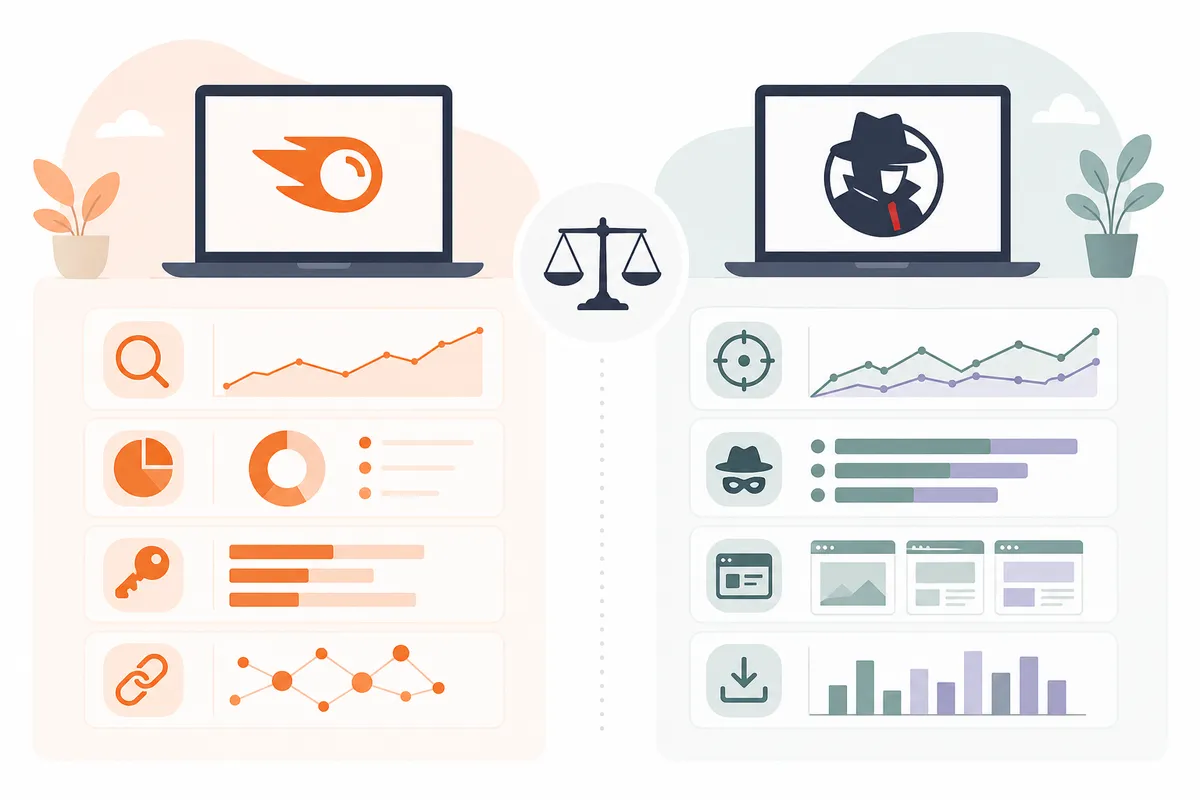
| Semrush | SpyFu | |
|---|---|---|
| Starting price | See their pricing page (14-day free trial on the Pro plan) | $39/month (Basic plan, per SpyFu's own blog, as of October 2026) |
| Free plan | No permanent free tier; trial-based access only | Free plan available, though paid plans don't offer a trial |
| Best for | Teams needing an all-in-one SEO, PPC, content, and social toolkit | Budget-conscious marketers focused on competitor and PPC research |
| Standout feature | Competitive Research Toolkit (Organic Research, Keyword Gap, Brand Monitoring) | Kombat tool and full AdWords campaign history for competitors |
| Main limit | Core plan costs aren't listed in SpyFu's or Semrush's public comparison material reviewed here; the Trends add-on runs an extra $200/month | Search data is limited mainly to US and UK markets |
What Actually Matters When You Compare Them
Competitor Analysis and PPC Research
This is where both tools compete hardest. Semrush's Competitive Research Toolkit splits into SEO, Advertising, Content and PR, and Social Media categories. It lets you pull a competitor's organic keywords, backlink profile, and ad copy from one dashboard. If you want deeper traffic and market-share data, Semrush sells that separately through its Trends add-on. It's priced at roughly $200/month on top of your regular plan.
SpyFu builds its entire product around this use case. Its Kombat feature lines up multiple competitors to find keyword overlaps and gaps. Its AdWords Advisor suggests keywords based on competitor buy patterns. Its AdWords History shows a rival's full Google Ads campaign history, including past ad copy and cost-per-click.
One honesty check: a case study from InvisiblePPC compared both tools' PPC spend estimates against verified real ad budgets across 21 websites. In one example, a business verified at $7,500 in monthly ad spend showed as $2,250 estimated on SpyFu and $0 on Semrush. In another, a verified $104,000-a-month spender showed roughly $5,830 on SpyFu and $539 on Semrush. Treat PPC budget estimates from either tool as rough signals, not audited numbers.
Winner: SpyFu, for teams whose main job is reverse-engineering a competitor's ad and keyword strategy. If you also want backlink and audience intelligence outside PPC, Semrush's broader toolkit closes more gaps. See our Semrush vs Similarweb comparison if traffic estimation specifically is your priority.
Keyword Research and Market Coverage
Semrush markets a very large keyword and domain database spanning multiple countries, which matters if your competitors operate internationally. SpyFu's own data collection is drawn from US and UK Google results, and it doesn't return full results for other markets. That's a limitation the vendor's own site has acknowledged in third-party reviews.
Winner: Semrush, for any business tracking competitors or keywords outside the US and UK. SpyFu still wins on US/UK-focused keyword depth for the price.
Ease of Use
SpyFu is widely described as the simpler interface: fewer menus, clearer overview reports, and a shorter learning curve for beginners. Semrush packs in far more modules, site audit, content tools, social tracking, PPC, and the Trends suite. That means more value, but also more navigation to learn.
Winner: SpyFu, for solo marketers and small teams that want answers fast without a training period.
Pricing and Value
SpyFu publishes three tiers on its own blog. Basic starts at $39/month, Pro plus the RivalFlow AI bundle runs $119/month ($59 for the first month), and Team/Agency costs $249/month. All three include unlimited search results and data exports, as of October 2026. Semrush doesn't publish a single flat starting price in the material reviewed for this comparison. Confirm current tiers on Semrush's own pricing page. It does offer a 14-day free trial of its Pro plan. Its Trends add-on is a separate $200/month cost layered on top of a base plan.
If cost-per-dollar of competitor data is your main concern, run the numbers against Ahrefs too. Our Ahrefs vs Semrush cost breakdown lays out how a third major player stacks up on price.
Winner: SpyFu, for transparent, lower published pricing. Confirm Semrush's exact tier costs directly before deciding, since they weren't confirmable from the sources used here.
Support
Both vendors offer standard support channels through their help centers and documentation. Neither product's support quality is independently verified in the material reviewed for this comparison. Check each vendor's support page for current response times and channels before you commit to an annual plan.

Common Mistakes When Choosing Between Them

- Treating PPC budget estimates as exact. As the InvisiblePPC case study above shows, both tools can report a fraction of a competitor's real verified ad spend. Use estimates as a starting point, not a final number.
- Ignoring SpyFu's geographic limits. If your market or competitors sit outside the US and UK, SpyFu's coverage gap can leave real blind spots.
- Forgetting add-on costs. Semrush's base subscription doesn't include Trends, budget the extra $200/month separately if you need traffic and market-share data.
- Picking by price alone. A cheaper plan that doesn't cover your actual use case, content planning, social tracking, international keywords, costs more in workarounds later.
- Skipping the trial or free plan. Semrush offers a 14-day Pro trial and SpyFu has a free plan; test your actual workflow in both before paying.
Whichever direction a semrush vs spyfu decision pushes you, remember that competitor data is only useful if you act on it. Turning a keyword gap or backlink opportunity into a page that actually ranks still requires real content work and technical follow-through. Google's own Search Central documentation is a good baseline for understanding what ranking factors any competitor-research tool helps you influence.
FAQs
Is SpyFu cheaper than Semrush?
Based on each vendor's own pricing pages, SpyFu publishes a lower, more transparent entry price, $39/month for its Basic plan as of October 2026. Semrush's exact entry-level price wasn't confirmable from the material used in this comparison, so check its pricing page directly. Its Trends add-on costs an extra $200/month.
Does SpyFu have a free plan?
Yes, SpyFu offers a free plan with limited features, though it doesn't extend free trials to its paid tiers. Semrush instead offers a 14-day free trial of its Pro plan rather than an ongoing free tier.
Which tool is better for PPC competitor research?
SpyFu is built specifically around PPC and organic competitor spying, with features like Kombat and full AdWords campaign history. Semrush covers similar ground through its Advertising Research tools but as part of a much broader platform.
Does Semrush or SpyFu cover international markets better?
Semrush generally covers more countries and geo-databases. SpyFu's data is drawn mainly from US and UK search results, so it covers fewer markets outside those two countries.
Can I use both Semrush and SpyFu together?
Some agencies run both: SpyFu for fast, affordable competitor and PPC snapshots, and Semrush for the broader SEO, content, and site-audit work. Whether that's worth the combined cost depends on your budget and how much each tool's unique data actually moves your strategy.
Put the Data to Work
Neither tool matters much until the keyword gaps and competitor insights turn into pages that actually rank. If you want to see what that looks like for your own site, talk to the team. Get a sample SEO report built from your own domain before committing budget to either side of a semrush vs spyfu decision.
Resources / References
Sources
About the author
SearchBlueprint researched, wrote and scored this article with the content pipeline our customers run on their own sites. The score in the byline is what our content engine gave this page before it published. Nothing here is reviewed by hand, which is the point: it is the product's output, published where anyone can check it.