SEO for Spas: The Local Fixes That Fill Your Calendar
By Toy Wen Da, Co-Founder · · 10 min read · scored 97/100
SEO for spas means getting your Google Business Profile, website, and content found by people searching for massages, facials, and day-spa treatments near them, then converting that visibility into booked appointments. The fastest first step is claiming and fully completing your Google Business Profile, since most spa searches show a map pack before any website link.
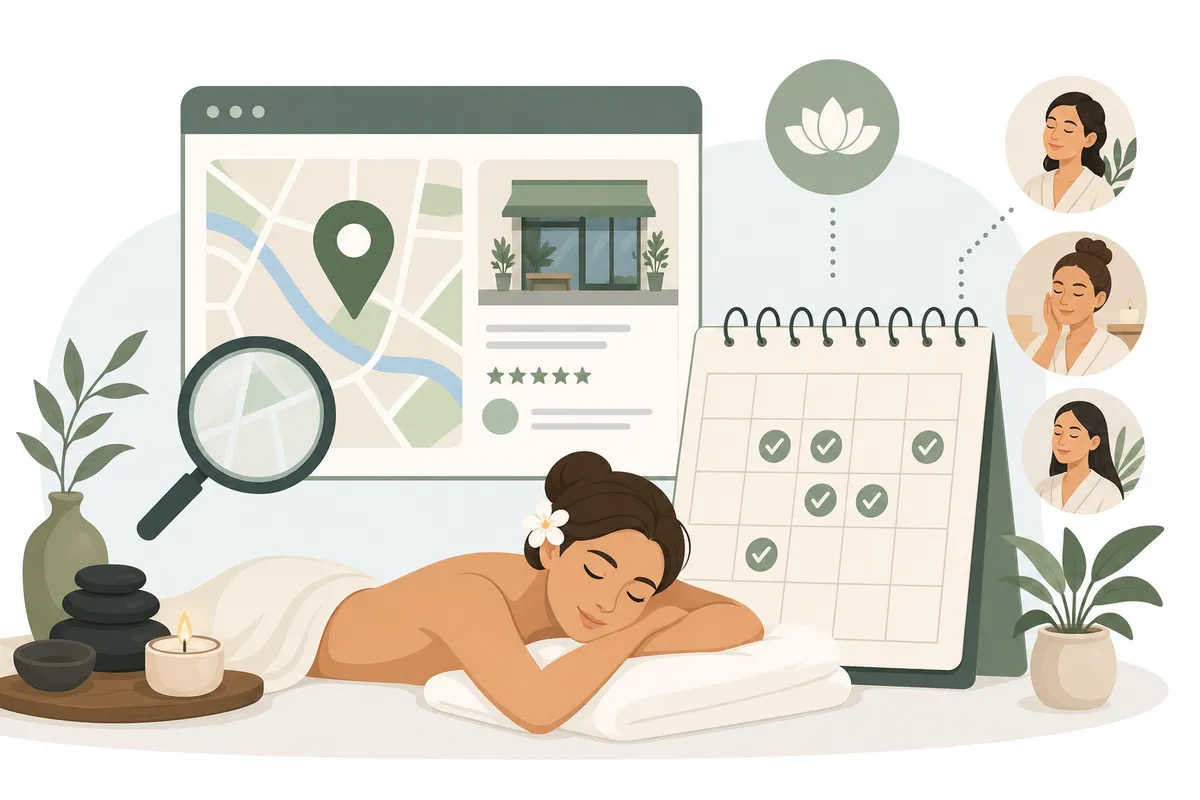
Tools built for this problem can speed things up considerably. A local SEO feature that shows your rank in a visual grid across neighborhoods, flags missing citations, and tracks map-pack position over time takes the guesswork out of deciding what to fix first, instead of auditing your listing by hand and hoping you caught everything.
Start With Local SEO: Your Google Business Profile
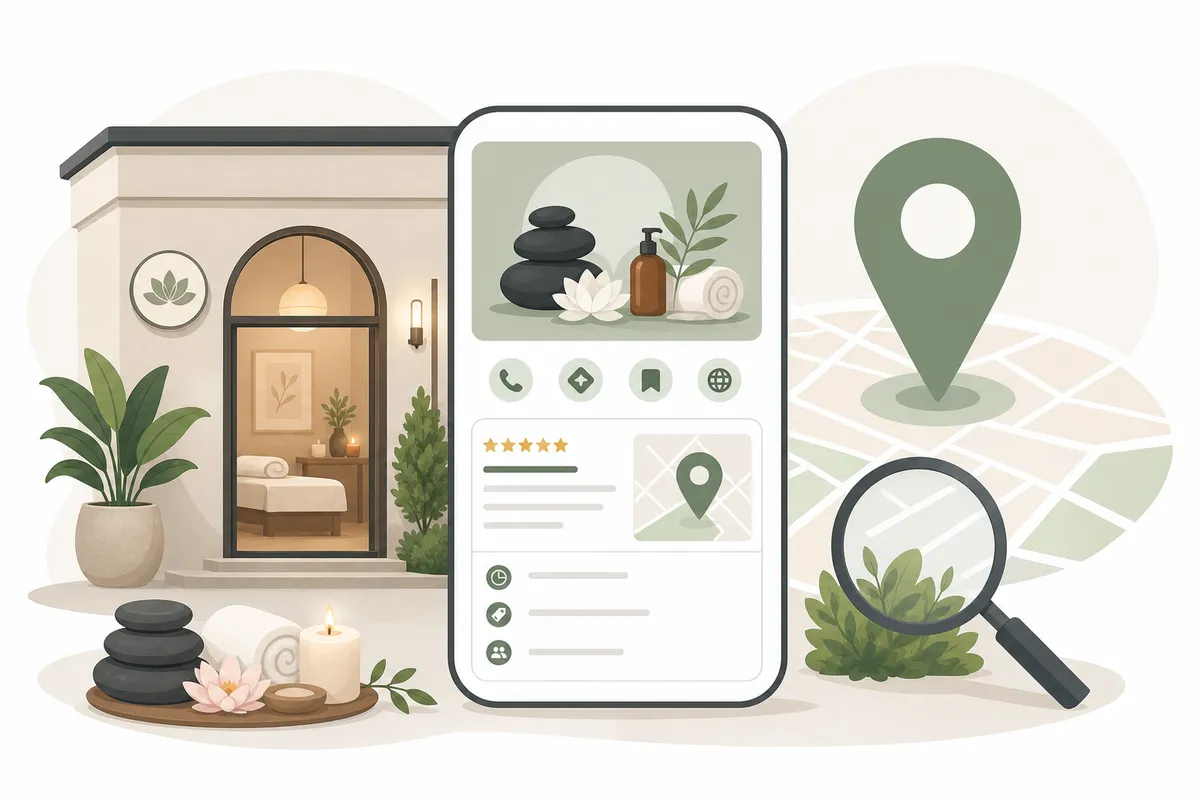
Local SEO for spas starts outside your website. When someone searches "massage near me" or "day spa," Google typically shows a map pack of three businesses above the regular organic results. If your profile isn't optimized, you're invisible in that spot no matter how good your site is.
Claim, Verify, and Fully Complete Your Profile
Go to google.com/business and claim your listing if you haven't already. Verification usually happens by mail, phone, or video, depending on what Google offers your business category. Once verified:
- Open the Business Profile and select Edit profile.
- Fill in the Services section with every treatment you offer, massage types, facials, body wraps, waxing, not just "spa services."
- Set accurate hours, including holiday hours, since mismatched hours hurt both rankings and trust.
- Add a complete business description that names your treatments and neighborhood, written for a human reader, not stuffed with keywords.
- Upload photos under the Photos tab, treatment rooms, your storefront, and staff build more trust than stock imagery.
- Use Posts to share promotions, seasonal packages, or new services; profiles that post regularly tend to show more activity signals to Google.
Collect and Respond to Reviews
Reviews influence both rankings and conversion. Ask satisfied clients to leave one before they walk out the door, and respond to every review, good or bad, through the Reviews tab. A thoughtful reply to a negative review often does more for trust than ten five-star reviews with no owner engagement.
When GBP Alone Is Enough, and When It Isn't
This is where a lot of spa owners stop, and for a single-location business chasing local foot traffic, that's often fine. But Google Business Profile only controls what happens in the map pack. It does nothing for your website's organic rankings, blog traffic, or visibility for broader keywords like "lymphatic massage" or "how much to tip a massage therapist."
| Situation | Is GBP Alone Enough? | Why |
|---|---|---|
| Single location, mostly walk-in and local map-pack traffic | Often yes | Map pack visibility drives most "near me" bookings |
| Multiple locations or service areas | No | Each location needs its own listing and local content |
| Ranking for informational searches (tipping, facial frequency, treatment benefits) | No | GBP doesn't index blog content or answer research-stage questions |
| One-off listing fix (wrong hours, missing category) | Yes | A quick manual edit solves a one-time problem |
| Recurring visibility problem (slipping rank, losing map-pack spot) | No | A recurring issue usually points to a site-wide or competitive gap GBP can't fix alone |
| Competing for broader organic terms ("spa," "massage spa") | No | That's a website and content problem, not a profile setting |
If your spa needs more than the map pack, multiple locations, service-area pages, or organic rankings for treatment keywords, that's the point where a dedicated local SEO tool earns its keep, tracking rank by neighborhood and flagging citation gaps you'd otherwise miss by checking each directory by hand.
Keyword Research: What People Type Before They Book
People rarely search just "spa." They search for the specific problem or service: "deep tissue massage for back pain," "how often should you get a facial," or "best day spa in Austin." Each of those represents a different stage of the buying decision, and each deserves its own page or post.
Broad head terms like "spa" or "massage spa" are dominated by directories and national brands, hard for a single-location business to outrank. Specific, local, or question-based terms are usually far more winnable and often convert better, since the searcher already has intent.
A few practical starting points for spa keyword research:
- Treatment names: massage, facial, body wrap, waxing, each split by sub-type (deep tissue, Swedish, hot stone).
- Local modifiers: your city or neighborhood name attached to a treatment, not just "spa near me."
- Pre-booking questions: tipping etiquette, how often to get a treatment, what to wear, how to prepare.
- Comparison and decision terms: "spa vs. massage therapist," "day spa vs. medical spa."
If you're comparing keyword research tools to build this list at scale, it's worth reading how two major platforms stack up, the breakdown in Semrush vs. Serpstat: The 2026 Verdict for SEO Teams covers which one handles local and niche keyword data better for smaller teams.
Build Pages That Convert: Services, Treatments, and Blog Content
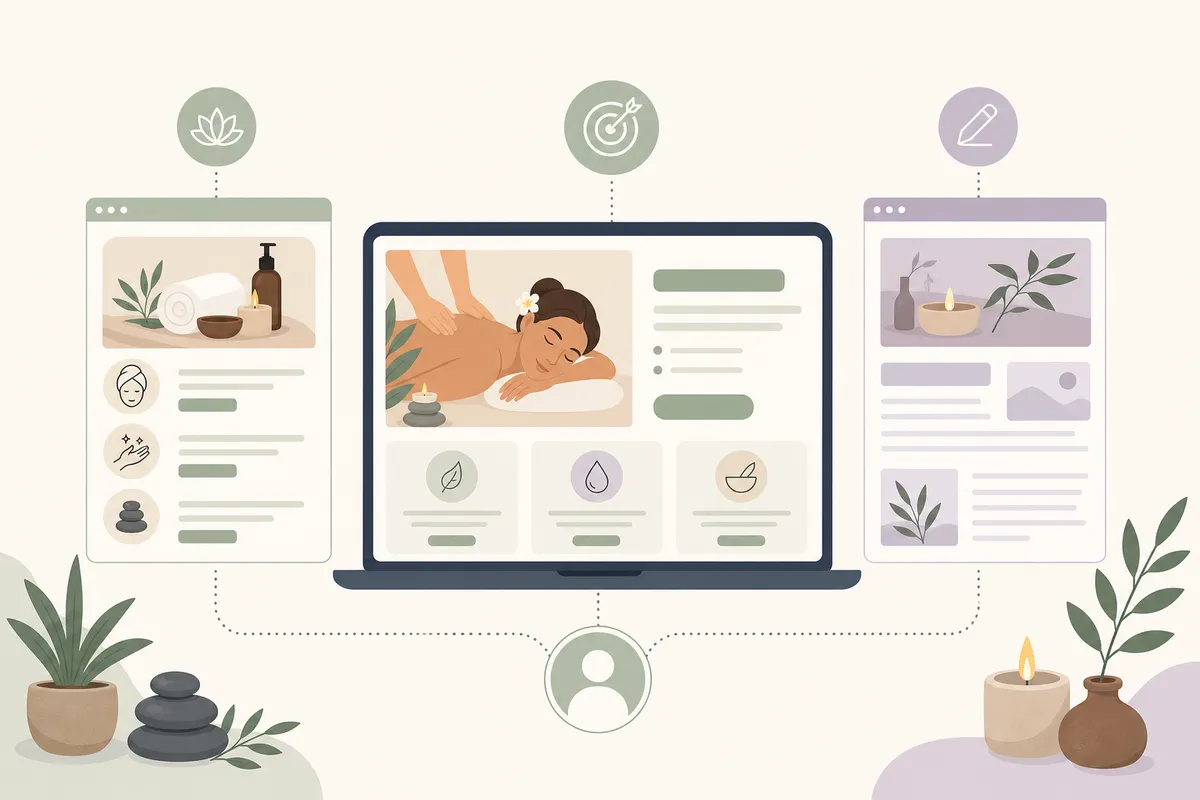
Knowing what people search for is only useful if you have a page built to answer it. A homepage that just says "welcome to our spa" won't rank for "deep tissue massage" or "hot stone facial."
Treatment Landing Pages
Create one page per core service: massage, facials, body treatments, waxing. Each page should cover what the treatment involves, how long it takes, typical pricing, and a clear way to book. This also gives you a logical place to add location-specific details if you serve more than one area.
Blog Posts for the Research Phase
Questions like "how much should I tip a massage therapist" or "how often should you get a facial" get searched regularly by people who haven't picked a spa yet. A well-written post answering the question directly, then linking to the relevant service page, captures that traffic before a competitor does.
If your site runs on a common platform like Wix, Squarespace, or Shopify, the settings that matter most for SEO differ by platform. The CMS-specific SEO guides walk through which settings to change first, in order, rather than leaving you to guess. And if your spa's site is a custom build deployed through code commits rather than a traditional CMS, the same logic applies in a different form, see SEO for git-built sites via GitHub commits for how publishing and indexing work in that setup.
Technical SEO and Page Speed Most Spas Overlook
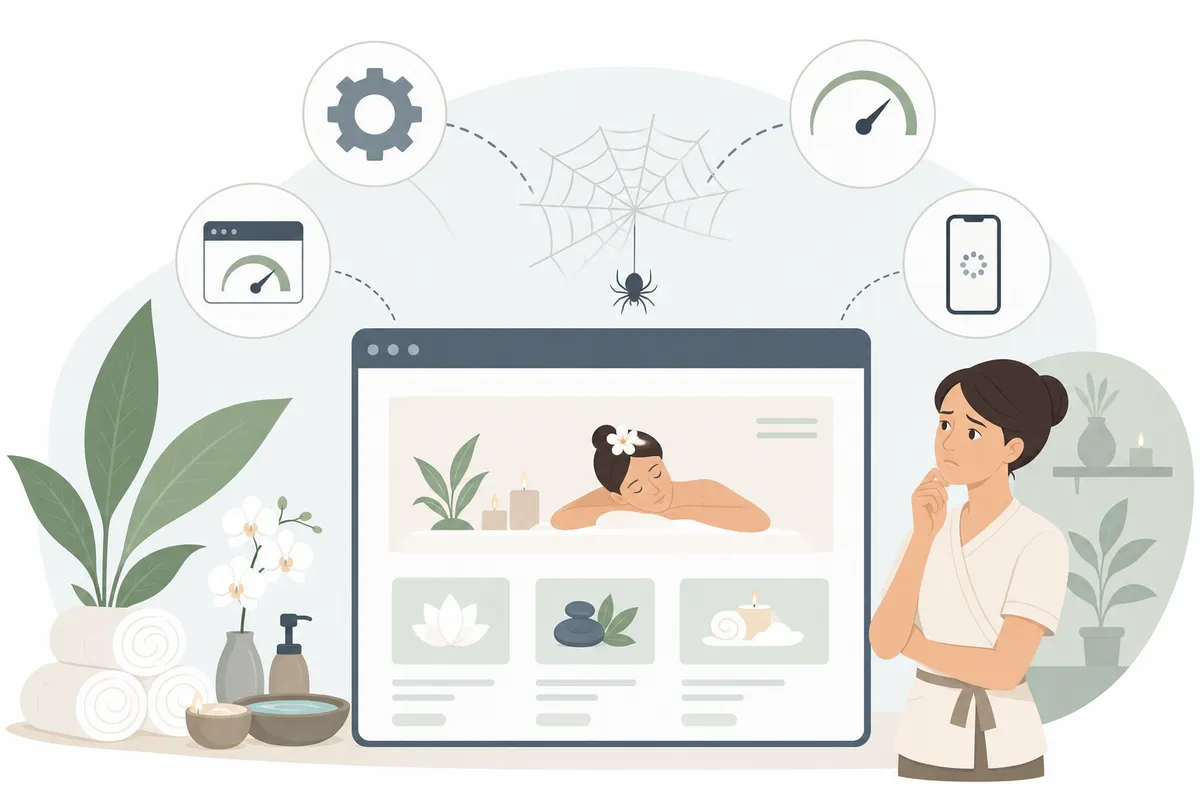
Even great content and a complete Google Business Profile won't help if Google can't crawl your site or if it loads too slowly to keep visitors around. Page-speed research consistently shows that a majority of mobile visitors abandon a site that takes too long to load, and spa booking pages, often loaded with large photos and embedded booking widgets, are frequent offenders.
A few technical basics worth checking before anything else:
- No accidental noindex tags. A page with a
noindexdirective won't appear in search no matter how good the content is, per Google Search Essentials. - Mobile load time. Most spa searches happen on phones; a slow booking page loses clients before they see your prices.
- Image size. Treatment-room photos are often uploaded at full camera resolution, which drags down load speed without adding visible quality.
- Working internal links. Every treatment page should link to your booking page and back to a related service, not dead-end.
For a broader checklist of what Google actually penalizes versus what's a myth, the summary in Google Guidelines for SEO: What to Fix First in 2026 is a useful gut check before you spend time on the wrong fix.
Link Building for Spas: Earning Local Authority
Backlinks still matter, especially for more competitive treatment keywords. For spas, the realistic path isn't national press, it's local. Partnerships with nearby hotels, wellness bloggers, local wedding vendors, and chamber of commerce directories tend to be far more attainable than a feature in a national magazine, and they carry local relevance Google weighs heavily for "near me" searches.
A practical approach: list your spa in every legitimate local directory relevant to your industry, sponsor a local event in exchange for a website mention, and reach out to local bloggers who write about wellness or self-care for a review or feature. Each of these also reinforces the citation consistency that local SEO rankings depend on.
Common Mistakes That Keep Spas Off Page One
| Mistake | Why It Hurts | Fix |
|---|---|---|
| Incomplete Google Business Profile | Map pack rankings favor complete, active profiles | Fill every field, add photos, post regularly |
| One homepage for every service | No page targets specific treatment keywords | Build a dedicated landing page per treatment |
| Inconsistent business name, address, phone across directories | Confuses Google's trust signals for your location | Audit and correct citations across all listings |
| Ignoring reviews | Missed trust signal and ranking factor | Respond to every review, request them after each visit |
| Slow-loading booking pages | Visitors leave before completing a booking | Compress images, simplify booking widgets |
| No blog or informational content | Misses research-stage searches entirely | Publish posts answering common pre-booking questions |
Local SEO Isn't Unique to Spas
The fixes that move the needle for a spa, a complete profile, consistent citations, service-specific pages, and genuine local backlinks, are the same ones that move rankings for other local service businesses. The approach in SEO for Car Dealerships: The Fixes That Move Rankings and SEO for Property Managers: What to Fix First on Your Site follows the same core logic, just applied to a different service. If you manage SEO across several local business types, the playbook transfers more than you'd expect.
FAQs
How long does SEO for spas take to show results?
Google Business Profile changes can show movement in weeks, since the map pack updates frequently. Organic website rankings for competitive treatment keywords usually take a few months of consistent content and link-building before you see meaningful traffic.
Do I need a blog if I just want local bookings?
Not strictly, but a blog captures research-stage searches, tipping etiquette, treatment frequency, what to expect, that a service page alone won't rank for. It's optional for a single-location spa relying mainly on map-pack traffic, more valuable if you're competing for organic search too.
Does having multiple locations change my SEO approach?
Yes. Each location needs its own Google Business Profile, consistent citations, and ideally its own location page on your site. Treating multiple locations as one listing confuses both Google and potential clients.
Should I focus on Instagram and social media instead of SEO?
They serve different purposes. Social media builds brand awareness and repeat engagement; SEO captures people actively searching with intent to book. Most spas benefit from both, but search traffic tends to convert at a higher rate since the searcher is already looking for a service like yours.
What's the single highest-impact fix for a new spa website?
A fully completed, verified Google Business Profile paired with one dedicated landing page per treatment. Together they cover the two places most spa searches happen: the map pack and organic results for specific services.
Check Where Your Spa Actually Stands
Start with your Google Business Profile this week, a complete, verified listing with real photos and recent reviews moves the needle faster than almost anything else on this list. Once that's in order, turn to your website's service pages and page speed before chasing backlinks. That's the core of seo for spas: profile first, pages and speed next, backlinks last. If you want a clear picture of where your spa's SEO stands right now, talk to the team and get a sample report showing exactly what to fix first.
Resources / References
Sources
- Main SPA SEO challenges and ways to make your web ...
- SEO for Single Page Applications: Basics, Challenges & Tips
- Optimizing Single-Page Applications for SEO & AI Search
- SEO for Spas
- Technical SEO for Single Page Applications (SPAs)
Disclaimer: This article is general health information, not individual medical advice. It cannot account for your history, medication or examination findings. For advice about your own symptoms, speak to a qualified clinician; if symptoms are severe or worsening, seek urgent care.
About the author
SearchBlueprint researched, wrote and scored this article with the content pipeline our customers run on their own sites. The score in the byline is what our content engine gave this page before it published. Nothing here is reviewed by hand, which is the point: it is the product's output, published where anyone can check it.