SEO for Caterers: How to Rank for Local Searches in 2026
By Toy Wen Da, Co-Founder · Updated · 11 min read · scored 93/100
SEO for caterers means making your website and Google Business Profile show up when someone nearby searches "wedding caterer," "corporate lunch catering," or "catering near me." Start by claiming and fully filling out your Google Business Profile, then make sure every page of your website names your city, your service types and your menu style.
SearchBlueprint's local SEO tools scan your Google Business Profile, your city and service pages and your review activity in one pass, and they flag which of those is holding your catering business back. Local SEO for caterers rarely fails for a single reason. A thin profile and a vague homepage usually show up together, often alongside stale reviews, so you need to see all of it at once to know where to begin.
What SEO for caterers means for your booking calendar
Catering is a hyperlocal business. Nobody searches for a caterer three states away; they want someone who can show up at their venue, on their date, with food that fits their event. For that reason SEO for caterers looks different from SEO for an ecommerce store or a national brand, since almost every ranking factor ties back to location and to trust signals a nearby buyer can verify fast.
Why catering is a local search business first
When someone types "corporate catering" or "wedding caterers," Google leans heavily on your Google Business Profile and your website's local signals, and then weighs your reviews on top. A caterer with excellent food and a weak online presence loses bookings to a mediocre caterer with a complete profile and recent five-star reviews. It isn't fair, but it is how local search works.
The market is growing, and so is the competition
The catering industry isn't shrinking, which is exactly why SEO for catering businesses matters more now than it did five years ago. More operators are chasing the same searches.
| Market measure | Figure | Source |
|---|---|---|
| U.S. catering services market, heading into 2026 | around $77 billion, with corporate events as the top growth driver | Industry market research |
| U.S. caterers industry (narrow NAICS definition), 2026 | roughly $15.7 billion, 6.7% CAGR over the prior five years | IBISWorld, February 2026 update |
| Broader U.S. catering services market, 2025 | approximately $77.18 billion, projected to reach $140.85 billion by 2035 at a 6.2% CAGR | Expert Market Research |
| Global catering services market, 2026 | $135.87 billion, on track for $196.2 billion by 2034 | Business Research Insights |
| U.S. catering services market, 2030 forecast | $109.41 billion at a 7.7% CAGR | Grand View Research |
| Catering services and food contractors market, 2024–2025 | $295.04 billion growing to $312.23 billion at a 5.8% CAGR | The Business Research Company |
Operators feel this too. FLIP's 2026 catering statistics put the share planning to expand operations in 2026 at 48.5%, even though 60.2% name rising costs as their biggest challenge. Per the International Caterers Association, 48% of caterers say corporate events are their largest growth area, and weddings remain the main source of revenue growth for 35% of them. Roughly 2 million weddings happen in the U.S. every year, and full-service wedding events often run $15,000 to $40,000, so the upside is real. More caterers are investing in SEO to grab a piece of it, and you'll see faster gains if you run your site like a lead-gen business in any other local service, the way solar companies fight for local roofing and installation leads, instead of treating it as a digital brochure.
Fix catering SEO on your own website, step by step
Most of the work happens inside tools you already have: your Google Business Profile dashboard and your website's CMS. The order below gets results fastest.
Step 1: Fully build out your Google Business Profile
Sign into Google Business Profile and fill in every field, even the optional ones. Set your primary category to Caterer, then add secondary categories like Wedding Service or Corporate Event Caterer if they fit. Add your service area and hours, plus at least 30 photos of plated dishes, event setups and your team at work, and post an update at least monthly. An empty or half-filled profile is the single biggest reason a catering business doesn't show up for "catering near me" searches.
Step 2: Fix title tags and page copy for each service
Open your page editor and check the title tag field on your homepage and on every service page. Each one should name your city and your service type: "Wedding Catering in Austin" reads very differently to Google than a generic "Home" or "Catering Services." If you're unsure your title tags are set up correctly, run your homepage URL through a free on-page SEO checker to see what's missing.
Step 3: Add LocalBusiness and FoodEstablishment schema
Structured data tells Google what kind of business you are, along with your address, hours and price range, in a format search engines can parse directly. Schema.org defines a FoodEstablishment type built for this use case. Most website builders let you add it through a settings panel or a plugin, and if you're on WordPress, a complete local SEO setup guide for WordPress walks through the exact menu path. If your site is built and deployed through code commits rather than a visual editor, the steps differ, so see the SEO guide for git-based sites for how structured data gets added in that workflow. Once it's live, confirm it validates with a free schema validator.
Step 4: Build separate pages for each event type and city
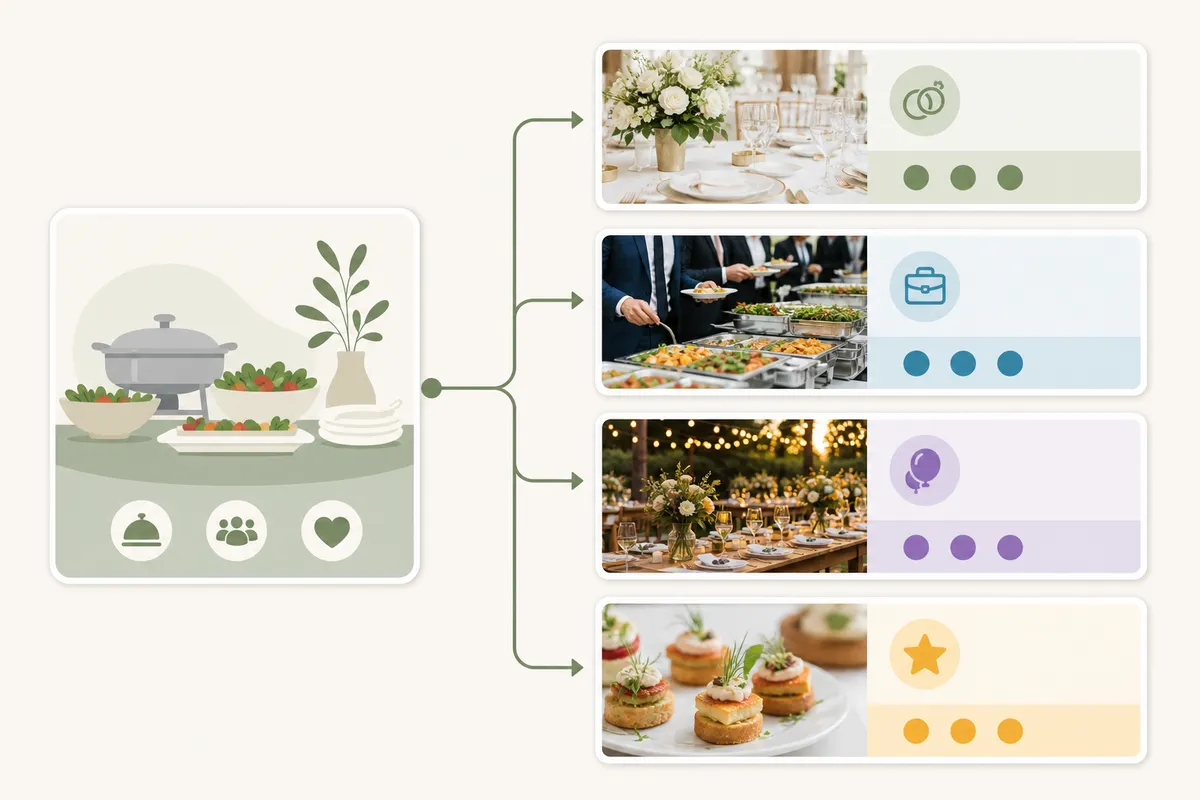
Don't cram weddings and corporate lunches onto one page with birthday parties. Create a dedicated page for each major event type, and if you serve more than one city or metro area, build a page per city as well. Each page needs unique content: a realistic per-person price range (many caterers show $25 to $65 per person depending on service style), sample menus, and photos from real events in that category. A general CMS SEO settings guide helps here, since the menu names for adding and publishing pages vary by platform.
Step 5: Build a review collection habit
Reviews are an ongoing habit. Google's local ranking weighs recency and frequency alongside volume, so a caterer with 40 reviews from the last six months typically outranks one sitting on 200 reviews from 2022. Ask for a review within 48 hours of every event, while the experience is still fresh. Some caterers also run simple referral incentives, like a $200 credit or a bottle of wine for a referred booking, to keep reviews and word-of-mouth bookings flowing.
Step 6: Publish seasonal content and check technical health
A blog is how a catering site ranks for searches that won't fit on a service page, like "holiday office party catering" or "graduation party menu ideas." If you want those posts indexed fast instead of sitting unseen for weeks, the approach news publishers use to get articles crawled quickly applies just as well to a seasonal catering post. Once pages are live, run a free SEO audit and a website speed test to catch slow-loading pages, because Google's own Search Essentials guidance treats page experience as part of how pages get ranked.

When your website's own SEO tools are enough, and when they aren't

Most website builders and CMS platforms now include some kind of built-in SEO panel: a field for title tags, maybe an SEO score, sometimes a sitemap generator. For a one-off fix on a single page, that's usually all you need. Ongoing, site-wide SEO for caterers asks for more.
| Situation | Built-in tools enough? | Why |
|---|---|---|
| Fixing one page's title tag or meta description | Yes | A single-page edit is exactly what a CMS's built-in SEO field is built for. |
| Checking if one new blog post has a working schema tag | Yes | Run it through a validator once, confirm, move on. |
| Finding every page site-wide with a duplicate or missing title tag | No | Most CMS panels check one page at a time; they don't scan the whole site for patterns. |
| Tracking whether your rankings are actually moving month over month | No | That needs ongoing rank tracking rather than a one-time score. |
| Diagnosing why bookings dropped after a site redesign | No | This is usually a mix of broken redirects and lost schema alongside changed URLs, which takes a cross-page diagnosis. |
| Spotting a broken internal link or image alt text gap | Yes, for a quick spot-check | A free broken link checker handles this in minutes. |
A single URL with a specific, known problem is a DIY job. A recurring pattern across dozens of pages, or a problem you can't pin down to one cause, is where ongoing monitoring earns its keep. If you can't tell which one you're facing, a sample SEO report shows what a full site scan surfaces, side by side with what a single-page checker catches.
Common mistakes in SEO for caterers
Caterers tend to repeat a handful of avoidable errors, and each is easy to fix once you know to look for it.
| Mistake | What it costs you | The fix |
|---|---|---|
| One generic "Catering Services" page for every event type | Google can't match you to specific searches like "corporate lunch catering" | Build a page per event type with its own copy and photos |
| Google Business Profile left half-filled | You lose the map pack for "near me" searches | Fill every field, add 30+ photos, post monthly |
| No per-person pricing anywhere on the site | Unqualified leads waste your time on calls | Show a price range, even a wide one, to filter inquiries |
| Reviews collected once a year in a batch | Recency-weighted ranking signals fade fast | Ask within 48 hours of every event, consistently |
| Chasing high-volume, high-difficulty keywords like generic "catering" | You compete against national directories and lose | Target realistic, specific phrases tied to what you can actually deliver |
The last mistake trips up smaller operators the most. A caterer with a five-person team chasing "catering for 100 people" or a nationally competitive term is fighting directories and larger competitors, and losing. A more specific phrase tied to your real capacity, such as a cuisine specialty, a neighborhood or an event size you can staff, converts better even with lower search volume. The same lesson applies to interior designers building a portfolio site, where niche-specific pages beat one broad page every time. Real estate investors need the same discipline when deciding which local lead searches are worth chasing and which only look attractive on paper, and optometrists need to fix the handful of things that move rankings before they touch anything else on their site.
Competing with directories like WeddingWire and The Knot
Caterers face a version of the problem travel agencies face against Expedia: big directories such as WeddingWire, The Knot and Yelp often outrank individual catering websites for broad terms. The approach travel agencies use to rank above Expedia applies here too, which means you shouldn't fight a directory on its own turf. Go deeper on what it can't match: your actual menus, your actual pricing, photos from your actual events, and content that answers the exact questions a local client has about booking you specifically. A directory profile can't show that level of specificity or trust, even though directories win on volume.
FAQs
How long does SEO for caterers take to show results?
Most caterers see Google Business Profile changes reflected within a few weeks, since that profile updates faster than organic rankings. Website and content changes usually take two to four months to move rankings meaningfully, because Google needs to recrawl and re-evaluate the pages.
Do I need a blog if I only take bookings through inquiries, not online orders?
Yes. A blog is how you rank for searches beyond your core service pages, such as seasonal event ideas, menu questions and planning guides. It won't replace your service pages, but it brings in searches they can't target directly.
Is Google Business Profile more important than my website for catering SEO?
For local "near me" and map-pack searches, yes, because most people see your profile before they click through to your site. Your website still matters for conversion once they land, and for ranking in the standard organic results below the map.
Should I list my pricing publicly if competitors keep theirs private?
A visible price range, even a wide one like $25 to $65 per person, filters out unqualified leads and builds trust. Many caterers keep exact pricing private until a quote, but a general range on the site tends to outperform no pricing information at all.
What's the fastest fix if I only have time for one thing this month?
Complete your Google Business Profile. It's the highest-leverage item on the list: categories, service area, 30-plus photos and a monthly post. Everything else builds from there.
Get your catering site checked this week
Pick one fix from this guide and do it before the month ends; most caterers start with their Google Business Profile or their title tags. Rankings move slowly, so starting earlier means the gains compound sooner. If you want to see which of these gaps your own site has, talk to the team and get a sample report built around your pages instead of a generic checklist.
Sources
About the author
SearchBlueprint researched, wrote and scored this article with the content pipeline our customers run on their own sites. The score in the byline is what our content engine gave this page before it published. Nothing here is reviewed by hand, which is the point: it is the product's output, published where anyone can check it.