B2B SEO: The Playbook for Long Sales Cycles and Few Buyers
By Toy Wen Da, Co-Founder · · 10 min read · scored 98/100
B2B SEO is the practice of ranking your site for the specific, lower-volume searches that matter to a buying committee. The handful of people who actually evaluate and approve a purchase run these searches before they ever contact sales. Because B2B buying groups are small and deliberate, the first move is mapping each buyer's search to one page that answers it. Don't start by chasing broad traffic.

Before you touch a single page, it helps to see the whole picture at once. The SearchBlueprint SEO plan builds that picture for a B2B or IT site specifically. It lists which pages are missing for your buying committee's questions. It also flags which existing pages are close but under-optimized, and what order to fix them in. That order puts the highest-impact work first.
What B2B SEO Means When You Have Long Sales Cycles and Few Buyers

Consumer SEO chases volume. It chases the right 40 people instead of the wrong 4,000. A term like "enterprise data backup software" might get a fraction of the searches that "data backup" gets. But nearly everyone typing it is already shopping.
That difference changes almost every decision you make. It changes which keywords you target, how much content you need, and how you measure success. A program that reports only on traffic is reporting on the wrong number. Qualified leads and sales-stage movement matter more.
Why B2B SEO Differs from B2C SEO
| Factor | B2B SEO | B2C SEO |
|---|---|---|
| Decision-makers | Several people (technical lead, budget owner, end user) evaluate the same purchase | Usually one person decides alone |
| Sales cycle | Weeks to many months, with research at every stage | Often same-day or same-visit |
| Search volume | Lower per keyword, but higher purchase intent | Higher per keyword, more browsing intent |
| Content needed | Case studies, comparison pages, ROI pages, technical docs | Product pages, reviews, promotions |
| Success metric | Qualified leads, pipeline, sales-stage conversion | Traffic, add-to-cart, purchase |
Why Low Search Volume Keywords Still Matter
A term like "seo for it companies" won't fill a traffic dashboard. But the person typing it is often an IT services founder or marketing lead actively planning a budget line. In this category, that one visit can be worth more than a thousand visits from a broad, unqualified term. Treat low-volume, specific phrases as the goal, not a consolation prize.
Fix B2B SEO Inside Your Website, Step by Step
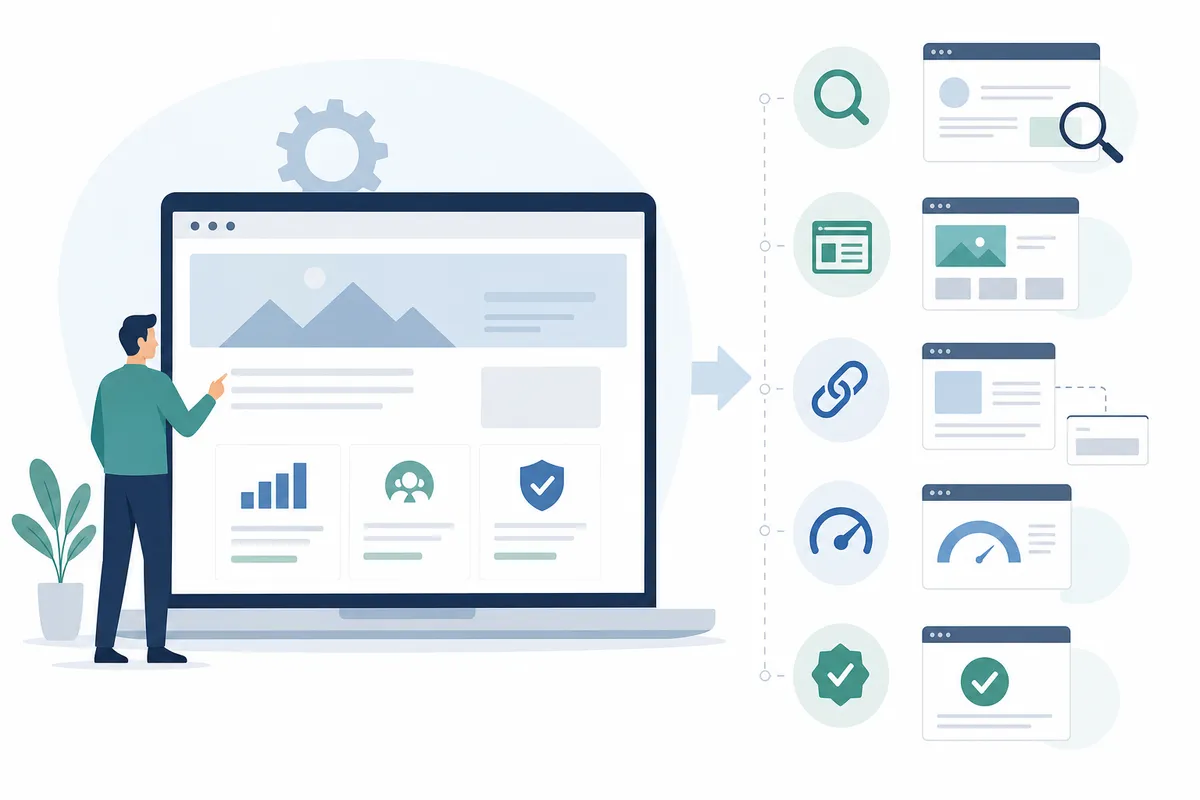
Before adding anything new, find out what your site already has and whether it's reaching the right people. Work through this in order.
Step 1: Audit What's Already Ranking
Open Google Search Console and go to the Performance report. Filter by query and look for phrases that include your product category, your industry, or a competitor's name. Sort by impressions to find pages that show up in search but get few clicks. That's usually a weak title or meta description, not a ranking problem. Then check the Pages report to see which URLs get indexed and which don't. A page stuck out of the index can't rank no matter how good it is.
Step 2: Map Each Keyword to a Buyer Stage and a Page
List out your buying committee's roles, technical evaluator, economic buyer, end user, and the questions each one searches. Assign every keyword on your list to exactly one existing page, or flag it as a page you still need to write. Two pages competing for the same query usually means both rank worse than one well-built page would.
Step 3: Fix the Technical Basics
A technical SEO audit catches the issues that quietly cap every other effort. These include slow page loads, broken internal links, missing structured data, and duplicate title tags across similar product or service pages. Google's own Search Essentials guidance is clear on this point. A page has to be crawlable and indexable before quality content can help it rank at all. Fix access before you fix wording.
Step 4: Build Content for Every Stage of the Sales Cycle
An SEO strategy that stops at awareness content leaves bottom-of-funnel searches to competitors. You need:
- Top-of-funnel: educational posts answering "what is X" and "why does X matter" questions
- Middle-of-funnel: comparison pages, buyer's guides, and ROI breakdowns
- Bottom-of-funnel: case studies, pricing pages, and detailed product or service pages
Each piece should link to the next logical step, guiding a reader from a broad question toward a decision page.
Platform-by-Platform: Where to Make the Technical Fixes

Where you actually go to fix an issue like this depends entirely on what your site runs on. The concept, fix titles, fix redirects, fix sitemaps, stays the same across platforms, but the menu you open does not.
| Platform | Common B2B site issue | Where the fix usually lives | Guide |
|---|---|---|---|
| WordPress | Plugin conflicts bury title and meta controls | Your SEO plugin's page-level settings and permalink structure | WordPress SEO settings |
| Webflow | Canonical tags and 301 redirects get skipped during a rebuild | Site settings panel and the redirect manager | Webflow SEO settings |
| Shopify | Collection and product pages compete for the same keyword | Theme-level canonical and pagination settings | Shopify SEO settings |
| Wix | Limited redirect and URL control on lower-tier plans | The built-in SEO checklist and URL structure settings | Wix SEO settings |
| Next.js | Metadata, sitemap, and robots files ship broken because they're generated at build time | The metadata configuration and sitemap/robots generation code | Next.js SEO settings |
| GitHub-built static sites | A deploy can ship without anyone verifying meta tags actually rendered | Commit-based publish checks tied to your build pipeline | SEO for GitHub-built sites |
| Lovable | The blog section often ships with no SEO fields at all | Whatever page-level SEO fields the platform exposes | Lovable blog SEO |
If you're not sure which row applies to you, check your site's footer or ask whoever built it. Guessing wrong wastes a round trip through settings that don't exist on your platform.
When Your Website's Own Tools Are Enough, and When They're Not

This is the honest part. Search Console, your CMS's built-in SEO fields, and free checkers handle a real share of this work. They stop being enough once the problem spans your whole site or keeps coming back.
One Page vs. the Whole Site
Fixing one page's title tag, meta description, or broken link is a five-minute job inside your CMS. Finding every page on a 200-page B2B site with a duplicate title, thin meta description, or missing H1 is different. That's a pattern, and patterns need a crawl, not a page-by-page check.
A One-Off Problem vs. a Recurring One
A single broken redirect after a URL change is a one-off; fix it and move on. A ranking that slides every quarter because competitors keep publishing and you don't is recurring. It needs a standing plan rather than a one-time fix.
| Situation | Free/built-in tools | When you need more |
|---|---|---|
| One page's title or meta is wrong | Fix directly in your CMS | , |
| You're not sure which pages are duplicate or thin | Manual review doesn't scale past a few dozen pages | A full-site crawl and audit |
| Rankings dropped once after a redesign | Check Search Console's coverage report | , |
| Rankings have drifted down for months | Spot-checking won't show the pattern | A technical SEO audit and an ongoing SEO plan |
| You need one keyword idea | A free keyword tool | , |
| You need every buyer-stage keyword mapped to a page, kept current | A spreadsheet goes stale fast | A plan that updates as rankings move |
If the honest answer is "this is a whole-site, ongoing problem," that's exactly what the SearchBlueprint SEO plan is built to track. It re-checks your site rather than giving you a one-time snapshot. You won't have to remember to repeat it yourself.
Building Authority: Backlinks and Local Signals for B2B
Content and technical fixes only get you so far without authority behind them. In this category specifically, the backlinks that move rankings come from sites your actual buyers already trust. Think industry publications, partner sites, and relevant directories, not high-volume, low-relevance link farms. The types of B2B backlinks that drive real SEO results breaks down which link sources are worth the outreach time. It also flags which ones aren't.
If your B2B company sells into specific regions or maintains offices, territories, or dealer networks, don't skip location signals either. A local SEO setup that covers each territory page helps buyers in that region find you. It also keeps your national pages from having to compete with themselves for local terms.
Common B2B SEO Mistakes to Avoid
Most underperformance here traces back to a short list of repeated mistakes, not to some hidden algorithm problem.
| Mistake | Why it hurts | Fix |
|---|---|---|
| Writing only for one buyer persona | Other stakeholders find nothing that speaks to their concern and stall the deal | Map content to every role in the buying committee |
| Chasing high-volume, generic keywords | Traffic arrives but doesn't convert, and competition is fiercest here | Prioritize specific, intent-matched long-tail terms |
| No content past the homepage for the decision stage | Buyers compare you against competitors who do have case studies and pricing clarity | Build comparison, case study, and pricing pages |
| Treating SEO as a one-time project | Rankings erode as competitors publish and your pages age | Keep a standing SEO plan, not a single audit |
| Ignoring technical health | Good content on a slow or unindexed page still won't rank | Run a technical SEO audit before investing more in content |
| Measuring only traffic | A traffic increase that isn't qualified leads doesn't justify the spend | Track qualified leads and pipeline stage, not just visits |
FAQs
What makes B2B SEO different from regular SEO?
B2B SEO targets the handful of people who research and approve a purchase for a company, not a single consumer. That means lower search volume per keyword and longer sales cycles. It also means content that speaks to several roles, technical, financial, and operational, instead of just one.
How long does B2B SEO take to show results?
It generally takes longer to show results than consumer SEO. Buying cycles themselves are longer and search volumes are lower, so ranking changes take more time to translate into visible leads. Technical fixes can show up in weeks; content and authority gains typically take months.
Do I need separate pages for each type of buyer?
Usually yes. A technical evaluator searching for integration specs and a budget owner searching for ROI numbers are looking for different proof. One generic page rarely satisfies both. Separate, specific pages tend to convert better than one page trying to cover everyone.
Is keyword volume a reliable signal for B2B SEO?
Not on its own. A B2B keyword with modest monthly search volume can still be worth targeting if the searcher is close to a purchase decision. Intent matters more than raw volume in this category.
Can I do B2B SEO myself without an agency?
For a single page or a one-off fix, yes, your CMS and free tools like Search Console cover that. Once the problem spans your whole site, needs ongoing tracking, or involves mapping dozens of keywords to buyer stages, that's different. A dedicated plan becomes worth the time it saves.
Start With the Page Google Already Ranks You On
Pick your best-performing page in Search Console's Performance report. Check whether its title, meta description, and content actually match what a buyer searching that term needs next. That single check tells you more about your B2B SEO health than any broad audit promise. When you're ready to see the fuller picture, every gap, every priority, in order, talk to the team. You'll get a sample report built around your own site.
Resources / References
Sources
- B2B SEO Services For Lead Gen & Revenue Growth
- The Advanced Guide to B2B SEO
- The Complete B2B SEO Guide for 2026
- B2B SEO Marketing: A Complete Guide | PDM
- Expert B2B SEO Agency: SEO Services for Businesses
Disclaimer: This article is general information about rules and figures that applied when it was written, not personalised financial, tax or investment advice. It does not take account of your income, obligations, risk tolerance or goals, and rates and thresholds change. Verify the current position with the relevant authority, and speak to a licensed adviser or a qualified accountant before acting.
About the author
SearchBlueprint researched, wrote and scored this article with the content pipeline our customers run on their own sites. The score in the byline is what our content engine gave this page before it published. Nothing here is reviewed by hand, which is the point: it is the product's output, published where anyone can check it.