SEO for Franchises: Fix Location Pages That Don't Rank
By Toy Wen Da, Co-Founder · · 7 min read · scored 98/100
SEO for franchises is the work of getting every individual location found in local search, not just the corporate brand. Google ranks each location page, each Google Business Profile, and each set of reviews on its own merits. Start by checking whether every location has its own page, listing, and content unique to that place.
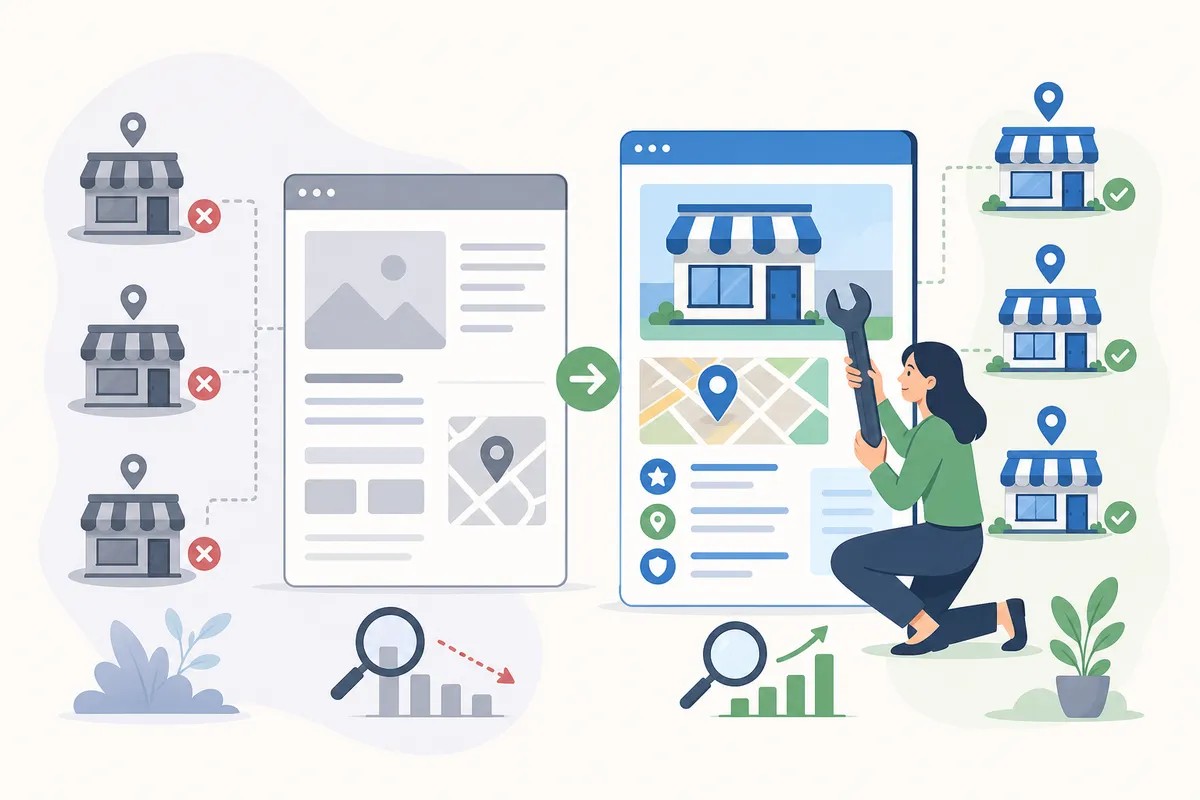
A tool built for local SEO can show you this at a glance. It flags which locations have thin or duplicate pages, which listings are missing fields, and which city pages are actually competing with each other for the same keyword. That matters more for franchises than almost any other business type, because the problem scales with every new location you open.
Why Franchise SEO Is Different From Regular Local SEO
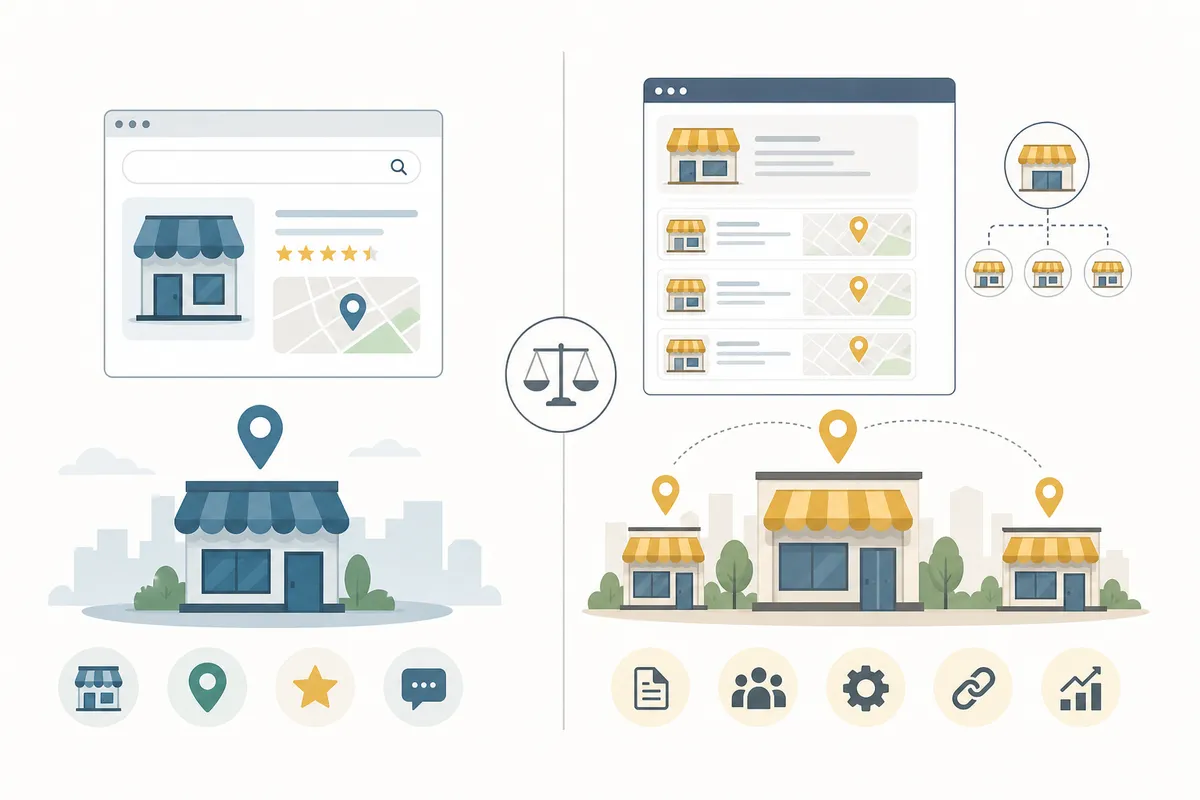
A single-location business optimizes one site for one market. A franchise runs the same playbook dozens or hundreds of times, often with different people touching different pages. That's where things break down.
Google Ranks the Location, Not the Brand
Your brand name carries weight with people who already know it. But for local search, each location competes on its own: its own listing, its own reviews, its own page content. A new franchise location with a thin page and no reviews won't outrank an independent competitor who has built real local signals, even if your brand is bigger. In fact, a single-location independent business that nails local content and review volume can out-rank a weaker franchise location sitting right next to it. This is exactly the dynamic: one moving company used to rank above national franchise brands in its own city.
The Problem Compounds With Every Location You Add
One weak page is a minor issue. Fifty weak pages, built from the same template with only the city swapped, is a structural problem. Search engines read that pattern as duplicate content, and it suppresses every page in the set, not just the newest ones.
What to Check Inside Your Website Right Now

Before buying any tool, open your own site and look for these things:
- Does every location have its own URL? It should live in a clear, consistent pattern, something like
/locations/city-name, not buried inside a PDF or a single "Our Locations" list page. - Is the content unique to that city? Check for a local phone number, local service area, local hours if they differ, and at least one paragraph that couldn't apply to any other location.
- Are your title tag and meta description location-specific? A generic "Home Cleaning Services" title on every page is a missed opportunity and a duplicate-content risk.
- Do you have a local FAQ section? Real questions a customer in that specific city would ask, answered specifically, give both readers and AI search tools something concrete to work with.
- Is there an embedded map and a review widget pulling from that location's own profile, not a shared corporate one?
Where these settings live depends entirely on your platform. Some franchise sites are git-built, with pages deployed straight from GitHub rather than edited in a drag-and-drop builder. On those sites, the fix happens in the codebase template, and this guide to SEO for git-built sites walks through what to change there. For everything else, start from the CMS-by-CMS settings guides and find the one matching your platform before touching anything.
Building Location Pages That Actually Rank
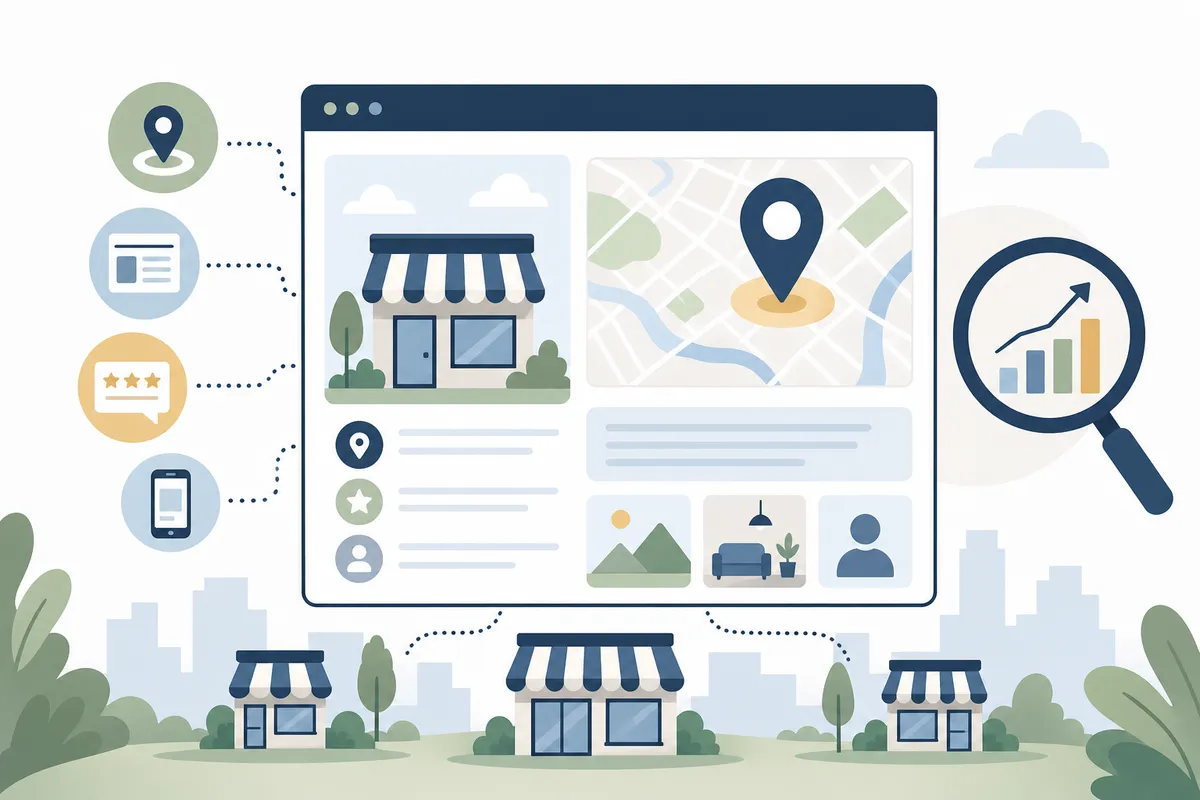
The most common issue with franchise SEO is a location page that's identical to every other one except the city name. Search engines treat this as near-duplicate content and won't rank it ahead of a page clearly written for one place.
| Page Element | Weak Approach | Strong Approach |
|---|---|---|
| URL structure | Separate microsite per location | One domain, consistent /locations/city pattern |
| Local content | City name swapped into generic template copy | Unique paragraph on neighborhoods served, local service notes, parking or access details |
| Reviews | Corporate review feed shown on every page | Embedded widget pulling only that location's reviews |
| FAQ section | None, or copied verbatim across pages | Questions specific to that city's customers |
| NAP data | Address formatted differently across pages | Identical formatting matching the Google Business Profile exactly |
Consolidating onto one domain also keeps your site's overall authority working for every location, instead of splitting it across separate standalone sites that each start from zero.
One Google Business Profile Per Location, Done Right
Every physical location needs its own fully verified Google Business Profile, linked to its own page, not the homepage. Verification matters as much as claiming. If the franchisor owns the listing, the local manager still needs real access to post updates, upload photos, and respond to reviews. That engagement is what actually moves rankings.
Keep the basics identical everywhere: the exact business name format, the same primary category, and a local phone number. The NAP must match the website character for character, down to how you punctuate the phone number.
When Your Website's Own Tools Are Enough, and When They're Not
Be honest with yourself about scope. If you're checking one page for one location, your CMS's built-in editor and Google Search Console are enough. Think a missing meta description, a wrong phone number, a duplicate title tag. Fix it, request reindexing, and move on.
The free route stops being enough once the problem is systemic. If you're managing more than a handful of locations, a one-off manual check won't catch everything. It can't catch a franchisee two time zones away publishing a copied template, or a NAP mismatch that crept in after a phone system change. At that scale, franchise SEO needs something that audits every location page and every listing on a recurring basis, not a spreadsheet someone updates when they remember to.
Common Mistakes to Avoid
- Letting franchisees build their own standalone microsites. It scatters your domain's authority instead of consolidating it.
- Using one shared Google Business Profile for multiple addresses. Google treats this as a policy violation risk and it hurts map pack visibility for every location involved.
- Sending review requests to a generic link instead of each location's own review URL, which means a happy customer's review never reaches the profile that earned it.
- Leaving hours or address details out of sync between the website and the listing, even a one-hour mismatch can cost you an "open now" search.
- Treating franchise SEO as a one-time project. Reviews, photos, and local content need ongoing attention at every location, not a launch-day checklist.
Google's own Search Essentials guidance is explicit about this. Pages built mainly to manipulate rankings, including templated, near-duplicate pages, work against you rather than for you. That's the exact trap franchise location pages fall into most often.
FAQs
What is SEO for franchises?
It's the practice of optimizing both a franchise's corporate website and every individual location's online presence, pages, Google Business Profile, reviews. The goal is for each location to rank in its own local search results, rather than relying on brand recognition alone.
Should each franchise location have its own website?
No. The stronger setup is one domain with a dedicated page per location, using a consistent URL pattern. Separate websites per location split your overall domain authority and make every page weaker.
Does Google Business Profile matter more than the website for franchise SEO?
They work together. Your Business Profile is often the first thing a searcher sees. But it needs to link to a genuinely unique page on your site, or the local match Google is looking for falls apart.
How do you stop franchise location pages from competing with each other?
Give each page a tightly defined service area, unique local content, and geo-specific keywords rather than the same broad term repeated everywhere. Overlapping, identical pages cannibalize each other's rankings instead of each winning its own territory.
How long does franchise SEO take to show results?
It varies by market competitiveness and how much work the pages need. Organic local rankings build over weeks and months of consistent signals, not overnight. That's why ongoing review activity and content upkeep matter more than a one-time fix.
Start With One Location's Page
Pick your weakest-performing location and audit its page against the checklist above. Fixing the NAP mismatches and duplicate content first is usually where the biggest ranking gains are sitting untouched. That's the fastest way to get results from seo for franchises, one location at a time. If you want to see exactly what's holding each of your locations back before you commit to a bigger cleanup, talk to the team and get a sample report built around your own site.
Resources / References
Sources
About the author
SearchBlueprint researched, wrote and scored this article with the content pipeline our customers run on their own sites. The score in the byline is what our content engine gave this page before it published. Nothing here is reviewed by hand, which is the point: it is the product's output, published where anyone can check it.