Why Enhance Cross-Channel SEO for Better Brand Visibility (and How to Prove It)
SearchBlueprint · · 10 min read · scored 92/100

Why enhance cross-channel SEO for better brand visibility? Because buyers no longer follow a single path to a purchase. They meet a brand in a Google result, a social feed, an inbox, and an AI answer. Every consistent appearance compounds into branded demand and stronger rankings.
This guide is for marketing teams, founders, and agencies that already publish on several channels but plan each one separately. It covers what cross-channel coordination actually changes, the research behind it, the steps to run it with a small team, and the numbers that prove whether it is working.
What cross-channel SEO is (and what it is not)
Cross-channel SEO means coordinating search optimization across every channel a brand runs. Google results, social profiles, email campaigns, paid ads, and AI answer engines all reinforce the same keywords, claims, and identity. Most teams already publish in all of those places. Far fewer make the channels agree with each other.

The distinction matters because three similar-sounding terms describe three different operating models:
| Approach | How the channels run | What visibility looks like | The typical failure |
|---|---|---|---|
| Multichannel | Each channel has its own team, keywords, and calendar | The brand is present everywhere but sounds different everywhere | Fragmented messaging dilutes keyword authority and confuses returning visitors |
| Cross-channel | Channels share keyword themes, messaging, and timing, but keep their own formats | Each appearance reinforces the others, and recognition builds across touchpoints | It needs a named owner; without one, teams drift back into silos |
| Omnichannel | Every touchpoint is unified and personalized to the individual | The strongest continuity a brand can offer | Requires data and personalization infrastructure most small teams cannot justify yet |
Cross-channel sits in the useful middle. It delivers most of the visibility benefit of omnichannel without the infrastructure. That makes it the sensible next step for teams that have outgrown pure multichannel. Agencies have been saying this for a while: an SEO strategist at Online Optimism argued back in 2024 that multichannel marketing was no longer optional but a necessary baseline. The part most teams still skip is the coordination itself. If you want the case for simply being present on more platforms first, this breakdown of seven benefits of multi-platform SEO covers what each additional surface adds on its own.
Why enhance cross-channel SEO: the case for better brand visibility
The short answer: discovery no longer happens in one place. Search engines also increasingly reward brands that people already recognize and look for by name.

Buyers stopped following one path
Amazon Ads' Beyond the Buy research found that 54% of consumers discover brands while engaging with entertainment content, and 50% view entertainment as part of their shopping experience. The same research found that 75% of surveyed consumers think about shopping multiple times per week. Amazon Ads publishes the full findings in its cross-channel marketing guide.
Read those three figures together and the funnel picture collapses. People are not moving neatly from awareness to consideration to purchase. They are half-shopping while they watch, scroll, and read, several times a week. A brand that only optimizes its website is invisible for most of that time. A brand that shows up consistently across the surfaces people actually inhabit gets remembered. Remembered brands get searched for.
Consistency compounds into branded demand
When someone sees the same core message in a search snippet, a LinkedIn post, and a follow-up email, each exposure does more work than the last. Recognition turns into branded searches. Branded searches tell Google that people specifically want you. That supports your rankings for non-branded terms too. This is the compounding loop single-channel SEO never triggers. It is also the mechanism behind most visibility gains that look sudden from the outside.
This is also why visibility is worth tracking as its own number rather than a feeling. If you have never quantified yours, start with what a search engine visibility score measures and how to grow it, then watch how the score moves as your channels start agreeing with each other.
Google's own documentation supports the underlying logic. Google Search Central describes ranking systems built to surface content that people find helpful and reliable. Consistent, accurate information about your brand across the open web is the raw material those systems evaluate. Contradictory claims across your own channels work directly against you.
AI answer engines read everything you publish
ChatGPT, Perplexity, Claude, and Google's AI Overviews assemble their answers from many surfaces at once: your site, your profiles, forums, reviews, and third-party mentions. When those sources describe your business the same way, you become easy to summarize and safe to cite. When they conflict, the engines hedge or skip you. Cross-channel consistency is no longer only a branding nicety; it decides whether AI answers mention you at all.
How to enhance cross-channel SEO step by step
Coordination is an operating model, not a software purchase. Four steps cover most of the value.
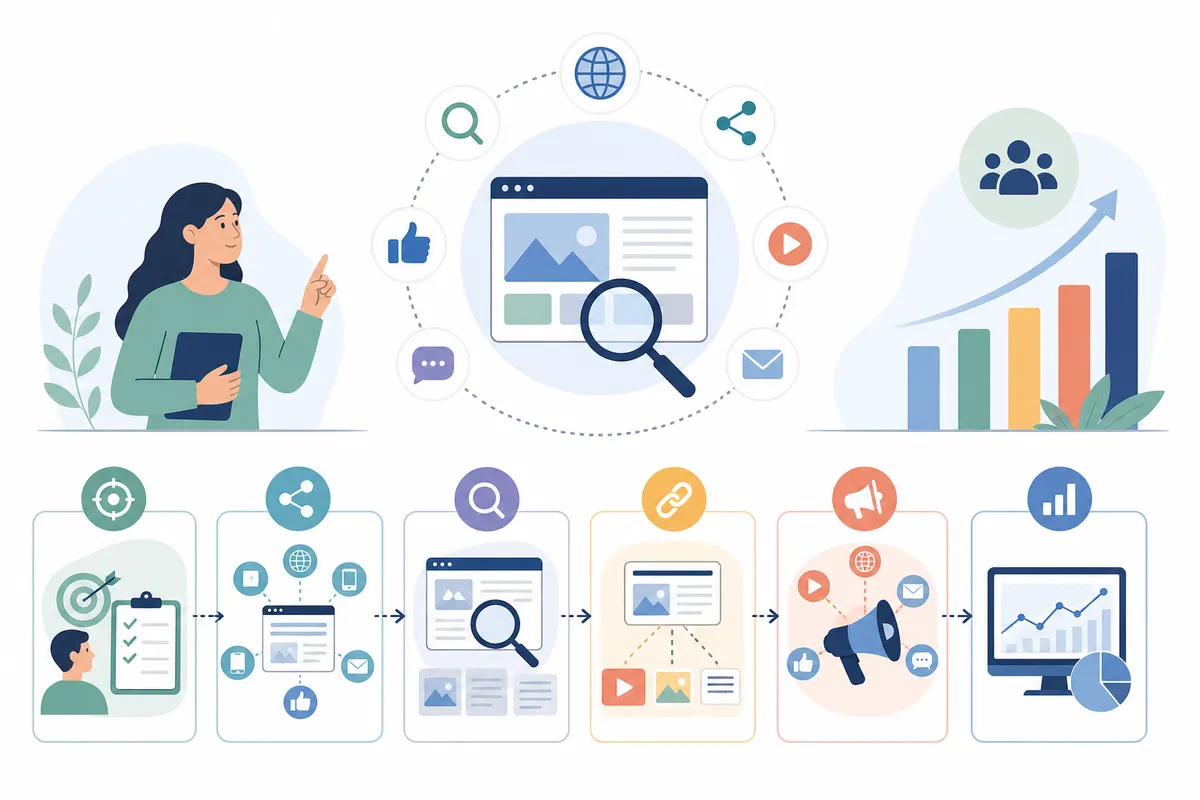
Build one shared keyword vocabulary
Pick a short list of keyword themes, somewhere in the range of ten to twenty, and make them the shared language for page titles, social copy, email subject lines, and ad headlines. Consistency is not repetition; it is the same conceptual framing translated into each channel's native tone. A free keyword suggestions tool helps you expand each theme into the long-tail variants worth owning. This walkthrough of keyword optimization from research to rank then shows how to map each theme to one page, so your own content never competes with itself.
Run one calendar, not five
A page targeting a high-intent theme performs better when it launches alongside a social push and an email to your list in the same week. The coordinated spike in visits and engagement is a stronger signal than a quiet organic launch. The artifact that makes this real is boring on purpose: one shared calendar that maps every piece to a theme, a channel, and a date. When the calendar lives in five tools, it does not exist.
Fix the technical entry points
Every channel ends at a page. A visitor who taps a social link and lands on a slow mobile page burns the touchpoint you paid for with effort or money. Check speed and layout stability on the exact pages your campaigns point to, on the devices your audience actually uses. Google's Core Web Vitals thresholds define what fast and stable mean in practice. For local businesses, keep the name, address, and phone details identical everywhere they appear. Google's own guidelines for representing your business ask for exactly that consistency, and inconsistent listings undercut both map rankings and AI answers.
Publish where your site already lives
Each platform has its own publishing quirks, verification steps, and failure modes, and a post that never actually went live earns nothing. If your site runs on Shopify, WordPress, Webflow, or another common platform, the platform-by-platform SEO guides cover the specifics before they cost you a launch week.
Here is what coordination looks like per channel, and what each one feeds back:
| Channel | What coordination looks like | What it feeds back to search |
|---|---|---|
| Organic search | One page owns the deep answer for each keyword theme | Rankings, plus the URLs every other channel points at |
| Social | The same theme reframed for the feed, with profile bios carrying your core terms | Branded searches from people who saw you but did not click |
| Subject lines reuse the keyword framing that already wins in search | Return visits and direct traffic to the pages you want ranking | |
| Paid ads | Bids cover the terms organic does not hold yet, with ad copy matching the landing page | Conversion data showing which keywords actually make money |
| AI answer engines | Identical business facts everywhere the engines read | Citations and brand mentions inside generated answers |
How to measure whether it is working
Measurement is where cross-channel programs usually die. The default attribution model is built to hide their value. Last-click attribution gives 100% of conversion credit to the final touchpoint, as Google's own attribution documentation spells out. The social post that introduced you and the article that earned trust register as worthless. Their budgets get cut, and the whole loop unwinds.
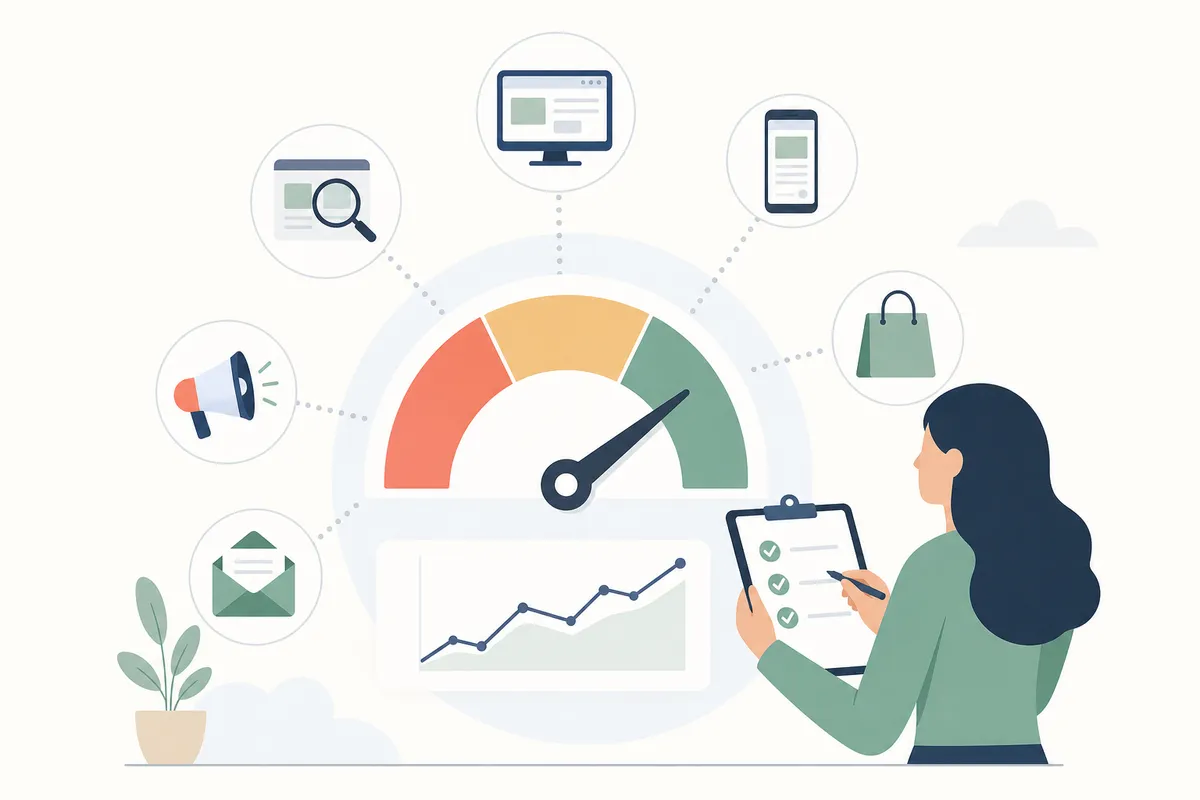
Watch these four numbers instead:
- Branded search volume, tracked weekly in Google Search Console's performance report. Rising queries for your name are the clearest sign that other channels are creating demand.
- Direct traffic trends. People who met you on social or in a podcast often return by typing your address. A climbing direct line is a halo effect, not a mystery.
- Share of voice across your theme list. Track where you rank for the whole vocabulary, not one trophy keyword, so you see the portfolio move.
- Assisted conversions. Multi-touch reports show how many sales involved an organic or social touchpoint that was not the last click.
Split branded from non-branded performance in your reporting. If branded queries grow while non-branded traffic holds flat, the awareness layer is working. Rankings typically follow as authority builds. That compounding, low-cost route to demand is the same one described in this guide to getting more customers from Google without paying for ads, and cross-channel coordination is what accelerates it.
The mistakes that keep channels working against each other
Most cross-channel failures are organizational, not technical, and they repeat across companies of every size.
- Paid bids on branded terms organic already owns. The budget buys clicks you were getting free, and the two teams never compare notes.
- Contradictory framing. The SEO team spends months establishing one way of describing the product, then email subject lines and ad headlines describe it another way. Every contradiction spends the credibility the last touchpoint earned.
- No owner. Everyone can see everyone else's work and nobody is responsible for making it match. The fix is one coordinator who owns the keyword themes, the calendar, and the reporting, while each channel keeps its own execution.
- Judging every channel by its own last click. This is the measurement mistake above wearing a management costume, and it defunds exactly the channels that create demand.
None of these require new software to fix. They require a decision about who holds the pen.
FAQs
What is cross-channel SEO in simple terms?
It is one search strategy expressed through every channel you run. The same keyword themes and the same core message appear in your pages, social posts, emails, and ads, each translated into that channel's natural format. Every appearance then reinforces the others instead of starting from zero.
Is cross-channel SEO the same as omnichannel marketing?
No. Omnichannel unifies and personalizes every touchpoint per individual, which takes serious data infrastructure. Cross-channel coordinates messaging and timing across channels that still operate separately. It captures most of the visibility benefit at a fraction of the complexity. That makes it the right starting point for most teams.
How long does it take to see results?
Typically months rather than weeks, because the mechanism is accumulated recognition. Branded search volume is the leading indicator and usually moves first; rankings for non-branded terms follow as that demand builds. Coordinated launches can produce visible engagement spikes much sooner, but the compounding effect is the prize.
Do social media signals directly improve Google rankings?
Google has not documented likes or shares as direct ranking factors, so treat any promise of a direct line skeptically. The effect is indirect and still real: social exposure drives branded searches, return visits, and links. Those are signals search systems do respond to.
Can a small team run cross-channel SEO without new tools?
Yes. The core assets are a shared keyword theme list, one publishing calendar, and the analytics you already have, such as Google Search Console and your site analytics. Coordination is a habit and an owner, not a platform. Add tooling when the manual version starts costing you real hours, not before.
Talk to the team
So why enhance cross-channel SEO for better brand visibility? Because a coordinated search presence is something you can inspect before you commit to building it. Open a sample SEO report to see how brand visibility reads when it is measured across channels, then talk to the team about what that coordination would look like on your own site. Bring one competitor's name; the side-by-side usually settles the question faster than any argument could.
Resources / References
- cross-channel marketing guide
- Google Search Central
- Core Web Vitals thresholds
- guidelines for representing your business
- attribution documentation
- performance report
Related reading: Multichannel SEO Strategy Guide: Rank Everywhere Customers Search.
Related reading: Email Campaigns and SEO: How to Make Each One Boost the Other.
Sources
About the author
SearchBlueprint researched, wrote and scored this article with the content pipeline our customers run on their own sites. The score in the byline is what our content engine gave this page before it published. Nothing here is reviewed by hand, which is the point: it is the product's output, published where anyone can check it.