Why Multi-Platform SEO Pays Off: 7 Benefits for Marketers
SearchBlueprint · · 10 min read · scored 90/100

The core benefits of multi-platform SEO for marketers are wider reach across the surfaces buyers actually search, resilience when any single algorithm shifts, cheaper wins on less-crowded platforms, and compounding brand signals that lift your Google rankings and AI citations at the same time. It turns one content investment into visibility on five or six discovery channels instead of one.
That answer sounds tidy. The messier truth is that most teams still run 100% of their search budget against a single channel while their buyers discover brands on TikTok, evaluate them on Reddit and YouTube, and confirm them through ChatGPT. This guide breaks down each benefit with the numbers behind it, shows where the trade-offs bite, and lays out how to prove the lift in 90 days.
Key Takeaways
- Buyers now split their search behavior: a Her Campus Media survey found 74% of Gen Z use TikTok as a search engine and often prefer it to Google or Bing.
- Diversifying reduces algorithm risk, a single Google update can no longer erase your entire pipeline.
- Most platforms outside Google are still less competitive, so early movers capture rankings at a fraction of the effort.
- Cross-platform presence feeds back into traditional SEO: mentions, engagement, and citations strengthen the entity signals Google and AI assistants both reward.
- Start with three platforms, not eight. A common pilot benchmark is a 15% lift in branded search impressions within 90 days.
What Multi-Platform SEO Actually Means
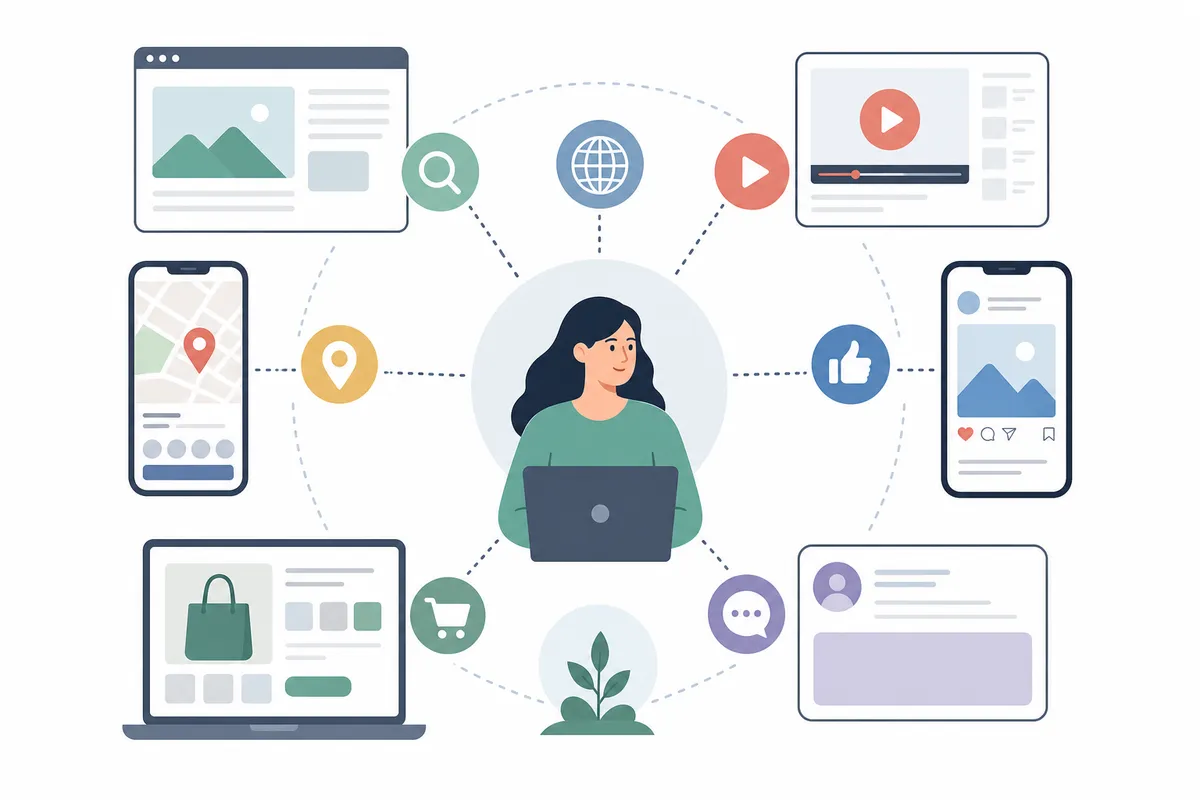
Multi-platform SEO (sometimes called search everywhere optimization) is the practice of optimizing your brand's visibility on every surface with a search bar, Google, YouTube, TikTok, LinkedIn, Reddit, Amazon, app stores, and AI assistants like ChatGPT and Perplexity, rather than treating search as a Google-only problem.
Google still holds a search market share of over 85%, and it has held the top spot for more than two decades. Nobody serious is telling you to abandon it. The shift is additive: your website remains the canonical source, and you adapt each core asset into platform-native formats that meet buyers where they already are. If you want the tactical execution side, our playbook for taking your search strategy beyond Google walks through the workflow step by step.
The 7 Real Benefits of Multi-Platform SEO for Marketers
Here is the full benefit stack, each mapped to the metric that proves it.
| Benefit | What It Does for You | How to Measure It | Typical Time to Signal |
|---|---|---|---|
| Wider reach | Puts your brand in front of buyers who never open a Google results page | Non-Google referral sessions, platform impressions | 30–60 days |
| Algorithm resilience | One update on one platform no longer wipes out your traffic | Traffic share per channel (no channel above ~60%) | Ongoing |
| Lower competition | Rankings on TikTok, Reddit, or YouTube often cost far less effort than page one of Google | Rank position per platform for core queries | 30–90 days |
| Compounding brand signals | Mentions and engagement off-Google strengthen the entity signals Google and LLMs reward | Branded search impressions, referring domains | 60–90 days |
| AI citation visibility | Structured, answer-first content gets quoted by ChatGPT and Perplexity | AI citation frequency, brand mentions in LLM answers | 60–120 days |
| Better audience intelligence | Each platform reveals different intent, language, and objections | Comment themes, query phrasing, engagement depth | 30 days |
| Content ROI multiplication | One core asset becomes five platform-native pieces | Output per asset, cost per published piece | Immediate |
1. Reach Buyers Who Never See a Google Results Page
Every platform is a distinct discovery surface with a distinct audience. A YouTube tutorial that ranks for a how-to query reaches people who typed their question straight into YouTube, the second-largest search property in global volume. The Her Campus Media finding that 74% of Gen Z treat TikTok as their search engine is the loudest version of this shift, but it is not only a Gen Z story: agencies commonly cite Amazon as owning more than 50% of product search intent in the US, and Reddit threads increasingly occupy Google's own results for evaluation queries.
The practical takeaway: a Google-only strategy is invisible during the discovery and evaluation stages that now happen elsewhere. You only show up at the end of a journey someone else's content started.
2. Stop Betting Your Pipeline on One Algorithm
Every marketer who has lived through a core update knows the feeling: traffic drops 30% overnight and nothing on your site changed. Multi-platform distribution is the hedge. When your visibility is spread across four or five surfaces, a shift on any one of them dents your numbers instead of destroying them.
This resilience is not theoretical. Agency-published case studies from migrations and algorithm-turbulent periods show diversified programs holding or growing, one reports a 40% increase in top-3 rankings alongside 83% growth in AI and SERP feature visibility during a period framed explicitly as "algorithm resilience" work. Diversified signal sources were part of how they got there.
3. Win Where Competitors Haven't Shown Up Yet
Page one of Google for a commercial keyword can take years of link building. The same topic on TikTok, LinkedIn, or a niche subreddit is often wide open. Because most businesses are still running a 2019-era, Google-only program, the marketer who publishes genuinely useful platform-native content early captures the position before the competition arrives, and platform algorithms tend to reward the accounts that established topical relevance first.
4. Feed the Signals That Lift Everything Else
This is the benefit most teams underestimate: cross-platform presence loops back into traditional SEO. YouTube videos, Reddit answers, and LinkedIn posts generate brand mentions, branded searches, and natural links. Those are exactly the trust signals that traditional rankings depend on, and they compound with the foundational benefits SEO already delivers for small businesses, like cost-effective visibility and long-term equity, rather than replacing them.
AI systems amplify the effect. Large language models favor brands with consistent entity signals, matching names, descriptions, and structured data across the web. Google's own documentation at Google Search Central explains how structured data helps its systems understand and represent content, and the same machine-readable clarity is what makes content quotable by answer engines.
5. Get Cited by ChatGPT and Perplexity
AI assistants are now a real referral channel, and adoption keeps climbing, industry surveys reported 35% of companies were already using AI in their business back in 2023, and consumer use of AI tools as a Google alternative has grown alongside it. The two big assistants behave differently: ChatGPT tends to surface brands during early ideation, while Perplexity leans on cited sources during deeper evaluation.
Answer-first articles, FAQ schema, named authors, and third-party mentions are what earn those citations. It's the same discipline that pays off in AI-assisted workflows generally, something we've covered in depth in our breakdown of the advantages of AI SEO for agencies and in-house professionals.
6. Learn What Your Audience Actually Asks
Each platform exposes a different slice of buyer psychology. Google Search Console shows you the keywords; TikTok comments show you the objections; Reddit threads show you the unfiltered comparisons buyers make between you and competitors. Marketers running multi-platform programs consistently report better messaging, better product positioning, and earlier awareness of emerging trends, because they hear the market in five dialects instead of one.
7. Multiply the ROI of Every Piece You Produce
Repurposing is not a shortcut, it is the operating model. Industry surveys report that 94% of marketers repurpose content across platforms. One well-researched pillar article becomes a YouTube explainer (H2s become chapter markers), a 45-second short-form script (pull the single most surprising claim), a LinkedIn document post (condense to five points), and a genuine Reddit answer that links back to the source. Five assets, one research cost.
Why This Shift Is Happening Now
Three forces converged. First, audience behavior: people spend enormous stretches of their day inside apps, Data Reportal research pegged average daily screen time at over six and a half hours for 16–64 year olds, and each app trained them to search inside it. Second, platform growth: one 2024 projection put YouTube's worldwide user base at 933 million, a 7.5% jump year over year, while TikTok passed a billion monthly actives. Third, AI answer engines inserted themselves between the query and the click, often answering without sending traffic anywhere.
Meanwhile, marketers kept doubling down on search itself: in one 2023 survey, 88% of marketers already investing in SEO either maintained or increased their budgets. The money isn't leaving search. It's following search to more places. Our guide to how to rank beyond Google in 2026 maps that landscape platform by platform.
Where Each Platform Fits in the Funnel
Not every surface deserves your effort. Match platforms to funnel stages and to where your specific buyers already are.
| Platform | Funnel Role | What Optimization Looks Like | Primary Metric |
|---|---|---|---|
| Google Search & AI Overviews | Evaluation and conversion | Answer-first headings, FAQ schema, E-E-A-T signals | Organic clicks, AI Overview appearances |
| YouTube | Discovery and evaluation | Keyword-rich titles, chapters, end-screen CTAs | Watch time, click-through to site |
| TikTok / Reels / Shorts | Discovery | Hook in the first 3 seconds, keyword text overlay, pinned link | Views, profile visits, bio-link clicks |
| B2B evaluation | Structured long-form posts, document carousels, employee amplification | Impressions, saves, profile visits | |
| Reddit / Quora | Evaluation and trust | Genuine answers, zero overt promotion, link to a truly useful resource | Upvotes, referral sessions |
| Amazon / Marketplaces | Conversion | Optimized titles and bullets, A+ content, review velocity | In-marketplace rank, conversion rate |
| ChatGPT / Perplexity | Discovery and evaluation | Cited, structured, answer-first content with a named author entity | AI citation frequency, branded query lift |
A rule of thumb worth stealing: pick three platforms, not eight. Depth on three compounds; shallow presence on ten evaporates. Score each candidate on two axes, is your buyer actually there, and how far are you from being visible, and start where high audience fit meets a large visibility gap.
How to Prove the Benefits in 90 Days
Benefits you can't measure are benefits your CFO won't fund. Here's the lean version of a pilot.
Weeks 1–2: Audit Your Current Visibility
Search your brand and three core non-branded queries on Google, YouTube, TikTok, Reddit, and ChatGPT. Screenshot everything. Check your branded vs. non-branded impression split in Search Console, a low branded share signals weak off-Google awareness. Ask ChatGPT and Perplexity "what's the best tool for" your category; if you're absent, you have an AI citation gap. The whole audit takes roughly two hours.
Weeks 3–12: Publish, Repurpose, Track
Produce one canonical answer-first article on your highest-value topic, add FAQ and Organization schema, then repurpose it into two platform-native pieces per platform per month. Set up UTM conventions before you publish anything, or attribution becomes guesswork. If your team is small, this cadence fits inside a genuinely modest time budget, our 5-hour monthly SEO plan for non-marketers shows how tight the loop can be.
Success Signals to Report
- A 15% lift in branded search impressions is the widely used pilot benchmark, branded lift is the earliest, cleanest sign that off-Google content is working.
- At least a couple of AI citation appearances per week for your core topics.
- One new referral source sending 100+ sessions per month.
- Assisted conversions in GA4 where a social or AI touch precedes the purchase, the revenue a Google-only report would never show you.
The Honest Caveats: When Focused Beats Wide
Multi-platform SEO is not free reach; it's redistributed effort. Be honest about three failure modes before you commit.
| Mistake | Why It Backfires | The Fix |
|---|---|---|
| Cross-posting identical content everywhere | Each algorithm rewards native formats; a Google-shaped article dies in the LinkedIn feed | Repurpose the idea, repackage the format |
| Spreading across 8+ platforms at once | No platform gets enough depth to compound; budgets evaporate on production | Three platforms for 90 days, then earn the fourth |
| Skipping measurement setup | You generate lift you can't attribute, and the program gets cut | UTMs, GA4 assisted conversions, and branded-impression tracking from day one |
And sometimes wide is simply wrong for now. If your website has broken technical foundations, thin core pages, or no keyword strategy, fix that first, every other platform's traffic eventually lands on your site, and a weak site squanders it. A local plumber with one part-time marketer will get more from dominating Google Maps and local pack results than from a TikTok channel. Multi-platform strategies pay off best once your owned foundation converts.
FAQs
What is the biggest benefit of multi-platform SEO for marketers?
Risk reduction combined with reach. You capture buyers on the platforms where they actually discover and evaluate products, and no single algorithm update can wipe out your visibility, because it's spread across several independent surfaces.
How many platforms should a marketing team start with?
Three. Industry consensus favors a focused portfolio of three or four platforms over a shallow presence on eight or more. Depth compounds, platform algorithms reward consistent, engaged accounts, while thin, sporadic posting underperforms everywhere at once.
Does multi-platform SEO replace traditional Google SEO?
No. Google still holds over 85% of search market share, and your website remains the canonical asset everything else points back to. Multi-platform work extends traditional SEO and actually strengthens it, because off-Google mentions and engagement feed the entity and authority signals Google rewards.
How long before multi-platform SEO shows results?
Early signals typically appear within 90 days: a lift in branded search impressions (15% is a common pilot benchmark), new referral sessions from non-Google sources, and initial AI citations. Compounding effects, domain authority, entity recognition, assisted revenue, build over six to twelve months.
How do you measure success across so many platforms?
Track one primary metric per platform (watch time on YouTube, upvotes and referral sessions from Reddit, citation frequency in AI assistants), plus two cross-cutting metrics: branded search impression growth in Search Console and assisted conversions in GA4 where a social or AI touchpoint precedes the sale.
Run Your Two-Hour Visibility Audit This Week
Search your brand on Google, YouTube, TikTok, Reddit, and ChatGPT, screenshot the results, and mark where you're invisible, that gap map is your entire multi-platform SEO priority list, and it costs nothing but an afternoon. If you'd rather see what a structured, measurable version of that picture looks like before you commit budget, review a sample SEO report and talk to the team about turning the audit into a 90-day plan.
Resources / References
Sources
- Multi-platform SEO: What is it and where did it come from?
- Importance of Multi-Platform SEO Strategy
- Benefits of Multi-Platform SEO for Marketers in 2026
- The Top 8 Benefits of SEO
- Multi-Platform SEO Services | Win Search Beyond Google
Disclaimer: This article is general information about rules and figures that applied when it was written, not personalised financial, tax or investment advice. It does not take account of your income, obligations, risk tolerance or goals, and rates and thresholds change. Verify the current position with the relevant authority, and speak to a licensed adviser or a qualified accountant before acting.
About the author
SearchBlueprint researched, wrote and scored this article with the content pipeline our customers run on their own sites. The score in the byline is what our content engine gave this page before it published. Nothing here is reviewed by hand, which is the point: it is the product's output, published where anyone can check it.