The 30-Day Plan to Prove AI Search Visibility for Brands
By Toy Wen Da, Co-Founder · Updated · 11 min read · scored 92/100
A day plan to prove AI search visibility for brands runs in three stretches. In week one you measure citation share on ChatGPT and Perplexity, plus Gemini and Google AI Overviews. In weeks two and three you fix the gaps. By day 30 you re-measure and report. The result is a before-and-after number your decision-makers can act on, where guesswork would have given them nothing.
Why a day plan to prove AI search visibility matters right now
The buyer research process has moved. G2's research, based on a March 2026 survey of 1,076 decision-makers, found that 51% of B2B buyers now start their research in an AI chatbot more often than Google. The figure was 29% in April 2025. Across the full research process, 71% rely on an AI chatbot somewhere along the way.
The shift already changes purchase outcomes. G2's data shows 69% of buyers chose a different vendor than they originally planned because of what an AI chatbot recommended, and another 33% bought from a vendor they had never heard of before the AI surfaced it. Buyers also trust the citation itself: 85% say they think more highly of a vendor an AI cites in its answer. If your brand is missing from that answer, you are missing from the shortlist, and there is rarely a page two to fall back on.
The buyer shift in numbers
| Metric | Figure | What it means for your plan |
|---|---|---|
| B2B buyers starting research in AI over Google | 51% (up from 29% in April 2025) | Your day plan needs a starting baseline now, not next quarter |
| Buyers relying on AI chatbots somewhere in research | 71% | Nearly every deal touches an AI answer at some point |
| Buyers who switched vendors on an AI recommendation | 69% | A missing citation can cost a sale you never saw slip away |
| Buyers who bought a vendor new to them, AI-surfaced | 33% | AI visibility can create demand as well as capture it |
| Buyers who rate a cited vendor more highly | 85% | A citation works as a trust signal even before anyone visits your site |
Platform growth backs this up. Perplexity grew from 388 million to 1.3 billion monthly visits in a single year, a 244% increase, and ChatGPT controls roughly 63% of the AI search market for B2B research. Gartner has projected that traditional search volume will drop by around 25% by 2026 as AI answers absorb queries that used to land on a search results page. You cannot plan around this later, because your buyers are already in the room.
What counts as "AI search visibility" (and what doesn't)
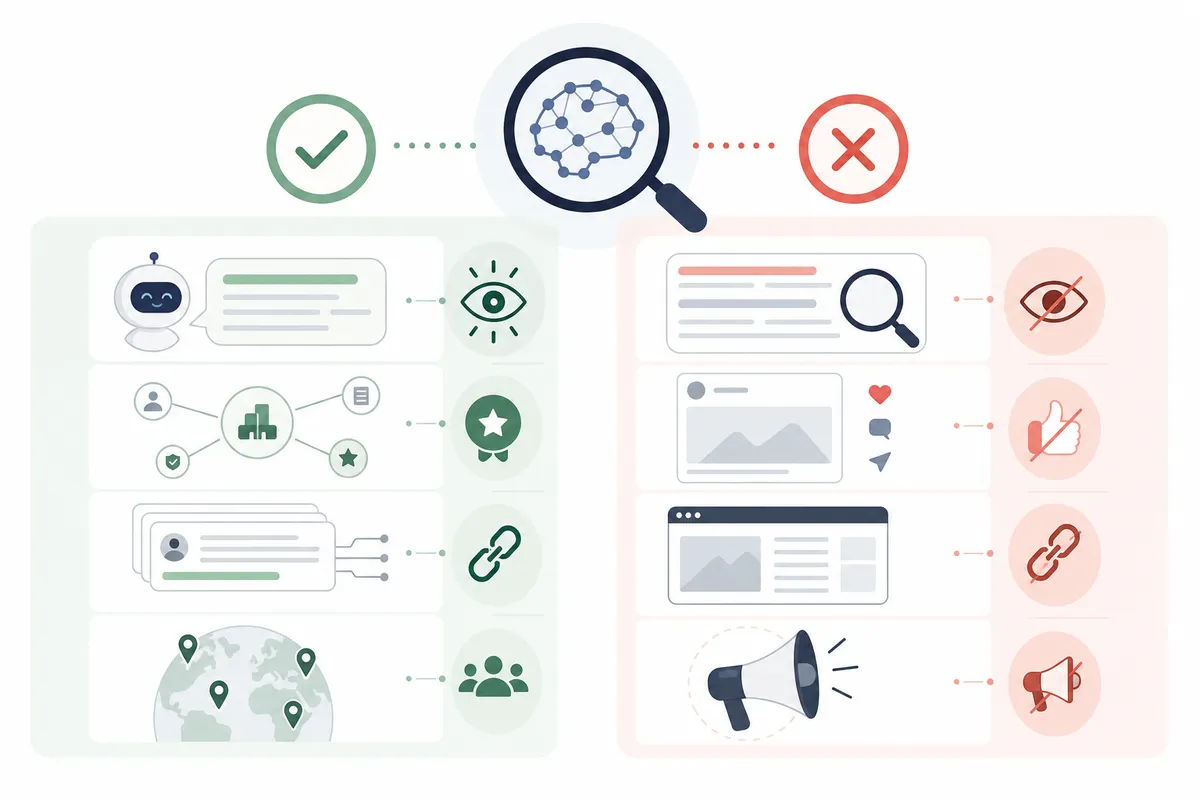
AI search visibility is whether an AI system, when asked a question in your category, names your brand, links to your content or recommends you as an answer. It is a different measurement from a Google ranking. You can hold the top organic position for a keyword and still be absent from the AI-generated answer sitting above it, because these systems retrieve and synthesize from sources they judge credible instead of ranking pages.
This distinction shapes the plan. Traditional SEO earns access: clean site architecture, fast pages and correct indexing controls give AI systems something to retrieve in the first place. Generative engine optimization then makes your content citable once it is found, through direct answers, clear structure and named expertise. Our guide to answer engine optimization explains how that citation mechanism works across ChatGPT, Perplexity and Google's AI Overviews, and it is worth reading before you build your own plan.
In practice, a search-visibility plan tracks rankings and clicks. An AI-visibility plan tracks whether your brand name, your data or your page gets pulled into the answer itself, whether or not the reader ever clicks through.
Before you start: what has to be in place

A day plan only works if you can compare a real "before" to a real "after." Skipping the baseline is the most common reason these plans fail to prove anything. Four things need to exist before day 1:
- Executive buy-in, so the plan does not stall when it asks for engineering or content resources in week two.
- An owner with a substantial share of their time set aside, since AI visibility work spans technical, content and PR tasks that nobody does part-time by accident.
- Tracking access: Google Search Console and Bing Webmaster Tools are connected, and your analytics platform already has data flowing.
- A content inventory, so you know what you have before you decide what to fix or write.
If any of these is missing, spend day 1 setting it up rather than starting the clock on a plan you cannot measure.
The 30-day plan, phase by phase
The plan runs in three roughly ten-day stretches, and each has one job. Skipping ahead, for example by publishing content before you have a baseline, is what turns a provable plan into an unprovable one.
| Phase | Days | Primary job | How you know it worked |
|---|---|---|---|
| Foundation and baseline | 1 to 10 | Confirm AI crawlers can reach your site and document current citation share | A written baseline number, by platform and query type |
| Fix and publish | 11 to 21 | Close the highest-impact content and structure gaps | 5 to 10 pages upgraded, 1 to 2 new citation-targeted pieces live |
| Re-measure and report | 22 to 30 | Re-run the same test set and present the change | A before-and-after table decision-makers can read in one glance |
Days 1 to 10: foundation and baseline
Start with access. Check your robots.txt file to confirm you are not accidentally blocking AI crawlers such as GPTBot, PerplexityBot or Googlebot. The failure is silent: the block returns no error, and your site simply stops appearing.
Next, confirm the structural signals. You want valid Organization, Article and FAQPage schema markup on the pages you most want cited, plus a knowledge graph that is internally consistent, so your business name, description and entity data say the same thing everywhere an AI system might check. If your schema or entity data is inconsistent, fixing your knowledge graph SEO is usually a 2 to 4 week project on its own, and it belongs in this first phase.
Then build the baseline. Pick 20 to 30 queries a real buyer in your category would ask an AI assistant, split between category questions, problem questions and "X vs Y" comparisons. Run each one across at least three platforms. Record whether your brand appears, which page (if any) gets cited, and who gets cited instead of you. Doing this by hand is tedious, but it has to happen now, while the plan still has 20 days left to act on what you find.

Days 11 to 21: fix and publish
With a documented baseline, prioritize by two questions: which gaps cost the most revenue if left open, and which can be closed fastest. Quick wins usually beat new content in week two. Upgrading five to ten existing pages with real data points, comparison tables, named author credentials and clearer headings is faster than writing from zero, and it gives AI systems freshly dated, more citable material to re-crawl.
Once the quick wins are live, publish the harder pieces: one or two definitive, data-backed guides aimed at gaps that nothing on your site answers well today. AI platforms increasingly reward genuinely new information over restated summaries, which is part of why AI Overviews now compete directly with organic clicks instead of simply sitting above them. A thin rewrite of what already ranks rarely earns a citation next to a source with real numbers in it.
Days 22 to 30: re-measure and report
Re-run the exact query set from your baseline on the same platforms. Do not swap in easier questions; the value of this phase is a like-for-like comparison.
Expect partial movement. AI citation changes typically take 4 to 8 weeks to fully materialize after content publication, because these systems do not always re-index and re-weight sources on the same schedule search engines do. A 30-day check is a real progress read but it is not the finish line. Our week-by-week guide to proving SEO and AI visibility in 30 days shows what realistic movement looks like at each checkpoint, so you are not judging your results against an unrealistic bar.
How to measure AI search visibility without guessing
Asking an AI assistant "what is [my brand]?" a handful of times is an anecdote and tells you little about your real position. Research from SparkToro found that asking an AI tool the identical question 100 times produced nearly 100 unique brand lists, in different orders, with different brands included. Any single query you run by hand could be the outlier.
Your test set therefore needs volume and repetition. Two practical options:
- Manual, structured testing: have two or three people each run the same 20 to 30 queries, paste every output into one shared document, and look for the pattern across all of it instead of trusting any one answer.
- Automated monitoring tools: several platforms track brand mentions across AI engines on an ongoing basis, which matters given how much answer-to-answer variance exists. Our free AEO and AI-search scorer is a fast way to check how citable a given page currently reads before you commit a monitoring budget.
Whichever method you pick, test more than one platform. ChatGPT leans heavily on Bing's index and its own training data, while Perplexity is citation-driven and pulls from live web sources on nearly every answer. Gemini blends Google's existing search index with its Knowledge Graph. A brand that is well cited in Perplexity can be completely absent from ChatGPT, because the two systems do not read the same signals.
How to report AI visibility to decision-makers
A budget committee is rarely convinced by a screenshot of one good answer. Present the same before-and-after structure you built the plan around.
| Metric | Day 1 baseline | Day 30 result | What changed |
|---|---|---|---|
| Total citations, your brand | Recorded count from your test set | Recorded count from the same test set | Direction and scale of movement |
| Citation share vs. top competitor | Your count out of total queries tested | Same comparison, re-run | Whether the gap closed or widened |
| Platform coverage | Which of ChatGPT, Perplexity, Gemini, Copilot cited you at all | Same check, re-run | New platforms gained, if any |
| AI-referred site visits | Baseline traffic from AI referral sources in analytics | Day 30 traffic from the same sources | Whether visibility is translating to visits |
Pair the numbers with what specifically changed: which pages were upgraded, which new content went live and which technical fixes shipped. A reader does not need to understand schema markup to follow "we fixed five inconsistent business listings and added structured data to twelve pages, and our citation share went from 2 of 10 category queries to 6 of 10." Consistent SEO signals across every channel, and not only the blog, are part of that story. If AI visibility is one piece of a broader reporting gap, improving cross-channel SEO to prove brand visibility covers how to tie those signals into one report instead of three disconnected ones.
FAQs
What is a day plan to prove AI search visibility for brands?
It is a structured, time-boxed process, typically 30 days, that documents your brand's current citation rate across AI platforms like ChatGPT and Perplexity. It then fixes the highest-impact gaps and re-measures the same test set, so you end up with a real before-and-after number instead of a guess.
How long does it take to see results after fixing AI visibility gaps?
Most AI platforms take roughly 4 to 8 weeks to fully reflect content and structural changes in their citations. A 30-day check will usually show early movement, especially from quick technical fixes, but treat it as a progress read and wait for the final score.
Which AI platforms should I test for brand visibility?
At minimum, test ChatGPT and Perplexity, plus Google's AI Overviews or Gemini, since each pulls from different sources and weighs them differently. A brand strong on one can be invisible on another, so testing only one platform will overstate or understate your real visibility.
What is the difference between AI search visibility and traditional SEO?
Traditional SEO measures rankings and clicks on a results page. AI search visibility measures whether an AI system names your brand or cites your content inside a generated answer. A citation can happen even when the reader never clicks through to your site, and it can fail to happen even when you rank well organically.
How do I report AI visibility progress to people who don't work in SEO?
Use a simple before-and-after table with citation count, citation share against your top competitor and the platforms that cited you. Measure each on day 1 and again on day 30, against the same query set. Pair each number with the specific fix that produced it so the metric never stands alone.
Get your AI citation baseline checked
Thirty days is enough time to learn whether your brand shows up in the answers your buyers are already reading. It is also enough to start closing the gap if it doesn't. If you want a professional read on where your citations, schema and content stand before you build your own day plan to prove AI search visibility for brands, get a sample SEO report and see what a baseline audit surfaces for a real site.
Sources
About the author
SearchBlueprint researched, wrote and scored this article with the content pipeline our customers run on their own sites. The score in the byline is what our content engine gave this page before it published. Nothing here is reviewed by hand, which is the point: it is the product's output, published where anyone can check it.