AI Search Engine Optimization: How to Get Cited in 2026
SearchBlueprint · · 12 min read · scored 92/100

AI search engine optimization is the work of making your site the source that ChatGPT, Google AI Overviews, Perplexity and Gemini quote when they answer a question. It builds on classic SEO, then adds three things: passages an AI can lift whole, off-site mentions the models trust, and open access for AI crawlers.
The shift is not hypothetical. Published industry research puts ChatGPT at more than 37.5 million search-like prompts a day, and reports AI Overviews appearing on roughly 13% of Google queries. If your pages are invisible to these systems, you are invisible to a growing share of your buyers.
What AI search engine optimization actually is
AI search engine optimization (often shortened to AI SEO) means optimizing your website so AI-powered search systems can find it, understand it, and cite it in generated answers. The systems in scope include Google AI Overviews and AI Mode, ChatGPT, Perplexity, Gemini, Microsoft Copilot and Meta AI.

What it is not
The phrase gets used two ways, and only one of them is this article. Using AI tools to do SEO work, such as drafting content or clustering keywords, is a workflow choice. Optimizing your site so AI engines cite it is a visibility discipline. Think "SEO for AI", not "AI for SEO".
Four names for one discipline
The industry has not settled on a single term, and you will meet all of these. They describe angles on the same job.
| Term | Stands for | What it focuses on |
|---|---|---|
| AI SEO | AI search engine optimization | The umbrella term: getting discovered and cited across every AI search platform |
| GEO | Generative engine optimization | Being one of the sources an AI-written summary is built from and linked to |
| AEO | Answer engine optimization | Direct answer extraction: featured snippets, voice replies and the concise answers AI tools pull from a page |
| LLMO | Large language model optimization | How models describe your brand, from both training data and live web lookups |
Google's own position is blunt: from its perspective, optimizing for generative AI features is still SEO, and it advises weighing third-party "AEO" or "GEO" pitches against its standard guidance. That said, AEO has real, specific techniques worth learning on their own, and the 2026 guide to answer engine optimization covers that layer in depth.
Why AI search engine optimization matters now
The adoption numbers reported across the industry are hard to dismiss. Alongside ChatGPT's reported 37.5 million daily search-like prompts, one widely cited analysis found 27% of people in the United States now using AI tools instead of a traditional search engine. During the 2024 holiday season, AI search referrals to retail sites reportedly surged 1,300%. These are buyers arriving through a door most sites have never optimized.

Zero-click is the norm, and that changes the prize
Roughly 58.5% of Google searches now reportedly end without a click on any result. AI Overviews accelerate that pattern. This sounds like bad news, but the brands cited inside those answers still collect visibility and trust, the way a word-of-mouth mention does. The impression is the value, and the click is a bonus.
The channel rewards early movers
AI engines lean on a small set of sources per answer. Once a competitor becomes the page these systems reach for, displacing them is slow work. The practical takeaway from how AI search engines are reshaping SEO strategy in 2026 is that the cost of waiting compounds: every month unoptimized is a month of answers written from someone else's pages.
How AI search engines choose what to cite
You cannot optimize a system you do not understand. Three mechanisms drive almost everything.
Retrieval-augmented generation: AI answers start with a search
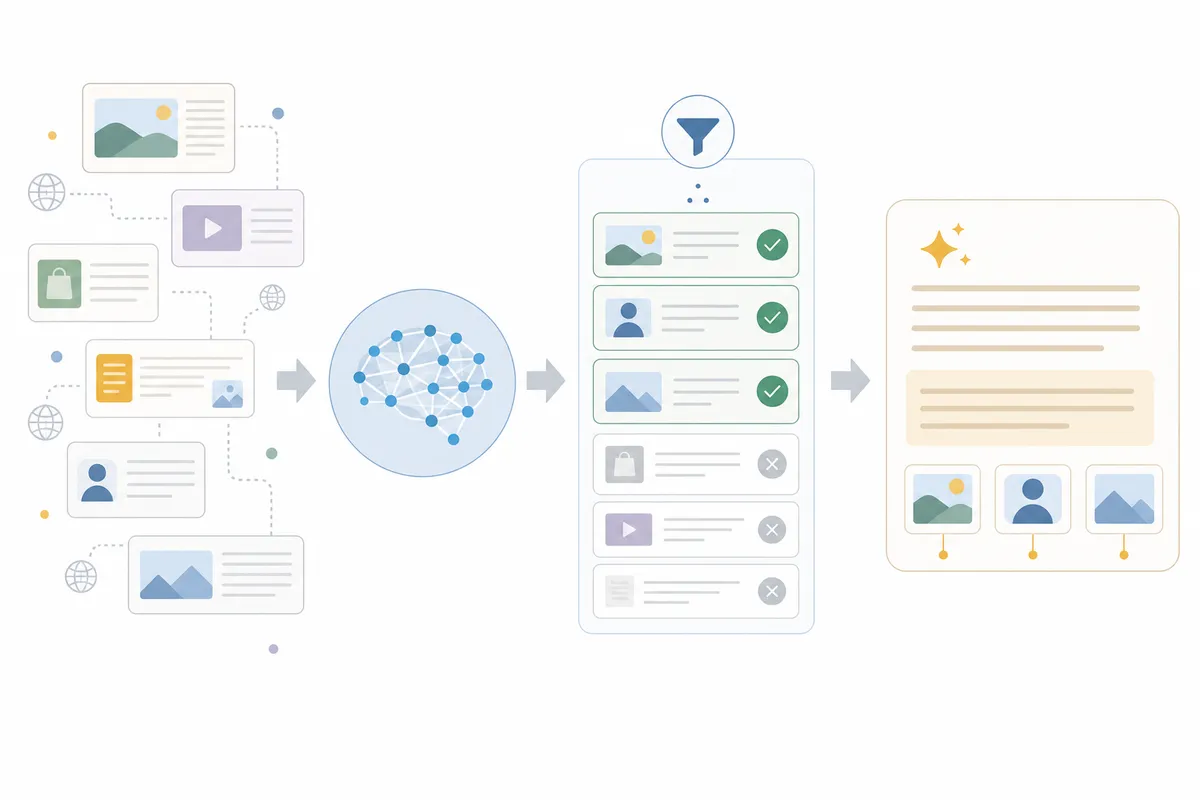
Google explains that its generative AI features use retrieval-augmented generation (RAG), also called grounding. The model runs real searches against the ordinary index, reads the retrieved pages, then writes an answer with links to the pages that support it. The full explanation is in Google's guide to succeeding in AI search features. The consequence is simple: if a page cannot rank, it cannot ground an answer.
Query fan-out: one question becomes many searches
AI systems split a user's question into several smaller sub-queries. Ask about fixing a weed-filled lawn, and the system may quietly search for the best herbicides, chemical-free removal and prevention, then blend the results. Your page does not need to match the user's full sentence. It needs to rank for the shorter sub-queries hiding inside it.
Every platform pulls from somewhere specific
Each engine grounds its answers in a particular index, and that decides where your effort pays off.
| Platform | Where its answers come from | What that means for you |
|---|---|---|
| Google AI Overviews and AI Mode | Google's own index and ranking systems | Your existing Google SEO is the direct foundation of your AI visibility |
| ChatGPT | Google results, reportedly via a third-party data provider, having used Bing before | Ranking in Google feeds ChatGPT today, but keep Bing healthy as a hedge |
| Perplexity | Its own crawler plus a mix of search sources, with citations on every answer | Allow PerplexityBot and publish well-sourced pages built to be quoted |
| Gemini | Google Search and the Google Knowledge Graph | Strong Google SEO plus consistent entity and business data carry straight over |
| Microsoft Copilot | Bing's index | Verify your site in Bing Webmaster Tools; Bing is not optional here |
| Meta AI | Bing web search, inside Facebook, Instagram and WhatsApp | The same Bing groundwork covers three of the largest apps in the world |
Answers change on every run
Ask the same question five times and you will get five different answers. There is no stable position one in ChatGPT. The metric that replaces rank is share of voice: how often your brand appears across many runs of many relevant prompts. That is exactly what generative engine optimization measured live tracks, because a single spot check tells you almost nothing.
AI search optimization vs. traditional SEO
The fundamentals transfer. Quality content, authority signals, technical health and internal linking matter in both worlds. What changes is what you count.
| Signal | Traditional search | AI search | What to change |
|---|---|---|---|
| Success metric | A ranking position on one results page | A citation inside a generated answer | Track citations and share of voice, not just positions |
| Query model | One keyword, one page of results | One question fanned out into several sub-queries | Cover a topic's sub-questions, not just its head term |
| Visit model | Visibility means clicks to your site | Most visibility is zero-click brand mention | Value impressions; make your brand name travel with the fact |
| Stability | Rankings move slowly day to day | Answers differ on every single run | Measure frequency across many runs, never one query |
| Scope | Mostly Google | Google, ChatGPT, Perplexity, Gemini, Copilot, Meta AI | Audit crawler access and presence per platform |

None of this retires on-page work. Headings, titles and clean HTML are how retrieval systems parse meaning, which is why on-page SEO still matters in AI search even as the results page changes shape.
How to do AI search engine optimization, step by step
Six moves cover most of the gains. Do them in this order.
1. Let the AI crawlers in
This is the most common silent failure. Check robots.txt for blocks on GPTBot, PerplexityBot, ClaudeBot and Google-Extended, and check your CDN settings too: Cloudflare has reportedly moved to blocking AI crawlers by default, so access can be shut off without anyone on your team choosing it. Also confirm the basics Google requires: a page must be indexed and eligible to appear with a snippet before it can appear in Google's AI features at all.
2. Answer first, then explain
AI systems quote self-contained passages. Open every important section with a direct answer of two to four sentences, then add the detail underneath. A paragraph should survive being lifted out alone: named subject, plain claim, no "as mentioned above". If you want a fast diagnostic, the ten signs your content is not AI-search ready is a checklist you can run against any page in a few minutes.
3. Publish non-commodity content
Google's guidance is unusually specific here. Content likely to influence AI visibility long term offers a genuinely unique angle: firsthand reviews, original data, an expert's contrarian read. Commodity listicles restating common knowledge are precisely what a model can generate without you. Add real numbers, named examples and positions you can defend. This is also where honesty pays: an AI engine citing sources for a comparison favors the page that admits trade-offs over the one that only sells.
4. Ship structured data that matches the page
Structured data using the Schema.org vocabulary helps machines resolve what a page is about: an article, a product, an FAQ, a local business. Two rules keep it safe. Markup must describe what is visibly on the page, and it must validate. If your pages are built to be extracted, the payoff shows up across snippets, voice and AI answers together, which is the whole premise of answer engine optimization as a product feature rather than a one-off fix.
5. Build co-occurrence and citations off your site
Models associate brands with topics by how often they appear together across the web: forums, comparison posts, industry publications, Reddit and Quora threads. This is the successor to link building. Earn mentions where your category is discussed, and pursue inclusion in the roundup articles AI engines already cite for your money queries. A mention without a link still teaches the model who you are.
6. Keep local and commerce data feeds current
For product and local-intent questions, AI responses can draw on merchant listings and business profiles directly. Google points to Merchant Center feeds and a maintained Google Business Profile as inputs to its AI experiences. If you sell things or serve a place, those feeds are AI search inputs, not admin chores.
Once these are in place, score a page before and after. The free answer engine optimization scorer grades a URL on extractability and answer-readiness, which makes the rewrite measurable instead of a matter of taste.
What you can safely ignore
A young discipline attracts folk remedies. Google has publicly debunked the loudest ones.
- llms.txt files. Google Search does not use them. Creating one neither helps nor hurts your Google visibility. Other systems may read them, so keeping one is harmless, but it is not the lever it is sold as.
- "Chunking" your content for AI. There is no requirement to break content into model-sized fragments. Write for humans, with clear sections and headings.
- A page for every phrasing. Spinning out near-duplicate pages to chase every query variant violates Google's scaled content abuse policy, documented in Google Search Essentials, and its systems already match relevance without exact wording.
- Secret AI markup. No special file or tag whitelists you into AI answers. Eligibility runs through ordinary indexing.
The pattern behind all four myths is the same: they promise a shortcut around making better pages, and the systems are built to ignore shortcuts.
How to measure AI search visibility
You cannot manage a channel you cannot see. Three measurements cover it.
Share of voice across prompts
Run a fixed set of buying-intent prompts against each platform on a schedule, and record how often your brand appears versus competitors. Because answers are non-deterministic, frequency across runs is the honest number. Trend it monthly.
Citation frequency and referral traffic
Track how often your URLs appear as cited sources, and segment AI referrals in your analytics: traffic from chatgpt.com, perplexity.ai and gemini.google.com is measurable today. One agency's published client case study reports a 586% increase in traffic from generative AI sources after sustained GEO work, and that kind of claim is only verifiable if your own baseline exists before the work starts.
Which levers moved the number
Attribution matters more than dashboards. When visibility rises, you want to know whether crawler access, content rewrites or off-site mentions did the lifting. The breakdown of six real levers AI search optimization tools actually pull maps each tactic to the metric it moves, which keeps the program honest.
Can you do this yourself, or do you need help?
Mostly, yes, you can. Everything in the playbook above is executable by a competent in-house marketer, and Google's official guidance is free. The honest boundary is measurement: checking your presence across six platforms by hand does not scale past the first week.
| Path | Typical cost | What you get | Fits best when |
|---|---|---|---|
| Do it yourself | Your time only | Full control; the fundamentals here plus free official docs and free checkers | One site, technical comfort, and patience to test by hand |
| Software platform | A monthly subscription, a fraction of a retainer | Automated share-of-voice tracking, page scoring and prioritized fixes | You want measurement and direction but will do the work in-house |
| Agency GEO retainer | Listed from $3,000 per month at one large provider, which also reports 12,335 client leads driven from AI sources | Strategy, content production, outreach and reporting done for you | Budget exists and internal bandwidth does not |
If you land on the software path, evaluate vendors on whether they measure real AI answers rather than proxy scores. The 2026 buyer's guide to search engine optimization software lists the questions that separate measurement from theater.
FAQs
Is AI search engine optimization different from regular SEO?
It is an extension, not a replacement. AI engines retrieve answers from ordinary search indexes, so ranking remains the entry ticket. What changes is the goal (citations instead of positions), the metric (share of voice instead of rank) and the scope (six-plus platforms instead of one).
Does an llms.txt file help me appear in AI answers?
Not on Google. Google's documentation states that Google Search ignores llms.txt files, so they neither help nor hurt there. Some other tools may read them, so maintaining one is harmless, but treat it as housekeeping rather than strategy.
How do I check whether AI crawlers can read my site?
Read your robots.txt for rules blocking GPTBot, PerplexityBot, ClaudeBot or Google-Extended, then check your CDN or firewall, since some providers now block AI bots by default. Finally, confirm the page is indexed and snippet-eligible in Search Console, because Google's AI features only draw on indexed pages.
How long does it take to show up in AI answers?
It varies with your starting authority. Access fixes and structured data can register within weeks, because grounding uses live indexes. Becoming a habitual citation for competitive money queries usually takes months of content and off-site mention building. Anyone quoting an exact timeline is guessing.
What does AI search optimization cost?
Doing it yourself costs time only. Software platforms run on monthly subscriptions well below agency pricing. Full-service GEO retainers at one large agency are listed from $3,000 per month. Start by fixing access and structure yourself, then pay for measurement once the basics are live.
Test one page today
Open ChatGPT or Perplexity and ask the exact question your most valuable page answers. If your brand is missing from the reply, you have found where your AI search engine optimization work starts, and you have a baseline to beat. To see what a measured, page-by-page plan looks like, talk to the team and walk through a sample SEO report built on the same checks covered here.
Resources / References
Related reading: How to Rank in Perplexity: Get Cited, Not Just Crawled.
Sources
About the author
SearchBlueprint researched, wrote and scored this article with the content pipeline our customers run on their own sites. The score in the byline is what our content engine gave this page before it published. Nothing here is reviewed by hand, which is the point: it is the product's output, published where anyone can check it.