How to Rank in Perplexity: Get Cited, Not Just Crawled
SearchBlueprint · · 10 min read · scored 92/100

How to rank in Perplexity comes down to one shift: you optimize for citation, not position. Perplexity reads live pages and quotes the ones that answer a question in the first two sentences, carry third-party mentions on sites it already trusts, and stay visibly fresh. Win the citation and your brand appears inside the answer itself.
Key takeaways
- Perplexity has no page-one positions. Visibility means being one of the cited sources pinned to the top of a generated answer.
- Classic SEO still buys you entry: BrightEdge research found that 60% of Perplexity's citations overlap with Google's top 10 results for the same query.
- Third-party mentions outweigh your own site. A 2024 FirstPageSage survey put authoritative "best of" list mentions at 64% of Perplexity's general recommendation weighting, against 31% for reviews and 5% for awards.
- Reddit supplied 46.7% of Perplexity's top-10 citations between August 2024 and June 2025, per data from Profound.
- Structure beats volume: put the answer first, mark pages up with schema, and refresh on a schedule.
What ranking in Perplexity actually means
Perplexity is an answer engine. Ask it a question and it searches the web in real time, reads a handful of pages, and writes one consolidated answer with clickable source cards at the top. Nobody scrolls a list of blue links. Either your page is one of the cited sources, or you are invisible for that query.

Citations, not positions
Under the hood, Perplexity runs retrieval-augmented generation. It interprets the question, retrieves live pages that look authoritative and relevant, then summarizes them into a conversational answer with citations attached. That pipeline changes what wins. A page that ranks fourth on Google but buries its answer under three paragraphs of scene-setting can lose the citation to a page that answers in its opening sentence.
Queries change shape too. On Google, people type short keyword strings. In Perplexity, they ask full questions with context: budget, situation, constraints. Your content earns citations when it answers those natural-language questions directly and comes from a source the engine has reason to trust.
The numbers behind the shift
Perplexity is small next to Google and reportedly accounts for only about 2% of AI search queries. The absolute volume is not small: reported figures put it at roughly 780 million monthly queries by May 2025, up from 230 million nine months earlier, and the company has said it processes more than 100 million searches a week. BrightEdge has measured Perplexity query volume growing at around 40% per month. A citation there also compounds: the same qualities that earn it tend to earn mentions in Google's AI Overviews and ChatGPT answers as well. If you are weighing this against other engines, our guide to multi-platform SEO beyond Google maps where each one pays off.
How Perplexity chooses what to cite
Independent research, including analysis covered by Search Engine Land, points to a consistent set of signals. Perplexity leans on pre-categorized lists of authoritative domains, favors fresh and specific pages, and lifts passages it can quote cleanly.
| Signal | What Perplexity favors | Your move |
|---|---|---|
| Authority | Trusted domains, and sites those domains mention | Earn links and named mentions on established sites in your niche |
| Extractability | Direct answers it can lift in one or two sentences | Put the answer in the first sentence under a question-shaped heading |
| Freshness | Recently published or visibly updated pages | Refresh key pages on a schedule and show the updated date |
| Corroboration | Claims backed by data and named sources | Cite primary sources and publish your own figures |
| Google overlap | 60% of citations match Google's top 10, per BrightEdge | Keep classic SEO running; it feeds the same candidate pool |
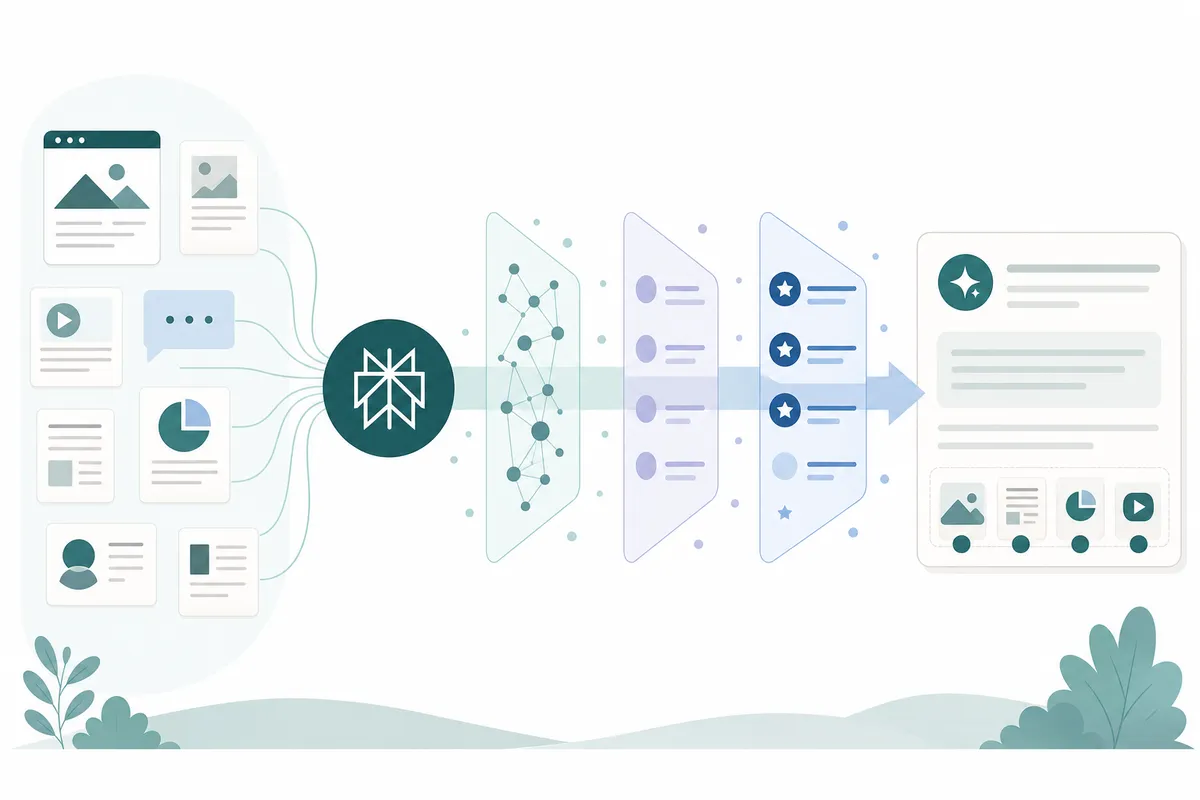
No single signal wins alone. A fresh page on a weak domain loses to a slightly older page on a strong one, and a strong domain that rambles loses the quote to a modest site that answers cleanly.
How to rank in Perplexity: seven moves that earn citations
Work these in order. The first three cover most of the gap for most sites.
1. Lead every page with the answer
Open each section with the answer, then add the context. If your H2 asks "How much does rank tracking cost?", the first sentence under it should state a figure or a range, not the history of rank tracking. AI engines extract; they do not wade. A page that takes three paragraphs to get to the point loses the citation to a competitor that gets there in one.
Question-shaped H2s help because they mirror the prompts people actually type. Follow each with a 40 to 60 word self-contained answer, then expand below it. Depth still matters, just not padding: cover the question fully and stop, the approach we break down in topic depth without bloat.
2. Keep your classic SEO running
BrightEdge found 60% of Perplexity's citations overlap with Google's top 10 organic results for the same query. That makes traditional SEO the cheapest Perplexity tactic available: crawlable URLs, clean titles and meta descriptions, strong internal links, real backlinks, and a site that loads fast. Companies that paused SEO to chase AI visibility are pulling from the wrong end. The Google top 10 is the shortlist Perplexity draws from most often.
3. Get named on "best of" lists
The 2024 FirstPageSage survey found that authoritative list mentions account for 64% of Perplexity's general recommendation weighting, far ahead of online reviews at 31% and awards or affiliations at 5%. Even in local recommendation queries, list mentions contribute 34%. When someone asks Perplexity for the best tool, agency, or service in a category, it leans heavily on roundups published by third parties.
So pitch the roundups. Find the "best X for Y" articles that already rank in your category, and give their authors a concrete reason to include you: a real differentiator, current pricing, a customer result they can verify. One placement on a list Perplexity already cites is worth more than ten new posts on your own blog.
4. Show up where Perplexity already reads
Perplexity's citation diet is unusually social. The figures below are worth internalizing before you allocate any outreach time.
| Finding | Figure | Window and engine | Reported by |
|---|---|---|---|
| Reddit's share of Perplexity's top-10 citations | 46.7% | August 2024 to June 2025, Perplexity | Profound |
| Reddit's share of ChatGPT's top-10 citations | 11.3% | Same window, ChatGPT | Profound |
| Wikipedia's share of ChatGPT's top-10 citations | 47.9% | Same window, ChatGPT | Profound |
| LinkedIn's presence in LLM responses | About 11% of responses, second only to Reddit | Across major LLMs | SEO.com |
| Weight of list mentions in Perplexity recommendations | 64% | 2024 survey | FirstPageSage |
Nearly half of Perplexity's top citations coming from Reddit means genuine subreddit participation is a Perplexity tactic, not just a community one. Answer real questions in your niche's subreddits with specifics, and skip the pitch: communities downvote marketing fast, and a removed thread cites nobody. On LinkedIn, in-depth posts and newsletters under a named expert give Perplexity an authoritative, attributable source to quote.

5. Mark pages up with structured data
Schema markup gives the engine machine-readable confirmation of what a page is. A 2023 study by Data World found that when LLMs are powered by structured data or knowledge graphs, their responses improve by 300%. The Schema.org types that map most directly to Perplexity's habits:
- FAQPage on question-and-answer sections, since it mirrors the prompt format
- Article with author, date published, and date modified, which backs your freshness signal
- Organization and Person, so the engine can attribute expertise to a named entity
- Product with price and availability, for anything shoppable
- HowTo on step-by-step guides
Markup does not rescue thin content. It makes good content easier to trust and lift.
6. Refresh what you already have
Perplexity prefers current information, so an aging library quietly loses citations to competitors with newer dates and newer figures. Refreshing means adding value, not swapping a few words: update statistics, cut sections that are no longer true, answer the follow-up questions readers now ask, and move the most important section up the page. Pages that already sit in Google's top 10 are the priority, because they are already in Perplexity's candidate pool.
7. Use Perplexity's own surface area
Perplexity offers direct routes in. Its Merchant Program is free for ecommerce brands and indexes your product data, specs, pricing, and availability, so shopping answers can recommend you. The Publisher Program shares ad revenue with media companies whose content gets cited; per Perplexity's own materials, joining starts with an email to publishers@perplexity.ai. Perplexity Pages lets you publish articles inside the platform itself. And the emerging LLMs.txt standard, a structured file that helps LLMs parse your site, is early but cheap to adopt. Multimodal content earns its own slots too: Perplexity surfaces YouTube explainers and clearly labeled images in its Video and Image tabs.
Measure your Perplexity ranking progress
You cannot manage citations you never look for. Tracking is less convenient than a Google rank report, but it is straightforward to start by hand.
- Write down 20 to 30 prompts your buyers would actually ask, from "what is" questions to "best tool for" recommendations.
- Run them in Perplexity monthly and log which domains get cited for each.
- Record your mentions and citations separately. A mention with no link still shapes the answer a buyer reads.
- Track competitors in the same log. Their citations show you which roundups and threads to target next.

Can you do this yourself? Yes, and for a single site you probably should for the first quarter, because reading full answers teaches you what the engine rewards in your niche. Paid visibility tools and platforms earn their keep once you track many prompts across many markets, or report to clients who want the numbers monthly.
Your first 30 days, week by week
| Week | Focus | What you ship | How you check |
|---|---|---|---|
| 1 | Baseline and quick wins | A list of 20 buyer prompts, a manual citation log, answer-first rewrites on your 5 most important pages | The log shows exactly which prompts cite you today |
| 2 | Structure and schema | FAQPage and Article markup on the rewritten pages, question-shaped H2s throughout | Markup validates cleanly; re-run the same 20 prompts |
| 3 | Third-party mentions | Pitches to 3 relevant "best of" roundups, 5 genuinely useful Reddit answers, 2 in-depth LinkedIn posts | Placements live, threads standing, nothing removed as spam |
| 4 | Refresh and measure | Updates to 3 aging pages with current figures and dates | Citation count against week 1, plus which moves drove it |
Thirty days is enough to move on structural fixes. Authority-driven citations, the kind that come from roundup placements and community reputation, typically build over a few months.
FAQs
How long does it take to rank in Perplexity?
Reported timelines run from a few weeks to a few months. Sites with an established SEO foundation see citations sooner because 60% of Perplexity's citations already overlap with Google's top 10. Answer-first rewrites and schema can shift results within weeks; authority signals take longer.
Is Perplexity worth optimizing for at 2% of AI search?
Yes. That 2% reportedly represented about 780 million monthly queries as of May 2025, growth from 230 million nine months earlier, and BrightEdge has measured roughly 40% month-over-month query growth. The work also transfers: the same content wins citations in AI Overviews and ChatGPT.
Does traditional SEO still matter for Perplexity?
It matters more than any Perplexity-specific trick. The engine draws heavily from pages that already rank in Google's top 10, so crawlability, backlinks, titles, and content quality remain the entry fee. Perplexity SEO adds citation-focused structure on top; it does not replace the base.
Which schema types help Perplexity understand a page?
FAQPage, Article, Organization, Person, Product, and HowTo are the practical set. They confirm what the page is, who wrote it, and when it changed. The Data World finding that structured data improves LLM responses by 300% is the strongest published signal that markup is worth the hour it takes.
How do I track whether Perplexity cites my site?
Run a fixed list of buyer prompts monthly and log the cited domains, your mentions, and your competitors' mentions. There is no official ranking report, so consistency in your prompt list is what makes the trend readable. Move to a visibility platform once the manual log outgrows a spreadsheet.
Audit your answer pages before you write new ones
Citations follow pages that already answer cleanly, so find out which of yours bury the answer before adding anything to the calendar. Pull your top pages, check whether each one answers its question in the first sentence, and fix the ones that do not. Then look at a sample SEO report and talk to the team about how to rank in Perplexity for the questions your buyers are already asking.
Resources / References
Sources
- How to Rank in Perplexity: Boost Your Visibility in AI Search
- How to Rank on Perplexity: 8 Tips & Strategies
- Perplexity SEO: How to Get Brand Mentions in Responses
- Perplexity SEO | How to Rank in Perplexity | Get Started ...
- How Perplexity ranks content: Research uncovers core ...
Disclaimer: This article is general information about rules and figures that applied when it was written, not personalised financial, tax or investment advice. It does not take account of your income, obligations, risk tolerance or goals, and rates and thresholds change. Verify the current position with the relevant authority, and speak to a licensed adviser or a qualified accountant before acting.
About the author
SearchBlueprint researched, wrote and scored this article with the content pipeline our customers run on their own sites. The score in the byline is what our content engine gave this page before it published. Nothing here is reviewed by hand, which is the point: it is the product's output, published where anyone can check it.