AI Overviews SEO: Winning Citations as Clicks Get Scarce
SearchBlueprint · · 12 min read · scored 95/100

AI Overviews SEO means earning a citation inside Google's AI-generated answer, not just a blue link underneath it. You get there by applying the fundamentals harder than your competitors: indexable pages, self-contained passages that each answer one question, clear entity signals, and deliberate measurement. Google sets no special eligibility rules.
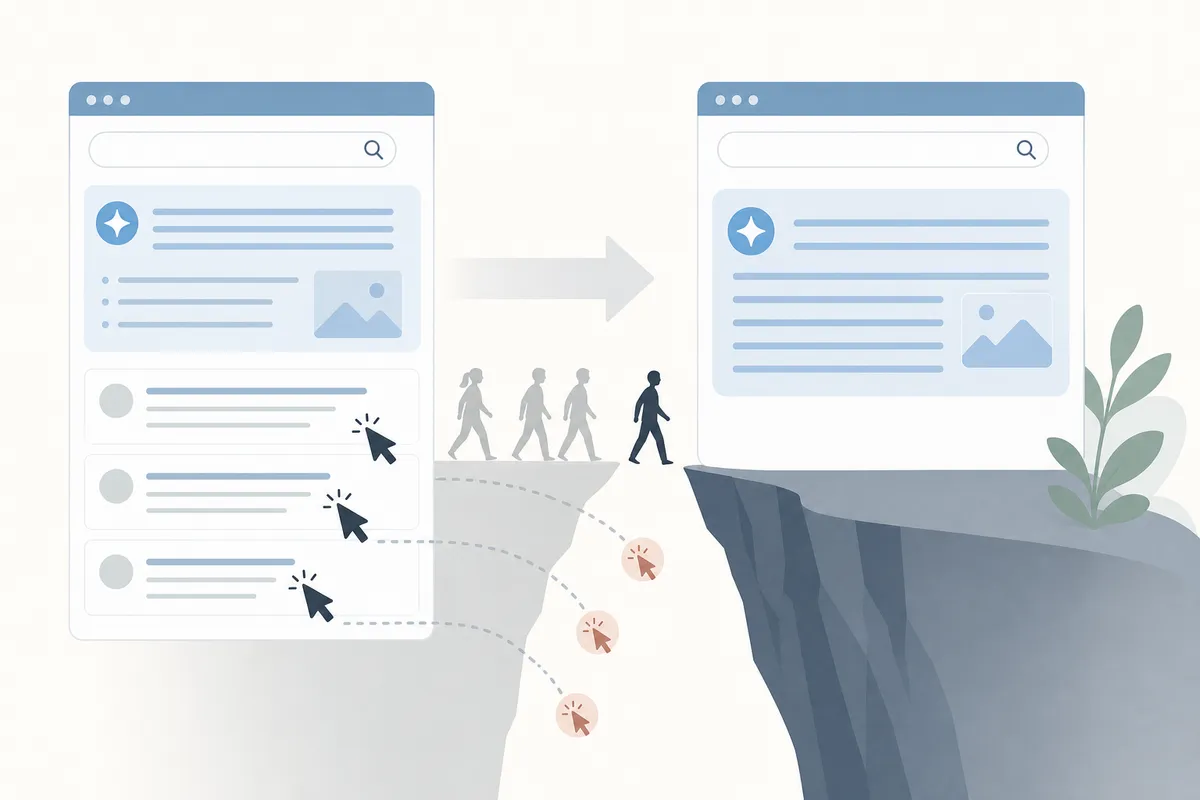
The stakes are simple to state. A Pew Research Center report suggests users click traditional result links just 8% of the time when an AI Overview is present, against 15% when there is none, and they click links inside the overview itself only about 1% of the time. Yet the same body of research reports that a site cited as a source sees its click-through rate rise by up to 80% compared with non-cited sources. The feature punishes the average page and rewards the quoted one.
What AI Overviews SEO actually changes
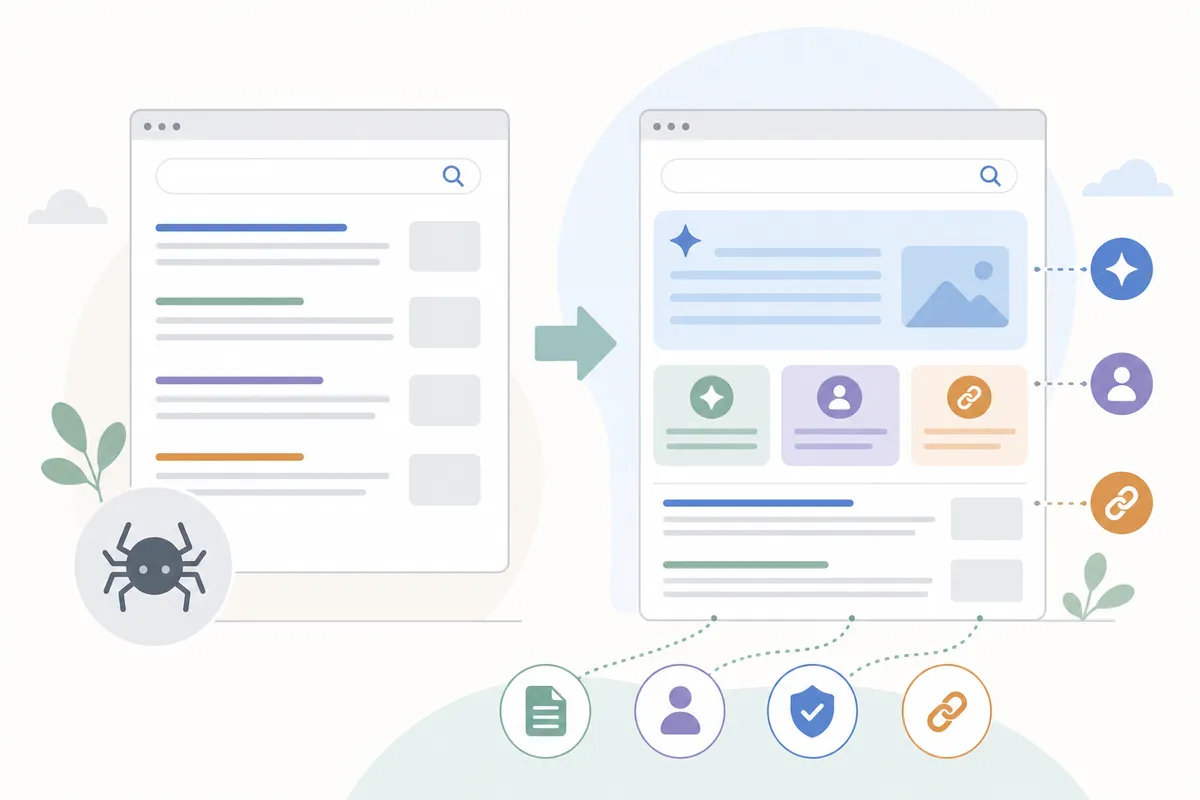
An AI Overview is a generated summary that sits at or near the top of the results page. Google's Gemini models assemble it from multiple sources and link to those sources. The feature began as the Search Generative Experience in Search Labs, went live for all US users on May 14, 2024, and now runs in more than 200 countries and territories in over 40 languages, according to Semrush. It is separate from AI Mode, the fuller conversational search experience Google introduced in 2025.
The rollout still has edges
Europe came later and with conditions. Google confirmed the rollout to Germany, Austria, and Switzerland on March 26, 2025, and in those markets users must be at least 18 years old and logged into a Google account to see overviews at all. If you serve several countries, your exposure differs by market, and your analytics will reflect that unevenness. This sits inside a larger shift in how answers get assembled and attributed, which is worth understanding as a whole; the overview of how AI search engines are reshaping SEO strategy in 2026 covers the full ecosystem beyond Google.
Intent coverage is widening
The early read was that overviews were an informational-query feature. That reading is aging fast. Semrush research shows keywords triggering AI Overviews went from 89.03% informational in October 2024 to 57.16% informational in October 2025. Commercial and transactional queries are being pulled in, which means your money pages, not just your blog, now need passages worth quoting.
How often AI Overviews appear, and for what
Frequency is the most misreported number in this space, so anchor on the studies. Right after the May 2024 launch, some sources estimated that up to 42% of queries carried an overview. Google then pulled back hard. SE Ranking found overviews on 12.47% of queries in August 2024, and by December 2024 a SeoClarity analysis of 120 million queries measured just 4.5%. Most current estimates land between 4.5% and 12.5%, depending on methodology.
Averages hide the split that actually matters for planning:
| Query context | Reported AI Overview rate | Source, as framed | What it means for you |
|---|---|---|---|
| All queries, August 2024 | 12.47% | SE Ranking study | Even at its post-launch peak, roughly seven in eight searches showed no overview at all. |
| All queries, December 2024 | 4.5% of 120 million queries examined | SeoClarity analysis | The baseline is low; panic-driven strategy rewrites are not supported by the data. |
| Health topics | Up to 67.5% | Industry meta-analysis of published AIO studies | Health and medical publishers should assume most informational queries now resolve inside an overview. |
| Technology topics | Up to 23% | Same meta-analysis | Tech explainers and how-to content face meaningful but not total overview coverage. |
| Commercial searches | Below 6% on average | Same meta-analysis | Buying-intent pages still compete mostly in classic results, where ads fund the SERP. |
What triggers an overview
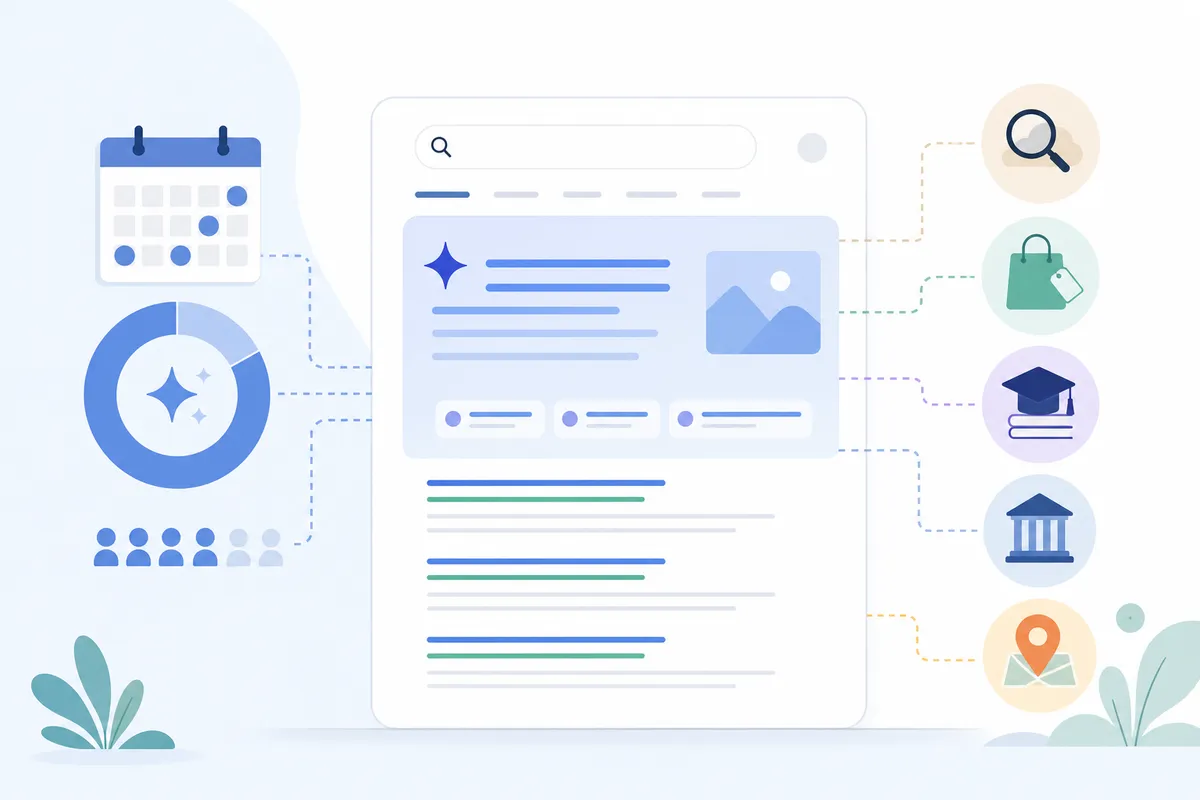
Intent and complexity, mostly. Ahrefs found AI Overviews appearing on 99.2% of the informational queries it examined, and Google itself says overviews target questions that would otherwise take several searches. Long, specific, multi-part queries trigger them most often.
Two SERP signals are worth checking across your own keyword set. Advanced Web Ranking found that 59.5% of AI Overviews shared the results page with a featured snippet, while SE Ranking found only 13.51% of overview SERPs also displayed ads. So if a keyword already carries a featured snippet, an overview is plausible next. If the keyword is heavily monetized, an overview is less likely, presumably because Google protects ad revenue on those pages.
What an AI Overview costs you in clicks
Zero-click pressure is real and measured. Beyond the Pew figures above, an analysis by Kevin Indig put the average organic CTR decline at 8.9% when an overview is present. Part of that is simple geometry: a Press Gazette study found organic results pushed down by an average of 980 pixels when an overview displays, which on a phone can mean a full screen of scrolling before the first classic listing appears.
Paid search takes a harder hit. In one study cited across industry meta-analyses, search ad CTR fell from 21.27% to 9.87% when an AI Overview appeared on the results page.
The counterweight is citation. Cited sources reportedly see up to 80% higher CTR than non-cited ones, an unlinked brand mention inside the answer still puts your name at the top of the page, and Google states that clicks coming from pages with overviews tend to be higher quality, with visitors spending more time on the site. The strategic conclusion is uncomfortable but clear: you cannot vote the feature away, so the only winning position is inside it.
Eligibility: what Google actually requires
The official bar is lower than most vendors imply. Per Google Search Central, a page is eligible to appear as a supporting link in AI Overviews or AI Mode when it is indexed and eligible to show in Google Search with a snippet. That is the entire list. No special schema type, no AI text file, no new markup, no separate submission.
Google's documentation does name the fundamentals that still apply: crawling allowed in robots.txt and by your CDN, content findable through internal links, important information available as text rather than locked in images, and structured data that matches the visible text on the page. Eligibility is not a guarantee of inclusion, but ineligibility is a guarantee of exclusion, and most exclusions are self-inflicted technical faults.
How to optimize for AI Overviews
The work divides into five moves. None of them is exotic, and every one of them also improves classic rankings, which matters because analyses across markets report that overview sources come mostly from the top 10 results.
Lead with the answer, then earn the depth
Generative systems quote passages that stand alone. Open each page, and each major section, with a 40 to 60 word passage that answers the question directly, names the subject explicitly, and would survive being lifted out of context. Detail, evidence, and nuance follow underneath. A buried answer forces the model to paraphrase someone else's clearer one.
Cover the fan-out, not just the keyword
Google's documentation describes a query fan-out technique: the system issues multiple related searches across subtopics to build one response. A page that answers only the head term matches one of those searches. A page with question-shaped H2s and H3s covering cost, timing, alternatives, and failure cases can match several. Long-tail, specific queries are also the ones most likely to trigger an overview in the first place, so the fan-out and your keyword research point at the same structure.
Make your entities unambiguous
Overviews are assembled from an understanding of things, not strings. Consistent naming, an about page that states plainly who you are and what you do, and Schema.org markup that mirrors your visible text all help Google resolve your brand, authors, and products into entities it can safely attribute. The mechanics of that resolution run deeper than markup alone; the piece on why entities and knowledge graphs decide AI visibility walks through how the graph gets built and where sites fall out of it.
Keep the technical floor solid
Blocked robots.txt rules, accidental noindex tags, 4xx errors, and orphaned pages remove you from consideration before quality is ever evaluated. Platform-hosted sites carry their own recurring faults here; the review of Shopify SEO apps that fix Core Web Vitals, schema, and AI visibility shows how much of the eligibility gap on storefronts is tooling, not effort.
Draft with AI, publish with judgment
Scaled thin content is the fastest way to lose both classic rankings and citations, and AI drafting makes scaling thin content effortless. It can still be used well. The guide to using AI content writers without tanking your rankings sets out the guardrails: real sourcing, expert review, and original information the model could not have generated on its own.
| Move | Why it earns citations | How to check it worked |
|---|---|---|
| Answer-first passages of 40-60 words | A passage that stands alone can be quoted without editing, which is what generative systems prefer. | Read the passage out of context; it should still answer the question and name the subject. |
| Question-shaped H2s and H3s | Query fan-out runs multiple related searches, and each specific heading is a chance to match one. | Compare your headings against People Also Ask and related searches for the target query. |
| One idea per paragraph | Short, single-idea paragraphs extract cleanly; tangled ones get skipped for a competitor's cleaner version. | Flag any paragraph that needs the previous one to make sense, then rewrite it to stand alone. |
| Markup that matches visible text | Google's guidance requires structured data to reflect what is on the page, and mismatches undermine trust in the source. | Validate the markup, then confirm every claimed property appears in the rendered content. |
| Scheduled fact refreshes | Overviews favor current, accurate sources, especially on fast-moving topics. | Recheck statistics, dates, and prices on your highest-value pages on a fixed cadence. |
Controlling what AI Overviews can show
You can limit what Google quotes, but every control has a price, because AI features in Search obey the same mechanisms as snippets. These are the levers Google documents:
| Control | What it does | What it costs you |
|---|---|---|
| nosnippet | Removes the page's text from search snippets and AI-generated results. | You lose the normal snippet too, which typically lowers CTR on the classic listing. |
| data-nosnippet | Excludes specific marked sections of a page from snippets and overviews. | The safest option: the rest of the page stays quotable while sensitive sections stay out. |
| max-snippet | Caps how many characters Google may show from the page. | Set too low, it makes the page a weaker candidate as a cited source. |
| noindex | Removes the page from Google Search entirely. | All organic visibility disappears, not just the overview appearance. |
| Google-Extended | Limits use of your content for AI training and grounding in some other Google systems. | It does not remove you from Search or AI Overviews; those follow the Googlebot rules above. |
If you apply a control and still see your content in overviews, Google's advice is to verify the tag is visible to Googlebot with the URL Inspection tool and then wait out a recrawl, which can take days to months depending on the page.
How to measure AI Overview performance
There is no dedicated AI Overview report. Google includes overview and AI Mode traffic in the overall search totals in Search Console, reported inside the Performance report under the Web search type. That has two practical consequences.
First, the telltale pattern for overview impact is stable or rising impressions with falling CTR on specific queries. Segment your keyword set, watch those queries over time, and compare against queries where no overview shows.
Second, citation tracking has to be done on the SERP itself. Maintain a watchlist of the queries that matter commercially, record whether an overview appears, and record whether you are cited in it. Doing this by hand across markets gets old quickly, which is exactly the kind of loop an AI SEO agent that runs the full audit from one URL exists to automate: eligibility checks, citation presence, and the fixes in one pass instead of three tools and a spreadsheet.
Pair the search data with analytics. Google reports that clicks from results pages with overviews are higher quality, so judge those sessions on engagement and conversion, not raw volume.
The first 30 days
A workable sequence for a small team, in priority order:
- Days 1-5: clear the eligibility floor. Crawl the site, fix blocked pages, stray noindex tags, and 4xx errors on anything that earns money or links.
- Days 5-10: map exposure. Pull your ranking keywords, mark which SERPs show an overview, and flag featured-snippet queries as likely next candidates given the 59.5% overlap.
- Days 10-20: restructure the top pages. Answer-first passages, question-shaped headings, one idea per paragraph, entities named consistently.
- Days 20-27: refresh and align. Update dated claims and make structured data match the visible text exactly.
- Days 27-30: set the baseline and the workflow. Export Search Console data, record current citations, and decide where drafting help fits using the comparison of AI versus human content and when each belongs.
FAQs
Do you need special schema or an AI text file to appear in AI Overviews?
No. Google Search Central states there are no additional technical requirements and no special structured data for AI features. A page must be indexed and eligible to appear with a snippet. Schema markup still helps Google understand your entities, but no markup type unlocks overviews on its own.
How often do AI Overviews actually show up?
Current studies place them on roughly 4.5% to 12.5% of queries overall, down from early post-launch estimates of up to 42%. The rate is heavily topic-dependent: reported figures reach 67.5% for health queries and up to 23% for technology, while commercial searches average below 6%.
Do you have to rank on page one to get cited?
Mostly, yes. Analyses across markets report that cited sources come predominantly from the top 10 results, so classic ranking work remains the foundation. Citations from deeper positions happen, but they are the exception, not a strategy.
Can you keep content out of AI Overviews without leaving Google?
Yes. The nosnippet and data-nosnippet controls remove full pages or marked sections from AI-generated results, and max-snippet caps what can be shown. The trade-off is that these controls also limit your normal search snippets, so most sites apply data-nosnippet surgically rather than blocking whole pages.
Will an AI Overview always cut your traffic?
On average, clicks drop: one analysis measured an 8.9% CTR decline when an overview is present. But cited sources reportedly see up to 80% higher CTR than non-cited ones, and Google says clicks from overview pages tend to be higher quality. The realistic goal is not avoiding overviews; it is being the source they quote.
Start with a citation baseline
AI Overviews SEO is testable: for each query you care about, your pages are either cited, eligible but ignored, or invisible, and everything above depends on knowing which. Talk to the team about running that baseline for your site, and look through a sample SEO report first to see exactly how eligibility, citations, and the fix list are laid out. One URL is enough to start.
Resources / References
Related reading: The Zero-Click Search Strategy Roadmap to Win Citations, Not Clicks.
Sources
- AI Features and Your Website | Google Search Central
- AI Overviews: What Are They & How to Optimize for Them
- 7 Strategies to Optimize for Google AI Overviews SEO
- Google AI-Powered Overviews Really the End of SEO?
- Google AI Overviews: What's Changing for SEO & SEA in ...
Disclaimer: This article is general legal information, not legal advice, and does not create a solicitor-client relationship. The law changes and its application depends on your particular facts. Speak to a qualified lawyer in the relevant jurisdiction before acting — some rights and claims are subject to strict time limits.
About the author
SearchBlueprint researched, wrote and scored this article with the content pipeline our customers run on their own sites. The score in the byline is what our content engine gave this page before it published. Nothing here is reviewed by hand, which is the point: it is the product's output, published where anyone can check it.