The Zero-Click Search Strategy Roadmap to Win Citations, Not Clicks
SearchBlueprint · · 14 min read · scored 92/100

This zero-click search strategy roadmap to win citations, not clicks, shifts your SEO priorities from chasing clicks to earning citations. You structure content for direct extraction, fix the schema and entity signals that make AI Overviews trust you, and track citation share and branded search lift instead of sessions alone. The goal is visibility inside the answer, not just a ranking beside it.
Why Clicks Stopped Being the Real Goal
For most of the last two decades, SEO had one job: get ranked, get clicked. That equation is broken. Semrush's analysis of zero-click search behavior found that 58.5% of U.S. searches and 59.7% of E.U. searches ended without a click in 2024. SparkToro and Datos clickstream data puts the figure even higher across all Google searches globally. When an AI Overview appears on the page, the share of searches that end with no click climbs sharply.
The acceleration is recent and it is not slowing down. Google's AI Overviews were triggered for 13.14% of queries in March 2025, up from 6.49% in January 2025, according to Semrush's tracking, more than doubling in two months. One SEO professional, Ankush Gupta, described watching this play out in a client's Search Console. Impressions kept climbing while click-through rate fell from roughly 1.5% to under 0.5% on the same queries. Google was showing the content, just not sending anyone to read it.
This is where a proper answer engine optimization approach starts to matter more than classic ranking tactics. Ranking third for a query nobody clicks is worth less than being the source an AI Overview quotes, even at position zero on a page the user never opens.
How Big the Shift Really Is, by Query Type
Not every query is equally exposed. One 2026 breakdown of AI Overview trigger rates by query type shows a clear pattern: informational queries get absorbed almost entirely, while transactional queries mostly still send a click.
| Query type | Typical zero-click rate | What that means for you |
|---|---|---|
| Definitional / "what is" queries | 85% | Write the answer for the AI, not the visit, these rarely convert to traffic anyway |
| How-to / step-by-step queries | 72% | Structure numbered steps so they can be lifted whole into an answer |
| Comparison queries | 61% | A clear comparison table is the asset most likely to get cited |
| Best-of / listicle queries | 57% | Ranking factors and criteria need to be explicit, not implied |
| Product research queries | 38% | Still worth ranking pages for, buyers keep reading before deciding |
| Transactional / buy queries | 22% | This is where clicks, and revenue, still concentrate |
Read that table as a budget guide. Spend your extraction-structuring effort on the top rows, where AI Overviews dominate. Keep your conversion-focused landing pages doing what they already do well on the bottom rows.
What Counts as a "Win" Now
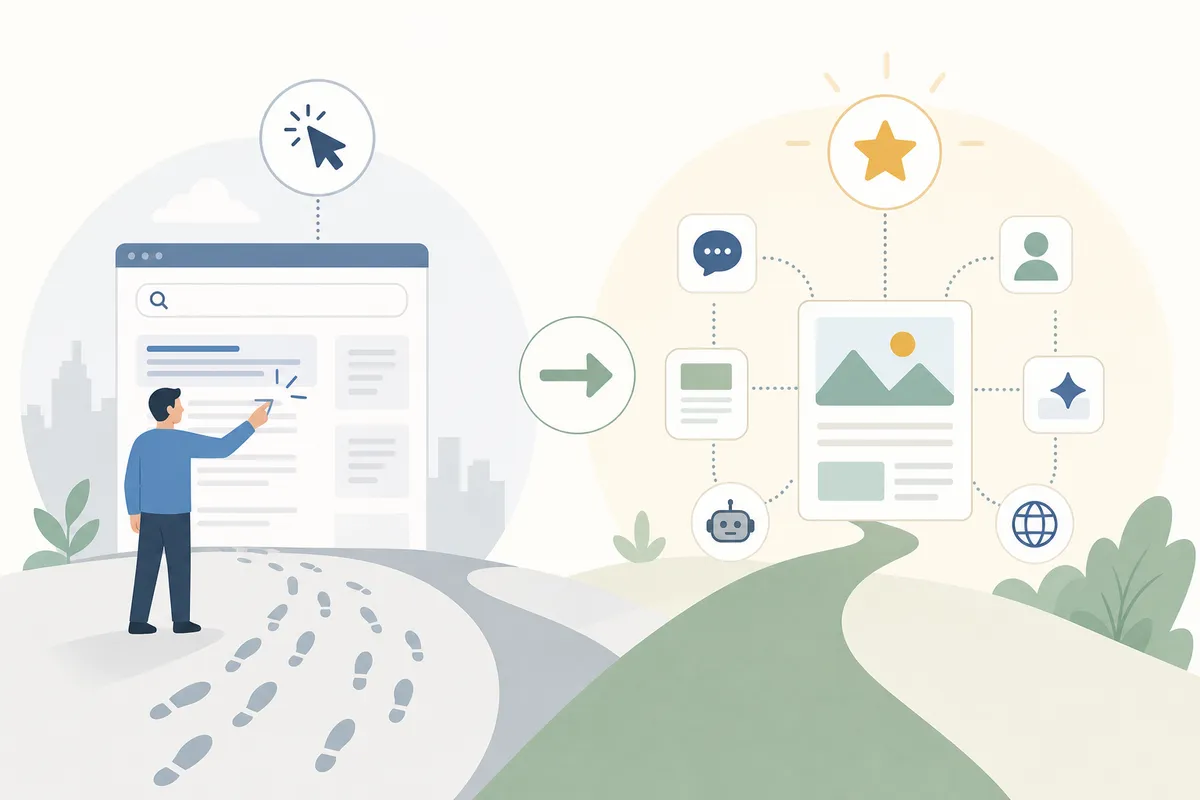
If a page can no longer be judged by its click volume alone, you need a different definition of success. A win in a zero-click environment looks like this: your brand appears accurately inside the answer, and a reader who saw that answer later searches your brand name directly. The smaller number of people who do click also convert at a noticeably higher rate than old-style organic traffic did. None of that shows up in a standard traffic report, which is exactly why the KPI section further down matters as much as the content work.
Build Your Zero-Click Search Strategy, Step by Step
Treat this as a sequence, not a checklist you tackle all at once. Each step depends on groundwork from the one before it, and most teams can realistically move through all four inside a single quarter.
Step 1: Audit Where You're Already Losing Clicks
Start by finding out which of your priority queries already trigger AI Overviews, featured snippets, or People Also Ask boxes. Then check whether you're the cited source or invisible to them. Pull your top 30 to 50 revenue-relevant queries from Search Console, then check each one manually against the live SERP. A People Also Ask finder is the fastest way to see which questions Google already associates with your topic. That way, you're not guessing at what the AI Overview is drawing from.
Flag three buckets: queries where you're cited, queries where a competitor is cited and you're not, and queries with no citation happening yet, which are your easiest openings. That third bucket is where a new content investment pays off fastest, because there's no incumbent citation to displace.
Step 2: Structure Content So It Can Be Extracted Whole
An AI Overview doesn't reward a page for being comprehensive. It rewards a passage for being liftable. That means a direct 40-to-60-word answer sitting right under a question-phrased heading, written so it makes sense read completely out of context. That's exactly how it will be used.
This is the core discipline behind generative engine optimization: writing content that works twice. It works once as a normal page for a human visitor, and once as source material an AI system can quote cleanly. Semantic HTML, logical heading hierarchy, and one clear claim per paragraph aren't nice-to-haves here. They're the difference between a passage that gets cited and one that gets skipped in favor of a competitor's cleaner structure.
Step 3: Fix the Entity and Schema Layer Underneath the Content
Good writing structure gets you halfway. The other half is making sure AI systems can confirm who you are and what you do, consistently, across every place your brand appears. Inconsistent business names, mismatched addresses, or schema that contradicts what's visible on the page all erode trust signals. AI Overviews and knowledge panels rely on those signals before they'll cite you.
This is where entity SEO work pays off, and it scales badly if you're not careful. Our guide on scaling entity SEO without breaking your schema covers the specific failure mode teams hit when they try to roll structured data out across hundreds of pages at once. The usual culprit: duplicate or conflicting entity IDs that confuse the very systems you're trying to inform.
Step 4: Build Assets Specifically Designed to Get Cited
Once the structure and the technical layer are solid, the highest-leverage move is publishing something an AI system has no substitute for. That means original data, a named expert's point of view, or a comparison framework nobody else has built. Generic definitions and standard how-to content have already been absorbed into AI Overviews wholesale and will not recover, that ground is gone. What's left uncontested is primary research and firsthand analysis.
If your business sits on local or multi-location data, knowledge graph gaps are often the fastest fix available. Our walkthrough on fixing knowledge graph SEO to win AI citations in two to four weeks is written around exactly this kind of short, high-impact project.
Your first week, condensed to five moves: Pull your top 30 queries and check which already show an AI Overview. Identify the three queries where a competitor is cited and you're not. Fix the single worst schema inconsistency you find (usually a mismatched business name or address). Rewrite one high-traffic page's opening paragraph into a direct, quotable 40-to-60-word answer. And set a recurring weekly reminder to re-check the same query set, because today's SERP is not next week's.

The Technical Backbone: Schema and Content Structure for Extraction

Content structure and technical markup have to work together, or the extraction systems underneath AI Overviews will read your page as unclear even when a human wouldn't. A page with strong writing but broken schema often gets passed over. A page with pristine schema but vague content doesn't have anything worth extracting in the first place.
Which Schema Types Actually Move the Needle
Not every schema type carries equal weight for zero-click visibility. Prioritize based on what your business actually publishes, rather than adding every schema type available.
| Schema type | Where it helps | Priority for most sites |
|---|---|---|
| FAQPage | People Also Ask boxes, direct Q&A extraction | High, any page with genuine Q&A content |
| HowTo | Featured snippets, step-list extraction | High for process or tutorial content |
| LocalBusiness | Knowledge panels, local pack results | High for brick-and-mortar or service-area businesses |
| Article / BlogPosting | Author and freshness signals for E-E-A-T | Medium, supports credibility, rarely the citation trigger itself |
| Organization | Entity consistency across the knowledge graph | Medium, but foundational once at scale |
Before you publish new markup, run it through a free schema validator to catch syntax errors and missing required properties. Invalid JSON-LD doesn't get partially credited. It gets ignored entirely, which means a small typo can cost you a citation opportunity you already did the content work to earn.
Keep Your Entity Signals Consistent Everywhere
AI systems characterize your brand from the sum of what they can find about it, not just from your own site. A dedicated answer engine optimization approach treats your name, address, category, and description as a single fact set. That fact set has to match across your website, your Google Business Profile, directory listings, and any third-party mentions you can influence. When those sources disagree, AI systems tend to hedge or skip the citation rather than guess which version is correct.
New KPIs for a World Without Clicks
The standard SEO dashboard, organic sessions, click-through rate, average position, was built to measure a world where every impression was supposed to become a visit. That assumption no longer holds. Reporting only those three numbers to a team leader who doesn't know why is a fast way to make good work look like a decline.
| Old KPI | What it misses now | Replace or pair it with |
|---|---|---|
| Organic sessions | Ignores brand impressions from citations that never click | Impressions + citation share on priority queries |
| Click-through rate | Falls even when visibility is rising, because AI Overviews absorb the click | Share of AI Overview and featured snippet appearances |
| Average position | A #1 ranking beneath an AI Overview can still get almost no traffic | Citation accuracy across AI Overviews, Claude, and other assistants |
| Total conversions | Doesn't separate high-intent zero-click visitors from low-intent traffic | Conversion rate segmented by traffic source |
| Nothing (usually untracked) | Branded search lift after a citation goes unmeasured entirely | Branded search volume trend, tracked monthly |
The conversion-rate argument alone is worth building into your reporting. One 2026 conversion-rate benchmark comparing traffic sources found AI-assisted search visitors who click through convert at roughly 8.4% on average. That's well above the 0.37% average for traditional organic search and the 0.19% average for social traffic. A separate cross-industry study by BrightEdge, covering 1,200 websites, found that AI search visitors who click through convert at close to 23 times the rate of traditional organic visitors. Fewer visits paired with meaningfully higher conversion rates is not a failing strategy. It's the zero-click search strategy working as intended, and it's worth saying explicitly in your next report so a shrinking session count doesn't get misread as a problem.
Businesses cited consistently in AI Overviews have also reported roughly 34% higher direct traffic and about 28% higher branded search volume within 30 days, according to industry tracking of citation impact. Both are signs that the visit is happening, just one step later and one search away from where your analytics can see it start.
Turn Your Zero-Click Search Strategy Into a Monitoring Habit
A zero-click search strategy that gets audited once a quarter is already out of date by the time the report ships. AI Overview coverage, featured snippet ownership, and knowledge panel accuracy all shift with model updates and algorithm changes. Those changes arrive with no warning and no changelog you can subscribe to.
Set a Cadence That Matches How Fast the Surface Moves
| Surface | Recommended check frequency | Why |
|---|---|---|
| AI Overview citations on priority queries | Weekly | Coverage and cited sources both change with model updates |
| Featured snippet ownership | Weekly | A snippet can flip to a competitor overnight with no ranking change underneath it |
| Knowledge panel accuracy | Biweekly | Stale panel data (old pricing, wrong hours) sits live until someone catches it |
| Branded search volume | Monthly | The lagging proxy for citation impact, needs a longer window to read a trend |
| Schema validity across the site | After every content publish | Cheapest problem to catch early, most expensive to find in bulk later |
Use a free AEO and AI-search scorer to get a fast read on how extraction-ready a given page is before you invest further content work into it. That way, you're not finding out three months later that the structure was the blocker all along. Only 14% of enterprise marketing teams currently track AI and LLM citation visibility at all, according to a Goodfirms survey of digital marketing practitioners. That means a basic weekly check already puts you ahead of most of the category you're competing in.
Tools to Track Citations Without Overspending
You don't need an enterprise platform to start. A workable free stack covers query discovery, structure scoring, and technical validation. It's enough to run the audit and monitoring cadence above without a new line item in the budget.
- Query and question discovery, a People Also Ask finder surfaces the exact question phrasing Google already treats as related to your topic, which is the raw material for extraction-ready headings.
- Extraction readiness scoring, an AEO scorer flags pages that are structurally unlikely to get lifted into an AI Overview before you spend more time writing for them.
- Schema validation, a schema validator catches the JSON-LD errors that silently disqualify a page from rich-result eligibility.
- Search Console, still the most reliable free source for the impressions-versus-clicks gap that signals AI Overview exposure on a specific query, even though it won't name the AI surface directly.
Different AI assistants also weight sources differently, and it's worth checking more than Google. Our citation playbook for ranking in Claude covers what changes when the audience is an assistant rather than a traditional SERP. That's a distinction most zero-click advice glosses over by treating every AI surface as interchangeable.
Common Mistakes That Sink a Zero-Click Strategy
Most zero-click programs don't fail because the team didn't try. They fail because the effort went into the wrong layer, or stopped at the first one. Four patterns show up repeatedly:
- Rewriting content without fixing the technical layer underneath it. Perfect prose sitting on broken schema still doesn't get extracted.
- Blocking AI crawlers defensively. Some sites block Google-Extended and similar crawlers hoping to limit AI use of their content. But this typically reduces future citation chances without meaningfully protecting anything already cached.
- Reporting only session counts to leadership. If the KPI dashboard still leads with sessions and CTR, a genuinely improving zero-click search strategy will read as a decline to anyone who hasn't seen this article.
- Treating every query the same. Chasing citation on a transactional query, where clicks were always going to happen anyway, wastes effort. That effort is better spent on the definitional and how-to queries AI Overviews have already absorbed almost completely.
If you're not sure which of these applies to your site, check it against the signs that your content isn't ready for AI search in the first place. Our breakdown of ten signs your content isn't AI search ready walks through the diagnostic in more depth than a single checklist item can.
FAQs
What is a zero-click search strategy?
A zero-click search strategy is an SEO approach built around earning visibility inside search answers: AI Overviews, featured snippets, knowledge panels, and People Also Ask boxes. It's not only about optimizing for a click to your website. It prioritizes extractable content structure, accurate schema and entity data, and citation-based KPIs alongside traditional ranking work.
How do you get cited in Google AI Overviews?
Structure content with a direct 40-to-60-word answer immediately under a question-phrased heading. Back it with valid schema markup, and keep your entity signals (name, address, category, description) consistent across your website and third-party sources. Original data and named expert analysis get cited more often than generic definitional content, which AI Overviews have already absorbed at scale.
Do zero-click searches hurt SEO?
They change what SEO has to deliver, but they don't make it worthless. Organic search is still a major discovery channel. Traffic that does click through after a zero-click encounter converts at a notably higher rate than traditional organic traffic did before AI Overviews existed. The work shifts from volume toward earning inclusion and trust.
What KPIs should replace clicks and sessions?
Track citation share on your priority queries, featured snippet and AI Overview appearance rate, branded search volume trend, and conversion rate segmented by traffic source. Keep session count as a secondary metric rather than the headline number. A falling session count paired with rising citation share and conversion rate is a sign the strategy is working, not failing.
How often should you check your AI Overview citations?
Check AI Overview and featured snippet coverage on your priority queries weekly, knowledge panel accuracy biweekly, and branded search volume monthly. AI Overview eligibility and cited sources shift with model updates that arrive with no announcement, so a quarterly audit alone will always be reading stale data.
See Where Your Own Pages Stand
The fastest way to know whether your content is structured to earn citations or just to rank is to look at a real report against your own pages, not a generic checklist. Talk to the team behind SearchBlueprint by reviewing a sample SEO report, and see exactly what a zero-click search strategy roadmap to win citations, not clicks, would surface for your site.
Resources / References
Sources
- The Zero-Click Shift: What Happens When Your Audience ...
- How to Win in a Zero-Click Search Market
- Zero-Click Marketing: How to Win When Google Stops Sending ...
- 60% Zero-Click Searches: The 2026 SEO Crisis Strategy
- How To Survive The AI 'Zero-Click' Era
Disclaimer: This article is general information about rules and figures that applied when it was written, not personalised financial, tax or investment advice. It does not take account of your income, obligations, risk tolerance or goals, and rates and thresholds change. Verify the current position with the relevant authority, and speak to a licensed adviser or a qualified accountant before acting.
About the author
SearchBlueprint researched, wrote and scored this article with the content pipeline our customers run on their own sites. The score in the byline is what our content engine gave this page before it published. Nothing here is reviewed by hand, which is the point: it is the product's output, published where anyone can check it.