Shopify SEO Apps That Fix Core Web Vitals, Schema, and AI Visibility
SearchBlueprint · · 16 min read · scored 84/100

The best Shopify SEO apps for improving Core Web Vitals, schema, and AI visibility are TinyIMG for image speed, Webrex or Schema Plus for JSON-LD, and StoreSEO, Tapita, or Lumos for AI search. Most stores need two or three apps in total. Install more than that and you usually ship duplicate schema and a slower theme.
This guide is written for merchants who run their own Shopify store and for agencies managing a portfolio of them. Every price, rating, and review count below is quoted as listed on the Shopify App Store or in the agency roundups that track these apps, current as of September 2026. Listings change, so confirm on the app page before you subscribe.
Key takeaways
- Two or three apps beat ten. Overlapping apps inject duplicate JSON-LD and competing scripts, which slows down the store they were installed to speed up.
- Interaction to Next Paint (INP) became a Core Web Vital in 2024, and it punishes image-heavy Shopify themes that used to pass on load speed alone.
- A schema app only helps if it is your single source of structured data. The theme, the review app, and the SEO app must not all emit Product markup.
- AI visibility is now a real job: chunkable copy, clean product schema, and llms.txt files feed the assistants where a growing share of shoppers start.
- Listed prices run from free plans to $249.99 a month. A serious stack for most stores lands between $0 and about $75 a month as listed.
Why your app stack matters more than it did two years ago
Shopify's built-in SEO is a floor, not a strategy. An app earns its subscription only when it does something the platform cannot, and the list of things the platform cannot do has changed shape.
What Shopify covers on its own
Out of the box, Shopify generates your XML sitemap, sets canonical tags on products reachable through multiple collections, provides SSL on every plan, and lets you edit meta titles and descriptions one page at a time. Shopify Magic now drafts basic meta text for free. That kills the business case for any app whose main trick is writing a title tag. What the admin still will not do is bulk metadata across thousands of SKUs, image compression at catalog scale, deep JSON-LD beyond the theme's defaults, or any measurement of how AI assistants describe your store. Apps exist to fill exactly those gaps, and they sit inside a wider discipline; if you are weighing platform-level work too, start with how e-commerce SEO works on Shopify and BigCommerce before buying anything.
The three shifts that changed the job
First, Google confirmed INP as a Core Web Vital in 2024, replacing First Input Delay. Image-heavy themes that passed on Largest Contentful Paint alone started failing on interactivity, which is why speed apps now matter for rankings and not just conversion. The documentation on Google's ranking systems and page experience lives at Google Search Central.
Second, AI answers moved in front of the results page. ResultFirst, an ecommerce SEO agency, cites Google AI Overviews appearing on almost 43% of searches and around 35 to 37% of shoppers starting product research in ChatGPT, Gemini, or Perplexity rather than a search box. The same write-up puts Shopify at over 14% of U.S. ecommerce by sales, so the competition for those citations is dense.
Third, agent commerce stopped being theoretical. Shopify's collaboration with OpenAI, announced in late 2025, points at assistants that browse and buy on a shopper's behalf. Stores whose product data is structured and readable get recommended; stores whose data is a wall of unmarked HTML do not.
The three jobs: Core Web Vitals, schema markup, and AI visibility
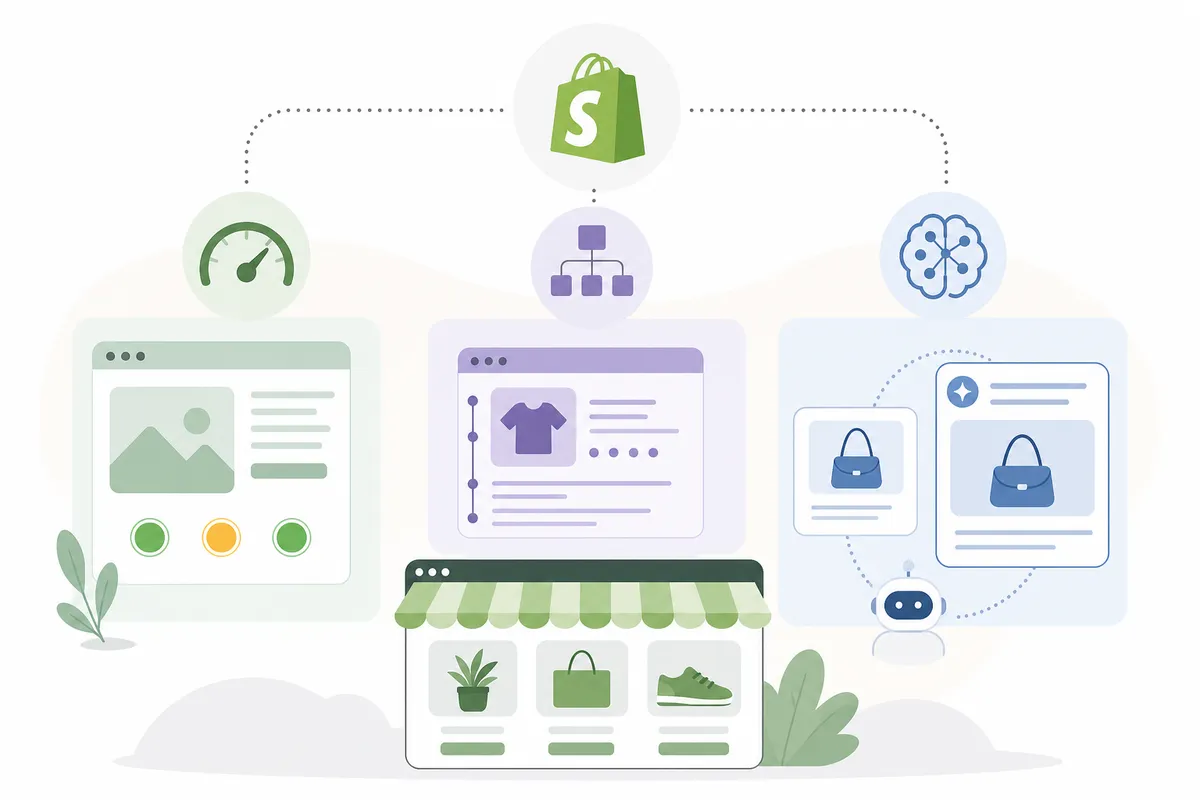
Before comparing apps, be clear about what each job involves, because almost every app claims all three and very few own more than one.
| The job | What actually moves it | Apps built for it | The warning sign |
|---|---|---|---|
| Core Web Vitals | Image compression, WebP conversion, lazy loading, script and theme cleanup | TinyIMG, Avada, SearchPie, Tiny SEO Speed | The score improves in the app's own dashboard but not in PageSpeed Insights |
| Schema (JSON-LD) | Product, Offer, Review, FAQ, and breadcrumb markup with one source of truth | Webrex, Schema Plus, Ilana's JSON-LD, TinyIMG | The theme, a review app, and an SEO app all emit Product markup for the same page |
| AI visibility (AEO) | Chunkable self-contained copy, clean product data, llms.txt, specific reviews | StoreSEO, Tapita, Lumos, SEOWILL | A dashboard selling an "AI ranking" number that no AI engine actually publishes |
Core Web Vitals: INP is the metric that bites
Core Web Vitals measure loading (LCP), visual stability (CLS), and responsiveness (INP). Shopify stores fail these for predictable reasons: uncompressed product photography, render-blocking app scripts, and themes carrying years of accumulated code. Speed apps attack the first cause well. TinyIMG lists compression of up to 70% without visible quality loss, plus lazy loading and WebP conversion. What no app can do is remove the weight added by other apps, which is why the fix for a slow Shopify store is sometimes an uninstall, not an install.
Schema: JSON-LD is how machines read your catalog
Structured data labels your content in a vocabulary machines share, defined at Schema.org, and JSON-LD is the format Shopify themes and apps use. Product, Offer, and Review markup earns price and rating snippets in Google. FAQ and breadcrumb markup adds context. The same markup is what AI systems lean on when they summarize your product, which makes schema the one job that serves classic SEO and AI visibility at once. The catch is duplication: most themes already ship partial Product markup, so a schema app must detect and replace it, not pile on top of it.
AI visibility: the newest job, and the least standardized
Answer engine optimization means making each page quotable. A paragraph should answer one question, stand alone out of context, and still name your product. Specific reviews teach models more than generic praise; "great product" trains nothing, while a review naming the exact use case gives an assistant a reason to recommend you for that query. The llms.txt file, an emerging convention describing how AI agents should read your site, costs little to add even though no engine has committed to it. If this layer is new to you, the broader shift is mapped in what AI search engines mean for your SEO strategy in 2026.
The best Shopify SEO apps compared
Prices and ratings below are as listed on the Shopify App Store or in the September 2026 agency roundups from Charle and FoxEcom. Treat them as a snapshot.
| App | Best for | Listed price | Listed rating (reviews) | Jobs covered |
|---|---|---|---|---|
| TinyIMG | Image optimization plus JSON-LD | Free / from $14/mo | 5.0 (2,400+) | Speed, schema |
| Booster SEO | All-in-one automation | Free / $39 or $69/mo | 4.9 (6,400+) | Speed, schema |
| Avada SEO | Broadest free plan | Free / $34.95/mo Pro | 4.9 (4,681) | Speed, schema, AEO checklist |
| Sherpas: Smart SEO | AI meta tags and bulk edits | Free / from $9.99/mo | 4.9 (1,200+) | Speed, schema |
| SearchPie | Mobile speed and structure | Free / $39 / $99/mo | 4.9 (3,500+) | Speed, schema, AEO |
| Tapita SEO | Multi-language stores and llms.txt | Free / from $9.99/mo | 4.8 (1,000+) | Speed, AI visibility |
| StoreSEO | Predictive insights and AEO | Free / from $14.99/mo | 5.0 (570+) | Schema, AI visibility |
| SEOWILL (formerly SEOAnt) | Automated audits and AI visibility | Free / from $15.99/mo | 4.8 (1,400+) | Speed, schema, AI visibility |
| Webrex SEO Schema | Rich snippets | Free / $9.99/mo Growth | 4.9 (665+) | Schema |
| Schema Plus | Schema without complexity | $14.99/mo | 4.9 (400+) | Schema |
| Ilana's JSON-LD | Advanced schema at agency depth | $33.25/mo | 5.0 (500+) | Schema |
| Lumos AI SEO | AEO and llms.txt | Free / $9.99/mo | 4.8 (100+) | AI visibility |

Three notes on reading that table. A huge review count proves the app is stable and supported, not that it fits your store; an app with thousands of five-star reviews can still be the wrong tool for a very large catalog, while a newcomer with a hundred reviews can be the right one because it owns a discipline, like llms.txt, that nothing older does well. Free tiers have hard caps that matter: Avada's free plan covers 100 image optimizations and 20 on-page audits, and StoreSEO's free plan optimizes 25 products with 5 tracked keywords. And the price spread is real, from Webrex's free schema plan to StoreSEO's $249.99 Advanced tier, so match the tier to the job rather than buying the biggest plan defensively.
Which app owns which problem
Shopify SEO apps for Core Web Vitals and page speed
TinyIMG is the strongest single install for image-driven speed problems. Its listing covers compression up to 70%, bulk AI alt text, lazy loading, broken-link detection, and JSON-LD in one subscription starting at $14 a month after a free tier. Charle Agency, a Shopify Plus partner that says it has installed and audited SEO apps across more than 100 Plus stores, reports a fashion client doing roughly $300K a month whose mobile Lighthouse score climbed from 38 to 71 within fourteen days of a clean TinyIMG install, with a measurable INP improvement on collection pages.
Avada's speed tooling comes bundled with the widest free plan in the category. The Pro tier at $34.95 a month, or $348 a year at a listed 17% saving, adds unlimited image optimization, 1,000 AI credits, and its stronger structured data; Enterprise at $99 a month, or $990 a year, adds an AI on-page audit agent, 10,000 credits, and 24/7 support. Its own listing shows 4.9 across 4,681 reviews.
SearchPie leans mobile. That focus matters because Statista data cited in FoxEcom's roundup puts mobile at 62.54% of global web traffic in mid-2025, and Google indexes mobile-first. SearchPie's Premium tier is listed at $39 a month and Enterprise at $99, adding schema customization and AEO features. If you want a free single-purpose option, Tiny SEO Speed Image Optimizer holds a listed 5.0 across 2,507 reviews and is free to install.
Schema and structured data apps
Webrex SEO Schema is the value pick. Its free plan lists unlimited product schema plus local business and organization markup with automatic sync when products change, and the Growth plan at $9.99 a month adds integrations for 35 or more apps, AI-optimized FAQ schema, and JSON-LD formatted for AI consumption. It holds a listed 4.9 across 665 reviews.
Schema Plus at $14.99 a month is the simplicity option, listed at 4.9 across 400+ reviews. Ilana's JSON-LD for SEO at $33.25 a month, with a listed 5.0 across 500+ reviews, is the long-standing specialist that agencies reach for when a catalog needs schema depth beyond templates. Whichever you pick, enforce one rule: a single source of structured data per page. Disable the theme's built-in markup or confirm the app deduplicates it, and watch for apps that inject their own canonical logic, a conflict ResultFirst flags as a common way stores split ranking signal across duplicate URLs.
AI visibility and AEO apps
StoreSEO has the most interesting evidence trail. It turns analytics into predictive suggestions, and its published example from the merchant ScottsSweaters shows a one-word correction, "woman's" to "women's", lifting product SEO scores from 20% to a range of 75 to 86%. Tiers are listed at $14.99 (Lite, 100 products), $39.99 (Essential, sitemap auto-submission and expanded AI content), and $249.99 (Advanced, multilingual and multi-location with bulk audits), with a 5.0 rating across 570+ reviews.
SEOWILL, formerly SEOAnt, pairs automated technical fixes with AI-visibility work. Its Pro plan at $29.99 a month lists structured data, bulk optimization, and visibility across models like ChatGPT and Claude; Premium at $59.99 adds ranking insights and E-E-A-T signals. It carries a listed 4.8 across 1,400+ reviews, and one merchant review from the store Forgely reports traffic tripling after applying its recommendations day by day. Tapita, from $9.99 a month with a 4.8 rating across 1,000+ reviews, includes a free llms.txt feature and is the natural fit for multi-language stores. Lumos AI SEO, free or $9.99 a month at a listed 4.8 across 100+ reviews, is the newest and narrowest, built around AEO and llms.txt specifically.
One caution on this category: several of these apps generate content, not just markup. AI-drafted product copy can be a genuine time-saver or a rankings liability depending on how it is reviewed, and the difference is process, not the tool. The ground rules are covered in how to use AI writers without tanking your rankings, and the honest split of when AI content beats human content, and when it does not is worth reading before you turn any generator loose on a thousand SKUs.
All-in-one apps
Booster SEO is the most battle-tested generalist, listed at 4.9 across 6,400+ reviews, with paid plans at $39 and $69 a month covering bulk meta editing, structured data, and an autopilot mode that fixes routine issues like missing descriptions and 404 redirects. Reviewers' recurring caveat: autopilot can make unwanted changes if nobody checks its work. Sherpas: Smart SEO covers AI meta tags and bulk edits from a free plan; FoxEcom's tier rundown lists Pro at $14.99, Business at $24.99 with bulk optimization and audits across roughly 500 pages, and Premium at $49.99 with AI optimization and link-profile analysis. For beginners, SEO Manager at free or $9 a month (4.7, 1,700+ reviews) and Plug In SEO at $29.99 (4.7, 2,500+ reviews) remain the gentle on-ramps, while SEO King at free or $19 a month (4.8, 700+ reviews) focuses on multi-AI product descriptions.
How to choose a Shopify SEO app without wasting a quarter
The apps above are all rated 4.7 or higher, so ratings will not make the decision for you. Process will.
- Name the job before you browse. Run PageSpeed Insights on your home page and a product page, validate one product URL in Google's Rich Results Test, and ask one AI assistant to recommend products in your category. The gap you find is the job. Shopping for an app before diagnosing is how stores end up with three apps doing the same thing.
- Buy an owner, not a checklist. The agencies that install these for a living judge an app on whether it fully owns one pillar rather than half-doing five. A speed app with a mediocre schema module is fine; just do not let that module run.
- Read reviews from stores your size. Support quality and catalog scale are what reviews actually reveal. An app praised by 200-product stores may choke on 12,000 SKUs.
- Benchmark before and after. Record Lighthouse mobile scores the day you install and again two weeks later. Charle's 38-to-71 example took fourteen days; if you see nothing move in that window, the app is not the constraint.
- Check what winning competitors run. View source on the stores outranking you and look at their JSON-LD and script stack. A structured way to do this is the five-step AI competitive analysis workflow, which turns competitor teardown into a repeatable checklist instead of guesswork.
- Plan the uninstall on day one. Know what code the app injects and how to remove it. Orphaned script tags from departed apps are one of the quiet reasons Shopify themes get slower every year.
Recommended stacks by store stage
| Store stage | Stack as listed | Listed monthly total | Why this pairing |
|---|---|---|---|
| New store, under about 100 products | Avada free plan + Webrex free plan | $0 | Avada's free tier covers 100 image optimizations, 20 audits, and basic structured data; Webrex adds unlimited product schema at no cost. |
| Growing store, hundreds to a few thousand SKUs | TinyIMG at $14/mo + StoreSEO Lite at $14.99/mo | About $29 | Image speed and JSON-LD from one app, predictive on-page insights and AEO groundwork from the other, with almost no overlap. |
| High-SKU or Shopify Plus | TinyIMG paid + Sherpas Business at $24.99/mo + Ilana's JSON-LD at $33.25/mo | About $72 | Bulk edits across hundreds of pages plus agency-depth schema, with speed handled by a dedicated specialist. |
| Multi-market or multilingual | Tapita from $9.99/mo + StoreSEO Advanced at $249.99/mo | Up to about $260 | Multi-language optimization plus multilingual SEO, multi-location support, and bulk audits for expanded catalogs. |
For agencies, the calculus is different: you are choosing a standard, not an app. Picking one stack and repeating it across every client store makes audits comparable and onboarding fast, which is a big part of why agencies are moving to AI-assisted SEO operations in the first place. If clients see reports under your brand, weigh the app layer alongside how to choose a white label SEO platform with AI visibility built in, so app-level fixes and client-facing reporting tell the same story.
The mistakes that turn an SEO app into a liability
Every failure mode below comes from real patterns the agency roundups describe, and all of them are avoidable.
- Stacking overlapping apps. Five or six SEO apps means duplicate JSON-LD, conflicting meta tags, and a slower store. Two or three, each owning a distinct job, is the working ceiling.
- Running autopilot unsupervised. Booster's automation is genuinely useful for missing descriptions and redirects, but bulk rewrites need review before they go live. The line between safe and risky automation is drawn in detail in this guide to which SEO tasks are safe to automate.
- Letting an app override canonicals. An app injecting its own canonical logic on top of Shopify's defaults can split authority across duplicate product URLs. Verify with view-source after install.
- Editing robots.txt casually. One wrong disallow line on /products/ or /collections/ can deindex a whole catalog. Test every change before saving.
- Paying for what Shopify Magic does free. Basic meta generation is now built in. An app has to clear a higher bar than writing title tags.
- Treating automation as platform-specific wisdom. The discipline transfers: the same automate-or-skip test applies to what to automate and skip on WordPress, and learning it once protects every site you run.
What no app can fix
Apps optimize what already exists. They compress the images you uploaded, mark up the products you created, and tidy the metadata you wrote. They do not decide what to publish, which keywords deserve pages, or whether your content answers anything a shopper asks. That work is editorial, and it starts with understanding what makes an SEO article worth publishing rather than generating filler at scale.
| Capability | Shopify out of the box | A good app stack | A full SEO platform |
|---|---|---|---|
| Sitemaps, canonicals, SSL | Handled automatically | Monitored and repaired | Audited across every site you run |
| Image speed and Core Web Vitals | Not addressed | Owned, with measurable gains | Measured over time against competitors |
| JSON-LD depth | Basic theme markup | Full product, FAQ, breadcrumb coverage | Validated sitewide with issues tracked to resolution |
| Keyword and competitor research | Not addressed | Light suggestions at best | Full research across markets |
| Content production and internal links | Manual | AI drafts needing review | Researched drafts, links drawn from your own crawl |
| Rank and AI visibility tracking | Not addressed | Snapshots inside one app | Weekly series per market, AI citations measured live |
The honest budget picture: a two-app stack at $0 to $75 a month is the right first spend for most stores, and a small store can live on it for a long while. The platform layer earns its place when you need the loop closed continuously, from research through content to measurement, which is the job an AI SEO agent that runs that loop from a single URL exists to do. Apps and platforms are complements here, not substitutes.
FAQs
Do Shopify SEO apps actually improve Core Web Vitals?
Yes, when the problem is images and lazy loading. TinyIMG lists up to 70% file-size reduction, and Charle Agency reports a client's mobile Lighthouse score rising from 38 to 71 within fourteen days of installing it. No app can rescue a bloated theme, though, and every extra app adds script weight. Verify results in PageSpeed Insights, never in the app's own dashboard.
How many SEO apps should one Shopify store run?
Two or three, each owning a distinct job: one for speed and images, one for schema, and optionally one for AI visibility. Stacking five or six produces duplicate JSON-LD, conflicting meta tags, and a slower store, which is the opposite of what you paid for.
Does Shopify generate schema markup on its own?
Most themes ship basic Product JSON-LD, and Shopify handles sitemaps and canonical tags automatically. Apps add the depth that earns rich results: FAQ, breadcrumb, review, and organization markup. The critical rule is one source of truth per page, so confirm your app replaces theme markup rather than duplicating it.
What is llms.txt and is it worth adding?
It is an emerging convention, similar in spirit to robots.txt, that tells AI agents how to read and represent your site. No engine has committed to honoring it, but the cost is near zero: Tapita includes a free llms.txt feature and Lumos builds around it. Treat it as a cheap early position, not a ranking lever.
Are free Shopify SEO apps enough to start with?
For small catalogs, yes. Avada's free plan lists 100 image optimizations and 20 audits, Webrex offers unlimited product schema free, and StoreSEO's free tier covers 25 products. You outgrow free plans when your catalog passes their caps or when you need bulk editing, which is when the $14 to $40 tiers earn their keep.
Measure before you install another app
One afternoon of measurement tells you more than a week of reading listings. Run PageSpeed Insights on a product page, validate its markup, ask one AI assistant about your category, and match the gap you find to the tables above. If you would rather see the whole picture in one pass, look at a sample SEO report and talk to the team about which Shopify SEO apps will actually move your Core Web Vitals, schema, and AI visibility first.
Resources / References
Sources
- Avada AI SEO Image Optimizer
- 16 Best SEO Apps for Shopify in 2026 | Charle Agency
- Shopify SEO Checklist: 14 Steps to Improve Search Visibility
- 10 Best SEO Apps For Shopify As 2026 AI-Driven Search Hits
- How do we optimize our Shopify stores for LLMs (ChatGPT, ...
Disclaimer: This article is general legal information, not legal advice, and does not create a solicitor-client relationship. The law changes and its application depends on your particular facts. Speak to a qualified lawyer in the relevant jurisdiction before acting — some rights and claims are subject to strict time limits.
About the author
SearchBlueprint researched, wrote and scored this article with the content pipeline our customers run on their own sites. The score in the byline is what our content engine gave this page before it published. Nothing here is reviewed by hand, which is the point: it is the product's output, published where anyone can check it.