Streamline Your Link Building Workflow for Higher Rankings in 5 Repeatable Steps
SearchBlueprint · · 7 min read · scored 88/100

The fastest way to streamline your link building workflow for higher rankings is to run four fixed stages, prospecting, qualification, outreach, and tracking, off shared templates and criteria instead of ad hoc research, so every campaign repeats the parts that worked and skips the parts that didn't.
Why Most Link Building Workflows Stall Out
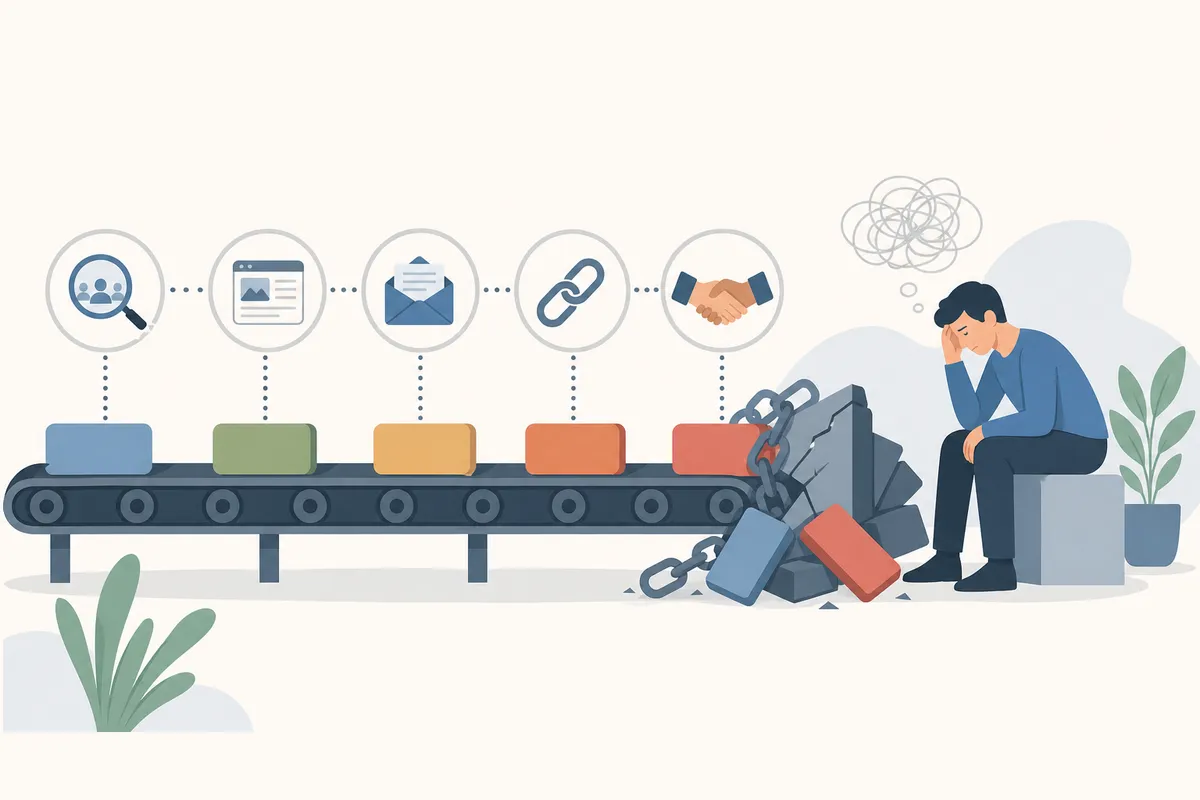
Most link building efforts don't fail from lack of effort. They fail because every step lives in a different tool, or in someone's head. A marketer finds prospects in a spreadsheet, writes pitches in a separate doc, and checks rankings in a third tab. Nothing connects.
That gap shows up in three places. Prospecting takes too long because there's no saved criteria to filter against. Outreach quality drops because templates get reused without checking if they still fit the site. And tracking becomes a monthly scramble instead of a running total, because nobody logged the link the day it went live.
A streamlined link building workflow fixes this by giving each stage one home, one owner, and one output that feeds the next stage. That's the whole idea. It's not about doing more outreach. It's about not losing what you already did. Get that structure right and you streamline your link building workflow for higher rankings without adding headcount.
If you're earlier in the process and still building your first links, how to build backlinks for strong SEO results covers the fundamentals this workflow assumes you already have in place.
The Four Stages of a Streamlined Link Building Workflow
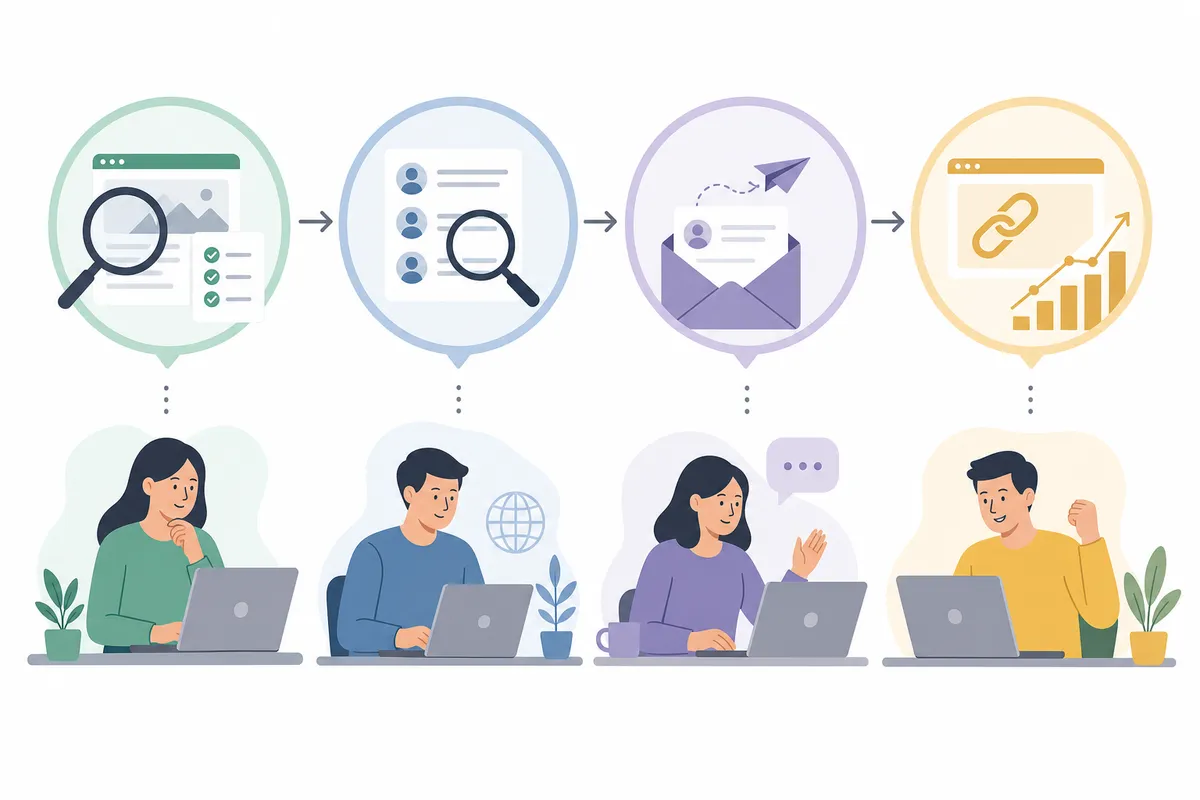
Every efficient link building workflow breaks into the same four stages, whether you run it by hand or with software doing the heavy lifting. The table below shows what each stage actually produces, and where teams most often lose time.
| Stage | What happens | Output that feeds the next stage | Where teams lose time |
|---|---|---|---|
| Prospect criteria | Define target site types, topical fit, and quality thresholds | A written, reusable filter | Re-deciding criteria on every campaign |
| Qualification | Score and shortlist sites against that filter | A ranked prospect list | Manually checking sites one by one |
| Outreach | Personalize and send pitches, then follow up | Replies and placed links | Generic templates that get ignored |
| Tracking | Confirm the link is live and log its quality | A running record of results | Links checked once, then forgotten |
Stage 1: Lock Down Prospect Criteria First
Before you search for a single site, write down what a good target looks like. Topic relevance, domain age, traffic range, and whether the site accepts guest content are all fair filters. Put this in a document your whole team can reuse. Sites that publish paid or guest content without disclosing it are supposed to mark those links rel="sponsored" or rel="nofollow", per Google's guidance on qualifying outbound links, a site that skips this is a bigger risk than the metrics alone show.
Skipping this step is the single biggest reason link building workflows slow down. Without written criteria, every new hire or contractor re-invents the filter, and quality swings from campaign to campaign.
Stage 2: Automate Prospecting and Qualification
This is where automation genuinely saves time. Tools can pull a list of sites that match your criteria far faster than manual search, and score them against metrics like relevance and authority before a human ever looks at them.
But automation should narrow the list, not make the final call. A site can score well on paper and still be a bad fit for your niche. Keep a short manual review step before anything moves to outreach.
Google's own guidance on link spam is worth reading here: links earned for their relevance and quality hold up, links acquired purely for volume are a risk to the whole domain. Speed is only a win if the filter stays strict.
Stage 3: Run Outreach at Scale Without Losing the Human Touch
Outreach is the stage most teams try to fully automate, and it's usually the wrong one. A templated pitch that ignores the site's actual content reads as spam, and most editors can tell in one sentence.
The fix is a middle ground: build a short library of proven templates, then require one custom line per pitch that references something specific on the target site. That single line does most of the work of making outreach feel personal.
Winning SEO outreach strategies breaks down six pitch angles that hold up better than a generic "we loved your article" opener. And if you're deciding how much of outreach to hand off to software in the first place, backlink outreach automation walks through what it can and can't reliably do for you.
Stage 4: Track Acquisition and Quality in One Place
A link isn't done the day it's placed. Confirm it's live, note the anchor text, and record which prospect list and pitch template produced it. Over a few campaigns, this record tells you which sources and angles actually work, instead of relying on memory.
Keep this in one system, not scattered across a CRM, an email thread, and a spreadsheet someone forgot to update. That single source of truth is what makes the whole link building workflow repeatable instead of a one-off push. SearchBlueprint's feature set includes reporting built around this same idea: keep the data connected to the work that produced it, not filed away separately.
Manual, Semi-Automated, or Outsourced: Choosing Your Approach
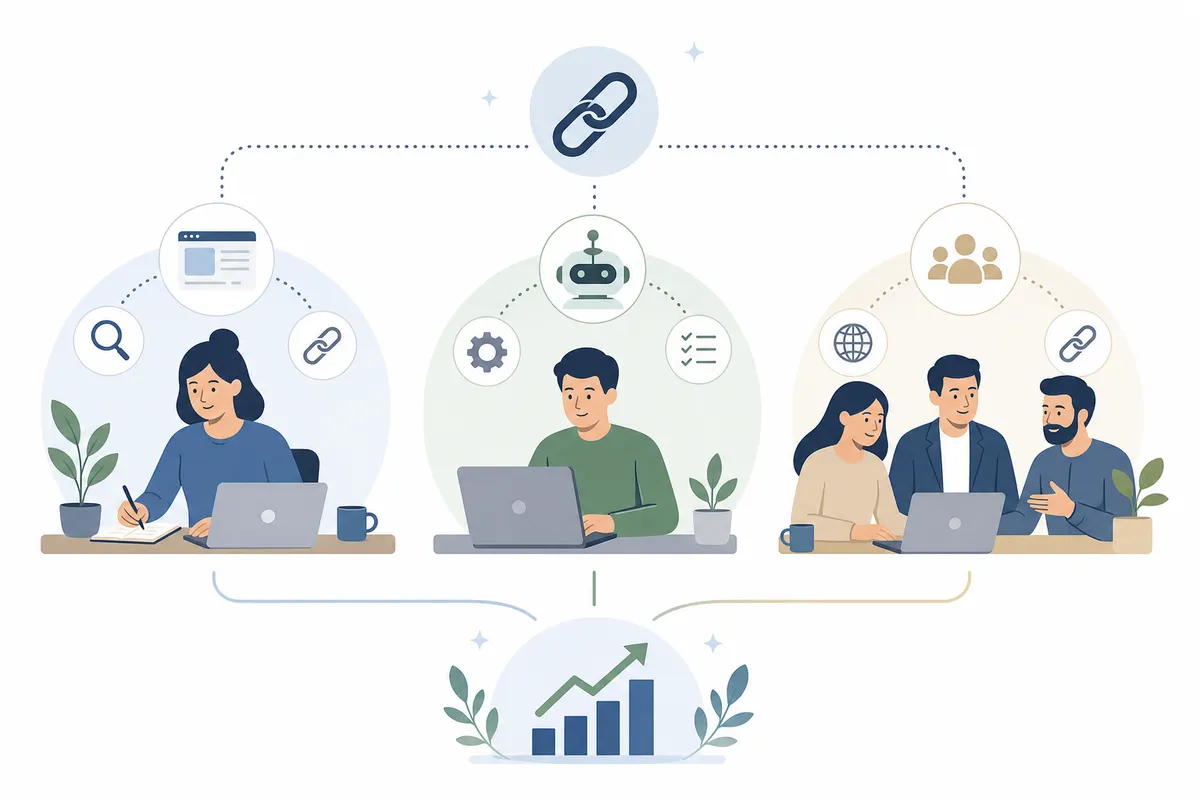
There isn't one right way to run link building. The right setup depends on how much time your team has and how much control you want over quality. Here's how the three common approaches trade off.
| Approach | Time investment | Control over quality | Best fit |
|---|---|---|---|
| Fully manual | High, every stage done by hand | Highest, a person reviews every prospect and pitch | Small teams building a first link profile carefully |
| Semi-automated | Moderate, tools handle prospecting and tracking | Good, humans still write and approve outreach | Teams running ongoing campaigns without a dedicated link builder |
| Outsourced agency | Low, mostly review and approval | Varies by agency, worth vetting their prospect criteria | Teams that need volume and lack in-house time |
None of these is a permanent choice. Many teams start manual to learn what works, move to semi-automated once the criteria are proven, and only outsource the parts that are pure volume, like initial prospecting.
Common Bottlenecks That Undo a Good Workflow
Even a well-designed process breaks down in predictable places. Watch for these:
- No follow-up cadence. Most replies come from a second or third email, not the first. A workflow with no scheduled follow-up leaves placements on the table.
- Criteria drift. Prospect standards loosen under deadline pressure, and low-quality links slip through.
- Disconnected tools. Prospecting in one app, outreach in another, and tracking in a third means nobody sees the full picture.
- No ownership per stage. When everyone can technically do outreach, nobody consistently does.
Fixing these rarely means new software. It usually means writing the process down once, and holding to it on the campaigns that feel rushed.
FAQs
How long does it take to streamline a link building workflow?
Most teams can document their prospect criteria and set up a tracking system within a week. The bigger shift, actually sticking to the process on every campaign, takes a few full cycles to become habit.
Do I need software to streamline link building, or can I do it manually?
Software speeds up prospecting and qualification, where volume matters most. A small team can still run an effective manual workflow, as long as criteria and tracking are written down and consistently followed.
Is it safe to automate outreach emails entirely?
Fully automated outreach tends to read as generic and gets ignored or flagged as spam. A short, manually written line referencing the target site, on top of a reusable template, performs far better than a fully automated send. Automated sends still need to meet baseline compliance rules too, like the ones in the FTC's CAN-SPAM Act compliance guide, which covers accurate sender information and a working opt-out.
How do I know if a prospect site is worth pursuing?
Check topical relevance to your content first, then site traffic and whether it has a track record of publishing outside content. A site that's popular but off-topic is rarely worth the outreach time.
Should link building be handled in-house or by an agency?
It depends on available time, not just budget. In-house control tends to produce more relevant links when someone owns the process; an agency makes sense when volume is the priority and no one internally has the bandwidth. Whichever route you pick, any paid or sponsored placement still needs to be disclosed under the FTC's endorsement guidance.
See Where Your Link Profile Stands Today
Before you rebuild your process, it helps to see what's already working and what isn't. Take a look at a sample SEO report to see exactly how link and ranking data comes together once you streamline your link building workflow for higher rankings, then talk to the team about applying it to your site.
Resources / References
About the author
SearchBlueprint researched, wrote and scored this article with the content pipeline our customers run on their own sites. The score in the byline is what our content engine gave this page before it published. Nothing here is reviewed by hand, which is the point: it is the product's output, published where anyone can check it.