SEO for Vacation Rentals: Get Direct Bookings, Not Just OTA Clicks
By Toy Wen Da, Co-Founder · Updated · 6 min read · scored 99/100
SEO for vacation rentals means optimizing your own booking website, not your Airbnb or Vrbo listing, so Google sends travelers straight to you instead of to a platform that takes a cut. Start by auditing what Google has indexed on your site: your homepage, your property pages and any local guides you've written.
Agencies that work exclusively with vacation rental managers report that organic search often accounts for more than half of trackable direct bookings for their best-performing clients. Those bookings carry no OTA commission, and the channel keeps paying off after you stop actively working on it.
What SEO for vacation rentals actually means

Vacation rental SEO is the practice of structuring and writing your website so it ranks for the exact phrases travelers and property owners type into Google, such as "pet-friendly cabin rentals Gatlinburg" or "vacation rental management company Destin." It is separate from listing optimization on Airbnb or Vrbo, which only improves your rank inside that platform.
Two audiences matter here:
- Guests searching for a place to stay, usually with a destination and an amenity in mind.
- Property owners searching for a management company to trust with their home.
A site built only around your brand name won't catch either group. Ranking for "Luxury Beachside Stays by Sarah" is pointless if nobody searches that phrase, whereas ranking for "luxury beachfront vacation rentals in Charleston SC" puts you in front of people ready to book.
Fix your own website first
Most of the real work happens on pages you already own, so go through these steps in order.
1. Check what's indexed
Search site:yourdomain.com in Google to see which pages show up. Pages missing from the results aren't competing for anything.
2. Rewrite your title tags and meta descriptions
Open the SEO settings for each page. In WordPress with a plugin like Yoast, they usually sit under a section labeled something like Search Appearance or Snippet Editor. Put your main keyword near the front of the title, keep it under roughly 60 characters, and write a meta description that gives a reason to click.
3. Build location-specific landing pages
Instead of one page trying to rank for every destination, create a separate page per city, neighborhood or property type: "Oceanfront condos in Hilton Head," "Pet-friendly cabins near Pigeon Forge." If your site runs on a particular platform or a git-based setup, the CMS SEO guide for your stack shows where these settings live.
4. Add internal links
Link your blog posts about local events or attractions directly to the relevant booking or category page. A post about the best beaches near your rentals should send readers straight to that area's property listings instead of sitting there as a standalone article.
5. Add structured data
Mark up your property pages with schema so Google reads them as lodging listings rather than generic text. Google's Search Central documentation explains how structured data helps search engines interpret page content, and the vocabulary itself comes from Schema.org.
6. Check page speed and mobile rendering
Slow, cluttered property pages lose both rankings and bookings. Run your site through a speed checker and fix anything flagged as blocking.

When your website's own tools are enough
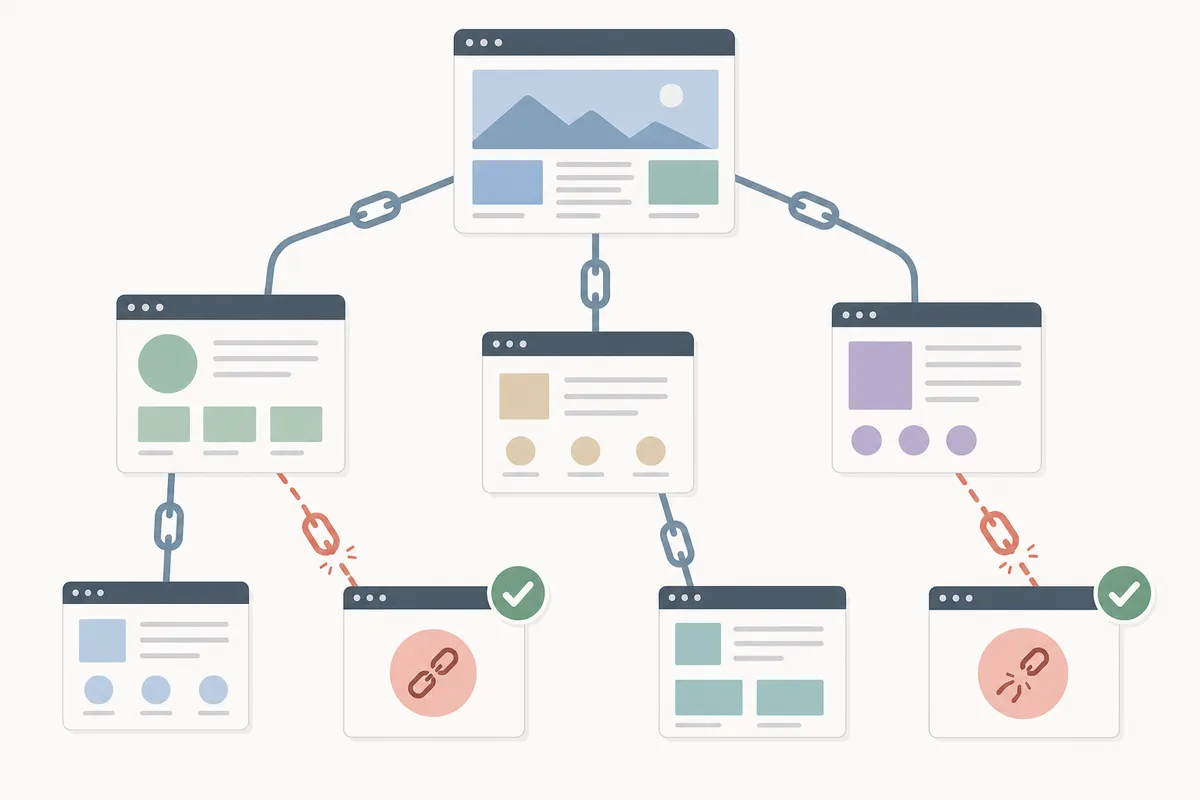
Not every SEO problem needs an agency. Some take five minutes, and others point to something systemic.
| Situation | Can you fix it yourself? | Why | What to do next |
|---|---|---|---|
| One page has a weak or missing title tag | Yes | It's a single, isolated edit in your page settings | Rewrite the title and meta description directly |
| A handful of internal links are broken | Yes | Low-risk, no technical dependencies | Update or remove the links manually |
| Rankings have dropped site-wide over weeks | Not reliably | Usually signals a technical or structural issue across many pages | Run a full site audit before guessing at fixes |
| New destination pages aren't getting indexed at all | Not reliably | Could be crawl budget, internal linking, or a technical block | Investigate indexing and site structure together |
| You're unsure which pages even target which keywords | Not reliably | This is a cannibalization or strategy problem, not a one-page fix | Map keywords to pages before writing anything new |
If the issue is confined to one page, fix it today. If it recurs, affects several pages or has no obvious cause, you need a proper audit rather than another round of guessing.
Common mistakes
- Chasing branded keywords instead of terms travelers actually search, like a destination plus property type.
- Letting two pages target the same keyword. This is cannibalization, and it drags both pages down instead of lifting one.
- Treating OTAs as the only channel, so the owner's own site never gets built out with local content.
- Publishing blog content with no internal links back to booking pages, which wastes the traffic it does attract.
- Never checking rankings or traffic, so there's no way to know what's working.
Other service businesses face the same on-page and local issues in different forms. This breakdown of fixes for a dermatology practice's site shows how niche-focused fixes can move a site that's stuck.
FAQs
Does SEO for vacation rentals help with Airbnb rankings too?
Not directly. Airbnb and Vrbo have their own internal ranking systems based on reviews, response rate and booking history. Website SEO only affects your own domain's visibility in Google.
How long does vacation rental SEO take to show results?
It varies by site and competition, but the process is cumulative. Expect weeks to months before new or improved pages climb.
Should I have one page per property or one page per destination?
Usually both. Destination and category pages (by neighborhood, amenity or property type) tend to capture broader searches, while individual property pages convert the traveler who has already decided on a specific home.
Do I need a blog for vacation rental SEO to work?
A blog isn't required. Local guides and event content do give you pages that can rank for informational searches, and a place to link from toward your booking pages.
What's the single highest-impact fix for a vacation rental website?
For most sites it's building dedicated local landing pages with real internal links to booking pages, since that is the gap more owners leave open than any other.
Put your site to the test
Pick the page most likely to bring in a direct booking, your homepage or a top destination page, and check its title tag, meta description and internal links against the steps above. If you want a clearer picture of where the rest of your site stands, talk to the team and get a sample report built around your own domain.
Resources / References
Sources
About the author
SearchBlueprint researched, wrote and scored this article with the content pipeline our customers run on their own sites. The score in the byline is what our content engine gave this page before it published. Nothing here is reviewed by hand, which is the point: it is the product's output, published where anyone can check it.