Best Local SEO Tools in 2026: Free vs Paid, Ranked
By Toy Wen Da, Co-Founder · Updated · 10 min read · scored 99/100
For most small businesses the best local SEO setup starts with a free tool, Google Business Profile. Add a paid platform when free stops being enough: BrightLocal if you manage citations and reviews across more than one location, or Semrush if you also want organic and AI search visibility tracked in the same place. Everything else on this list fills a narrower gap.

How we chose these local SEO tools
This comparison is built from each product's own website, pricing page and documentation. The question was which local SEO tools earn their subscription fee, and for whom.
Four things were weighed for every tool:
- Price and free plan: can you try it before paying, and what does the entry tier include?
- What it does well: most local SEO tools specialize in citations, rank tracking, reviews or a mix, so we looked at the one or two jobs each is built for.
- Limits: where the tool stops being useful and what you need to add on top.
- Fit for the reader: a single-location plumber and a 40-location franchise need very different tools, so "best" depends on your situation.
Prices and trial terms come from each vendor's pricing page as of October 2026 and can change, so confirm current numbers before you buy.

The 9 best local SEO tools, ranked
The nine tools below run from the free baseline every business needs to enterprise software built for hundreds of locations.
1. Google Business Profile: best as the free starting point for any local business
Google Business Profile is the free listing that controls how your business shows up in Google Search and Google Maps. You use it to publish hours, photos, posts and service areas, and to manage the reviews that appear directly in local search results. Every other tool on this list builds on top of it.
Starting price: free. Free plan: yes, fully free.
Pick it if you run any local business, because there is no scenario where you should skip it. Nobody should skip it, so claim and optimize this profile before buying anything else.
2. BrightLocal: best for an all-in-one local SEO platform
BrightLocal bundles rank tracking, citation auditing, Google Business Profile insights and review management into one dashboard. It is built for local search rather than general SEO, so its reporting and audits are tuned to local pack position and NAP consistency across directories. Agencies use it to run white-label reports for clients.
Starting price: from $31/mo (Track plan); the Grow plan adds review generation. Free plan: no permanent free plan, but a 14-day free trial with no card required.
Pick it if you want local rank tracking, citation management and review monitoring in a single subscription instead of stitching tools together. Skip it if you only need basic listing accuracy, since Moz Local is cheaper for that alone.
3. Semrush: best for local, organic and AI search visibility in one place
Semrush's Local toolkit distributes your business data to more than 70 directories and includes a map rank tracker with geo-grid heatmaps. What sets it apart in 2026 is that the same subscription tracks whether your business is cited in AI Overviews, Google's AI Mode, ChatGPT and Gemini, down to the neighborhood level. For a business that wants to appear in the local pack and in AI-generated answers, that means one dashboard instead of two or three.
Starting price: from $139/mo. Free plan: no free plan, but a 7-day free trial.
Pick it if you want local SEO, broader organic SEO and AI visibility tracking without running separate tools. If you're weighing it against other full-stack platforms, our roundup of all-in-one SEO tools goes deeper on that comparison. Skip it if you manage one location and don't care about AI search mentions yet, because the price is hard to justify for a simple use case.
4. Moz Local: best for budget-friendly listing management
Moz Local pushes your business details to major data aggregators so your name, address and phone number stay consistent everywhere, without you updating each directory by hand. It flags listing changes automatically and includes a basic reputation dashboard for reviews.
Starting price: $16/month. Free plan: limited free tools, no full free tier.
Pick it if inconsistent listings are your main pain point and you don't need deep rank tracking or review generation. Skip it if you need geo-grid rank tracking or AI visibility data, which it doesn't cover.
5. Whitespark: best for citation building and discovery
Whitespark specializes in finding and building local citations, including niche, industry-specific directories that generic tools miss. Its citation finder shows where competitors are listed and you aren't. It also offers a local rank tracker that can report by city, zip code or exact map coordinates.
Starting price: from $33/month. Free plan: limited free access, no full free plan.
Pick it if you're in a competitive local market and want manual, higher-quality citation placements over fully automated ones. Skip it if you want an all-in-one dashboard, since Whitespark is narrower by design.
6. Local Falcon: best for visual geo-grid rank tracking
Local Falcon shows a color-coded grid of where you rank across different points in a city, which tells you more than a single average position. If you need to show a client (or yourself) that you rank well three blocks from your storefront but fall off five miles away, this is the view that does it.
Starting price: $24.99/month. Free plan: no ongoing free plan, but 100 free credits to start.
Pick it if you need to visualize ranking variance across a metro area, especially for multi-location reporting. Skip it if you also need citation or review management, because it is purpose-built for geo-grid tracking.
7. Yext: best for enterprise multi-location businesses
Yext keeps business information synced in real time across a wide network of publishers, from Google and Yelp to industry-specific sites. It also supports structured data markup, sometimes called Knowledge Tags, to help search engines understand your business listings. It is a heavier, more expensive tool built for scale.
Starting price: $199/year. Free plan: no free plan, but a demo is available.
Pick it if you manage hundreds of locations or franchise sites and need guaranteed real-time accuracy across directories. Skip it if you run one location or a handful, because the cost and complexity outweigh the benefit.
8. SE Ranking: best for SEO and AI tracking without a full marketing stack
SE Ranking pairs local rank tracking with AI Overview tracking in one platform, aimed at businesses and agencies that want AI search visibility without buying a full enterprise marketing suite. Price-wise it sits between the budget listing tools and heavier platforms like Semrush.
Starting price: $129/month. Free plan: no free plan, but a 14-day trial.
Pick it if you want AI visibility tracking alongside local rank tracking at a lower entry price than Semrush. Skip it if you need the deepest citation-building or review-generation features, which aren't its focus.
9. Ahrefs: best if you already buy it for backlink and competitor research
Ahrefs isn't a dedicated local SEO tool, but its keyword research, backlink analysis and rank tracking are strong enough that many local businesses use it alongside a citation tool. You can research local search volumes, see which sites link to competing local businesses and track keyword difficulty for location-based terms.
Starting price: $129/month. Free plan: no free trial, though Ahrefs offers some free tools.
Pick it if backlinks and competitor research matter to your local strategy as much as listings and reviews do. For a closer look at tools built around technical diagnostics rather than links, see this technical SEO tools comparison. Skip it if citations, reviews or geo-grid tracking are your priority, since Ahrefs doesn't specialize in any of them.
Comparison table: local SEO tools at a glance
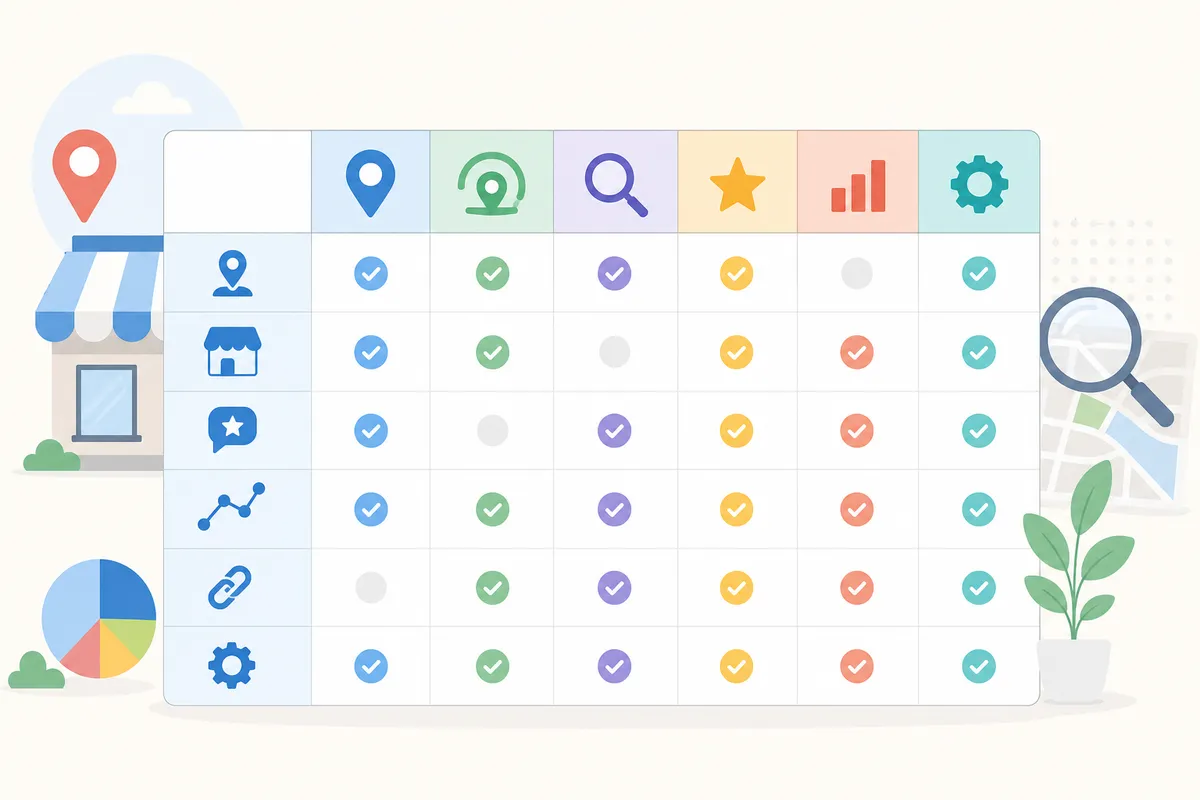
| Tool | Best For | Free Plan | Starting Price | Main Limit |
|---|---|---|---|---|
| Google Business Profile | Every local business | Fully free | Free | No rank tracking, citations or review automation |
| BrightLocal | All-in-one local SEO | 14-day trial, no card | from $31/mo | No AI search visibility tracking |
| Semrush | Local + organic + AI visibility | 7-day trial | from $139/mo | Highest entry price on this list |
| Moz Local | Budget listing management | Limited free tools | $16/month | Thin rank tracking and reporting |
| Whitespark | Citation building | Limited free | from $33/month | Narrow focus, no broad dashboard |
| Local Falcon | Geo-grid rank tracking | 100 free credits | $24.99/month | No citation or review management |
| Yext | Enterprise multi-location | Demo only | $199/year | Overkill and costly for small businesses |
| SE Ranking | SEO + AI tracking, lighter stack | 14-day trial | $129/month | Lighter on citations and reviews |
| Ahrefs | Local competitor research | Free tools only | $129/month | Not purpose-built for local listings |
How we compared
We read each vendor's public pricing and feature pages and cross-checked them against the review sites listed in Sources. No paid accounts were tested, so the descriptions reflect what vendors and reviewers publish, not our own hands-on use. Prices are the entry figures shown on the vendors' pricing pages in October 2026.
When the free option is enough, and when it isn't

Google Business Profile is free and enough by itself if you run a single location, respond to your own reviews and don't need competitor benchmarking. Many small local service businesses need nothing more than that plus consistent effort.
It stops being enough once any of these apply:
- You manage more than one location and checking each listing by hand eats hours every week.
- You need to prove ranking performance to a client, investor or boss with real reporting.
- Your citations are inconsistent across directories and you can't find every instance by hand.
- You want to know whether AI Overviews, ChatGPT or Gemini cite your business for "best [service] near me" queries, which no free tool currently tracks well.
Industry figures put a large share of all Google searches at local intent, and a majority of people who search locally visit a business within a day. If your visibility lives in a profile you check twice a month, a paid local SEO tool usually pays for itself through time saved alone.
Local SEO tools vs general SEO platforms
A general SEO platform tracks organic rankings, backlinks and keyword research across an entire site. A dedicated local tool adds what a general platform usually lacks: citation consistency across dozens of directories, review monitoring across 80-plus review sites, Google Business Profile auditing, and rank tracking down to a specific street or zip code instead of a national average.
If your site also needs broader technical or content work, pair a local tool with something built for that. A WordPress-specific SEO toolkit handles on-page and technical issues a local listing tool was never designed to catch, and an AI SEO tools roundup helps if generative search visibility matters to you as much as the local pack.
BrightLocal and Yext also support structured data for local business listings. This is the markup Schema.org defines for business hours, address and reviews, and it helps search engines parse your information correctly.
FAQs
What is the single best free local SEO tool?
Google Business Profile. It directly controls how your business appears in Google Search and Google Maps, and any local visibility strategy, free or paid, depends on it.
Do I need a separate tool for local SEO, or will general SEO software cover it?
General SEO platforms handle organic rankings and backlinks well, but they typically don't manage citation consistency, local pack rank tracking or review monitoring across dozens of sites. A dedicated local SEO tool fills that gap.
Can I do local SEO myself without paying for software?
Yes, especially for a single location. You can claim your Google Business Profile, request reviews directly and manually check a handful of directories for accuracy. It takes more time than a paid tool, but it's workable at small scale.
How much do local SEO tools typically cost?
Entry pricing runs from about $16/month for basic listing management up to $139/mo or more for platforms that also track AI search visibility. Enterprise tools built for hundreds of locations, such as Yext, start at $199/year, so cost depends heavily on scale.
Is it worth paying for local SEO tools if I only have one location?
Often, yes, if you're short on time rather than short on reviews or listings. A tool like Moz Local or Whitespark can save hours on citation upkeep even for a single storefront, though many one-location businesses do fine with Google Business Profile and manual review requests alone.
Picking the right tool for where you are now
Match the tool to your actual bottleneck. If your listings are inconsistent, start with a citation-focused tool; if you can't prove ranking performance, add a rank tracker. A single location with time to spare may find that Google Business Profile alone carries it further than expected. Whichever of the best local SEO tools you choose, treat it as the next step after the basics are covered. If you want to see what a fuller SEO picture, local and otherwise, looks like before you commit to a new tool, talk to the team.
Resources / References
Sources
About the author
SearchBlueprint researched, wrote and scored this article with the content pipeline our customers run on their own sites. The score in the byline is what our content engine gave this page before it published. Nothing here is reviewed by hand, which is the point: it is the product's output, published where anyone can check it.