9 Top Organic Traffic Strategies That Boost Rankings: A 2026 Guide
SearchBlueprint · · 15 min read · scored 89/100

The top organic traffic strategies that boost rankings in 2026 are: targeting keywords with real search potential, building topic clusters, publishing content that demonstrates first-hand expertise, lifting click-through rate with better titles, fixing technical issues, internal linking, earning quality backlinks, refreshing old content, and structuring pages so AI answer engines can cite them.
None of these is new. What has changed is the environment they operate in. Zero-click searches now account for roughly 60% of Google queries, and about 77% on mobile, according to recent industry analyses. AI Overviews appear for around 13.14% of queries and cut click-through rates by nearly half when they show up. Yet Semrush's research on traffic channels found organic search still generated over 1 trillion visits in 2025, while AI-referred traffic remained a fraction of that even after growing 66%.
Translation: the pie has more competition for clicks, but it is still by far the biggest pie. The sites winning organic traffic in 2026 are the ones executing these strategies with more discipline, not the ones chasing a secret new tactic.
Why Organic Traffic Still Deserves Your Best Effort
Organic traffic is the stream of visitors who reach your site through unpaid search results, including clicks on your citations inside Google's AI Overviews and AI Mode. Unlike paid traffic, it does not stop the moment your budget does. It compounds: a page that ranks can keep sending visitors for years at no per-click cost.
Organic vs. paid vs. AI-referred traffic
Each channel behaves differently, and understanding the trade-offs shapes where you invest.
| Channel | Cost model | Speed to results | Durability | Best use |
|---|---|---|---|---|
| Organic search | Free per click; you invest in content and SEO upfront | Slow, typically months of consistent effort | High, pages keep earning as long as they stay relevant | Sustainable, compounding growth and lower acquisition costs |
| Paid search (PPC) | Pay per click, costs rise in competitive markets | Fast, visibility within hours | None, traffic stops when spend stops | Launches, testing, and short-term demand capture |
| AI-referred traffic (ChatGPT, Perplexity) | Free per click; earned through citations | Unpredictable, depends on being quoted | Growing, up 66% per Semrush research, but still a small fraction of organic volume | A supplementary channel that rewards the same quality signals as organic |
The honest downsides
Organic growth is slow, algorithm-dependent, and increasingly squeezed by zero-click features. One frequently cited figure puts Google's share of global search traffic at 89.66%, which means you are effectively building on one platform's rules. That is worth stating plainly, because the strategies below only pay off if you commit to them for months, not weeks. If you need traffic this quarter, run ads alongside. If you want traffic that keeps arriving in two years, keep reading.

Strategy 1: Target Keywords With Genuine Search Potential
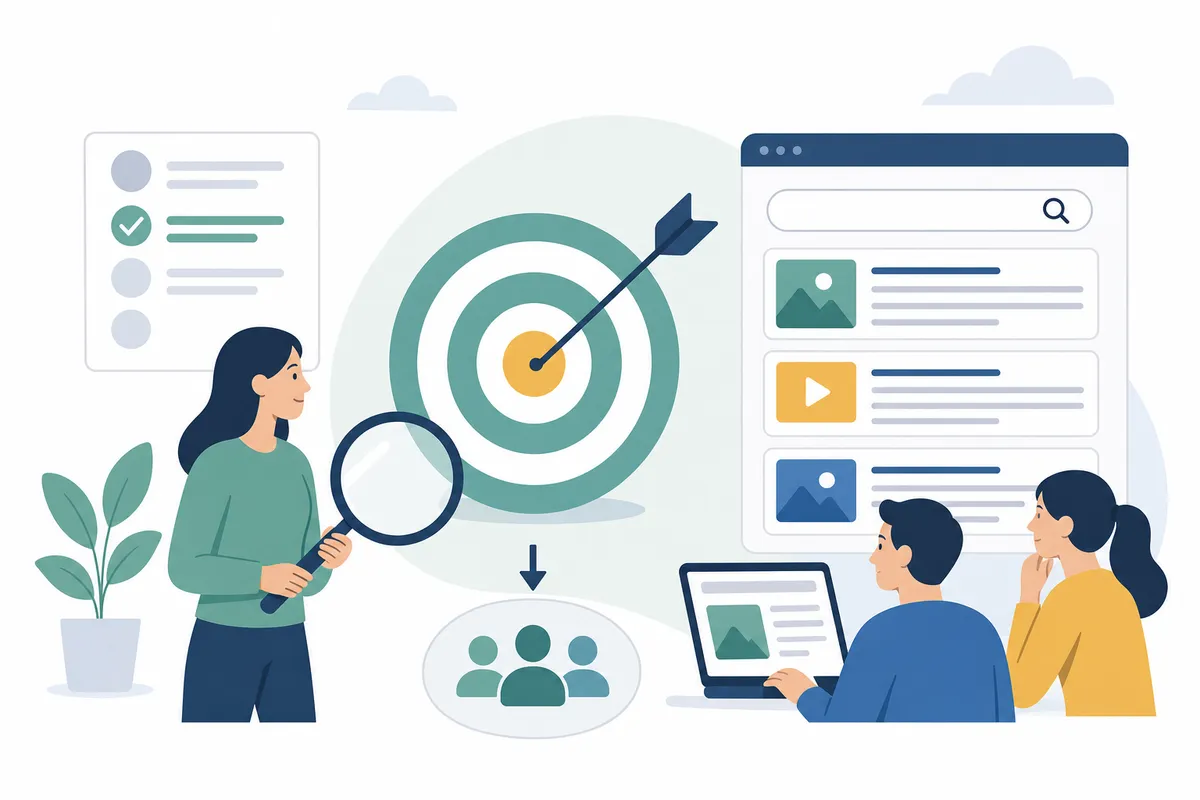
The single biggest reason websites fail to grow is publishing content nobody searches for. Ahrefs' well-known search traffic study revealed that 96.55% of all content on Google gets no traffic, meaning you, me, and everyone else consume less than 4% of the content on the internet. Random publishing produces a brief "spike of hope" and then silence.
Start with intent, not volume
Every query carries an intent: informational ("how does schema markup work"), navigational, commercial investigation ("best rank tracker"), or transactional ("buy SEO audit"). Match the page type to the intent before you look at volume. A blog post targeting a transactional keyword will lose to product pages every time, no matter how well it's written. The fastest way to read intent is to study page one: if the top results are comparison guides, Google has decided that query wants a comparison guide.
One useful benchmark from an SEO practitioner who published her traffic data: after years of intent-led targeting, 66.7% of her site's pages generated organic traffic, against a web-wide baseline where most pages earn nothing, with just 2 pages responsible for 67.1% of all visits. That skew is normal. Your job is to make sure the potential winners exist at all.
Mine the sources your competitors ignore
Standard tools show you what everyone else already sees. Two supplementary sources routinely surface queries they miss:
- Community platforms. Reddit, Quora, and forum discussions contain approximately 78% unique long-tail keywords not captured by mainstream research tools, per one 2026 analysis. These phrases are written in the customer's actual language.
- AI-powered discovery. The same research found AI-driven semantic discovery generates 53% unique queries that conventional tools never list, often question-shaped, high-intent phrases.
If you want a structured way to turn all of this into a publishing plan, a keyword research workflow that assigns every keyword its own page prevents the drift that kills most content calendars. And before you commit to a topic, run a quick competitor comparison of who already ranks for it, if page one is all major publishers, pick a longer-tail variant you can actually win.
Strategy 2: Build Topic Clusters, Not Random Posts
Google rewards sites that own a niche. One consultant on LinkedIn describes a client who tripled traffic by narrowing from twenty topics to two, depth beat breadth. The mechanism is topical authority: a pillar page covering a broad topic, supported by cluster pages that each go deep on one subtopic and link back.
The results reported for this architecture are striking. One 2026 guide cites cluster-based content driving 73% increases in website traffic within six months, and entity-based optimization reducing dependency on exact-match keywords by 67% while improving rankings across hundreds of semantically related terms. You stop ranking for one phrase and start ranking for a topic.
Kill keyword cannibalization
The flip side of clustering is the silent traffic killer: two pages on your own site targeting the same keyword. When that happens, you compete against yourself, Google splits the signals, and often neither page ranks well. The rule is simple, one page, one primary keyword. Everything else on that page is a secondary term. Audit your rankings for queries where two of your URLs trade positions; consolidate or re-target one of them, and rankings frequently recover on their own.
Strategy 3: Publish Content That Proves E-E-A-T
Google's quality framework, Experience, Expertise, Authoritativeness, Trustworthiness, laid out in its own guidance on creating helpful, reliable, people-first content, is not a slogan. It is the filter that separates content Google trusts from content it ignores. In practice, E-E-A-T means:
- Show first-hand experience. Real screenshots, real data, real outcomes. SearchBlueprint's own 347% traffic growth story, documented from its own dashboards, earns links and citations precisely because the numbers are verifiable.
- Name and credential the author. Google wants real experts behind claims, not anonymous content farms.
- Answer completely. The page should resolve the query so thoroughly the reader doesn't need to return to the results page.
- Back claims with sources. Cited statistics and named studies outrank vague assertions, and they get quoted by AI systems far more often.
Using AI writers without losing rank
AI drafting is now standard, and Google has been clear in its Search Central guidance on AI-generated content that it rewards helpful content regardless of how it was produced, but punishes thin, unedited output regardless of how it was produced. The workable middle path is AI for structure and drafts, humans for experience, data, and judgment. There's a full breakdown of that workflow in this guide to using AI content writers without tanking your rankings. The short version: never publish a draft that contains zero information the model couldn't have generated for your competitor too.
Strategy 4: On-Page SEO That Lifts Click-Through Rate
Ranking is only half the transaction. If your page ranks third for a keyword with 100 monthly searches and 15 people click, your organic CTR is 15%, and that ratio is something you can improve without moving position at all.
CTR itself is not a confirmed ranking factor, but user interaction is part of how Google evaluates results, and many practitioners report that listings earning above-average clicks tend to hold or improve position. Either way, more clicks from the same rankings is pure gain.
The levers, in priority order:
- Title tags (50–60 characters). Lead with the benefit or a number, include the primary keyword, and make a specific promise. "9 Organic Traffic Strategies That Actually Work" beats "Organic Traffic Strategies | Company Name."
- Meta descriptions (150–160 characters). Not a ranking factor, but the ad copy for your organic listing. Front-load the payoff.
- One H1, logical H2/H3 structure. Headings that name what each section covers help readers jump in, and help AI systems extract answers.
- Descriptive image alt text and compressed files. Accessibility, context for crawlers, and faster loads in one move.
- Natural keyword variation. Work the primary phrase and its variants at a natural rate; stuffing reads as machine-written to both users and algorithms.
- Schema markup. Structured data makes pages eligible for rich results, star ratings, FAQ dropdowns, prices, which visibly widen your listing and lift CTR.
Strategy 5: Fix the Technical Foundation
Technical SEO doesn't boost rankings so much as it stops your site from sabotaging them. Google can't rank what it can't crawl, and users won't wait for what won't load.
Core Web Vitals targets
Google publishes explicit thresholds in its Core Web Vitals documentation: Largest Contentful Paint under 2.5 seconds, Interaction to Next Paint under 200 milliseconds, and Cumulative Layout Shift under 0.1. Hit those and speed stops being a liability. Miss them badly and you leak both rankings and conversions, organic search already averages a 46.9% bounce rate per industry benchmarks, and slow pages push that higher.
The maintenance checklist
- Mobile parity. Google indexes the mobile version of your site. Content, links, and structured data must match desktop.
- Shallow architecture. Every important page within three clicks of the homepage.
- XML sitemap and robots.txt kept current, so crawlers find what matters and skip what doesn't.
- Broken links, redirect chains, and crawl errors cleared via Google Search Console, quarterly at minimum.
- JSON-LD structured data validated, so nothing silently breaks your rich-result eligibility.
Many of these checks cost nothing to run. This roundup of 25 free SEO tools that genuinely work covers the no-budget stack for audits, speed testing, and schema validation.
Strategy 6: Internal Linking, the Cheapest Ranking Lever You Own
Internal links are highways between your content. They pass authority from strong pages to pages that need it, help crawlers discover new content, and reinforce topical clusters. The impact can be dramatic for how little it costs: one SEO consultant reports a client jumping 15 positions in 30 days from strategic internal linking alone.
Three rules keep it effective:
- Link from your strongest pages (the ones with backlinks and traffic) to the pages you want to lift.
- Vary the anchor text. Repeating one exact-match anchor across your site reads as manipulation. Natural pages use several phrasings of the same idea.
- Give every page an onward path. A reader finishing any article should have somewhere sensible to go next, that improves engagement signals and keeps sessions above the 54-second organic average.
Strategy 7: Earn Backlinks That Actually Move Authority
Backlinks remain the backbone of domain authority, but quality has fully replaced quantity. One relevant industry link outweighs a hundred spammy directory entries, and one practitioner reports a client tripling organic traffic after landing just 5 high-authority backlinks.
The economics explain the strategy. High-quality link building is commonly listed at around $508 per quality link when outsourced, which is why the smartest programs focus on earning links rather than buying them one at a time. That cost math is also a big part of why many businesses are rethinking traditional agency arrangements, this comparison of seven alternatives to the monthly SEO retainer breaks down where that budget goes further.
Link tactics compared
| Tactic | Typical cost | Effort | What it earns | Best for |
|---|---|---|---|---|
| Digital PR and thought leadership | Time-heavy, low cash cost | High | Links from high-authority publications; rated most effective by 48.6% of SEOs surveyed for 2026 | Brands with genuine expertise or data to share |
| Original research / data studies | Moderate, research plus design | High | "Citation magnet" links from journalists and peers who reference your findings | Sites with proprietary data or the means to run surveys |
| Outsourced link acquisition | Around $508 per quality link, per industry figures | Low | Predictable link volume; ROI depends heavily on vendor quality | Teams with budget but no outreach capacity |
| Journalist request platforms (HARO-style) | Free to low | Medium | Contextual links via expert commentary | Founders and specialists who can respond fast |
| Unlinked brand mentions | Free | Low | Easy wins, sites already mention you; you ask for the link | Any brand with existing press or community presence |
One caution: anchor text over-optimization on the links you do earn can hurt rather than help. Natural, varied anchors, brand names, partial phrases, plain URLs, are what genuinely earned links look like.
Strategy 8: Refresh Old Content Before Writing New
Updating existing pages is cheaper, faster, and more predictable than publishing new ones, yet most sites treat published content as finished. It isn't. Search intent drifts, competitors leapfrog you, and information goes stale.
The evidence is consistent. One site owner documented what happened after rewriting 50% of an underperforming page and adding new keywords: rankings and traffic recovered measurably, and she reports the same approach working repeatedly on client sites. Google notices fresh, accurate content; so do readers, whose improved engagement feeds back into rankings.
A practical refresh cycle:
- Identify decliners. Pull pages whose impressions or clicks dropped over the last 6–12 months in Search Console.
- Re-check intent. Has page one changed shape for the target keyword? If listicles replaced guides, restructure.
- Update facts, dates, and screenshots. Then add something new, a table, a data point, an angle competitors lack.
- Rework tired sections rather than deleting them. A free text rewriter that preserves your meaning speeds up reworking paragraphs you need to keep but can't leave verbatim.
- Prune ruthlessly. Thin pages with no traffic and no links should be consolidated into stronger pieces or removed and redirected.
Strategy 9: Optimize for AI Answers, Not Just Blue Links
With AI Overviews appearing on roughly 13.14% of queries and reducing clicks by nearly half where they show, the pragmatic response is to become the source they cite. A click on your citation inside an AI Overview counts as organic traffic like any other click, and the pages that win citations share a recognizable shape:
- The answer comes first. Each section opens with a direct, self-contained answer, then adds detail. AI systems rarely read a page top to bottom; they extract the passage that resolves the question.
- Sections stand alone. A paragraph lifted out of context should still make sense and still be attributable to you.
- Claims are specific and sourced. "Costs around $508 per link, per industry figures" gets quoted; "can be expensive" does not.
- Structure is machine-readable. Descriptive H2s and H3s, FAQ sections, tables with labeled columns, and valid schema all make extraction easier.
The encouraging part: these are the same qualities that boost rankings in classic search. You are not running two playbooks. You are running one, with the answer moved to the front.
How to Measure Whether Any of This Is Working
Raw traffic is the vanity number. In a zero-click world, the metrics that define success are engagement and conversion, because a visitor who bounces in ten seconds was never really traffic at all.
| Metric | What it tells you | Benchmark context | Where to check |
|---|---|---|---|
| Organic sessions | Overall trend of unpaid search visits | Directional, compare against your own baseline monthly | Analytics, Search Console |
| Organic CTR by query | How well your listing competes on the results page | A #3 ranking earning 15 clicks per 100 searches = 15% CTR | Search Console |
| Average session duration | Whether visitors actually engage | Organic averages around 54 seconds, per industry benchmarks | Analytics |
| Bounce rate (organic) | Intent match between query and page | 46.9% is the commonly cited organic average | Analytics |
| Rankings per target keyword | Whether individual strategies are landing | Track weekly; one page per keyword | Rank tracker |
| Page-level traffic distribution | Where your wins concentrate | Expect skew, one owner reports 2 pages driving 67.1% of all traffic | Analytics |
Before you invest months in this, get a baseline. A free website traffic checker will estimate your current organic traffic in seconds, and you can run the same check on competitors to see the gap you're closing.
Then re-measure monthly. Organic strategies show honest results in quarters, not weeks; a strategy that hasn't moved anything after six months deserves scrutiny, but one that hasn't moved anything after six weeks just needs patience.
Where to Start: A Realistic Priority Order
If you're doing all of this from scratch, sequence matters. Fixes that unblock everything else come first:
- Weeks 1–2: Technical audit. Fix crawl errors, indexing blocks, and Core Web Vitals failures, nothing else works until Google can reach and render your pages.
- Weeks 3–4: Keyword and cannibalization audit. Map one primary keyword per page; consolidate overlaps.
- Months 2–3: Refresh your five most valuable declining pages, then build out one topic cluster completely.
- Months 3–6: Layer in digital PR or original research for links, and restructure top pages for AI-answer extraction.
The bottleneck for most teams isn't knowing this order, it's executing it week after week. That's exactly the gap an AI SEO agent that runs the whole loop from a single URL is built to close: audit, keyword mapping, drafting, publishing, and re-measuring on a schedule instead of when someone remembers.
FAQs
What is the fastest way to increase organic traffic?
Refreshing existing content is usually the fastest lever. Pages that already have some rankings and links respond quickly to updates, one site owner reported measurable recovery after rewriting 50% of a page's content. New content typically takes months longer to earn equivalent traffic.
How long do organic traffic strategies take to boost rankings?
Expect meaningful movement in three to six months for most sites, with compounding gains after that. Reported outliers exist, one consultant cites a 15-position jump in 30 days from internal linking, but those come from fixing specific bottlenecks, not from brand-new content maturing.
Do backlinks still matter for rankings in 2026?
Yes, but quality dominates quantity. One relevant, high-authority link outweighs hundreds of directory links, and 48.6% of SEOs surveyed rate digital PR as the most effective link-building tactic for 2026. Outsourced quality links are commonly listed at around $508 each, which is why earned-media approaches usually deliver better ROI.
Is organic traffic dying because of AI search?
No. Zero-click searches and AI Overviews have reduced click-through rates, but Semrush's research found organic search still drove over 1 trillion visits in 2025 while AI-referred traffic remained a small fraction of that despite 66% growth. The pages that rank well are also the pages AI systems cite, the two channels reward the same signals.
Why does my new content get no traffic?
Most likely it targets keywords nobody searches, the wrong intent, or a keyword another of your pages already targets. Ahrefs found 96.55% of all content on Google gets no traffic, almost always a targeting problem, not a quality problem. Validate the keyword and check page one's format before writing.
Run Your Baseline Audit This Week
Every one of the top organic traffic strategies that boost rankings starts from the same place: knowing exactly where your site stands today, its rankings, technical health, content gaps, and link profile. Pull that baseline now, before you change anything, so every improvement over the next six months is measurable rather than guessed. To see what a complete, decision-ready audit looks like, review a sample SEO report and talk to the team about running one for your own domain.
Resources / References
- guidance on creating helpful, reliable, people-first content
- Search Central guidance on AI-generated content
- Core Web Vitals documentation
Sources
- Tips to Improve Organic Search Ranking
- How To Increase Organic Traffic To Your Website
- What is organic traffic? (And how to increase it)
- How I Increase Organic Traffic to My Website — 3 Proven ...
- Best Strategies to Grow Organic Website Traffic: 2026 Guide
Disclaimer: This article is general information about rules and figures that applied when it was written, not personalised financial, tax or investment advice. It does not take account of your income, obligations, risk tolerance or goals, and rates and thresholds change. Verify the current position with the relevant authority, and speak to a licensed adviser or a qualified accountant before acting.
About the author
SearchBlueprint researched, wrote and scored this article with the content pipeline our customers run on their own sites. The score in the byline is what our content engine gave this page before it published. Nothing here is reviewed by hand, which is the point: it is the product's output, published where anyone can check it.