AI Audience Targeting Strategies for More Organic Traffic
SearchBlueprint · · 11 min read · scored 92/100

AI audience targeting strategies for more organic traffic replace static personas with behavior-based segments. These segments update as searchers show real intent. Instead of guessing who wants your content, machine learning tracks what people click, search for, and return to. It then matches your pages to that behavior. Google rewards the match with better rankings.
What Is AI Audience Targeting, and How Is It Different From Old Segmentation?
Audience targeting means identifying the people most likely to engage with your content or buy from you. From there, you shape what you publish and promote around them. That part hasn't changed. What's changed is the resolution.
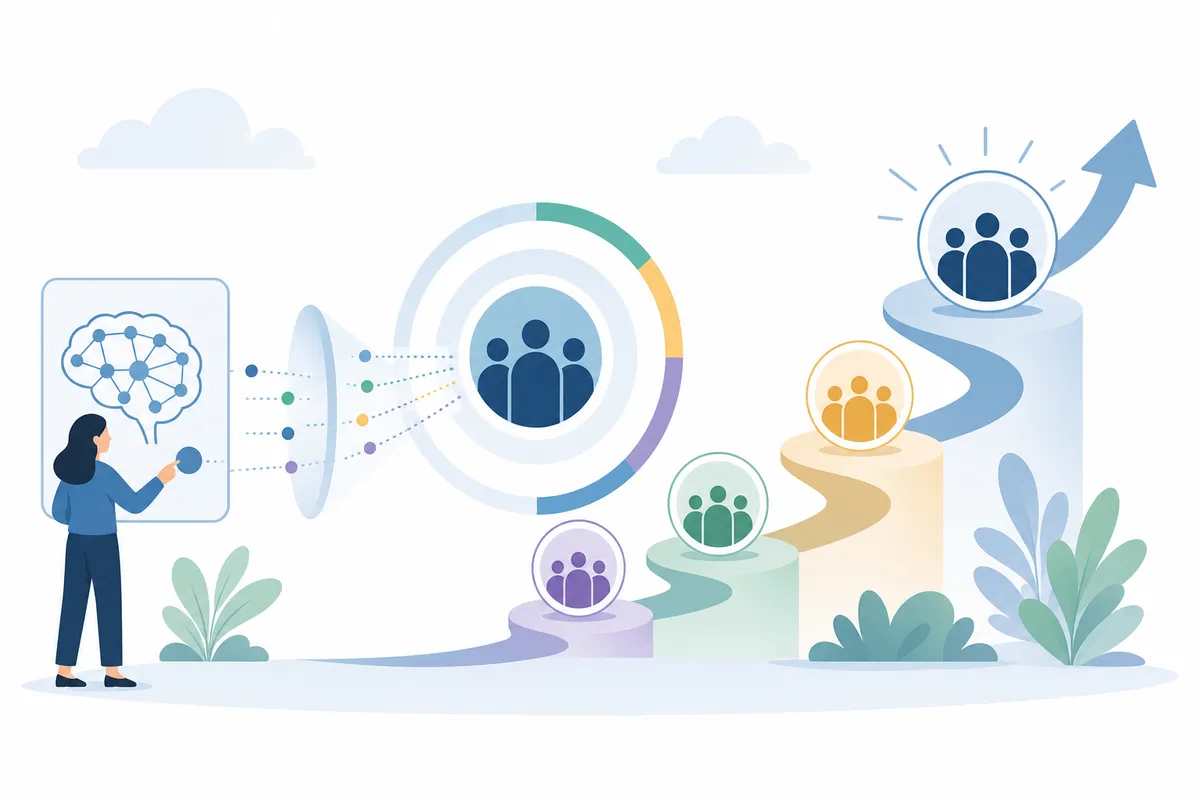
Traditional targeting groups people into broad buckets: age, location, job title. It leaves them there for the length of a campaign. AI audience targeting instead combines four layers of signal and keeps updating them as new data arrives:
- Demographics: age, location, job title, company size
- Behavioral signals: pages visited, purchase history, repeat visits, email engagement
- Interests and affinities: topics, industries, and content types someone regularly engages with
- Search intent: what a person is actively trying to accomplish right now
Combine those four layers and you stop broadcasting to a demographic. You start writing for a person mid-decision instead. That distinction is why AI audience targeting strategies for more organic traffic consistently outperform demographic-only segmentation on search. Content aligned to real intent gets read longer, shared more, and ranked higher.
The gap between the two approaches is not marginal. Industry benchmarks compare AI-driven segmentation against rule-based targeting. The AI-powered approach reports up to 30% higher ROI and 18% better conversion rates. Here's how the two compare directly:
| Factor | Traditional Targeting | AI-Powered Targeting | Reported Impact |
|---|---|---|---|
| Speed of adjustment | Days to weeks per review cycle | Near real time as behavior changes | Faster reaction to demand shifts |
| Segment logic | Fixed, rule-based groups | Dynamic, predictive modeling | Segments stay accurate as behavior changes |
| Return on investment | Baseline | Up to 30% higher, per industry benchmarks | Meaningful lift on the same budget |
| Personalization depth | Segment-level messaging | Individual-level messaging | Content matches intent, not just demographics |

Why AI Audience Targeting Matters More in 2026: The Zero-Click Shift

Search behavior has moved. Pew Research Center found that users click on traditional search results only about 8% of the time when an AI-generated summary appears on the results page. Without that summary, the click rate is roughly 15%. That's a drop of close to half. Bain & Company estimates that around 60% of searches now end with no click at all. One analysis ties that to a 15-25% reduction in overall organic traffic for informational queries specifically.
That sounds like bad news for anyone relying on rankings alone. It's really a targeting problem. And targeting is exactly what AI audience segmentation is built to solve.
Authority Still Wins, Even When Clicks Decline
Not every site loses traffic equally. Digital Content Next reported that established news publishers saw smaller organic declines (around -7%) than entertainment publishers (around -14%). That gap suggests recognized authority provides real protection against the zero-click shift. Sites that do get cited inside AI-generated answers see the opposite problem, in a good way. Reported figures show 35% higher organic click-through rates and 91% higher paid click-through rates. That's compared with competitors who aren't cited.
The pattern holds for the visitors who do click through from an AI surface. Industry data shows those visitors spend around 8% longer on-site. They also view about 12% more pages than a typical organic visitor. One analysis found AI-sourced visitors convert at roughly 4.4 times the rate of traditional organic traffic. Fewer, higher-intent visitors are replacing a larger volume of low-intent ones. AI overviews already appear for around 13% of queries. That share keeps expanding. This isn't a temporary dip to wait out.
For a broader breakdown of how these traffic patterns actually work and what to measure instead of raw sessions, see what organic traffic actually measures and how it grows.
Mapping Search Intent to the Buyer Journey

Once you accept that fewer, better-matched visitors beat more, poorly-matched ones, the next question is practical. How do you find the searches that match each stage of a buyer's decision?
Search intent generally falls into three buckets:
- Informational intent, the person is learning ("what is audience targeting")
- Commercial intent, the person is comparing options ("best AI targeting tools for small business")
- Transactional intent, the person is ready to act ("try AI SEO software free")
Mapping keywords to these stages turns content planning from a guessing game into a system:
| Buyer Journey Stage | Search Intent | What the Searcher Wants | Example Keyword Pattern |
|---|---|---|---|
| Awareness | Informational | To understand a problem or concept | "how to find target audience" |
| Consideration | Commercial | To compare tools or approaches | "AI targeting tools compared" |
| Decision | Transactional | To take the next step | "sign up for targeting software" |
Build an Intent Map in Five Steps
- List your top 5 to 10 customer questions at each journey stage. Pull these from support tickets, sales calls, and your own email replies, not guesswork.
- Research the actual search queries behind those questions. Free lookup tools can confirm real search volume and competition before you commit writing time. The free keyword checker is a fast way to validate volume and intent for a shortlist.
- Audit existing content against the map. Flag stages with no content. Also flag stages with too much overlapping content competing for the same query.
- Assign one page per keyword and stage. Ranking two pages for the same intent splits authority instead of building it. See how AI-driven keyword mapping gives every keyword its own page for the mechanics.
- Review click-through rate, time on page, and conversions by intent stage quarterly. Intent shifts as your market and competitors change. A mapping exercise done once and never revisited goes stale fast.
Building an AI Audience Targeting Strategy That Compounds
Understanding segmentation and intent mapping is the theory. Turning it into a working strategy is where most small and mid-sized teams stall. Usually, they skip straight to running campaigns instead of building the foundation first.
Start With Your Ideal Customer Profile
Look at your best existing customers, not your average ones. What industry are they in? What size is the company? What problem brought them to you? How fast did they decide? That profile becomes your targeting anchor for every segment you build afterward.
Segment by Intent Before You Segment by Demographics
Divide your audience into at least three groups. Base the groups on where they sit in the buyer journey. Give each group different content and a different call to action. A visitor comparing tools does not want a "buy now" button. A visitor ready to act does not want another explainer.
Let the Model Learn Before You Narrow It
AI targeting needs real data before it performs well. Benchmarks put the minimum at around 50 conversions within a 7-day window. A model needs that much data before it can optimize segments effectively. Platforms like Facebook Lookalike Audiences report conversion gains of 20-25%. That's once a model has learned from a large enough seed audience. Start broad. Let the algorithm run for two to three weeks. Resist the urge to narrow on day one. An under-fed model just guesses.
Track Assisted Conversions, Not Just Last-Click Sessions
Last-click reporting misses most of what AI-driven targeting actually influences. AI-powered attribution models report accuracy rates around 92.3% at identifying organic influence on conversions. A last-click report would credit those conversions to something else entirely. One behavioral pattern is worth watching specifically. Some visitors return to a pricing page twice within 48 hours. They convert at roughly 3 times the rate of first-time visitors. That's a signal worth building an automated follow-up around.
For the full six-step framework behind turning these signals into a repeatable traffic system, see how to increase organic traffic with AI-driven SEO.
Privacy-First Targeting: What Still Works Without Third-Party Cookies
Third-party cookies are largely gone. Regulations including GDPR have narrowed what counts as a legitimate basis for tracking someone across the web. That sounds like a constraint on AI audience targeting. In practice, the tactics that remain compliant tend to perform better anyway. The data behind them is cleaner and more directly relevant:
- Contextual targeting matches your content or ads to the page someone is already reading. No personal data is processed, and there's no consent risk.
- First-party data activation uses your own email list, CRM records, and purchase history. This is data collected with consent, and you're free to use it.
- Suppression and exclusion lists remove existing customers and recent converters from acquisition campaigns. This saves budget and avoids annoying people who already trust you.
- Regular creative refresh prevents audience fatigue. Industry guidance recommends refreshing ad creative every 4 to 6 weeks. Stale creative shows up as declining click-through rates and rising costs.
- Clear consent mechanisms, cookie banners, opt-in forms, preference centers, are not just a legal requirement. They signal trustworthiness to the audience you're targeting.
First-party data has a second advantage beyond compliance. It captures the exact language your real customers use to describe their problems. That language, fed back into keyword research, often surfaces intent-matched queries that generic keyword tools never surface. Teams building this out systematically report that it compounds. SearchBlueprint's own case study on growing traffic 347% by dogfooding its own AI-driven SEO tool documents one real example of first-party signal feeding directly back into content targeting.
Mistakes That Quietly Undercut AI Audience Targeting
A few habits show up again and again. They appear in accounts that adopt AI targeting tools but don't see the promised lift. None of them are exotic. They're mostly impatience or an old instinct applied to a new system.
| Common Mistake | Why It Backfires | What Works Instead |
|---|---|---|
| Narrowing the audience on day one | Starves the model of the data it needs to learn, so it never finds your best customers | Start broad, let the model run 2-3 weeks before narrowing |
| Treating AI targeting as "set and forget" | Segments drift as market conditions and search behavior shift | Review segment performance quarterly, not annually |
| Measuring only last-click conversions | Undercounts the influence of AI-assisted and zero-click touchpoints | Track assisted conversions and AI-surface impressions alongside clicks |
| Chasing volume over fit | More traffic that doesn't convert wastes content budget and dilutes authority signals | Prioritize intent-matched visitors, even if the raw number is smaller |
This is also where a durable, compounding approach beats a campaign-by-campaign mindset. Building organic growth this way is less about one clever segment. It's more about a system that keeps improving. That's the kind of approach laid out in how to achieve sustainable growth with AI-driven SEO as a compounding system. It's also the broader case made for why organic website traffic grows the way it does.
Google's own Search Central documentation on AI Overviews confirms this: strong organic ranking remains the single strongest signal for a page to be included in an AI-generated summary. That means the targeting and content-quality work described here isn't separate from AI-search visibility. It's the same work.
FAQs
What is AI audience targeting?
AI audience targeting is the use of machine learning. It identifies, segments, and reaches the people most likely to engage with your content or buy from you. It's based on real behavior and search intent rather than fixed demographic categories alone.
How is AI audience targeting different from traditional audience segmentation?
Traditional segmentation sorts people into static groups that get reviewed and updated manually, often weeks apart. AI audience targeting updates segments continuously as new behavioral and intent signals come in. That keeps the groups accurate as people's needs change.
How much data does an AI targeting model need before it performs well?
Benchmarks suggest around 50 conversions within a 7-day window as a rough minimum. A model needs that much data to optimize segments effectively. Launching with too narrow an audience starves the model and delays results.
Does AI audience targeting still work without third-party cookies?
Yes. Contextual targeting, first-party data from your own CRM and email list, and consent-based tracking all remain fully compliant. In many cases, they perform better than third-party cookie data. The signal is cleaner and more directly relevant.
How does AI audience targeting affect organic traffic specifically?
Content matched precisely to search intent earns longer dwell time and lower bounce rates. Search engines read both as relevance signals. That relevance also improves the odds of being cited inside AI-generated search summaries. Those summaries carry their own click-through advantage over non-cited results.
Test Your Current Audience Match Before You Rebuild Anything
Pick one page and one segment you can measure this month, not a five-tier framework you'll abandon by week three. Then pull a sample SEO report to see where that page is winning or losing intent-matched visitors before you touch your segments. That single check shows whether your AI audience targeting strategies for more organic traffic are paying off before you rebuild anything else.
Sources
About the author
SearchBlueprint researched, wrote and scored this article with the content pipeline our customers run on their own sites. The score in the byline is what our content engine gave this page before it published. Nothing here is reviewed by hand, which is the point: it is the product's output, published where anyone can check it.