7 Key Benefits of AI in SEO for Digital Growth Success
SearchBlueprint · · 9 min read · scored 95/100

The key benefits of AI in SEO for digital growth success come down to speed, scale and precision: AI compresses keyword research and technical audits from weeks into hours, matches content to real search intent, and adapts to algorithm changes faster than manual work. Used well, those advantages compound into more organic traffic.
Why AI in SEO Drives Digital Growth Success
Search itself has changed shape. Google's Search Generative Experience, AI Overviews, and answer engines like ChatGPT and Perplexity now often answer a question before a user clicks anything. Traditional SEO, built around matching keywords to pages, was not designed for a search results page that writes its own summary.
That shift is exactly where AI-driven SEO earns its keep. Machine learning models read far more data than a person can, at a speed no manual process can match, and they surface patterns in search intent that keyword lists alone miss. According to BrightEdge's research on AI in search marketing, 58% of SEO professionals plan to integrate generative AI functionality into their workflows in the next year, and consulting firm McKinsey has projected that generative AI could deliver roughly $460 billion in incremental productivity across marketing over the next decade. That is not a hypothetical trend. It is already reshaping how ranking teams work day to day.
From Keyword Matching to Intent Understanding
Early SEO was mechanical: find a keyword, place it on a page, build links, wait. AI-driven SEO works differently. It analyzes what a searcher is actually trying to accomplish, not just which words they typed, and it can tailor content and technical fixes to that intent at a scale no team could manage by hand. Google's own guidance on structured data and search fundamentals, published at Google Search Essentials, reflects the same shift: ranking systems increasingly reward content that answers a real question clearly, not content that simply contains the right words.

The Key Benefits of AI in SEO, Section by Section
Here is where the key benefits of AI in SEO actually show up in a working SEO program, and what each one changes about how your team spends its time.
1. Faster Keyword Research and Search Intent Mapping
Manual keyword research means pulling volume data, checking difficulty, guessing at intent, and repeating that process for every topic on your list. AI-driven tools do the heavy lifting in a fraction of the time: clustering related terms, flagging the questions behind a search, and separating commercial intent from informational intent automatically. That matters because a keyword mapped to the wrong page competes with your own content instead of ranking it. AI-driven keyword mapping exists precisely to solve that: giving every keyword one clear page to own, rather than three pages quietly fighting each other for the same term.
2. Content Creation and Optimization at Scale
Content remains the backbone of SEO, and AI has changed how much of it a team can realistically produce. Instead of a writer starting from a blank page, AI can draft structured, research-backed outlines and full drafts aligned to search intent, which a human editor then refines for voice, accuracy and nuance. The risk is publishing AI output unedited. Thin, generic AI content doesn't rank, and Google has been explicit that content created primarily to manipulate rankings, rather than to help a reader, falls under its spam policies. The teams getting this right treat AI as a drafting tool and keep a human in the editing loop; how to use AI content writers without losing rank walks through exactly where that line sits.
3. Technical SEO Audits With Machine-Level Precision
Crawl errors, broken schema, slow pages and indexing issues are easy for a person to miss across a large site and easy for AI to catch, because it can check every URL against every rule instead of sampling a handful. An AI-driven audit flags a bad canonical tag or a missing structured data property the same way on page 4 as it does on page 4,000. That consistency is the real advantage: it is not that AI finds problems a good auditor wouldn't eventually find, it is that AI finds all of them, immediately, every time the site changes. A connected AI SEO agent that runs this loop continuously, rather than once a quarter, is how technical debt stops accumulating quietly in the background.
4. Real-Time Adaptation to Algorithm and SERP Changes
Google updates its ranking systems constantly, and most of those changes are never formally announced. A manual process finds out about a shift when traffic drops and someone investigates. AI-driven monitoring tools compare rankings, SERP features and competitor movement on an ongoing basis, so a strategy adjustment happens in days rather than after a quarter of lost traffic. With search volume climbing at a steady rate year over year by most industry estimates, the cost of a slow reaction only grows.
5. Better Odds of Being Cited in AI Overviews and Answer Engines
This is one of the clearest, most measurable benefits available right now. According to BrightEdge's internal research, pages that directly address specific queries see 31% higher citation rates in AI-generated search results. That is not a small edge. It means the structure of your content (clear headers, direct answers, self-contained passages) now affects whether an AI Overview quotes your page or a competitor's. Winning citations in AI Overviews covers how to structure content specifically for that outcome, which matters more each quarter as fewer searches end in a click.
6. Data-Driven Decisions Instead of Guesswork
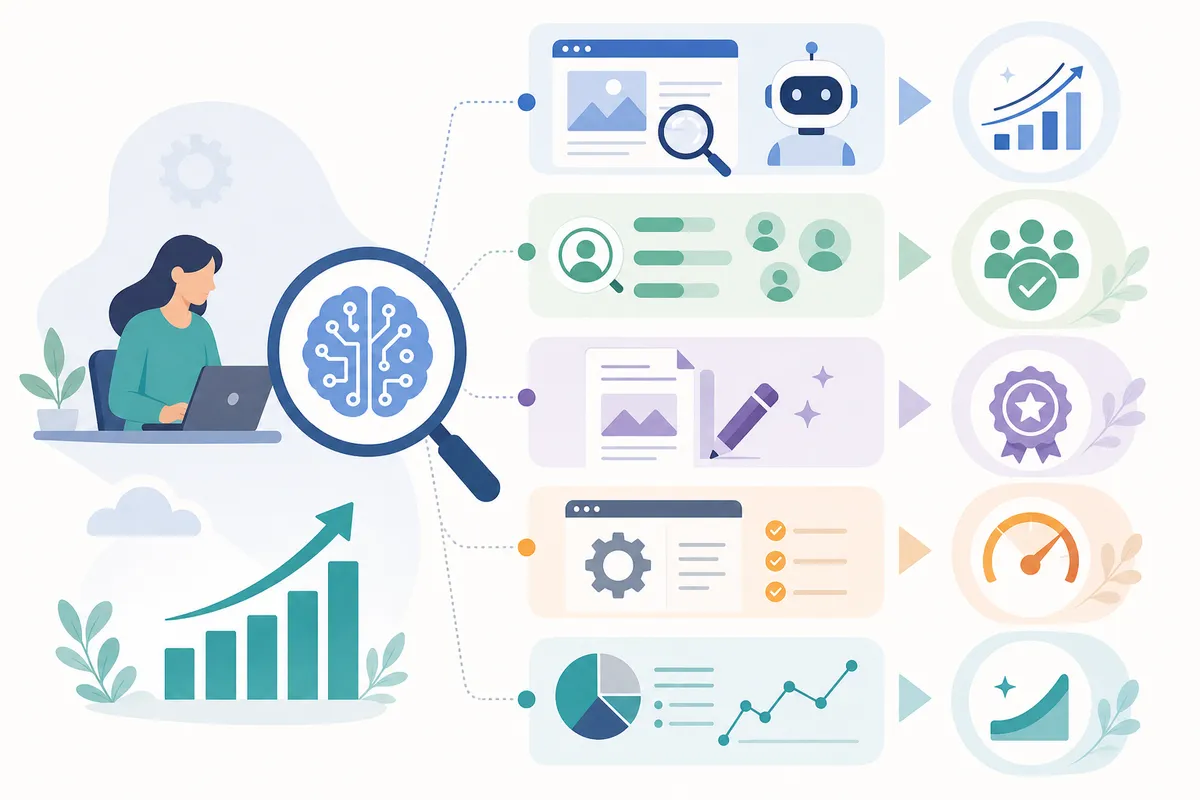
Traditional SEO decisions often relied on a mix of experience and intuition, because pulling and cross-referencing enough data to be certain took too long to be practical. AI changes that math. It can process competitor content, ranking history and user behavior together, and surface which action is actually likely to move the needle, rather than which action feels right. BrightEdge's research found that 90% of surveyed organizations plan to prioritize SEO more going forward, which tracks with SEO's growing influence over broader marketing and product decisions once the data is trustworthy enough to act on.
7. Compounding Growth That Builds on Itself
The individual benefits above are useful on their own. Stacked together, they compound. Faster keyword research feeds better-targeted content. Better content, verified by continuous technical audits, holds its rankings instead of decaying. Real-time monitoring catches problems before they cost traffic. Each cycle produces more data, which makes the next cycle more accurate. Increasing organic traffic with AI-driven SEO and building a compounding AI SEO system both describe this same pattern: growth that accelerates instead of plateauing, because each part of the system is feeding the next.
Where AI SEO Adoption Stands Right Now

The numbers below come from BrightEdge's published research on AI in search marketing and give a sense of how mainstream AI-driven SEO already is, not a future trend still waiting to arrive.
| Metric | Reported Figure | What It Signals |
|---|---|---|
| SEO professionals planning to integrate generative AI into their workflow | 58% | AI-driven SEO is now a majority practice, not an early-adopter experiment |
| SEO professionals already using AI to refresh and update content | 40% | Content maintenance, not just creation, is a proven AI use case |
| Organizations planning to prioritize SEO more going forward | 90% | Leadership confidence in SEO is rising alongside AI adoption |
| Higher citation rate for pages that directly answer a specific query | 31% | Content structure now directly affects AI Overview visibility |
What AI in SEO Still Can't Do for You
Being honest about the limits matters as much as listing the benefits. AI is very good at pattern recognition across huge datasets. It is not good at deciding what your brand should stand for, which market to prioritize this quarter, or whether a technically correct recommendation actually fits your business. Those calls still need a person who understands the company, not just the data.
There's also a cost side to this that's easy to skip past. Running AI across every part of an SEO program (content, audits, monitoring, reporting) adds up, and not every task needs the most expensive tool available. What to automate, what it costs, and what to skip breaks down where AI pays for itself quickly and where a simpler manual check is still the more sensible choice.
Treat AI-driven SEO as leverage for an experienced strategy, not a replacement for having one. A tool that drafts content ten times faster is only valuable if someone with real judgment is still deciding what gets published.

How to Start Capturing These Benefits
You don't need to overhaul your entire SEO program in one move. A practical rollout usually looks like this:
- Start with keyword mapping. Get every important term assigned to one clear page before you scale content production.
- Add AI to your existing content workflow, not as a replacement for your writers, but as a drafting and research accelerator they edit and approve.
- Automate technical monitoring so schema errors, crawl issues and broken pages are caught the day they happen, not the day someone notices a traffic drop.
- Structure new content for direct answers, since that is what earns citations in AI Overviews and answer engines.
- Review the data monthly, not just the rankings. The patterns in what's working are where the next quarter's strategy should come from.
Each step is small on its own. Together, they are how the key benefits of AI in SEO for digital growth success turn from a concept into a working system.
FAQs
What are the key benefits of AI in SEO for digital growth success?
The main benefits are speed, scale and precision: faster keyword research, content that better matches search intent, technical audits that catch every issue rather than a sample, real-time adaptation to algorithm changes, and a measurably better chance of being cited in AI Overviews and answer engines.
Will AI replace SEO professionals?
No. AI handles data processing and repetitive tasks at a scale people can't match, but strategic decisions, brand judgment and prioritization still need a person. BrightEdge's research found 90% of organizations plan to prioritize SEO more, not fewer people doing it.
How much of my content should AI write?
AI is strongest as a drafting and research tool. A human editor should still review every piece for accuracy, voice and whether it genuinely helps the reader, since content published purely to manipulate rankings falls under Google's spam policies and tends to underperform anyway.
Can AI help me get cited in Google AI Overviews?
Yes, largely through content structure. Pages that directly and clearly answer a specific query see 31% higher citation rates in AI-generated results, according to BrightEdge's research, which makes clear headers and self-contained answers a practical AI SEO priority.
What is the fastest way to start using AI in SEO?
Start with keyword mapping so every page has one clear job, then add AI-assisted technical monitoring so issues get caught immediately. Both are contained changes that show results quickly, before you touch anything else in the workflow.
See What AI-Driven SEO Would Find on Your Site
The key benefits of AI in SEO for digital growth success only show up once you apply them to your own site, not just read about them in the abstract. If you want to see where your pages stand today, on keyword targeting, technical health and AI Overview readiness, talk to the team and get a sample SEO report built from your actual site data.
Resources / References
Sources
About the author
SearchBlueprint researched, wrote and scored this article with the content pipeline our customers run on their own sites. The score in the byline is what our content engine gave this page before it published. Nothing here is reviewed by hand, which is the point: it is the product's output, published where anyone can check it.