Organic Growth Examples Made Better With AI, and Why They Work
SearchBlueprint · · 7 min read · scored 92/100
Organic growth examples made better with AI share one pattern: research that took days now takes minutes, content briefs already match search intent, and a clear list shows what to fix first. The gain is speed and focus, not magic, and the patterns below show where a human still needs to check the work.
How AI Changes the Mechanics of Organic Growth
The mechanics haven't changed. You still need the right keywords, content that answers the question, and a site Google can crawl and trust. That's the standard Google's own guide to how search works lays out. What changed is how fast a team can move through each step. Guesswork gets replaced with data pulled straight from a live crawl or a search API.
Faster Keyword and Intent Research
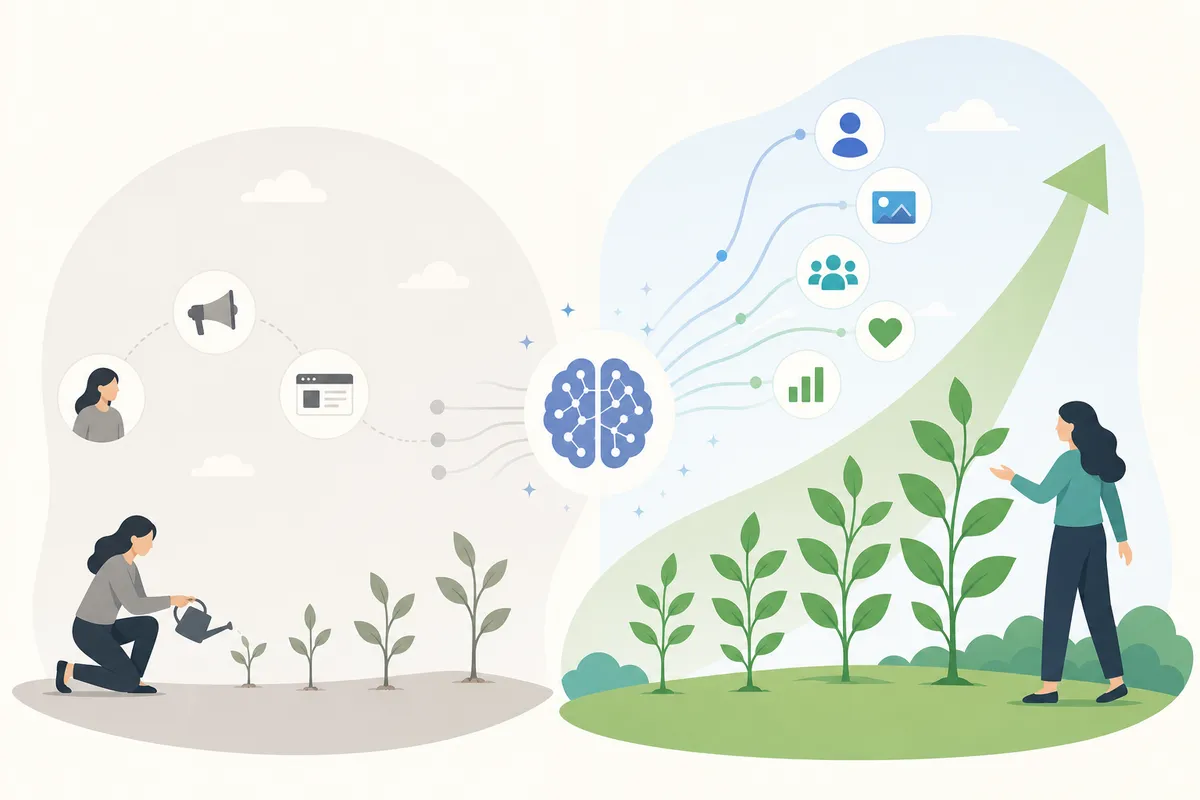
A researcher used to open five tabs, export a spreadsheet, and manually tag each keyword by intent. An AI-assisted workflow pulls search volume, competition, and related terms in one pass. It then groups them by what the searcher actually wants: information, a comparison, or a purchase. That cuts the research phase from a multi-day task to something you can turn around in an afternoon. A six-step process for turning AI-driven research into pages that rank shows how the research step feeds into what gets written next. It doesn't sit in a spreadsheet nobody opens again.
Content Briefs That Match Search Intent on the First Draft
The second place AI earns its keep is the brief. Instead of a generic outline, a well-built brief pulls the questions people actually ask and the format top results use. It shows whether that's a list, a comparison, or a how-to, and flags the gaps competitors left open. Writers still write, but they start from a brief that already reflects what's ranking, not a guess. Seven AI content tools built for exactly this handoff between research and drafting show how different tools split that work.
Prioritizing Fixes by Impact, Not Guesswork
Most sites have more technical and content issues than time to fix them. An AI-assisted audit ranks issues by how many pages they touch and how much traffic sits behind them. Google's own SEO Starter Guide covers the same technical and content basics an audit like this checks. A team fixes the five things that matter this month, not a 200-item checklist top to bottom.
Real Organic Growth Examples Made Better With AI
These are the patterns that show up repeatedly once a team adds AI to an existing SEO process, not hypothetical use cases.
Example 1: Keyword Research Compressed From Days to Minutes
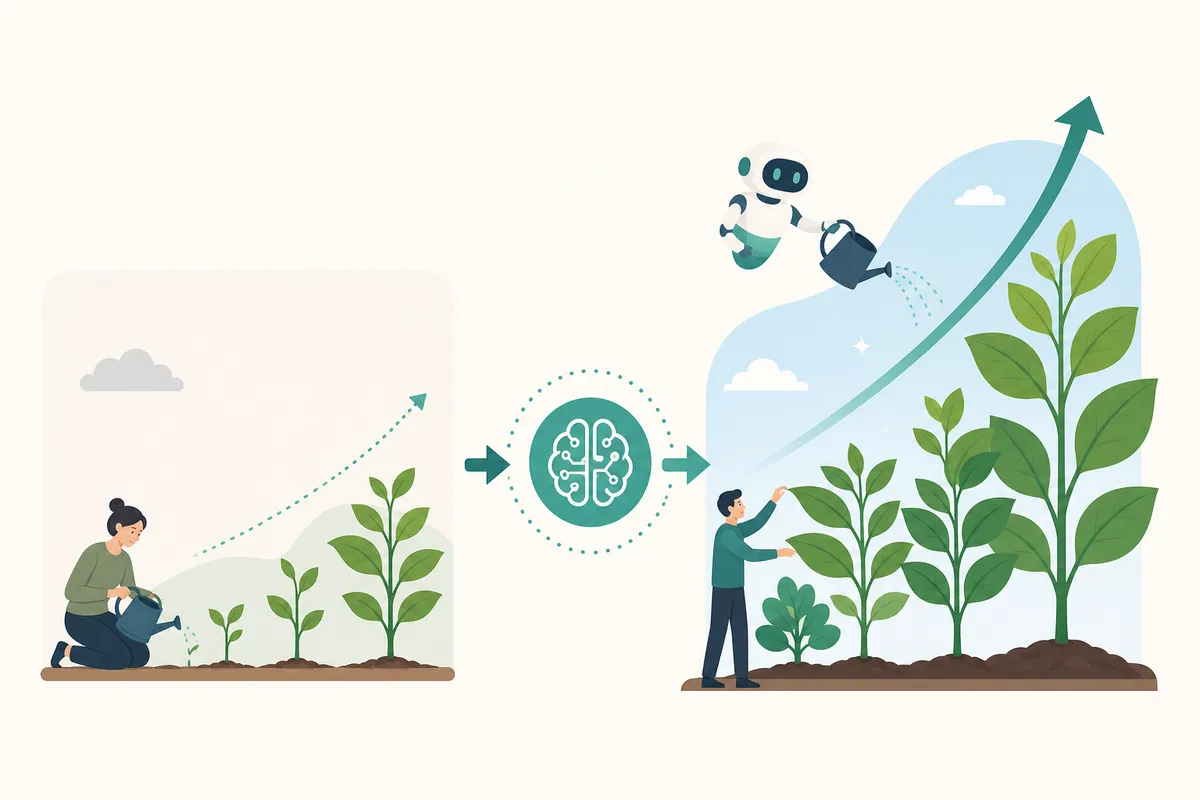
A team researching a new content vertical used to spend a week building a keyword list by hand. With AI pulling and clustering the data, that same list, sorted by intent and difficulty, comes back the same day. That leaves the rest of the week for writing and review instead of spreadsheet work.
Example 2: Content Refreshes That Recover Rankings Without a Rewrite
Old pages that have slipped in rankings often don't need a full rewrite. An AI-assisted refresh compares the page against what's currently ranking, flags outdated sections and missing subtopics, and proposes targeted edits. The page keeps its existing backlinks and history while catching up to what the query now demands.
Example 3: Internal Linking Built From an Actual Site Crawl
Internal links matter for both crawlability and topical authority. Google's own guidance on crawlable links explains why. But manually finding every relevant page to link from is tedious at scale. Pulling link suggestions from an actual site crawl, rather than a guess, surfaces connections a writer would never find by memory. Repeated across a growing content library, this turns individual articles into a compounding system. Each new page makes the next one easier to rank.
Example 4: Local Pages Built at Scale Without Duplicate Content
Service businesses with multiple locations used to either skip location pages entirely or publish near-duplicate ones that Google discounts. Generating each page from real local data, not a city name swapped into a template, keeps them from reading as boilerplate.
How to Evaluate Whether an AI-Assisted Organic Growth Strategy Is Working

Not every AI-assisted tactic is worth keeping. Judge the strategy on outcomes, not on how much content got shipped.
| Signal | What Good Looks Like | Warning Sign |
|---|---|---|
| Ranking movement | Target keywords climb over 8 to 12 weeks | Rankings flat or falling despite new content |
| Content quality on review | Human editor makes light edits, not a rewrite | Every AI draft needs a full rewrite to publish |
| Traffic quality | Organic visitors convert at a rate close to your best existing pages | Traffic grows but bounce rate spikes and leads don't follow |
If AI output is only good after a heavy rewrite, the tool is adding work, not removing it. A rundown of AI SEO tools and what each one actually costs is a reasonable starting point. Check it if the current stack isn't clearing that bar.
Paid Search vs Organic Growth: Where AI Changes the Math
Paid and organic aren't competitors so much as different time horizons. AI shifts organic's biggest weakness, the slow ramp-up, without changing what paid search is good at.
| Dimension | Paid Search | AI-Assisted Organic Growth |
|---|---|---|
| Time to first traffic | Immediate, tied to budget | Weeks to months, tied to indexing and ranking |
| Cost after the campaign ends | Traffic stops when spend stops | Pages keep earning traffic with no ongoing spend |
| Where AI helps most | Bid management, audience targeting | Research speed, content briefs, fix prioritization |
Neither replaces the other. Paid search is still the right lever for a launch date you can't move. Organic growth, sped up by AI, is the right lever for building an asset that outlives any single campaign.
The Overlooked Reality: AI Speeds Up Execution, Not Strategy
The part most explanations skip: AI doesn't decide what to build, who to target, or which market to enter next. It executes faster once a strategist has made those calls. A team that turns AI loose without a strategy behind it usually ends up publishing pages that rank for nothing anyone searches.
This is also where Google's own guidance is worth taking seriously. Its documentation on creating helpful, people-first content draws a clear line. Content produced mainly to manipulate rankings, rather than to help a reader, is the kind its systems are built to demote. AI can write the draft. It can't decide whether the draft is actually useful.
Doing this yourself works fine if you already understand your audience's search intent and review every AI draft before it ships. It's worth bringing in outside help once the volume outgrows what one person can review. The same goes once technical issues, crawl errors, indexing problems, site architecture, are past what a content workflow alone can fix.
FAQs
What's the fastest organic growth win from adding AI to an SEO process?
Keyword and intent research is usually the quickest win. Tasks that took days by hand, like clustering keywords by search intent, often compress to hours now. That happens once research pulls from live search data instead of manual tab-switching.
Does AI-generated content actually rank in search results?
It can, but ranking depends on whether the content is useful and accurate, not on who or what wrote the first draft. A human review pass checks facts, adds specifics, and confirms the piece matches search intent. That's close to the same bar Google's own Search Quality Rater Guidelines use to judge whether a page is genuinely helpful. That review is usually what separates content that ranks from content that doesn't.
Is AI-assisted organic growth cheaper than paid search?
It has a different cost shape rather than being simply cheaper. Paid search costs scale with traffic and stop the moment spend stops. AI-assisted organic content has an upfront cost to research and write, then keeps earning traffic with little ongoing spend once it ranks.
How long before organic growth examples made better with AI show results?
Most sites see initial ranking movement within 8 to 12 weeks of publishing or refreshing content, similar to organic SEO timelines generally. AI speeds up the research and writing steps; it doesn't speed up how quickly search engines re-crawl and re-rank a page.
Can a small business do this without hiring an agency?
Yes, for research, content briefs, and refreshes, especially with tools built for that workflow. Bring in outside help once technical SEO issues go beyond what a content-focused workflow can fix. The same goes once content volume outgrows one person's ability to review every draft.
See What This Looks Like on Your Own Site
Every site has a different mix of what's slowing growth down: thin content, weak internal linking, or technical issues nobody has audited. Before running one on your own site, look at a sample SEO report to see organic growth examples made better with AI.
Resources / References
About the author
SearchBlueprint researched, wrote and scored this article with the content pipeline our customers run on their own sites. The score in the byline is what our content engine gave this page before it published. Nothing here is reviewed by hand, which is the point: it is the product's output, published where anyone can check it.