What Is Multi-Domain SEO? When More Sites Help or Hurt
SearchBlueprint · · 10 min read · scored 92/100

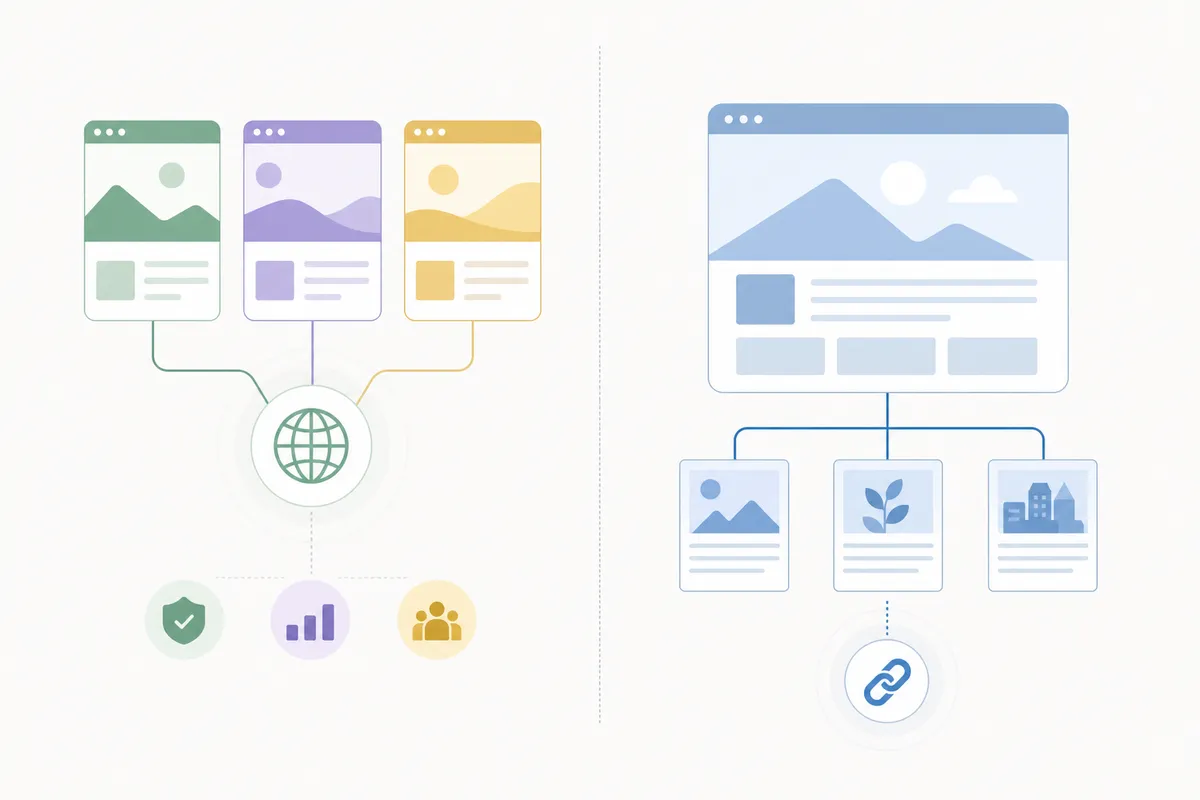
What is multi-domain SEO? It is the practice of ranking two or more separate websites owned by the same business, each with its own authority, content plan, and keyword map. It pays off when each site serves a distinct brand, country, or audience. For most businesses, one well-maintained domain outranks a spread of neglected ones.
This guide is written for owners and marketers who hold more than one domain, or are about to register a second. It covers how search engines treat separate domains, the cases where a split genuinely pays, and the habits that keep a portfolio from competing with itself.
What multi-domain SEO means
A domain is the unit search engines use to group content. Everything under one domain reads as one site: the pages share crawl history, internal links, and reputation. Content on a different domain starts from whatever that domain has earned on its own, which for a fresh registration is nothing.
Multi-domain SEO works with that separation instead of fighting it. Each site gets its own keyword research, its own content calendar, its own link building, and its own technical upkeep. The work does not shrink because the sites share an owner; it multiplies by the number of sites.

One domain, one reputation
Search engines read everything under a single domain as belonging together, and a separate domain as a separate site. Domain guides from IONOS extend the point to subdomains: from a search engine's point of view, shop.example.com can behave as its own site, apart from example.com. WordPress.com hosts every free blog on its own subdomain for that reason, so the hosted sites stay separate instead of competing with each other as sections of one giant site.
Multi-domain is not the same as multisite
Multisite is publishing technology: one CMS installation that manages and publishes several sites from a central place. Multi-domain is a strategy question about where your content should live. The two are independent. You can run multisite software on a single domain with language subfolders, or use it to publish five country domains. Plate, a CMS vendor that reports more than 100 multisite implementations, is blunt about the strategy half: there is no one-size-fits-all answer, and the right choice depends on targeting, budget, and how different the sites really are.
When multiple domains earn their keep
Four situations justify the extra cost.

Different countries and languages
Country-code domains, called ccTLDs, are two-letter endings tied to a place: .nl for the Netherlands, .fr for France, .uk for the United Kingdom, with the full registry maintained by IANA. A local ending signals a local business, and it tends to perform well in that country's results; Google's own guidance on multi-regional sites lists the ccTLD as a strong country-targeting signal. The trade is that each country domain builds authority from zero, so this route suits companies committed enough to staff and fund each market separately.
Language and country versions also have to be connected. An hreflang annotation tells search engines that two pages are the same content in different languages rather than duplicates; Wikipedia links its language editions exactly this way. Google documents the attribute in its Search Central guides, and it is easy to get wrong at scale, so check your annotations with a free hreflang validator after every structural change.
Separate brands with separate audiences
A company that owns a bakery chain and a catering-equipment wholesaler has no reason to force both onto one website. The audiences differ, the keywords differ, and a single site would blur two brands. Separate domains keep each proposition clean, and they occasionally put two of your sites on the same results page for a niche term. Plan for that as a side effect rather than the goal, because it only happens when each site earns its rankings on its own.
Keeping systems apart
Some splits are technical rather than strategic. A company might keep a brochure site on a static host, a store on a dedicated commerce platform, and a blog on WordPress, each under its own domain or subdomain. Every system then gets maintained on its own schedule, and a redesign or outage on one leaves the others alone. The SEO price of that convenience is three sets of rankings to defend instead of one.
Spreading algorithm risk
Rankings concentrated on one domain rise and fall together. Owners of large portfolios split domains partly so a core update or a manual penalty hits one site rather than all of them. That insurance is real, and it costs the full price of running each extra site properly.
When one domain wins
The case for a single domain is compounding. Each article you publish, each link you earn, and each mention of your brand lands on the domain where everything else already lives, and the whole site benefits. Split the same effort across three domains and each one grows at a third of the pace.
Cost runs the same direction. Three domains mean three content calendars, three technical audit cycles, three link profiles to build in the same niche, and three sets of hosting and renewal fees. If the fundamentals on your main site are still broken, that budget returns more where you already are; start with what to fix first across the different types of SEO.

The spare-domain myth
The version of multi-domain SEO that never works is the shortcut version: buying a batch of exact-match keyword domains and pointing them at an existing site. A parked domain that mirrors your content creates a duplicate competing with the original. A 301 redirect avoids the duplicate problem, but the redirected name brings only the rare visitor who types it straight into the address bar; there is no organic lift. Redirecting spare domains is still worth doing for brand protection and typo traffic. Just expect nothing in the rankings from it.
Thin sites built purely to funnel visitors toward one destination are worse. Google's Search Essentials spam policies describe doorway pages, and a set of near-identical city or keyword domains fits that description. The penalty risk lands on the brand behind them.
Multi-domain vs. single domain at a glance
| Factor | Several domains | One domain | What tips the decision |
|---|---|---|---|
| Local targeting | A ccTLD such as example.nl is a strong local signal in its market | One site targets countries through subfolders plus hreflang | Split when a market gets its own team and budget |
| Authority | Each domain earns links and trust from zero | Every link and article compounds in one place | Consolidate unless each site can earn links on its own |
| Cost and upkeep | Registrations, hosting, content, and audits multiply per site | One stack, one calendar, one audit cycle | Split only with budget for every site, not just the first |
| Risk | An update or penalty hits one site and spares the rest | All rankings rise and fall together | Split when one domain carries revenue you cannot pause |
| Reporting | Each site reports separately until you combine the data | One dashboard covers everything | Split only if you will actually watch every site |
| Brand clarity | Each brand keeps its own name and identity | Sub-brands share one identity | Split when the audiences would confuse each other |
How to manage multi-domain SEO
Portfolios that work share four habits.
Settle the structure before you build
Moving content between domains later means redirects, lost links, and months of re-crawling, so choose the structure first.
| Setup | Example | How search engines read it | Best fit |
|---|---|---|---|
| Subfolder | example.com/nl/ | Part of the main site, inherits its authority | Entering new markets on a limited budget |
| Subdomain | shop.example.com | Often treated as a site of its own | Separate systems such as a store or a blog |
| ccTLD | example.nl | A dedicated local site for one country | Markets with their own team and budget |
| Separate domain | othername.com | A fully independent site starting from zero | A distinct brand with its own audience |
Give each domain its own keyword map
Two of your own sites chasing the same primary keyword split clicks and links between them, and both rank worse for it. Assign every primary term to exactly one page on exactly one domain, and keep the map where the whole team can see it. The balance of work then differs per site: a local trades brand leans on local signals while a content brand leans on publishing, and the weight each site gives the core SEO strategies should follow its job.
Keep every page unique to its domain
Never publish the same page on two of your domains without either a canonical tag naming the original or an hreflang annotation that declares a translation; Google's documentation on consolidating duplicate URLs explains how the canonical does that job. Duplicates split ranking signals between URLs you own. The rule covers boilerplate too: identical About pages and service descriptions pasted across a portfolio give search engines less reason to rank any single copy.
Track each domain separately, then side by side
Measurement is where multi-domain SEO usually fails first. Each site needs its own analytics and its own search console property, and the owner needs one view across all of them; enterprise platforms such as seoClarity built dedicated multi-domain reporting because exporting each site's data separately does not scale. A smaller portfolio can get there with weekly rank tracking per market for each domain, reviewed side by side once a month. A drifting site shows up in that review long before it shows up in revenue.
Common multi-domain SEO pitfalls
Most failed portfolios trace back to one of these.
- Duplicate content across your own domains makes the copies compete with each other, and you end up building twice the links in the same niche to hold one position.
- Budget follows the flagship while the second site misses audits and fresh content, and its rankings slide until it is a liability carrying your brand name.
- A footer block connecting your whole portfolio on every page looks like a link scheme, so link between your sites where a reader benefits and nowhere else.
- Extra names bought and pointed at your main site change nothing in the results, whatever the domain reseller implied.
- Without one combined view across sites, a drifting domain goes unnoticed for months.
- A second domain funded from the first one's unfinished SEO budget usually produces two mediocre sites instead of one good one.
FAQs
Does having multiple domains help SEO?
Not on its own. Extra domains only help when each one is a real site with unique content, its own links, and a distinct job to do. Domains bought and pointed at an existing site add nothing to its rankings.
Is a subdomain or a separate domain better for SEO?
A subdomain keeps the family name but can still be treated as a separate site, so it suits technical splits such as a store or a blog. A separate domain suits a separate brand. If the goal is to concentrate authority, a subfolder on the main domain beats both.
Can I redirect spare domains to my main website?
Yes. A 301 redirect is the right way to hold misspellings and old brand names, and it avoids duplicate-content problems. It brings direct type-in visitors and nothing more, so expect no ranking movement from it.
Do multiple domains hurt SEO?
They can. Duplicate content across your own sites, links spread too thin to move any one domain, and self-competition on shared keywords all cost rankings. One maintained domain routinely outranks a scattered portfolio.
What is the difference between multi-domain SEO and multisite?
Multisite is publishing technology, meaning one CMS that manages several sites from a central place, while multi-domain SEO is the strategy of ranking separate domains. You can use multisite software on one domain or many, and the SEO questions stay the same either way.
Get a baseline before you add a domain
So what is multi-domain SEO, in the end? A multiplier on whatever you are already doing. Find out what your first domain actually needs before committing to a second. Read a sample SEO report to see what a full audit covers for one site, then talk to the team about running the same audit across every domain you own.
Resources / References
- IANA
- guidance on multi-regional sites
- Search Central guides
- Search Essentials
- documentation on consolidating duplicate URLs
Sources
About the author
SearchBlueprint researched, wrote and scored this article with the content pipeline our customers run on their own sites. The score in the byline is what our content engine gave this page before it published. Nothing here is reviewed by hand, which is the point: it is the product's output, published where anyone can check it.