Multi-Site Link Building That Scales Without Penalties
SearchBlueprint · · 8 min read · scored 95/100

Multi-site link building means running one link acquisition system across every domain you own: audit each site first, send outreach to the pages closest to ranking, keep cross-links between your own properties sparse and relevant, and measure referring domains site by site rather than in one blended number.
This guide is for agencies managing client portfolios, affiliate operators with several niche sites, and companies running separate brands or country domains. The tactics are the same ones that work for a single site. The discipline around them is not.
What multi-site link building is, and who it is for
Multi-site link building is the coordination layer on top of normal link building. Instead of one site earning links, you have several, and you decide where every hour of outreach and every earned link does the most good.
It is not a private blog network. A PBN exists to pass links between sites built for that purpose. A legitimate portfolio is a set of real sites with their own audiences, and each one has to earn links on its own merits. The moment your sites exist mainly to link to each other, you have crossed into the territory Google's spam policies describe.
The prize is real. Research from Backlinko found the top result on Google averages 3.8 times more backlinks than the results in positions 2 through 10. When you run several sites, the question is not whether links matter. It is which site deserves them next.

Audit your portfolio before you build a single link
Put every site on the same scorecard
Score each domain on the same sheet so the comparison is honest. For every site, record:
- Referring domains, and how they trend over recent months
- Keywords sitting on page two or the bottom of page one for money terms
- Content depth on the pages you would point links at
- Technical health: indexation, speed, mobile rendering
- Revenue role: what this site actually earns or feeds
A site with strong content and a thin link profile is a different job from a site with plenty of links and thin content. The first needs outreach. The second needs writing, and links can wait.
Decide which sites get links first
Splitting the budget evenly across eight sites usually means nothing moves anywhere. Concentrate instead.
| Priority | Which sites qualify | Link focus | Why they come first |
|---|---|---|---|
| First | Revenue pages just off page one, on a technically clean site | Digital PR and guest posts pointed at those exact URLs | A handful of strong links can tip an almost-ranking page, and nothing else in the portfolio pays back faster |
| Second | Established sites with good content but few referring domains | Steady outreach to the homepage and key category pages | Domain-level authority lifts every page, which compounds on a content-rich site |
| Last | New or weak sites with thin content or technical problems | No outreach yet; fix the site first | Links pointed at pages that cannot convert or rank are the most expensive links you will ever buy time for |
Safe cross-linking between your own sites
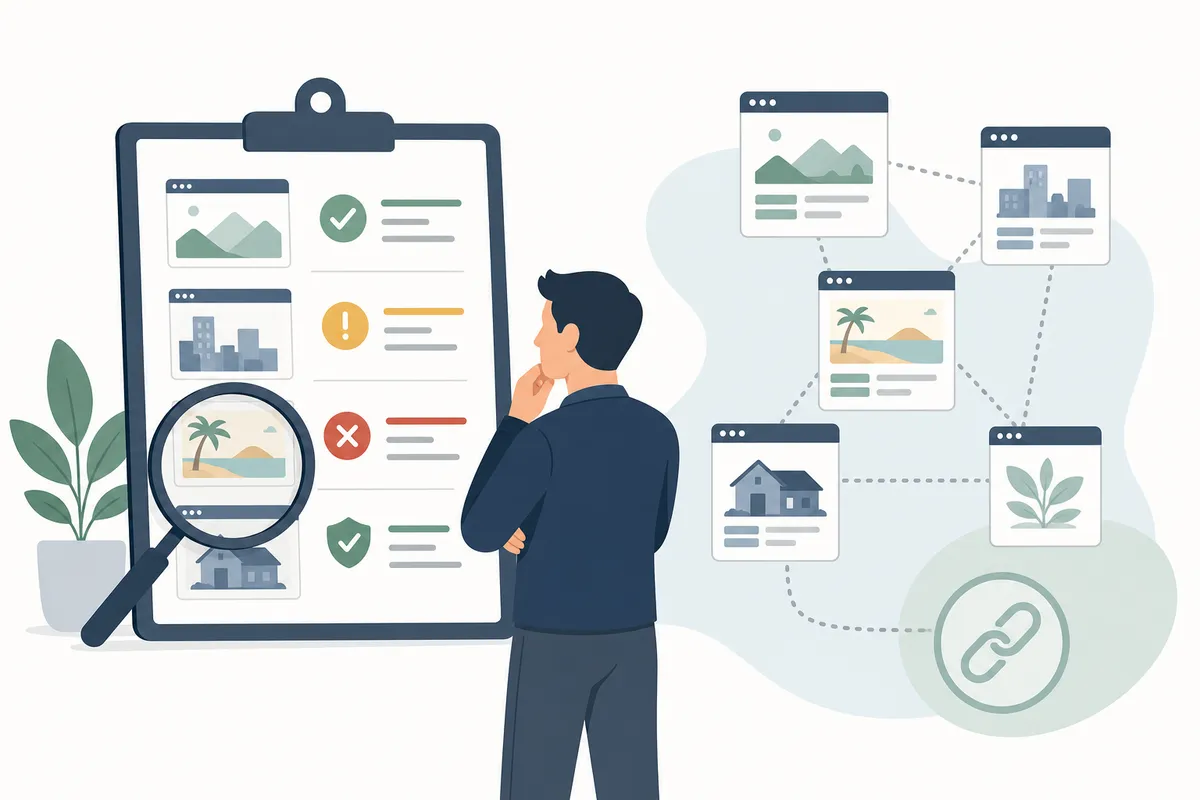
Linking your own sites to each other is legitimate when the link helps a reader. A recipe site pointing to your kitchen-equipment review site, on a page about that equipment, is a normal editorial choice. A footer on all six sites linking to the other five is a pattern, and patterns are what filters catch. Google's spam policies explicitly list excessive link exchanges and pages that exist only for cross-linking as link spam.
Rules that keep cross-links clean
- Link only where the destination genuinely answers something on the source page.
- Vary the anchor text the way independent sites would. Google's link best practices call for anchors that describe the destination page, and repeating one exact-match anchor across your portfolio reads as manipulation.
- Never use sitewide footers or sidebars to interlink the portfolio.
- Keep cross-links a small minority of each site's outbound links.
- Be comfortable with the ownership being discovered. If a link only makes sense while the shared owner is hidden, it should not exist.
The principles behind penalty-safe link building apply double here, because you control both ends of every link and nobody else is applying editorial judgment for you.
Footprints that get portfolios flagged
Trouble rarely comes from one cross-link. It comes from stacking signals: the same hosting, the same theme, the same analytics account, aggressive interlinking, and commercial exact-match anchors everywhere. Any two of those look like a company. All five look like a scheme. If your portfolio already looks like this, cut the cross-links back to the few a reader would actually use, and rebuild anchors so they describe the destination in plain words.

Playbooks that scale link building across multiple sites
Every external tactic that works for one site works for a portfolio. The advantage is reuse: one asset, one prospect list, or one spokesperson can serve every relevant domain you own. Start from the link building strategies SEO specialists run first and adapt each one for reuse.
Digital PR from one shared dataset
Commission or compile one piece of original data, then pitch it from several angles. Each journalist gets a tight, relevant story, and each placement links to whichever of your sites fits the angle. Timeliness helps: seasonal hooks give the same dataset several lives across the year.
Guest posting and expert commentary
Build one vetted prospect list per niche, not per site. Check each host for topical relevance, real traffic, and human authors before you pitch. Then route every accepted placement to the site in your portfolio it genuinely fits. The same logic works for journalist-request platforms: one credible spokesperson can answer queries that earn links across several of your domains.
Unlinked mentions and reclamation
Set alerts for every brand name in the portfolio. When a mention appears without a link, a short, polite request converts it. This is the lowest-effort tactic on the board, and portfolios benefit most because they have more brand names in circulation.
| Tactic | How it scales across a portfolio | Relative effort | Best for |
|---|---|---|---|
| Digital PR | One dataset is pitched from several angles, and each story links to the most relevant site you own | High | Sites that need a step change in authority |
| Guest posting | One vetted prospect list per niche serves every site in that niche | Medium | Steady growth on established sites |
| Expert commentary | One spokesperson answers journalist requests and earns links across several domains | Medium | Founders and specialists with real credentials |
| Unlinked mentions | Alerts on every brand name in the portfolio surface easy link requests | Low | Established brands with existing coverage |
Governance: one operation, many sites
Give every topic one owner
Two of your own sites chasing the same keyword compete with each other, and Google tends to rank neither well. Assign each money topic to exactly one site. The others may cover neighboring angles and link to the owner, but they never target the head term. Write the ownership map down; it is the single decision that prevents most portfolio waste.
Set velocity and quality floors
A steady monthly rhythm per site beats bursts. Define a quality floor for prospects, in terms of relevance, real traffic, and human authorship, and refuse anything under it even when it is easy. One weak site accepting junk links can drag scrutiny onto the domains that matter.
Measure per site, never per portfolio
Backlinko's research also tied higher rankings to links from more referring domains, not more links from the same ones. So report referring domains and target-page rankings for each site separately. A blended portfolio number hides a failing site behind a winning one, and it hides the moment a tactic stops working on one niche while it still works on another.
FAQs
Is multi-site link building the same as running a PBN?
No. A PBN is a set of sites built to pass link equity, which Google treats as link spam. Multi-site link building coordinates outreach for real sites with real audiences, where every link would still make sense if the shared ownership were public.
Should my sites link to each other at all?
Yes, where a reader genuinely benefits. Relevant, editorial cross-links between sister sites are normal business behavior. What gets portfolios into trouble is scale and pattern: sitewide links, exact-match anchors, and interlinking every site to every other site.
Which site in a portfolio should get links first?
The site where links change revenue soonest. Usually that is a technically healthy site with money pages sitting just off page one. Weak or thin sites come last, after their content and technical problems are fixed.
How many cross-links between my own sites are safe?
There is no safe fixed number, and anyone quoting one is guessing. Use a proportion test instead: cross-links should be a small share of each site's outbound links, every one should serve a reader, and none should sit in sitewide templates.
Do separate domains share link authority?
No. Each standalone domain builds its own link profile from zero, which is the price of running separate brands. That is why the audit matters: it tells you which domains have earned the right to more investment and which would be stronger folded into another site.
Audit one site this week
Pick the strongest site in your portfolio, pull its referring domains and near-ranking keywords, and score it against the checklist above; one afternoon of honest numbers usually reorders the whole plan. Multi-site link building rewards the operator who knows exactly where each domain stands before the first pitch goes out. To see what that audit output looks like in practice, review a sample SEO report and talk to the team about running one across your portfolio.
Resources / References
Sources
- Multisite Link Building : r/SEO
- What is Link Building? (And Why Is It Important?)
- Our 10 Best Link Building Strategies and Why They Work
- How I Develop Successful Link Building Strategies for My ...
- Can someone describe how to actually perform link ...
Disclaimer: This article is general health information, not individual medical advice. It cannot account for your history, medication or examination findings. For advice about your own symptoms, speak to a qualified clinician; if symptoms are severe or worsening, seek urgent care.
About the author
SearchBlueprint researched, wrote and scored this article with the content pipeline our customers run on their own sites. The score in the byline is what our content engine gave this page before it published. Nothing here is reviewed by hand, which is the point: it is the product's output, published where anyone can check it.