What Is Lead Generation? From First Click to Paying Customer
SearchBlueprint · · 12 min read · scored 92/100

What is lead generation? It is the process of attracting people who might buy from you and capturing a way to contact them, usually a name and an email address. A lead is a person who has shown real interest in your product and handed over their details through some deliberate action. Everything else in this guide is about doing that on purpose, at a cost you can live with.
Key Takeaways
- A lead is contact information plus demonstrated interest. Lead generation is the system for collecting both deliberately instead of waiting for referrals.
- Quality beats volume: ten leads with a real chance of buying are worth more than fifty that will never convert.
- Inbound channels like SEO and webinars compound over time, while outbound channels like ads and cold outreach buy speed.
- Every serious program qualifies its leads through scoring, persona matching, or a framework like BANT.
- The fastest fix in most programs is not more traffic. It is qualifying and following up on the leads you already capture.
What lead generation means (and what counts as a lead)
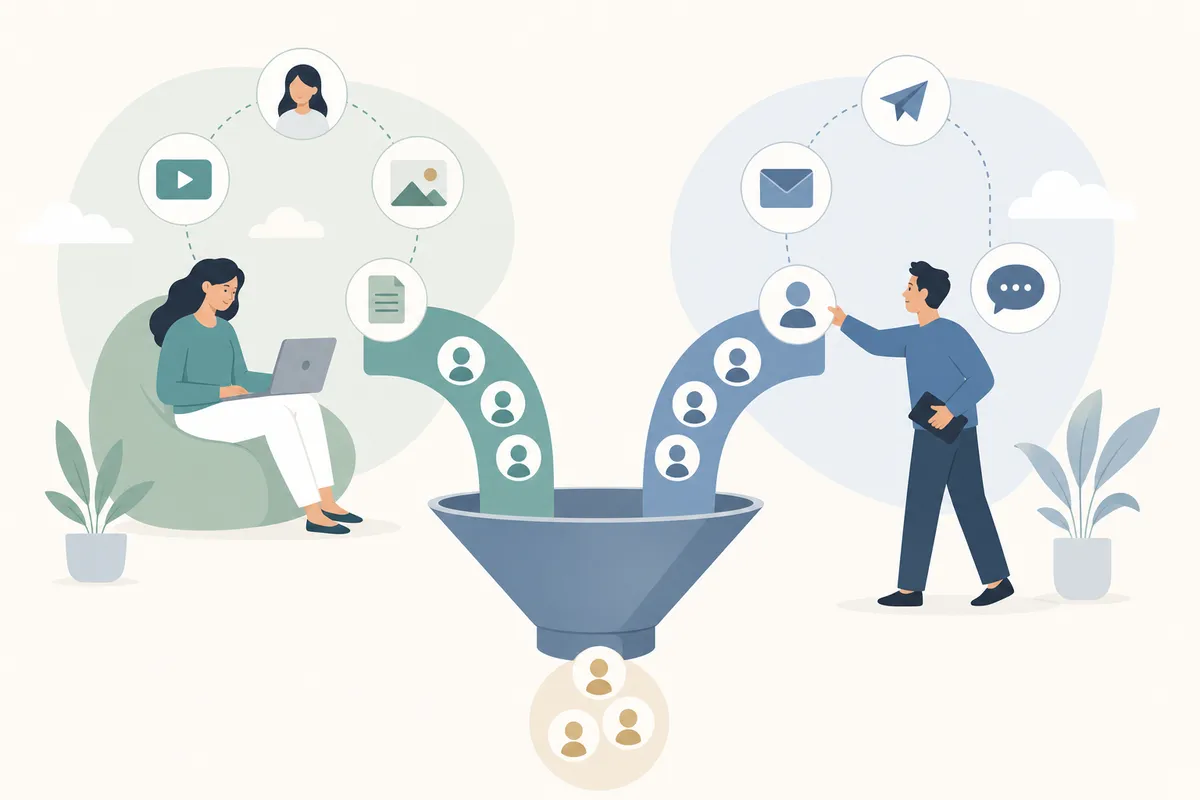
Strip the jargon away and lead generation is a trade. You offer something a potential customer wants: a guide, a price estimate, a free tool, a webinar seat. They hand over contact details to get it, and those details, plus the interest behind them, are the lead.
Leads arrive through more doors than most people assume. Web forms and landing pages are the obvious ones, but referrals, phone calls, event signups, and ad clicks that end in a submitted form all count. What matters is consent and interest: the person chose to engage, and you can now follow up without being a stranger.
From captured lead to pipeline
Capturing a lead starts a process rather than ending one. Lead generation is usually paired with lead management, which moves each contact through defined stages toward a purchase. Marketers call the combination pipeline marketing, and it is why a good program tracks leads all the way to revenue instead of stopping at the form submission.
One neighboring term is worth separating early. Demand generation builds awareness and desire broadly; lead generation converts that attention into named contacts you can actually follow up with. One creates the interest, the other captures it, and confusing the two is how teams end up measuring applause instead of pipeline.
Why budgets keep moving here
Companies fund what fills the pipeline. LinkedIn's B2B Marketing Benchmark found nearly 70% of B2B marketers increasing their lead generation budgets, which made it the top investment area across marketing teams. LinkedIn also reports an average 113% return on ad spend for B2B advertising on its platform, which hints at why so much of that budget flows to paid social.
The model reaches well beyond marketing departments, too. Uber has argued in federal court that it is not a taxi company but a lead generation platform connecting drivers with riders, the way eBay connects buyers with sellers. When a company that size describes its entire business this way, the term has clearly outgrown the marketing textbook.

How the lead generation process works
Every company runs this differently, but the machinery underneath rarely changes.
The five stages
- Create something worth a visitor's time: a blog post that answers a buying question, a free tool, a landing page, a webinar.
- Get discovered. Promote it through search, social, or paid campaigns so the right people actually find it. Volume matters here, and it helps to know how much website traffic you actually need before assuming more is the answer.
- Prompt an action. A clear call to action tells the visitor exactly what to do next, whether that is registering for a session or requesting a quote.
- Capture the details. A form trades your offer for their contact information, and shorter forms convert better. Ask for the essentials now and gather the rest during the conversation.
- Nurture. Follow up with personalized emails or calls, usually through a CRM, until the lead is ready to talk about price.
Where the process usually breaks
The failure points are boringly consistent. Forms ask for eleven fields when three would do, so people abandon them. Calls to action say "Learn more" instead of naming the thing on offer. Captured leads sit untouched for a week, by which point the interest that produced them has cooled. Fixing follow-up speed alone often returns more than doubling traffic would.

Inbound and outbound: two ways to fill the pipeline
Inbound lead generation means prospects find you. You publish content, rank in search, host webinars, and offer gated resources, and interested people start conversations on their own terms. It is slower to start and builds trust as it goes.
Outbound means you go find them: cold email, paid ads, trade shows, direct mail. It costs money per touch and can feel intrusive when done lazily, but it produces leads this week rather than this quarter. Most programs that last end up running both, because each covers the other's weakness.
Here is how the common channels compare:
| Channel | How it captures leads | Cost profile | Best for |
|---|---|---|---|
| SEO and content | Pages that rank or get cited by AI assistants bring visitors who run a tool or fill a form | Effort upfront, low cost per lead once ranking | Durable demand that compounds |
| Paid search | Ads on purchase-intent keywords send clicks to a landing page | Pay per click; stops when the budget stops | Fast tests and high-intent capture |
| Social media | Organic posts plus paid campaigns with built-in lead forms | Mixed; paid social bills per impression | B2B on LinkedIn, B2C on visual platforms |
| Webinars | Registration is the capture; the session delivers the value | Production and promotion time | Complex products that need explaining |
| Gated assets | An ebook, template, or report exchanged for an email address | Content production cost | Building a list to nurture |
| Newsletters and targeted sends to an opted-in list | Low, but the list must be earned first | Warming captured leads toward sales-ready | |
| Referrals | Existing customers recommend you, sometimes through a formal program | Near zero | The highest-converting leads most companies ever get |
| Purchased lists | Buying contact databases outright | Cheap per record | Almost nobody; records are stale and never opted in |
How to qualify the leads you generate
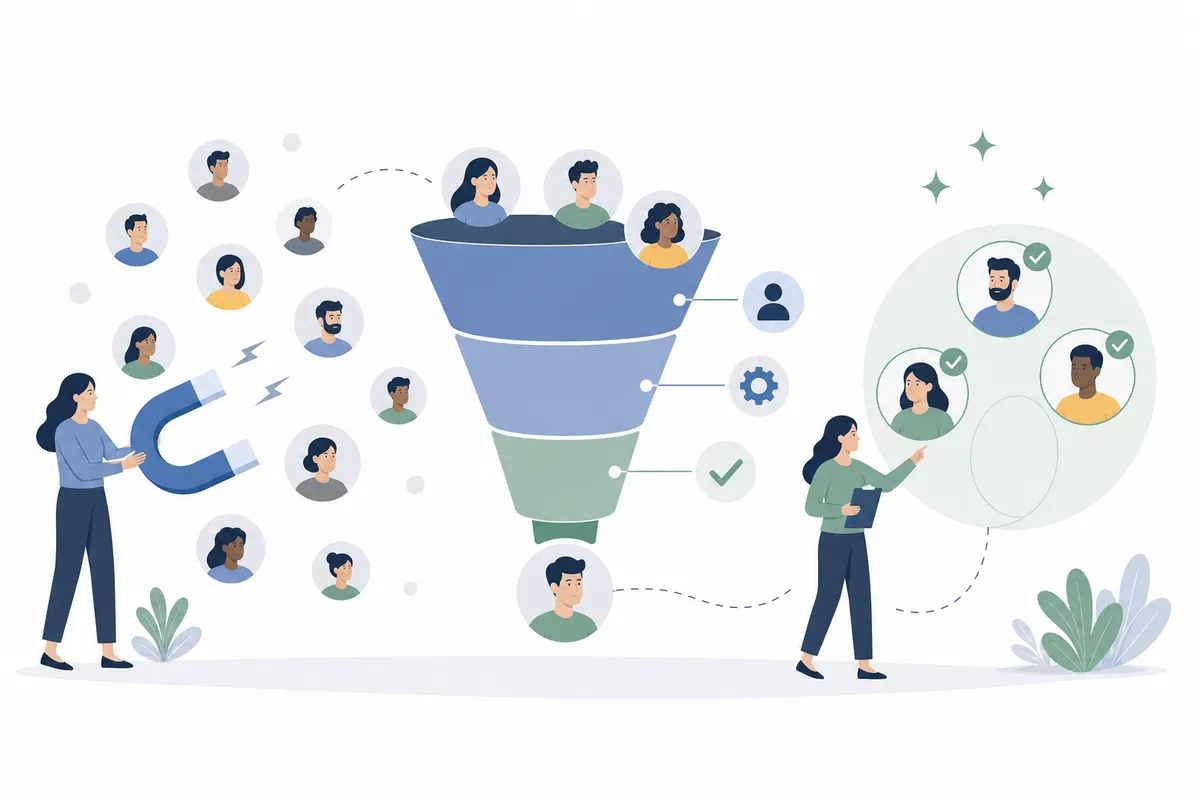
Not every lead deserves the same attention, and treating them identically wastes your best ones. It is more efficient, in both time and money, to work ten leads with a strong chance of converting than fifty with almost none. Qualification is how you tell the difference.
This is also where sales and marketing famously disagree. Marketing celebrates a full funnel of marketing qualified leads while sales complains that none of them buy. Teams that agree on one shared definition of "qualified", measured with one set of numbers, convert more of what they capture.
The four types of qualified leads
| Lead type | What it means | Typical signal | Sensible next step |
|---|---|---|---|
| Marketing qualified lead (MQL) | Interested in your brand but not ready to buy | Downloaded a guide, opens your newsletter | Keep nurturing with useful content |
| Sales qualified lead (SQL) | Actively evaluating a solution like yours | Requested a demo or asked about pricing | Sales follow-up within a day |
| Product qualified lead (PQL) | Already using a limited version of your product | Active on a free trial or free tool | Show what the paid tier unlocks |
| Service qualified lead | Existing customer signaling they want more | Asked support about an upgrade | Route to account management |
Lead scoring, personas, and BANT
Lead scoring assigns each lead a value, either a number on a scale like 1 to 10 or a label like hot and cold. The score draws on fit (industry, company size, job function) and behavior (pages visited, assets downloaded, emails opened), and it changes as the lead acts. Scoring used to be a manual chore; most teams now let automation handle the arithmetic.
Persona matching is blunter: define your ideal customer profile, then qualify the leads that resemble it. Action-based qualification is simpler still, treating specific behaviors, like requesting a demo, as qualification in themselves. BANT asks four questions of every lead: does this person have the Budget, the Authority, a genuine Need, and a Timeline? None of these frameworks is the correct one. The correct one is whichever your sales team will actually use.
Manual vs. automated lead generation
Automation is the loudest debate in lead generation right now, and the honest answer is that it multiplies whatever process you already have. Automate a good process and you generate good leads faster. Automate a bad one and you annoy more people per hour than any human could.
| Task | Manual approach | Automated approach | Where automation falls short |
|---|---|---|---|
| Finding prospects | Hand research through directories and LinkedIn | Intent data and enrichment tools flag matching companies | Judging genuine fit still takes a person |
| First outreach | Individually written emails | Sequenced sends with personalization tokens | Tokens read as templated when the list is generic |
| Scoring and routing | Someone reviews each inquiry | Rules or models score and assign instantly | Odd titles and mixed signals get misrouted |
| Content and follow-up | Writing every piece and every reply by hand | Scheduled publishing and drip nurture | Volume without judgment answers nobody's real question |
The content row deserves its own warning. Publishing more only generates more leads when each piece still answers a question a buyer actually has. The software is the easy part; the setup that makes automated content publishing work starts with verification, not volume.
SEO-driven lead generation: the channel that compounds
Ads stop producing the day you stop paying. A page that ranks for a buying question keeps capturing leads for as long as it ranks, and its cost per lead falls every month it ages. That arithmetic is why SEO earns a permanent seat in most lead generation programs despite being the slowest channel to start.
From query to captured lead
The chain is short, and every link in it is measurable. Someone searches a question your product answers. Your page ranks, or an AI assistant cites it. The visitor reads, sees a relevant next step, and trades an email address for something useful: a checklist, a calculator, a report on their own site. What separates pages that capture from pages that merely rank is intent. A page built around a question buyers ask at decision time will out-generate a higher-traffic page built around idle curiosity, which is the core of what makes an SEO article work.
Free tools deserve a special mention. A calculator, checker, or grader relevant to your product does double duty: it earns rankings because people genuinely use it, and it captures leads because using it is itself a statement of intent. Someone who runs their own site through a checker is much further along the buying path than someone skimming a blog post.
Getting cited, not just ranked
Search itself has changed shape. Google's AI Overviews, ChatGPT, and Perplexity now answer many questions directly and cite the pages they drew from. Clear, self-contained passages that answer a question head-on are what those systems quote, and being the cited source puts you in front of buyers who never scroll past the answer box. The lead generation playbook stays the same; the bar for clarity is simply higher.
One honest caveat: none of this is fast. New pages typically need months to rank and start compounding. Paid channels exist to fill exactly that gap while your owned ones mature.
Common lead generation mistakes (and one regulator watching)
The mistakes that quietly waste budgets
- Chasing volume over fit. Fifty poorly matched leads cost more to work than they return. The math favors fewer, better-matched leads every time.
- Buying lists. Purchased databases are stale, full of people who never opted in, and rough on your email deliverability. Cold-emailing them can also put you on the wrong side of the FTC's CAN-SPAM rules, which carry penalties per non-compliant message. They look cheapest per record and usually cost the most per actual customer.
- Long forms. Every extra field costs submissions. Ask for what you need to follow up and collect the rest later.
- No shared definition of qualified. If marketing and sales count different things, your conversion rate is an argument rather than a number.
- Set-and-forget nurture. Sequences written once and never revisited drift out of date and speak to nobody.
The regulator angle
Lead generation becomes regulated territory when financial products are involved. In February 2024, the Consumer Financial Protection Bureau issued guidance targeting manipulated comparison-shopping tools for financial products, where hidden kickbacks steered consumers toward certain offers. The bureau warned that such practices may breach federal consumer protection law. The wider lesson applies to everyone: capture leads transparently, honor opt-ins, disclose paid placements, and keep proof of consent. Deceptive capture is a liability now, not a shortcut.
Can you do this yourself, or should you hire help?
Do it yourself first: most companies can and should run lead generation in-house, and hire help only once the program outgrows one person's judgment. One clear offer, a short form, a follow-up sequence, and a founder answering replies personally will outperform a mediocre agency, because nobody qualifies a lead better than the person who built the product, and none of the basics are technically hard. A reasonable first month looks like this: pick the one question buyers ask you most often, publish a genuinely useful answer to it, put a short form beside it, and reply to every submission the same day. That loop, repeated, is the whole discipline in miniature.
Bring in help when the bottleneck changes shape: multiple channels running at once, enough volume that scoring and routing need real tooling, or paid budgets large enough that an amateur mistake costs more than professional fees would. Even then, software usually earns its keep before an agency does, because it makes your own judgment faster instead of replacing it.
FAQs
What is lead generation in simple terms?
It is how a business collects contact details from people who have shown interest, so it can follow up and turn some of them into customers. A submitted contact form, a webinar registration, and a free trial signup are all lead generation.
What is the difference between a lead and a prospect?
A lead has raised a hand by giving you contact details through an action they chose. A prospect fits your customer profile but has not engaged yet. Prospecting means reaching out cold; lead generation gets people to come to you.
Is lead generation a marketing job or a sales job?
Both, and the handoff is where programs fail. Marketing typically owns attracting and capturing leads, sales owns qualifying and closing them, and teams that share one definition of "qualified" convert more than teams that argue about whose numbers are real.
How much does lead generation cost?
It varies by channel more than by industry. Paid channels bill per click or impression and produce quickly. SEO and content cost effort upfront and very little per lead afterward. Purchased lists look cheapest per record and usually cost the most per paying customer.
How long does lead generation take to work?
Outbound and paid channels can produce leads within days. Inbound builds slowly: new content typically needs months to rank and start compounding. Durable programs run both at once, so paid covers the gap while owned channels mature.
Run the numbers on your own site
If you arrived here asking what is lead generation, you leave with a working answer: attract the right visitors, capture their details, qualify them, and follow up fast. Your website already attracts some visitors; the open question is whether any of that attention turns into measurable lead generation. Talk to the team about what your pages actually capture and what to fix first, or start with a sample SEO report to see exactly what an audit would tell you. One clear report beats another quarter of guessing.
Resources / References
Sources
About the author
SearchBlueprint researched, wrote and scored this article with the content pipeline our customers run on their own sites. The score in the byline is what our content engine gave this page before it published. Nothing here is reviewed by hand, which is the point: it is the product's output, published where anyone can check it.