Understanding the role of social media in SEO: what really moves rankings
SearchBlueprint · · 12 min read · scored 95/100

Understanding the role of social media in SEO starts with one distinction. Social activity is not a Google ranking factor, but a strong presence drives the traffic, backlinks, and branded searches that do influence rankings, and increasingly shows up inside search results itself.
You have probably heard both sides of this argument. Some marketers insist social signals do nothing for search. Others treat every retweet like a mini backlink. Neither view is quite right, and the confusion costs businesses real traffic. This guide breaks down exactly how social media and search engine optimization connect, where they overlap, and what to actually do about it.
The role of social media in SEO: direct or indirect?
Search engine optimization and social media marketing used to sit in separate departments, run by separate teams, measured by separate reports. That split never made sense, and it makes even less sense now.
Social media does not fit neatly into any of the three core types of SEO, on-page, off-page, and technical. It touches all three without belonging fully to any one of them. A well-optimized YouTube description is closer to on-page work. A shared blog post that earns a backlink is an off-page win. A social profile linked from your site's structured data brushes against technical SEO too.
Why this confuses so many marketers
The confusion comes from a simple category error. People ask "does social media help SEO" as if it were one thing. It is really three separate questions bundled together: does it affect Google's algorithm directly, does it drive the traffic and links that do affect rankings, and does it help you rank inside the social platforms themselves. Each question has a different answer.

Do social signals directly affect Google rankings?

No, not in the way most people assume. Google has never confirmed that likes, shares, retweets, or follower counts factor into its ranking algorithm. What social media does instead is create the conditions that lead to ranking factors Google actually uses.
Think of it as a chain reaction. A post gets shared. The share drives clicks to your site. Some of those visitors link to your content from their own websites. Those links are among the backlinks that actually move rankings. Google counts the backlink, not the tweet that led to it.
| Signal | Counted directly by Google? | What it actually does for SEO |
|---|---|---|
| Likes, shares, comments | No | Increases reach, which can lead to more clicks and links |
| Follower count | No | Builds trust with visitors who check your profile before buying |
| Backlinks earned through social sharing | Yes | Passes authority the way any earned link does |
| Branded search volume | Yes, as a usage signal | Shows Google people actively look for your brand by name |
| Social profile links in your site's schema | Indirectly, through entity verification | Helps confirm your business is the real, single entity behind the content |
That last row matters more than most businesses realize. Google increasingly cross-references your social profiles against your website to confirm you are a legitimate, consistent entity. That process is closely tied to the brand signals Google checks to confirm a business is real.
How social media indirectly strengthens your SEO
If direct ranking influence is off the table, the indirect paths are where the actual value sits. There are four that matter most.

Content distribution and earned backlinks
Every piece of content you publish needs an audience before it can earn links. Social media is often the fastest way to put new content in front of people who might actually cite it. A blog post shared to the right LinkedIn group or subreddit can reach writers, journalists, and bloggers who would never have found it through search alone.
This only works when the sharing itself is earned rather than bought. Paid engagement, link farms, and comment spam do not build the kind of authority Google rewards, a distinction covered in depth in how link building separates helpful links from harmful ones. A single link from a respected industry account, earned because your content was genuinely useful, outweighs a hundred shares from bot accounts.
Branded search and recognition
Repeated exposure on social media makes people remember your name. The next time they need what you sell, they type your brand into Google instead of a generic term. That branded search volume is a real signal search engines track, and it is one social media directly fuels.
E-E-A-T and topical authority
Google's own guidance on ranking helpful content leans on experience, expertise, authoritativeness, and trustworthiness, a framework the company outlines through its Search Central documentation. An active, consistent social presence supports every part of that framework. It shows a real person or team behind the content, answering questions, engaging with an audience, and building a reputation over time.
Local SEO signals
For businesses with a physical location or a defined service area, social platforms tie directly into local search. Google Business Profiles let you attach social links. Consistent activity on Facebook or Instagram, paired with genuine customer reviews, reinforces the same trust signals that push a business up the local map pack.
Social platforms are search engines now
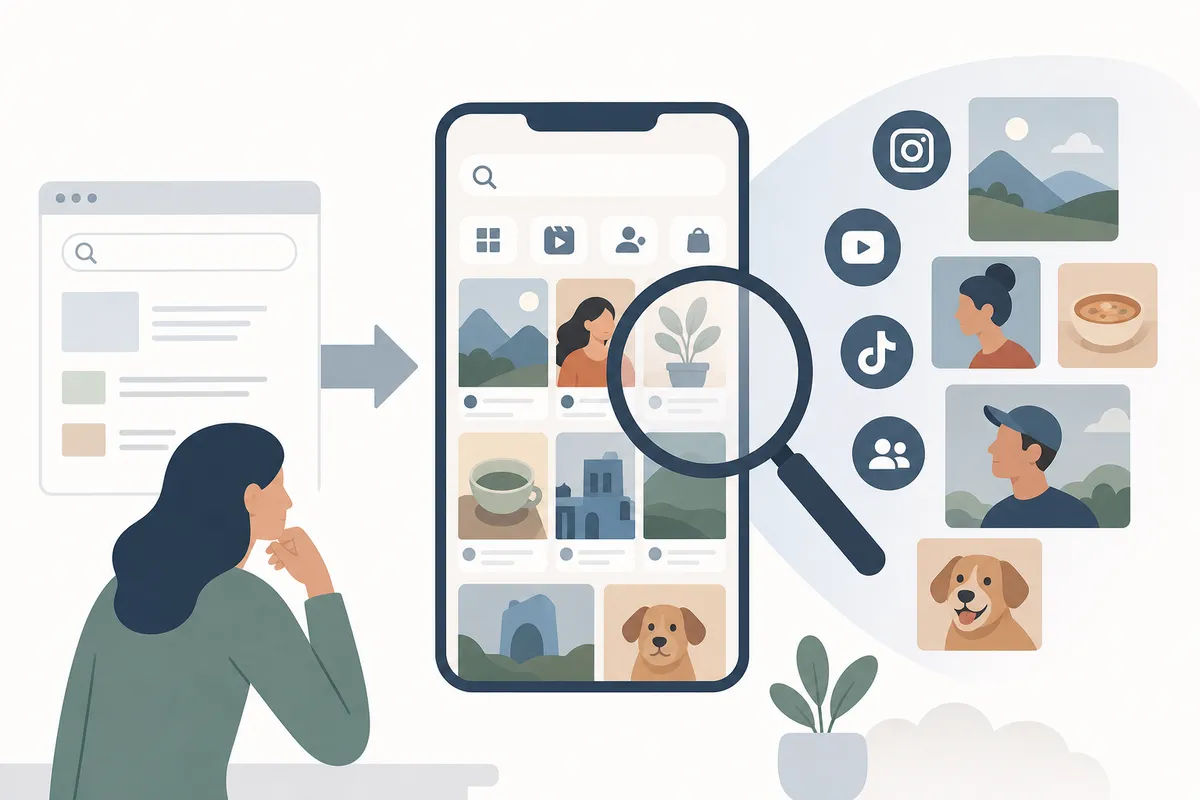
This is the part of the conversation most SEO advice from five years ago misses entirely. TikTok, YouTube, Reddit, and Instagram are not just distribution channels anymore. People search them directly, the way they used to search only Google.
| Platform | How people search it | Best content type | SEO move that matters most |
|---|---|---|---|
| YouTube | Deep, how-to intent, long-form learning | Tutorials, case studies, product demos | Keyword-rich titles, descriptions, and accurate captions |
| TikTok | Emotion-led discovery and trend-hunting | Short demos, quick tips, before-and-after clips | Problem-aware and solution-aware keywords in captions |
| Visual discovery, product and lifestyle research | Product shots, reels, user-generated content | Alt text, keyword-rich captions, consistent hashtags | |
| B2B credibility and peer validation | Expert commentary, case studies, industry data | Keywords in headline, summary, and job description fields | |
| Peer validation, unfiltered opinions, research | Honest answers inside existing threads | Participating where the conversation already exists |
Reddit deserves special attention here. Following a reported 60 million dollar licensing deal between Google and Reddit in 2024, Reddit threads have shown up far more often in Google's results. That includes ordinary, non-branded searches, where a forum discussion now outranks polished company content. Businesses that treat this as an opportunity rather than a threat are learning how ranking Reddit threads can turn into pages you actually own rather than traffic you only borrow.
YouTube behaves the same way, dominating results for anything people would rather watch than read. Instagram follows a similar pattern for visual, product-led queries. None of this is speculative. It is simply how modern search results are assembled today.
Real evidence social content is showing up in Google's results
Skeptics sometimes ask for proof that any of this is real rather than theoretical. The evidence is easy to find once you know where to look.
Instagram's own help documentation confirms that public posts from professional accounts, dated from January 1, 2020 onward, are eligible for indexing by Google. That means a well-optimized Instagram post can rank in ordinary search results years after it was published, not just inside Instagram's own search bar.
Reddit's rise inside Google results follows the same pattern. Search for almost any advice-driven query today, and you will likely see a Reddit thread sitting in the top few positions. It often ranks ahead of branded content written by companies with far more marketing budget behind it. Google is also drawing on forum discussions like these to help populate its AI Overviews, the summary boxes that now sit above traditional results for many queries.
None of this replaces a solid on-site strategy. It sits alongside one. A business that wants to show up wherever people search needs both. That is exactly why building an SEO strategy from scratch now has to account for social platforms as search surfaces, not just distribution channels.
How to optimize your social profiles for SEO
The good news is that social SEO does not require a full rebuild of your accounts. It mostly means treating profile fields as on-page elements, the same way you would treat a title tag or a meta description.
| Platform | Field to optimize | What to include | Why it matters |
|---|---|---|---|
| Page name, category, custom URL | Business name plus a clear category | Helps Facebook and Google understand what you offer | |
| Headline, summary, job titles | Industry keywords woven into natural sentences | Surfaces your page in LinkedIn's own search and in Google | |
| Instagram or TikTok | Bio, alt text, captions | One or two sentences describing what you do and for whom | Improves discoverability inside the app and in image search |
| YouTube | Titles, descriptions, captions | Exact phrases your audience actually searches for | Powers both YouTube search and Google's video carousels |
A few habits apply across every platform. Keep your handle consistent everywhere you can, so your brand is easy to recognize and hard to confuse with an impostor account. Use the same profile photo across accounts for the same reason. Get verified where verification is available, since verified accounts tend to surface more reliably in branded search results. And write your bio as a genuine description of what you do, not a tagline, because most brands underuse this field badly.
Pairing this profile-level work with your on-site foundation matters just as much. The eight-step process for improving a website's organic traffic covers the on-page half of this equation, and social optimization is most effective once that foundation is already solid.
Measuring whether social media is actually helping your SEO
Vague optimism is not a strategy. You need to know whether your social effort is actually contributing to search performance, and a handful of metrics answer that honestly.
Start with referral traffic in your analytics platform. How much of your site's traffic arrives from social links, and how does that traffic behave once it lands? Compare bounce rate and time on page against your organic search traffic to see whether social visitors engage as deeply.
Next, track branded search volume over time. If your name is being searched more often after a social campaign, that is a meaningful, measurable sign the campaign built recognition rather than just noise. Google Search Console will show you this directly.
Finally, watch your backlink profile for links that trace back to content you first promoted on social platforms. A steady trickle of new, earned links following a social push is the clearest proof the strategy is working the way it should.
None of these metrics move overnight, and none of them replace the fundamentals in a plan for ranking higher on Google that actually works. They sit downstream of it. Social media accelerates a strategy that already has good content and a sound technical foundation behind it. It rarely rescues one that does not.
Common social media SEO mistakes to avoid
A few habits quietly undercut everything covered above, and they show up constantly.
- Treating engagement as the finish line. Likes and comments feel good, but if none of that activity converts into clicks, links, or branded searches, it is not doing anything for your SEO.
- Ignoring alt text and captions. These fields are searchable and indexable on most platforms, and skipping them wastes free visibility.
- Using a different handle on every platform. Inconsistent branding makes it harder for search engines, and for people, to confirm you are one real business.
- Buying followers or engagement. Beyond the obvious credibility risk, inflated numbers do nothing to earn the genuine links and shares that actually support rankings.
- Posting without a keyword in mind. Every caption, title, and bio is an opportunity to match how real people phrase their searches, and most brands skip it entirely.
Avoiding these mistakes costs nothing but attention. It is one of the more reliable ways of boosting organic traffic naturally without paid ads, since organic social reach is free distribution you are likely already paying a team to create anyway.
Should you handle social SEO yourself or bring in help?
Most of what is covered here is genuinely doable without outside help. Optimizing a bio, adding alt text, choosing a consistent handle, and writing keyword-aware captions take time, not specialized expertise.
Where it gets harder is connecting social activity to actual ranking outcomes across a large content library, dozens of pages, or multiple locations. At that scale, tracking which social pushes led to which backlinks, and which branded searches followed which campaigns, becomes a full analytics project of its own.
| Situation | DIY usually works | Bringing in help pays off |
|---|---|---|
| A single business profile per platform | Yes | Rarely necessary |
| Fewer than 20 pieces of content a month | Yes | Optional |
| Multiple locations or a large content calendar | Sometimes | Usually, for tracking alone |
| Measuring social's contribution to rankings across a whole site | Rarely | Yes, this needs proper attribution tooling |
If you publish across several platforms and want a single view of where your traffic actually comes from, it helps to see how SEO strategy differs by platform. That beats applying one generic playbook everywhere. The mechanics change enough between YouTube, TikTok, and a standard website that treating them identically wastes effort on all three.
FAQs
Does social media directly affect Google rankings?
No. Google has never confirmed likes, shares, or follower counts as ranking factors. Social media influences rankings indirectly, by driving traffic, earning backlinks, and building the branded search volume Google does track.
Do links from social media posts count as backlinks?
Most links posted directly on social platforms carry a "nofollow" attribute, meaning they do not pass ranking authority the way a normal backlink would. Their real value is the traffic and exposure that leads other sites to link to you naturally.
Which social platform matters most for SEO?
It depends on your content. YouTube and Reddit tend to matter most for informational, research-driven queries, while Instagram and TikTok matter more for visual, product-led discovery. Most businesses benefit from a presence on whichever platform their actual buyers already search.
Can a strong social presence make up for a weak website?
No. Social media amplifies content that is already good and can accelerate discovery. But it cannot substitute for solid on-page content, a fast, crawlable site, or nine moves that compound organic traffic over time.
How long does it take for social media to show results in search?
There is no fixed timeline, because the path runs through traffic, earned links, and branded search volume building up gradually. Most businesses see the clearest impact over several months of consistent, genuine activity rather than from any single viral post.
See what your own site's SEO actually looks like
Social media will keep growing as a search surface. Understanding the role of social media in SEO, treating it as part of the same strategy rather than a separate department, is what lets a business build visibility on every front at once. If you want a clear, specific picture of where your own site stands today, request a sample SEO report and see exactly what a real audit would surface for your business.
Resources / References
Related reading: The Impact of Social Media on SEO: Signal vs. Myth in 2026.
Sources
About the author
SearchBlueprint researched, wrote and scored this article with the content pipeline our customers run on their own sites. The score in the byline is what our content engine gave this page before it published. Nothing here is reviewed by hand, which is the point: it is the product's output, published where anyone can check it.