Link Building for SEO: What Actually Moves Rankings in 2026
SearchBlueprint · · 10 min read · scored 100/100
Link building for SEO is the work of getting other websites to link to yours, because Google uses links both to find pages and as a signal of which pages deserve to rank. What moves rankings in 2026 is the same thing Google's rules have rewarded for years: links people give you because your page is worth pointing to.
What has changed is the cost of getting it wrong. Google's spam policies now describe paid guest posts, keyword-stuffed anchor text in press releases and link exchanges in detail, and its AI features draw on the same index those links help build. This guide covers what Google says about links, which tactics earn them honestly, and how to tell whether the work is paying off.
What link building means
A backlink is a link on another site that points to a page on yours. In the HTML it is an <a> element with an href, and the clickable words are the anchor text. Google's link guidance says it can generally only follow links written that way, and that it reads the anchor text to understand the page being linked to.
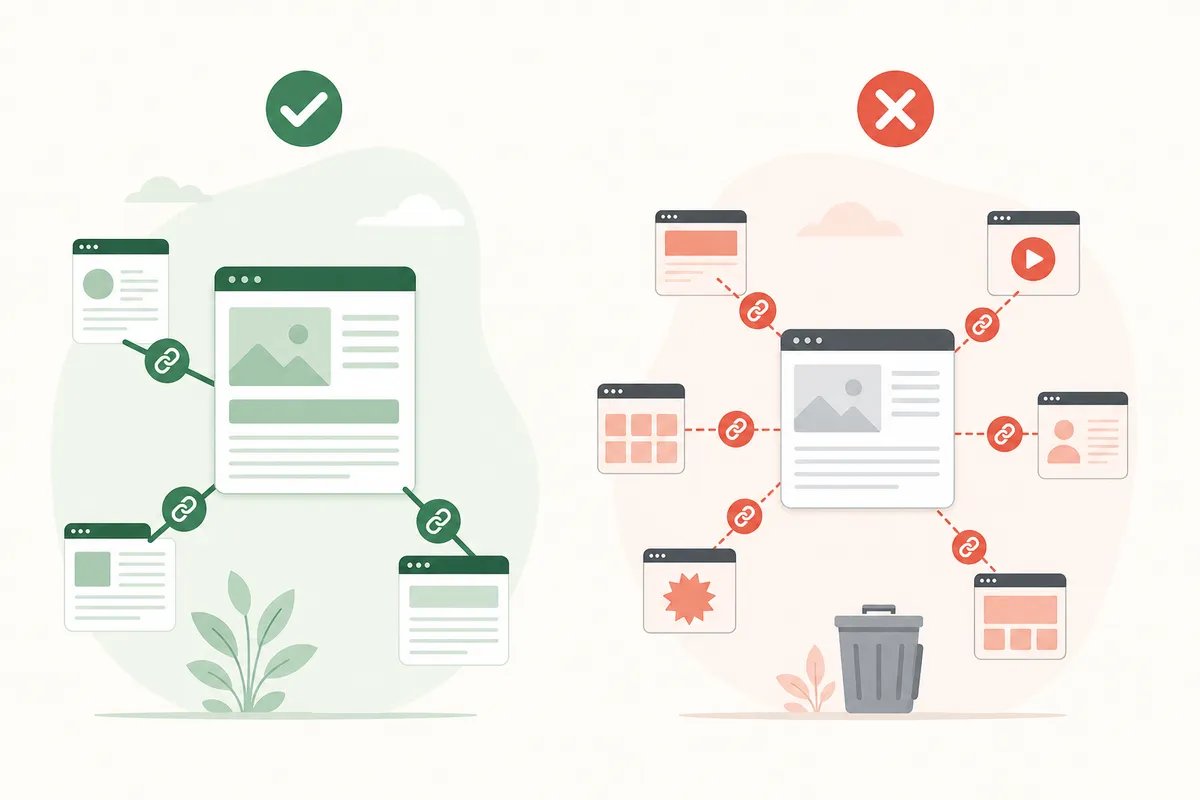
Link building is the effort to earn more of those links, from the right places. Some SEO people prefer to call it link earning, and the distinction is useful: the tactics that last all start with something on your site that another site's readers would benefit from. Our academy lesson on backlinks that matter covers the basics in a shorter read.
Why links still matter
Google's starter guide says Google primarily finds pages through links from pages it has already crawled, often on other websites. A sitemap helps, but links are the main route by which Google finds a site in the first place.
The same guide addresses ranking directly. PageRank uses links and is one of Google's fundamental algorithms, and in the next breath Google says there is much more to Search than links and that PageRank is one of many signals. Both halves matter. Links are not optional for competitive searches, and they cannot rescue a page that does not answer the search.
For AI answers the link is indirect. Google's guide to AI features and your website says a page needs to be indexed and eligible for a snippet to appear as a supporting link in AI Overviews or AI Mode, with no extra requirements. Links help pages get found and indexed, and mentions on other sites are part of how a business becomes known for a topic. Our lesson on brand mentions and entity SEO goes into that side.
What makes one link worth more than another
Google does not publish a formula for link value. Its guidance and spam policies point to a few qualities that separate a useful link from a useless or risky one.
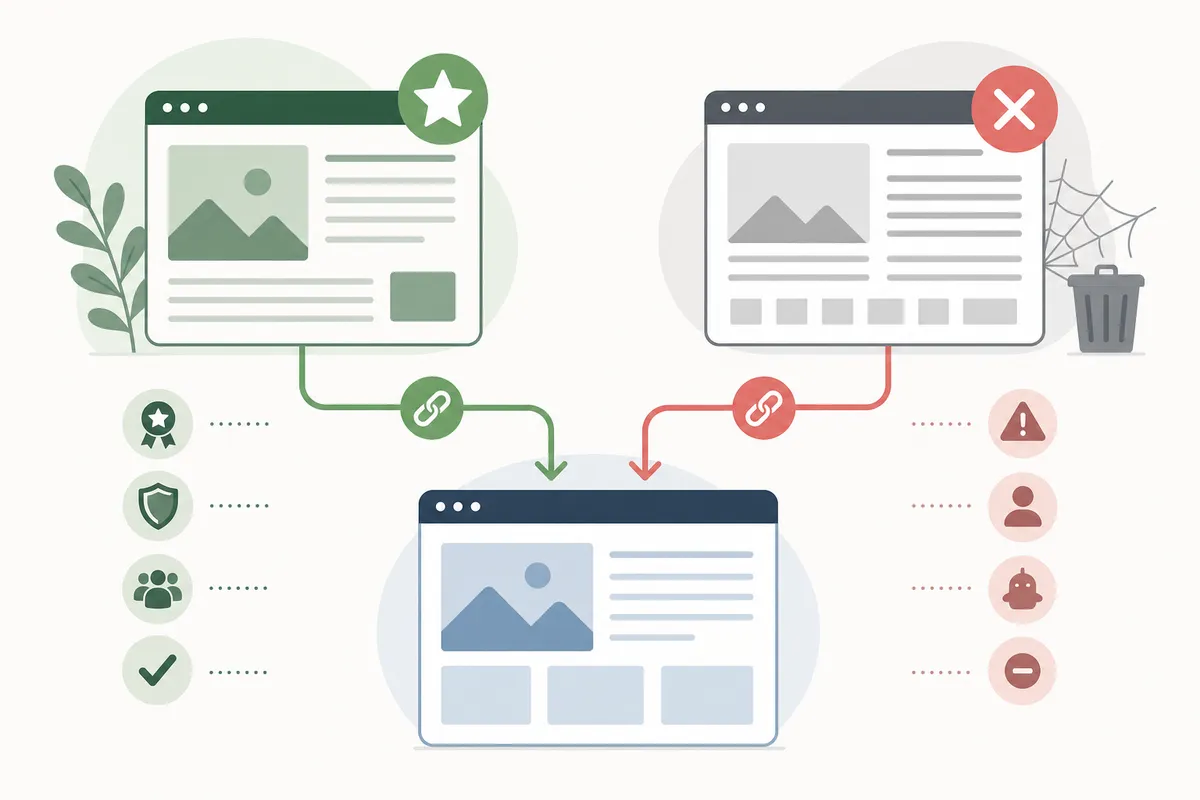
| Quality | A strong link | A weak or risky link |
|---|---|---|
| Relevance | A site your customers read, on your subject | An unrelated site with no audience overlap |
| Placement | In the body of an article, where a reader would click | Footer or template links repeated across many sites, which Google lists as link spam |
| Anchor text | Describes your page in natural words | Keyword-stuffed anchors in guest posts or press releases, also listed as link spam |
| Reason it exists | The author chose to cite you | Paid, swapped or required by a contract without a sponsored or nofollow tag |
| The linking page | A real page people visit | Low-quality directories and bookmark sites, named in Google's examples |
Third-party tools put a score on sites, such as an authority or rating number, and they help you compare prospects. Google's page on hiring an SEO is plain that third-party tools have no access to its internal ranking data, so treat any score as a tool's estimate.
How to mark links you are not vouching for
Google's guidance on qualifying outbound links gives three values for the rel attribute:
rel="sponsored"for adverts and paid placements. Google prefers this for paid links, thoughnofollowis still accepted.rel="ugc"for user-generated content such as comments and forum posts.rel="nofollow"for other links you would rather Google did not associate with your site.
Google's spam policy adds the important exception: buying and selling links is a normal part of advertising on the web, and it is not a violation as long as those links carry nofollow or sponsored. So you can sponsor a local event and accept a link; it simply should be marked, and you should value it for the visitors and visibility, not for rankings.
What Google counts as link spam
Read this list before paying anyone for "link building". Google's spam policies define link spam as creating links primarily to manipulate rankings, and give these examples, shortened here:
- Buying or selling links for ranking purposes, including money, goods or free products in exchange for a link. Paying to have a link added to an existing article, sold as a niche edit, falls under this too.
- Excessive link exchanges and partner pages that exist only to cross-link.
- Automated programs or services that create links to your site.
- Requiring a link in terms of service or a contract without letting the other site qualify it.
- Advertorials and guest posts or press releases carrying links that pass ranking credit or use optimized anchor text.
- Low-quality directory and bookmark links, widget links and links spread across footers and templates.
- Forum comments with optimized links in the post or signature.
Google detects this through automated systems and, where needed, human review, which can end in a manual action that Search Console's Manual actions report then shows. Google's help says link-related reconsideration requests can take longer to review than others, so the cleanup is slow as well as unpleasant.
Link building tactics that work
None of these is fast. All of them are within Google's rules and produce links that survive.
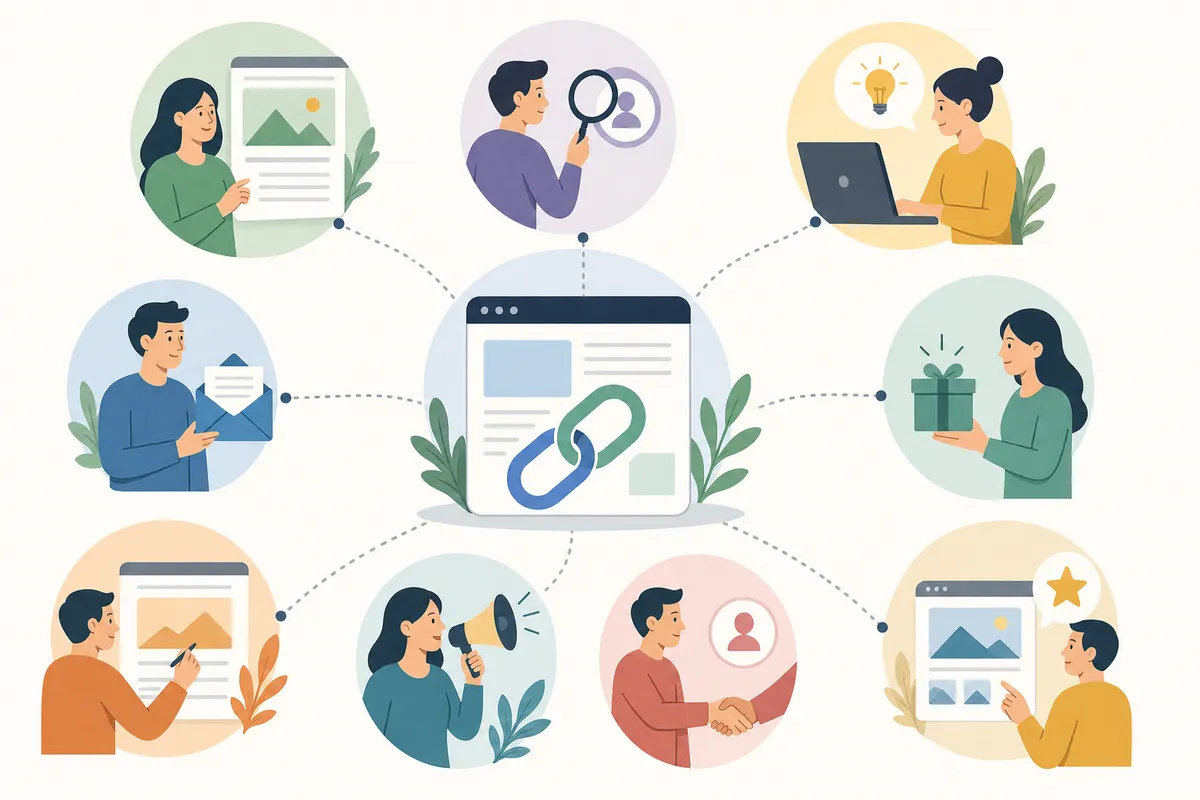
1. Ask the people who already know you
Suppliers, manufacturers you stock, partners, trade associations, chambers of commerce, the charity or team you sponsor, the venue that hosted your event. Many of them have pages listing members, stockists or partners. A short email asking to be included, with the exact URL and one line about you, is the highest-yield link building most small businesses ever do. Mark sponsorship links as sponsored, as above.
2. Make something people cite
Original numbers get linked. A survey of your own customers, a price index from your quotes, a calculator, a checklist that a trade body would send to its members. The test is simple: would a journalist or blogger writing about your industry need this to make their point? If yes, it can earn links for years without outreach.
3. Turn expertise into press coverage
Journalists need sources. Answer reporters' requests in your field, offer a local angle on national news, and keep a page on your site with your credentials and contact details so they can cite you. Our lesson on digital PR for small teams covers a routine that fits a busy week. Links in coverage are a by-product of being useful to the reporter, which is exactly why Google does not treat them as spam.
4. Replace broken links with your page
Pages that link to dead resources are common. Find a page in your field that links to something now gone, check that your page genuinely covers the same thing, and tell the site owner, with the broken URL and your replacement. The free broken link checker finds dead links on any page. It works because you fix a problem for the other site.
5. Reclaim unlinked mentions
Search for your business name and your products in quotes. Where a site mentions you without linking, a polite note asking them to add the link has a far better hit rate than cold outreach, because they already chose to write about you.
6. Write for other sites, carefully
Guest articles are fine when the point is reaching that site's readers. Google lists guest posts with optimized anchor text or links that pass ranking credit in exchange for payment as link spam. Write for sites your customers read, link to your site where it helps the reader, and accept that the editor may tag or remove the link.
A monthly routine for a small team
Link building fails most often because it happens in bursts. A routine that fits around client work:
| Week | Task | Time |
|---|---|---|
| 1 | Email two existing contacts (supplier, partner, association) about a link | 30 minutes |
| 2 | Check two broken-link or unlinked-mention opportunities | 45 minutes |
| 3 | Answer reporters' requests or pitch one local story | 45 minutes |
| 4 | Review the Search Console Links report and log new links | 20 minutes |
Keep a simple log of who you asked, when, and the result. After three months it tells you which tactic works in your market.
How to tell if your link building is working
Search Console's Links report shows the sites that link to you most, your most linked pages and the text used to link to you. Google's help notes it is a sample, grouped by root domain, and that it does not say whether a link is nofollow, so read it as a trend. Check it monthly:
- Are the new links on sites your customers read?
- Are they pointing at the pages you want to rank, or only at your home page?
- Is the anchor text natural, or has something started repeating an exact keyword?
Then look at the result that matters. In the Performance report, the pages that gained links should show rising impressions for their searches over the following weeks. Google's starter guide suggests waiting a few weeks before judging any change, and links are among the slowest.
Internal links count too. Once a page earns links, link from it to the pages you most want to rank. Our lesson on site architecture and internal links shows how authority moves through a site.
When to disavow, and when not to
Google's disavow tool lets you ask Google to ignore specific linking pages or domains. Google's own help says most sites will not need it, because Google can usually assess which links to trust without guidance. It recommends disavowing only when you have a considerable number of spammy or artificial links and they have caused, or will likely cause, a manual action. It also warns that using the tool incorrectly can harm your site's performance.
So for most businesses the answer is no. Random low-quality links pointing at your site are normal. The cases that need action are links you or a previous SEO bought or built, and a Manual actions report entry for unnatural links.
FAQs
How many backlinks do I need to rank?
There is no number. It depends on how strong the pages already ranking are for your search. A local service page may rank with a handful of relevant local links; a national comparison search can need far more.
Is it safe to buy backlinks?
Not for ranking. Google's spam policies list buying links for ranking purposes as link spam. Paid placements are fine for traffic and visibility if the links carry rel="sponsored" or rel="nofollow".
Are guest posts still worth doing?
Yes, for reaching a site's readers. Google lists guest posts with optimized anchor text, or links that pass ranking credit in exchange for payment, as link spam, so write for the audience and do not pay for the link.
Do nofollow links help?
Do not count on them for rankings. Google's guidance describes nofollow as a way to say you would rather Google not associate your site with the linked page. They still bring visitors, and a mention on a respected site helps people find and trust you.
How long does link building take to work?
Weeks to months. Links must be found and recrawled, and Google's starter guide suggests waiting a few weeks before judging any change.
See where you stand
Open Search Console's Links report and write down your top ten linking sites and your most linked pages. Then list five businesses or organisations you already work with that could link to you, and ask two of them this week. That is link building for SEO at its most reliable. Check your most important page with our free broken link checker too, so the visitors those links send never hit a dead end.
Sources
The facts in this guide come from these pages, each read on the date shown.
- Spam policies for Google web search (Google Search Central, read 12 October 2026)
- SEO Starter Guide (Google Search Central, read 12 October 2026)
- Link best practices for Google (Google Search Central, read 12 October 2026)
- Qualify your outbound links to Google (Google Search Central, read 12 October 2026)
- Disavow links to your site (Search Console Help, read 12 October 2026)
- Manual actions report (Search Console Help, read 12 October 2026)
- Links report (Search Console Help, read 12 October 2026)
- AI features and your website (Google Search Central, read 12 October 2026)
- Do you need an SEO? (Google Search Central, read 12 October 2026)
About the author
SearchBlueprint researched, wrote and scored this article with the content pipeline our customers run on their own sites. The score in the byline is what our content engine gave this page before it published. Nothing here is reviewed by hand, which is the point: it is the product's output, published where anyone can check it.