Top 6 Organic Traffic Solutions: What Actually Works Now
By Toy Wen Da, Co-Founder · Updated · 16 min read · scored 91/100
The top 6 organic traffic solutions in 2026 are intent-mapped keyword research, consistent quality content, technical SEO health, authority building, genuine engagement signals and AI search visibility. SEMrush, Ahrefs, Surfer and MarketMuse support each one, but no single subscription replaces the six working together.
Most "top solutions" lists are really tool ads. They rank six products, quote a discount and skip the harder question of which underlying strategies produce organic visitors who keep arriving after you stop paying attention. This guide covers the six solutions, the tools that deliver each one, the pricing that is actually listed, and the one "solution" you should probably avoid.
What counts as an organic traffic solution?

An organic traffic solution is any strategy, process or tool that increases the number of visitors reaching your site from unpaid results on Google, Bing and increasingly AI answer engines like ChatGPT and Perplexity. Paid ads are excluded because they stop delivering the moment your budget does.
This guide is written for business owners, in-house marketers and agency teams who publish content and want more of the right visitors rather than simply more of them. If you run an e-commerce store, a service business or a SaaS blog, all six solutions apply. What changes is the weighting: a slow site needs technical fixes first, while a fast site with thin content needs the content work first.
Some vendors now sell "organic traffic" as a product, with real humans paid to click your listings. Their sales pitch rests on genuine leaked-document evidence, and Solution 5 covers it. The short version is that the evidence about engagement signals is real, and the conclusion the vendors draw from it is where things get risky.
The top 6 organic traffic solutions at a glance
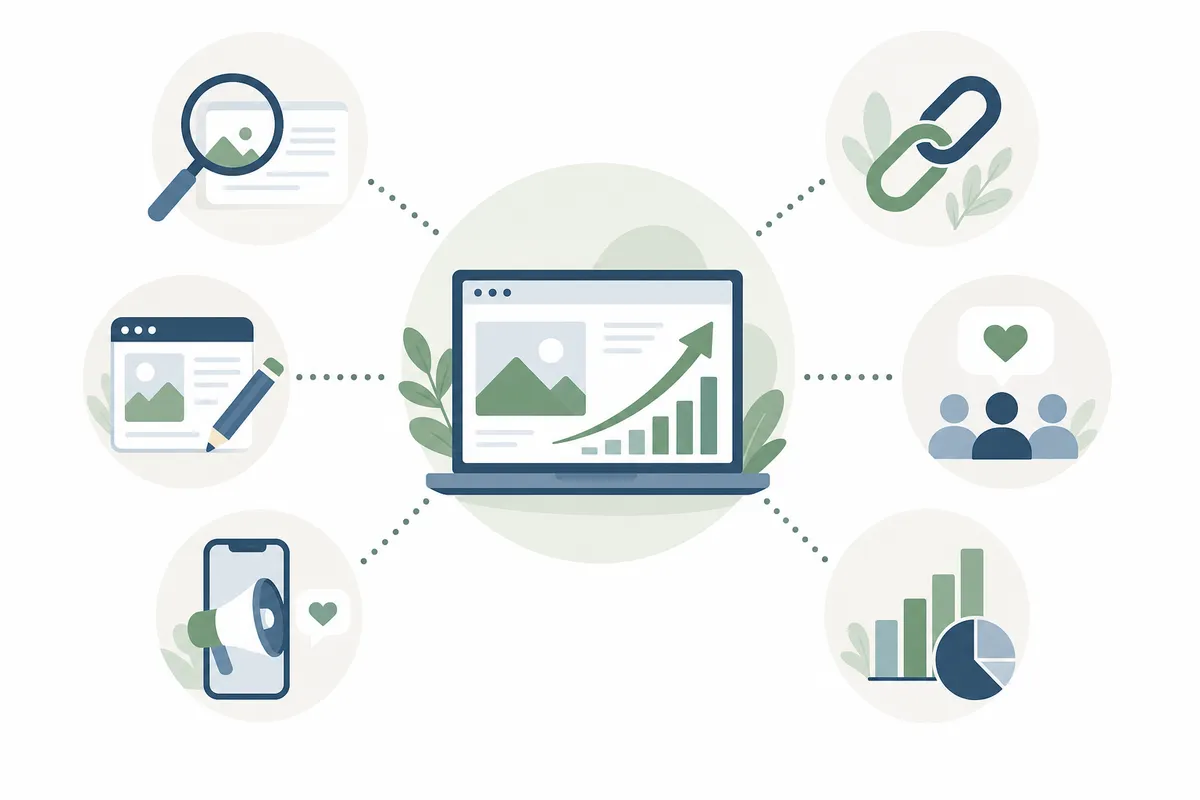
Each row below stands alone: the solution, the job it does, who benefits most and the effort involved.
| Solution | Core job | Best for | Effort required |
|---|---|---|---|
| 1. Intent-mapped keyword research | Finds queries real buyers type and matches each to the right page type | Any site publishing content; essential before writing anything | Moderate upfront, light ongoing |
| 2. Consistent quality content | Produces pages that satisfy searchers and meet Google's E-E-A-T bar | Blogs, e-commerce category pages, service pages | High and ongoing; AI assistance reduces it |
| 3. Technical SEO health | Makes the site fast, crawlable and indexable so rankings aren't capped | Sites with speed issues, crawl errors or messy architecture | Front-loaded, then periodic audits |
| 4. Authority building | Earns backlinks, reviews and mentions that lift the whole domain | Newer domains competing against established rivals | Slow, relationship-driven, compounds over time |
| 5. Engagement signals | Improves click-through rate and dwell time on listings you already have | Sites ranking on page one but in positions 4–10 | Low effort, fast feedback |
| 6. AI search visibility (GEO/AEO) | Gets your content cited in AI Overviews, ChatGPT and Perplexity answers | Brands whose buyers now ask AI assistants first | Moderate; builds on solutions 1–3 |
Solution 1: Intent-mapped keyword research

Every other solution builds on keyword research. Get it wrong and you produce content nobody searches for, or content that ranks for queries your buyers never type.
Match every keyword to one of four intents
Searcher intent is the "why" behind a query, and a mismatch is the most common reason pages fail to rank. Four types cover nearly everything:
| Intent type | Example query | Content that matches | Funnel stage |
|---|---|---|---|
| Informational | "how to start an online store" | Blog post, guide, tutorial | Early, learning |
| Navigational | "shopify login" | The brand's own page; rarely worth targeting | N/A |
| Commercial investigation | "best e-commerce SEO tools" | Comparison post, review roundup | Middle, evaluating |
| Transactional | "buy waterproof trail running shoes" | Product or service page | Late, ready to buy |
The rule is one page, one primary keyword, one intent. A product page chasing an informational query will lose to a blog post every time, and the reverse holds too. Sort your keyword list into these four buckets before you assign a single article.
Mine competitors for keywords you missed
Your rivals have already spent money finding out what ranks. Look at the keywords driving their traffic, the pages earning their links and the gaps where they rank and you don't. A free competitor analysis that compares your organic rivals side by side surfaces those gaps without a paid subscription. Prioritize keywords where a competitor sits in positions 4–15 with a weak page, because those are winnable.
Go long-tail and chase "People Also Ask"
Long-tail keywords are longer, more specific phrases such as "best waterproof trail running shoes for wide feet". They carry lower volume but far higher intent, since the people typing them are closer to buying. One Forbes Business Council contributor notes that a "People Also Ask" box appears in almost half of all Google searches, and that content answering those exact questions can win the placements directly (Forbes, 15 Low-Cost Tactics To Increase Organic Traffic). Pull the PAA questions for your main topics and answer each in a dedicated section or post.
Then organize everything into topic clusters, with one comprehensive pillar page per broad topic and spoke pages that cover subtopics and link back. Search engines read that structure as topical authority.
Solution 2: Consistent, quality content production
A keyword list is worthless until it becomes pages. The second solution is a repeatable production system that turns research into content Google wants to rank and readers actually finish.
What "quality" means: the E-E-A-T bar
Google's quality guidelines center on E-E-A-T: Experience, Expertise, Authoritativeness and Trustworthiness. In practice that means content that shows first-hand knowledge, is written or reviewed by someone qualified, sits on a site with a track record and is accurate enough to trust. Ranking content in 2026 also needs originality rather than a rehash of the current top ten, depth that gives a complete answer instead of a teaser, and formatting that scans well, with short paragraphs, descriptive headings, lists and tables.
On-page basics still matter more than most teams admit:
- Title tags of around 50–60 characters, with the primary keyword and a reason to click.
- Meta descriptions of around 150–160 characters. They are not a direct ranking factor, but they do influence click-through.
- One H1, a logical H2/H3 structure and descriptive image alt text.
- Internal links from every new page to related pages, so authority flows and crawlers find everything.
Using AI without publishing slop
AI drafting has changed the economics of content, and platforms in this space now automate topical maps, briefs, drafts and even publishing. Surfer combines a content editor with real-time optimization data, a content audit tool and a topical map. A sensible workflow is to run the audit first and then use the editor and topical map to build a 30-day publishing plan. MarketMuse takes a strategy-first angle: one documented B2B use case had a team audit its blog, identify coverage gaps and generate briefs that became a prioritized 90-day editorial plan focused on high-impact pages.
Raw AI output rarely meets the E-E-A-T bar on its own. The teams winning with AI content run every draft through structured checks for factual grounding, intent match, internal links, schema and readability, and they add genuine expertise before publishing. AI compresses the drafting hours but cannot replace judgment.
Refresh and prune what you already own
Your fastest content wins usually hide in your archive. Audit existing pages for three situations:
- Decaying winners are pages that ranked well and slipped. Update facts, add missing subtopics and re-optimize.
- Near-misses sit in positions 5–15, where small improvements move real traffic.
- Thin overlap is several weak pages on one topic. Consolidate them into one strong page and redirect the old URLs.
A refresh often moves rankings faster than a new post because the page already has age, links and indexed history.
Solution 3: Technical SEO health
Technical SEO sets the ceiling on everything else. Brilliant content on a slow, uncrawlable site underperforms mediocre content on a clean one.
Speed and Core Web Vitals
Google measures user experience through Core Web Vitals: Largest Contentful Paint for loading, Interaction to Next Paint for responsiveness and Cumulative Layout Shift for visual stability. Slow pages frustrate users, inflate bounce rates and get demoted. Run your key pages through Google's free PageSpeed Insights, then fix the usual suspects: oversized images, missing caching and render-blocking scripts. Mobile matters most because Google indexes the mobile version of your site first, so a page that is perfect on desktop and broken on mobile is a broken page.
Crawlability, architecture and indexing
Search engines can only rank what they can find and understand. The checklist:
- Shallow structure, with any important page reachable within a few clicks of the homepage.
- An XML sitemap listing your important URLs, submitted in Google Search Console.
- A robots.txt file that blocks what should be blocked and nothing more.
- No broken links or crawl errors. Check Search Console regularly and fix what it flags.
- Deliberate internal linking, since every orphaned page is a page Google may never rank.
Structured data and enhanced listings
Schema markup is code that tells search engines exactly what a page contains. Done right, it makes pages eligible for enhanced snippets such as star ratings, prices and FAQ dropdowns, which stand out in results and lift click-through rates. Product, Review, FAQ and Article schema are the highest-value types for most sites. Structured data also feeds Solution 6, since AI answer engines lean on it to understand pages and cite them confidently.
Solution 4: Authority building with links, reviews and borrowed audiences
Content and technical work determine whether you can rank. Authority often determines whether you do, especially in competitive niches where every top-ten page is already well optimized.
Backlinks that actually move rankings
Quality beats volume. One relevant link from a respected industry outlet outweighs dozens of directory listings. The tactics that reliably work:
- Linkable assets such as original data, calculators, free tools and definitive guides that other writers cite.
- Digital PR that pitches genuinely newsworthy angles to journalists and niche outlets.
- Co-branded content such as case studies and infographics produced with partners or customers, so both audiences see them and both sites link.
- Guest contributions, where you share expertise on external sites your buyers already read.
Some automated platforms now bundle backlink building through vetted partner networks into their subscriptions. Treat those claims carefully and verify that the linking sites are real outlets with real traffic. A cheap link from a spammy network can hurt more than no link at all.
Reviews and user-generated content
Reviews are an underrated organic traffic solution. Google favors businesses with strong review profiles, and review aggregators often dominate commercial search results. Review content on your own product pages also adds fresh, keyword-laden text you didn't have to write. Pair collected reviews with Review schema so star ratings appear in your search listings. That is a direct click-through lift that costs time and little else.
Borrowed audiences: podcasts, communities and social
Authority isn't only links. The Forbes panel's low-cost tactics cluster around one idea: show up where your audience already gathers. Pitch relevant podcasts with a genuine value-add for listeners. Answer real questions on Reddit, Quora and industry forums, which increasingly matters because AI engines mine those threads. Post consistently on the social platforms your buyers use and pull readers back to deeper content on your site. None of this ranks a page directly, but it builds the brand searches, mentions and links that do.
Solution 5: Engagement signals, the honest version
The top-ranking pages for this topic diverge sharply here, so it helps to separate the evidence from the sales pitch.
What NavBoost confirmed
In 2023, leaked internal Google documents and testimony in the DOJ antitrust trial confirmed that Google uses a system called NavBoost to adjust rankings based on user click behavior. It looks at which listings people click, how long they stay and whether they bounce back to click a competitor, a habit called "pogo-sticking". According to the leaked documentation, NavBoost has been part of Google's ranking system for over 13 years and is considered one of the more important signals in the algorithm.
The practical takeaway is real: a listing that earns more clicks and satisfies more visitors can genuinely climb. The legitimate ways to feed that system:
- Write titles that promise a specific outcome. This is the single most effective CTR improvement.
- Win enhanced results (Solution 3) so your listing visually outcompetes its neighbors.
- Answer the query completely so visitors don't pogo-stick back to the results page.
- Improve above-the-fold content so the first screen confirms the click was right.
Should you buy organic traffic?
An entire product category now sells paid clicks as an organic traffic solution. SerpClix, the most visible example, claims a network of over 400,000 real human clickers across 160+ countries who search your keyword, click your listing and stay on the page. It offers a free 7-day trial and plans from $197/month. The pitch cites the NavBoost evidence above and vendor comparisons claiming organic results capture 70%+ of clicks versus ads.
Here is how the three approaches compare:
| Approach | How it works | Risk level | Durability |
|---|---|---|---|
| Earned CTR optimization | Better titles, enhanced snippets and complete answers attract genuine clicks | None; this is just good SEO | High; improvements persist and compound |
| Paid human click services | Real people are paid to search, click and dwell on your listing | High; engagement is real but the intent is manufactured, and patterns can look anomalous | Uncertain; signals stop when payments stop |
| Bot traffic services | Scripts and proxies simulate visits for a few dollars per thousand | Severe; Google detects and discards bot signals, and patterns can trigger spam systems | None; can actively damage rankings |
The evidence that engagement influences rankings is solid. The leap from "engagement matters" to "purchased engagement is safe and durable" belongs to the vendors. Google has spent enormous resources detecting artificial click patterns, and manufactured clicks that stop when your subscription lapses leave you where you started, minus $197 a month. Spend that budget on titles, schema and content depth instead, because those earn the same signals from people who might actually buy something.
Solution 6: AI search visibility (GEO and AEO)
This is the newest of the six solutions and the one most buyers in 2026 underweight. A growing share of "searches" now happen inside ChatGPT, Perplexity, Claude and Google's AI Overviews, and those engines cite sources. Being the cited source is the new position one.
Why AI answers are the new front page
Generative engine optimization (GEO) and answer engine optimization (AEO) describe the same goal: getting your content quoted, cited or recommended inside AI-generated answers. When an AI Overview answers a query directly, the classic blue links below it lose clicks, but the two or three cited sources gain visibility, credibility and referral traffic. Tool vendors have noticed. Several platforms in the comparison below now track brand appearances across ChatGPT, Claude and Perplexity alongside traditional Google rankings, and some surface Reddit conversations where your brand could earn a mention because AI engines weight those threads heavily.
How to get cited by AI engines
AI engines quote content that is easy to lift and safe to attribute:
- Front-load answers. Open each section with a self-contained 40–60 word passage that answers the question directly, before the detail.
- Be specific. Concrete figures, named steps and clear definitions get cited, while vague claims don't.
- Use extractable structure. Tables, numbered lists and Q&A formats are what answer engines lift verbatim.
- Add FAQ and Article schema so engines can parse your content confidently.
- Build entity presence with consistent brand information across your site, your profiles and the communities AI engines mine.
Solutions 1 through 3 already do most of this work. GEO is largely rigorous SEO with an extraction-friendly writing style layered on top.
Which tools deliver these six solutions?
The top-ranking articles for this keyword mostly compare software, so here is that comparison with the pricing those sources actually publish and honest gaps where they don't. Every price below is as listed by the vendor or the comparison sources, so verify current rates before buying.
| Tool | Primary strength | Listed pricing | Best fit |
|---|---|---|---|
| SEMrush | All-in-one toolkits spanning SEO, content, local, social and ads | Multiple paid tiers plus free utilities; rates on vendor site, often cited as high for small businesses | Agencies and teams wanting one platform for everything, who can absorb a learning curve |
| Ahrefs | Backlink index and competitive keyword research depth | Tiered plans listed on vendor site | Teams prioritizing link analysis and competitor intelligence (Solutions 1 and 4) |
| Surfer | Real-time content editor, content audits, topical maps, plus AI visibility tracking | Not published in the comparisons reviewed; check vendor site | Content teams optimizing while drafting (Solution 2), with a noted learning curve for SEO beginners |
| MarketMuse | Topic authority analysis, gap identification and automated content briefs | Free tier plus Optimize, Research and Strategy paid tiers | Content teams and enterprises running large editorial operations; reviewers note it suits teams better than solo creators |
| Frase | Brief-to-draft content workflows built around answering search queries | Rates on vendor site | Smaller teams turning research into optimized drafts quickly |
| BabyLoveGrowth.ai | Automated content publishing, backlink network and AI-answer tracking in one pipeline | Listed at $99/month, discounted from $247/month, with agency options | Agencies wanting automation across content and links, with due diligence on the backlink network's quality |
Two buying principles matter more than any single row. First, match the tool to your weakest solution: a team with great content and no links needs Ahrefs-style analysis, and another editor won't help. Second, baseline before you buy, because a subscription can't show it worked if you don't know where you started.
DIY or hire help? An honest split
You do not need an agency for everything, and vendors won't tell you that.
Genuinely DIY-friendly: keyword research with free tools, refreshing existing content, writing titles and meta descriptions, collecting reviews, answering PAA questions, fixing broken links flagged by Search Console and posting consistently in communities. A motivated owner can run these in a few hours a week.
Worth professional help: site migrations, deep technical audits on large sites, structured data implementation at scale, digital PR campaigns and competitive niches where every rival has an in-house team. A botched migration can erase years of rankings, so the cost of doing these wrong usually exceeds the cost of doing them right.
Worth automating: the repetitive middle of the work, which covers briefs, drafts, internal link suggestions, rank tracking and reporting. The platforms above earn their subscriptions here, provided a human still owns strategy and quality control.
How to measure whether any of this works
Every one of the six solutions is measurable, and measurement is what separates strategy from hope.
Start with a baseline before changing anything. Run your domain through a free website traffic checker to estimate your current organic traffic, note your ranking keywords and screenshot your Search Console clicks and impressions. Then track four numbers monthly:
- Organic sessions, the headline metric, taken from your analytics platform.
- Ranking keywords and average position, which tell you whether you appear for more queries and higher up.
- Click-through rate by page, from Search Console, which is the direct readout on Solution 5.
- Conversions from organic, because traffic that doesn't convert is a vanity metric.
Organic growth is a compounding curve and no switch. Technical fixes and content refreshes tend to show movement first, new content and authority building take longer, and the gains stack. The businesses that win are the ones still publishing and refining in month six, when most competitors have quit.
FAQs
What is the fastest organic traffic solution?
Refreshing pages that already rank in positions 4–15 and improving their titles for click-through rate. These pages have existing authority, so small changes move measurable traffic faster than new content, which needs time to be crawled, indexed and trusted.
Are organic traffic solutions better than paid ads?
They serve different jobs. Paid ads deliver instant visibility but stop the moment spending stops, and costs rise in competitive markets. Organic traffic requires upfront effort but keeps arriving without a per-click cost, and users generally trust organic listings more than sponsored ones. Most healthy strategies use ads for speed and organic for durability.
Does buying organic traffic through click services actually work?
The engagement signals these services target are real: Google's NavBoost system, confirmed in the DOJ antitrust trial, uses click behavior in rankings. But purchased clicks carry manufactured intent, the signals stop when payments stop and services start around $197/month. Earning the same signals through better titles, enhanced snippets and complete answers is safer and more durable.
How long until organic traffic solutions show results?
It varies by starting point and competition. Technical fixes and content refreshes typically show movement soonest, while new content, authority building and AI-search visibility compound more gradually. Treat organic as a multi-month investment. Sources across the industry consistently describe it as a marathon rather than a sprint.
Which of the six solutions should a small business start with?
Run a baseline first by checking your current traffic, rankings and site health. Then fix the weakest link. Most small sites get the best early return from intent-mapped keyword research plus refreshing existing content, because both are low-cost and use assets you already own.
Baseline your site before you buy anything
Pick one solution from the top 6 organic traffic solutions above, measure where you stand today and commit to ninety days of consistent execution before judging results. If you want to see what a proper baseline looks like, with rankings, technical issues, content gaps and a prioritized plan in one document, browse a sample SEO report showing every metric worth tracking and talk to the team about running one for your site.
Resources / References
Sources
About the author
SearchBlueprint researched, wrote and scored this article with the content pipeline our customers run on their own sites. The score in the byline is what our content engine gave this page before it published. Nothing here is reviewed by hand, which is the point: it is the product's output, published where anyone can check it.