The SEO Funnel: How to Turn Search Traffic Into Customers
SearchBlueprint · · 6 min read · scored 90/100
What Is an SEO Funnel?
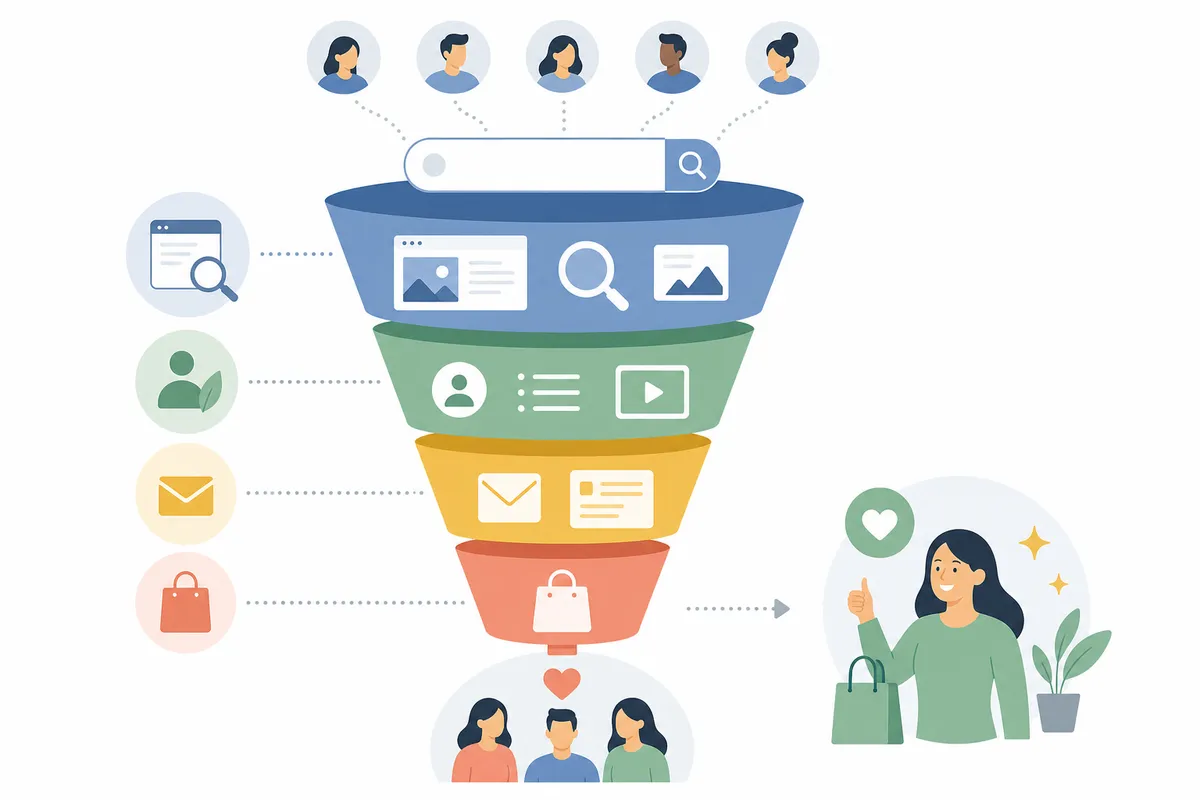
This funnel borrows its shape from the classic marketing funnel, but every stage runs on organic search instead of ads or an email list. Searchers enter at the top with a broad question. They narrow that search as they get closer to buying.
A traditional marketing funnel assumes you already have the prospect's attention, through a list, a retargeting pixel, or a sales call. This kind of funnel has no such head start. Every visitor arrives cold, through a query they typed themselves. That's why keyword research, not a persona workshop, drives each stage.
The purpose is simple: put the right page in front of the right searcher at the right moment in their decision. Miss the stage, and even a page one ranking won't convert.
The Three Stages of the Funnel
Each stage has its own intent, its own keywords, and its own job to do.
Top of Funnel (TOFU): Awareness
At the top, searchers don't know your brand yet. They're researching a problem, not a product: "why is my website not ranking" or "how does local SEO work." Target long-tail, question-based keywords here. Blog posts, guides and FAQ pages do the heaviest lifting.
Google's own search guidance rewards content that answers a query completely and honestly, not content stuffed with a keyword (Google Search Essentials, developers.google.com/search/docs/essentials). Write for the question first. The keyword comes second.
Middle of Funnel (MOFU): Consideration
In the middle, searchers know they have a problem and are comparing solutions. Their queries sharpen: "best SEO tool for agencies" or "SEO funnel vs marketing funnel." Comparison pages, case studies and detailed service pages fit this stage.
This is where an SEO plan that lists what to fix and build next earns its keep. Without one, it's easy to publish ten MOFU posts that all target the same comparison query and compete with each other instead of the competition.
Bottom of Funnel (BOFU): Decision
At the bottom, searchers are ready to act. They search branded terms, "near me," or pricing. These pages need proof: real pricing, reviews, case studies and one clear next step.
A location-based business has an extra BOFU lever: local search. Local SEO with a rank grid and dedicated location pages catches "near me" searches that a single company-wide service page can't win on its own.
Post-Purchase
The funnel doesn't end at the sale. Buyers still search: "how to use" your product, or your brand name plus "login" or "support." Help docs and onboarding content answer these searches, cut support tickets and reduce churn.
| Funnel Stage | Searcher Intent | Example Search | Content Type | Primary Goal |
|---|---|---|---|---|
| TOFU | Learning about a problem | "why is my website not ranking" | Blog posts, guides, FAQs | Earn attention and trust |
| MOFU | Comparing solutions | "best SEO software for agencies" | Comparison pages, case studies | Build a preference |
| BOFU | Ready to act | "SEO tool near me" or a pricing search | Pricing, demo, service pages | Convert the visit |
| Post-purchase | Confirming the choice | "how to use" the product | Help docs, onboarding guides | Retain and reduce churn |
How to Build a Search Funnel
Building the funnel is a sequence, not a single project:
- Map keywords to stage. Sort your keyword list by intent: informational, commercial or transactional.
- Audit what you already have. Check which stages have content and which ones are empty.
- Fill the gaps. Write or fix pages so each stage has content matched to its format.
- Link the stages together. TOFU posts should link to MOFU comparisons, which link to BOFU pages.
- Fix what's blocking rankings. A well-mapped funnel still fails if pages can't be crawled or indexed.
That last step trips up more funnels than bad content does. A technical SEO audit with fixes listed in priority order catches the crawl errors, broken redirects and slow pages that keep otherwise-good stage content from ranking at all.
How to Optimize Your Funnel for Conversions
Once every stage has content, three things decide whether traffic actually converts.
Internal links carry readers forward. Every TOFU page should link to the MOFU page that answers the next logical question, and every MOFU page should link to the BOFU page where a decision happens. A reader who has to search again to find your pricing page usually doesn't.
Structured data earns better visibility. Markup like FAQ or review schema (schema.org) can make a BOFU or MOFU page stand out in the results, which matters more as comparison searches get crowded.
Page speed protects the bottom of the funnel. A slow pricing or demo page loses the exact visitors who were closest to buying. Core Web Vitals (web.dev) measure this directly, and it's worth checking before blaming the copy for a weak conversion rate.
Measuring Funnel Performance
Each stage needs its own metric. Judging the whole funnel by one number, usually total organic traffic, hides where it's actually leaking.
TOFU measurement looks at reach: impressions, average ranking position, and new organic sessions from Search Console. Rising impressions with flat clicks usually means the title or snippet isn't earning the click.
MOFU measurement looks at engagement: pages per session, time on page, return visits, and assisted conversions. A comparison page that gets traffic but no second page view isn't doing its job.
BOFU measurement looks at outcomes: conversion rate, demo requests, and goal completions tied to organic sessions. This is the number that justifies the funnel's cost.
FAQs
What is an SEO funnel?
An SEO funnel is the organic-search path a visitor follows from an early, broad question to a branded or purchase-ready search, mapped to content built for each stage of that journey.
How is a search funnel different from a regular sales funnel?
A sales funnel can start from an email list, an ad click or a referral. A search funnel starts cold, from a query the searcher typed themselves, so it depends entirely on matching content to that search intent.
What keywords should I target at each stage?
Target long-tail, question-based keywords at the top, comparison and "best" queries in the middle, and branded or "near me" and pricing queries at the bottom.
How long does it take to see results from a search funnel?
It varies by competition, but informational TOFU pages often rank before commercial BOFU pages, since fewer sites compete for broad questions than for buying keywords. Results build over months, not days.
Do I need separate content for every funnel stage?
Yes. A single page rarely satisfies both a first-time researcher and a ready-to-buy visitor. Splitting them into TOFU, MOFU and BOFU pages lets each one be written for the search that actually lands on it.
Fix the Stage That's Leaking Traffic First
Most sites don't need a full funnel rebuild. They need the one gap closed where visitors currently drop off, whether that's a missing comparison page or a BOFU page nobody can find. Pull your current rankings, sort them by stage, and you'll usually spot it in minutes. If you want a second set of eyes on where your organic funnel is actually losing people, talk to the team.
Sources
About the author
SearchBlueprint researched, wrote and scored this article with the content pipeline our customers run on their own sites. The score in the byline is what our content engine gave this page before it published. Nothing here is reviewed by hand, which is the point: it is the product's output, published where anyone can check it.