SEO for Wineries: How to Rank for Tastings, Not Just Wine
By Toy Wen Da, Co-Founder · · 6 min read · scored 90/100
SEO for wineries means making your site show up for the searches a winery can actually win, "wine tasting near me," "vineyard tours," and your own name, rather than competing with national retailers for terms like "buy wine online." The first move is auditing which of those searches your homepage and tour page already answer, then fixing the ones that don't.
SearchBlueprint's local SEO tools pull this apart for a single property: they show which "near me" and tour-related searches your site currently ranks for, where you drop out of the local map pack, and which competing wineries or tasting rooms outrank you for the same terms. That's the starting diagnostic before you touch a single page.
What SEO for Wineries Actually Means
Generic SEO advice treats every business the same. Winery SEO is different because your buyer behaves in one of two ways: they already know your name, or they're searching for an experience near a specific place. Almost nobody discovers a small producer by typing "red wine" into Google.
Why You Can't Outrank the Big Retailers
Scale makes the difference obvious. A national wine retailer with a catalogue of thousands of labels generates a page for nearly every product search that exists. A winery has a few dozen wines, so it can't compete on volume. One comparison from UK search data makes the gap concrete: a well-known English wine producer ranked for 713 keywords and roughly 23,800 monthly visits, against a major retailer pulling in about 27 times the traffic and 29 times the keyword count. The lesson transfers directly: stop chasing "buy wine online" and start owning searches tied to your estate, your tours, and your tasting room.
The Three Keyword Types Worth Your Time
| Keyword type | Example | What it signals | Where it should live |
|---|---|---|---|
| Brand | your winery's name plus "hours" or "reservations" | They already know you | Homepage, Google Business Profile |
| Experience | "wine tasting near me," "vineyard tours" | Ready to visit now | Tasting/tour landing page |
| Product | "Pinot Noir gifts," "organic rosé" | Comparing options | Individual wine pages |
Experience searches are where SEO for wineries pays off fastest, because they're local, they're intent-driven, and big retailers largely ignore them.
Fixing It Inside Your Website
Start with the page that answers the visit question. If someone searches "vineyard tours" near your region, your tour page needs to state the price per person, the days it runs, and how long it lasts, directly in the first paragraph, not behind a "contact us" link. One well-known English estate's tour page shows up in Google's search result with the price and duration pulled straight from the page text; a vague "tours by appointment" line answers no search at all.
Inside your website's editor, go to the page or post settings panel and check the title tag and meta description fields, most site builders expose these under a "SEO" or "page settings" tab. Rewrite the title to include your winery's name, its specialty, and its location. Then do the same for your top wine pages, filling in tasting notes, food pairings, and vintage details instead of a few adjectives.
If your winery runs on a standard content platform, SearchBlueprint's CMS SEO guides walk through the exact settings to change, in order, for your specific platform. If your site is developer-built and updated through code pushes rather than a CMS dashboard, the equivalent steps are covered in the guide to SEO for git-built sites.
Claim and complete your Google Business Profile next: correct category, full hours, a phone number, and real photos of the tasting room, the vines, and the team. This is the single highest-leverage step for appearing in "near me" searches on a map.
The Seasonal Calendar Behind Winery SEO
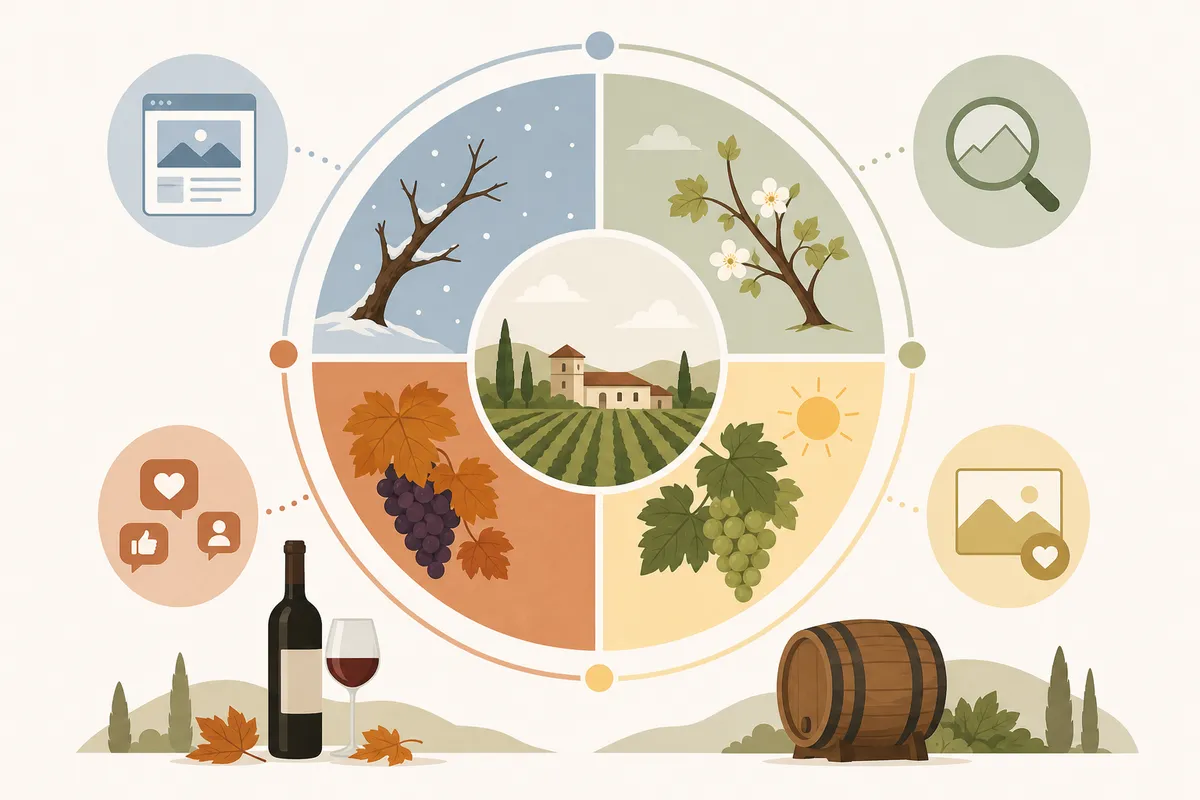
Search demand for wine and farm-visit terms swings hard across the year. Figures from a UK producer-focused study (DataForSEO, Google Ads data, October 2026) show the pattern clearly, and the same seasonal logic applies wherever you sell:
| Search | Typical monthly volume | Peak month | Volume at peak |
|---|---|---|---|
| Farm shop near me | 165,000 | August | 301,000 |
| Brewery near me | 49,500 | August | 74,000 |
| Christmas hampers | 33,100 | December | 201,000 |
| Vineyards near me | 14,800 | August | 27,100 |
| Cheese hampers | 9,900 | December | 49,500 |
| Wine tasting | 8,100 | several months | 9,900 |
| Corporate christmas gifts | 720 | October–November | 1,900 |
Two things fall out of this table. First, your tour and visit pages need to already be ranking by spring, well before the summer surge. Second, gift and corporate-hamper searches rise in September and October, a page published in December is too late for both Google and the buyer.
When Your Website's Own Tools Are Enough, and When They're Not
If you're fixing one page, rewriting a title tag, adding tasting notes, filling out a Google Business Profile, your CMS's built-in SEO fields and Google's free tools (Search Console, the Rich Results Test) are genuinely enough. That's a one-off task with a clear end point.
Where it breaks down is scale and repetition: tracking rankings across dozens of wine and location pages, catching a page that quietly slips after a redesign, or keeping schema markup consistent site-wide. According to Google's own documentation, structured data helps search engines understand a page but doesn't guarantee how it's displayed, getting it right across an entire catalogue is a recurring job, not a one-time fix (Google Search Central). That's the point where dashboard-based tools start outperforming manual checks.
Common Mistakes Wineries Make
- Writing tour pages around "contact us for details" instead of stating price, days, and duration.
- Competing for generic product terms a national retailer already owns.
- Leaving the Google Business Profile category generic instead of specific to a winery or tasting room.
- Publishing seasonal content (holiday gifts, hamper pages) after the season has already started climbing in search volume.
- Treating reviews as optional instead of asking every visitor at the end of a tasting.
FAQs
How long does SEO for wineries take to show results?
Local and brand-related fixes, like a completed Google Business Profile, can shift map visibility within weeks. Ranking improvements on competitive experience or product pages typically take longer and compound over months as reviews and content accumulate.
Do I need a blog to rank for winery SEO?
Not as the first priority. A tasting page that clearly states price, hours, and duration usually matters more than blog volume. Blog content helps once your core visit and product pages are solid.
How many Google reviews does a winery need to show up locally?
There's no fixed number, but competitive local packs skew high, one UK study found wineries appearing in local tour results carried anywhere from roughly 200 to over 1,400 reviews. More reviews, gathered consistently after each visit, strengthen your position.
Should a small winery run Google Ads or focus on SEO?
The two work differently. Local, visit-intent searches tend to cost less per click than broad product terms where national retailers also bid, so SEO on experience pages usually offers better long-term return for a small producer.
Can I do winery SEO myself, or do I need an agency?
Single-page fixes, a title tag, a Google Business Profile, a tour page rewrite, are well within reach using your CMS and free Google tools. Ongoing tracking across many pages is where most wineries start looking for outside help.
Put Your Tasting Page to the Test
Search Google for "vineyard tours" plus your region and see whether your own tour page shows up with a price and duration in the snippet, or not at all. If it's missing, that's the page to fix first. Talk to the team by pulling a sample SEO report and see exactly where your winery's site stands today.
About the author
SearchBlueprint researched, wrote and scored this article with the content pipeline our customers run on their own sites. The score in the byline is what our content engine gave this page before it published. Nothing here is reviewed by hand, which is the point: it is the product's output, published where anyone can check it.