Organic search engine optimization: what to fix, in order
SearchBlueprint · · 15 min read · scored 92/100

Organic search engine optimization is the work of earning unpaid rankings on Google and other search engines. You make your pages easy to crawl, clearly relevant to what people search for, and trusted enough to rank. You pay nothing per click, but you do pay in time: Market Veep puts first visibility at 3 to 6 months.
This guide is for business owners and in-house marketers who want more customers from search without paying for every visit. It explains how ranking works, the five parts of the job, the order to tackle them in, and when a specialist is worth the fee.
What organic SEO covers
Organic results are the listings a search engine shows because it judged them relevant. Nobody paid for the slot. That includes standard web results, image and video results, and the local map pack. Portent's guide to the channel stretches the idea further: ranking inside YouTube, Amazon, Etsy or eBay is organic search too.
Organic SEO is the set of tasks that moves you up those listings, and it sits beside paid search (PPC), where you bid on ad slots and pay for each click.
The visitors it brings are your organic traffic. They searched, saw an unpaid result and clicked it. For the measurement side, this explainer on what organic traffic is and how to grow it covers where those numbers come from and how to read them.

A short history that explains today's rules
The phrase "search engine optimization" came into use in 1997, according to a 2004 article by Danny Sullivan, then an industry analyst and now a Google employee. He credits practitioner Bruce Clay with making it popular. Early engines leaned hard on signals like meta tags, and site owners gamed them. As early as 1997, search engines began adjusting their algorithms to stop it. Most major changes since have followed the same pattern.
| Year | Change | What it targeted | The lesson that still applies |
|---|---|---|---|
| 1998 | Larry Page and Sergey Brin build PageRank at Stanford | Ranking pages by the quantity and strength of the links pointing to them | Links from strong, relevant sites still count as votes |
| 2007 | Google announces a campaign against paid links | Bought links that pass PageRank | Buying links puts your rankings at risk |
| 2010 | Google's Caffeine index goes live | Slow index updates; Google said it gave 50 percent fresher results | New and updated pages can be found and ranked quickly |
| 2011 | Google's Panda update | Thin, low-quality content | Depth and usefulness beat publishing volume |
| 2012 | Google's Penguin update | Link spam | Links have to be earned to be safe |
| 2013 | Google's Hummingbird update | Poor handling of natural-language queries | Write for the question behind the search |
| 2019 | Google's BERT update | Weak understanding of what a query means | Context carries more weight than exact-match phrasing |
Each tactic that worked by fooling the system was eventually switched off. The tactics that made pages more useful for searchers kept working. That pattern is the best guide you have to what will last.
Organic vs paid search: the trade-off
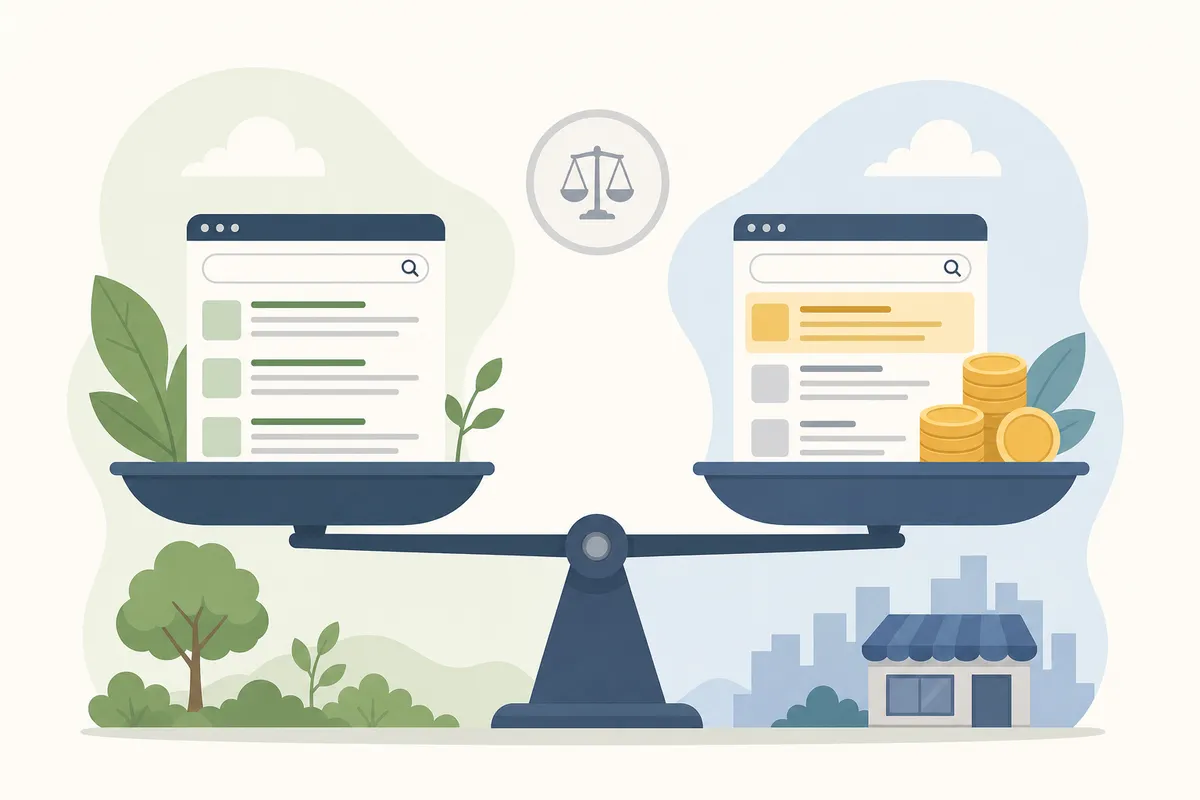
Paid search buys a position today, while organic search optimization earns one slowly and then keeps it at a lower running cost. Most businesses use both at some point. Market Veep quotes Andrew Shum, head of SEO at SeoProfy, on the choice: "It's not about SEO versus PPC. It's about what you need, and when."
| Factor | Organic SEO | Paid search (PPC) | What it means for you |
|---|---|---|---|
| How you pay | Time, content and tools, with no fee per click | Every click, at a price set by auction | Organic suits a steady budget; paid suits short, funded pushes |
| Time to results | Typically 3 to 6 months for visibility, per Market Veep | The day the campaign goes live | Paid wins for launches and seasonal offers |
| When spending stops | Rankings fade slowly as competitors improve | Ads disappear at once | Organic keeps working through a budget cut |
| Share of clicks | Over ten times as many Google clicks as paid, per Jumpshot and SparkToro data cited by Portent | A small slice of total Google clicks | Organic reaches most of the people searching |
| Control over the message | You shape the listing, but Google decides what shows | You choose the keyword, the ad copy and the landing page | Paid is better for testing exact offers and wording |
Why the numbers lean toward organic
Businesses spend heavily on ads. Portent notes that Google Ads brought in $134.81 billion in revenue in 2019. Yet paid clicks are the minority of what Google sends. Portent's figures show Google Search supplies 66% of referral clicks among the top 250 referring sites, and 41% of those clicks are organic.
Where you sit on page one matters as much as being there. Semrush's 2023 State of Search study found that on mobile, the first organic result gets a 22% click-through rate, the second 13% and the third 10%. So moving from third to first more than doubles the clicks the same page receives. Semrush also points to Gymshark, which it reports draws over 2 million monthly visitors from the 33,000-plus search terms it ranks for.
Organic visitors tend to convert well, because they arrived with a need. Market Veep cites organic leads converting at 14.6%, against 1.7% for traditional outbound methods. It also puts the average return at $7.48 for every $1 spent on SEO. Treat both as industry averages rather than a forecast for your site.
One more figure shapes how you build pages: Market Veep reports that over 60% of visits come from mobile users. That matches how Google indexes the web, since it judges the mobile version of your page first.
How search engines decide what ranks
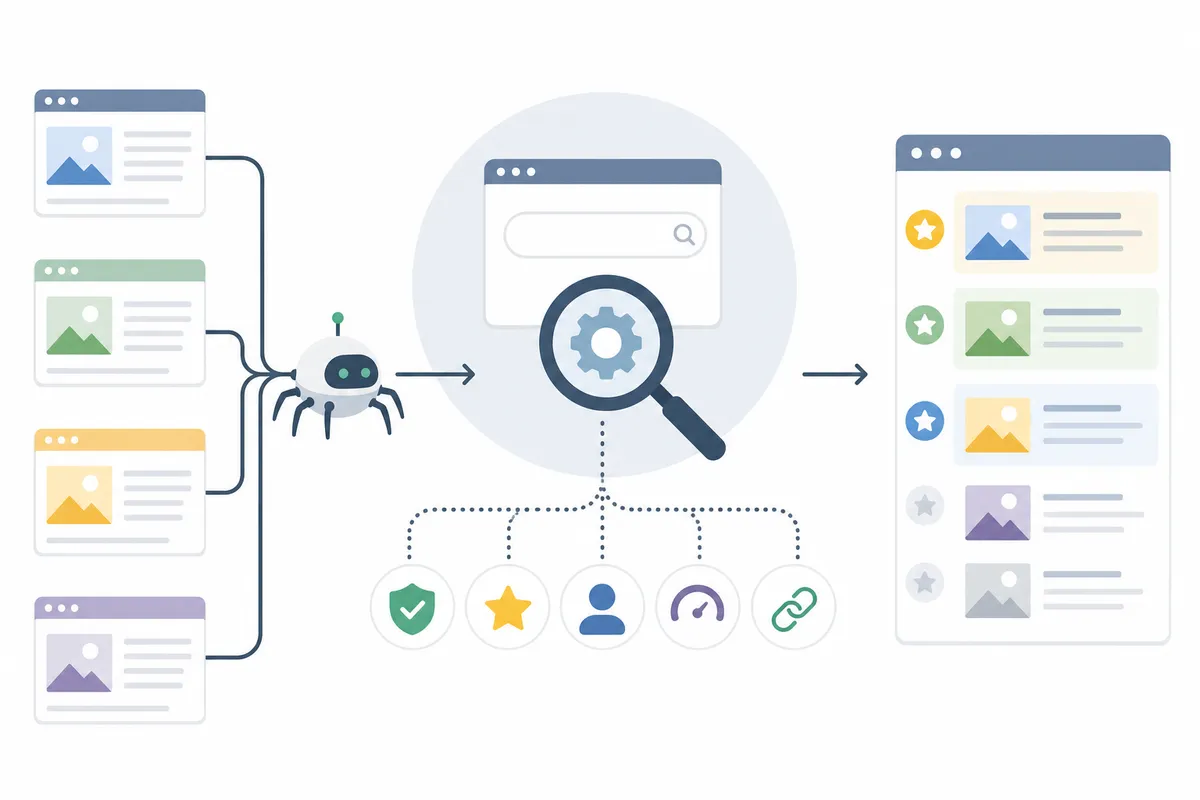
Every search engine does the same basic job. It finds everything someone might want, then sorts it by how well each page answers the query. Google splits that into four stages, and your page has to clear each one in order.
Crawling: can the engine find the page?
Crawlers, sometimes called spiders, discover pages by following links from one page to the next. An XML sitemap is the other main route, because it hands the engine a list of the URLs you want crawled. A page with no internal links pointing to it and no place in your sitemap may never be found. Google Search Central documents how Google crawls and how to submit a sitemap. Bing Webmaster Tools lets you submit sitemaps and track index status for Bing.
Rendering: does the page load for a bot?
Google and Bing build each page the way a browser does, running its HTML, CSS and JavaScript. Google uses mobile-first indexing, so it looks at the content that renders on a mobile browser. If the page arrives broken or blank, it will not rank. Content that only appears after a click or a slow script is at risk of being missed.
Indexing: is the page stored and eligible?
After rendering, the engine pulls out what matters and stores it in its index. Only indexed pages can appear in results. Modern indexes hold more than words. They also store images, videos, entities such as businesses and people, and single passages that answer a question. Common reasons a page stays out include a noindex tag, a canonical tag pointing elsewhere, a robots.txt block, or content that duplicates another page.
Ranking: which page best answers the query?
Portent notes that Google has said it uses over 200 ranking factors. The weights stay secret, but Google does describe the broad signals, which Semrush groups into four:
- Relevance: the page covers the topic and uses the terms the searcher asked about.
- Quality: the content is helpful, original, accurate and well organized.
- Authority: credible, related sites link to it.
- Usability: it loads fast, works on a phone and is easy to use.
Google's search quality rater guidelines sum up the quality goal as E-E-A-T: experience, expertise, authoritativeness and trust. Raters don't set rankings; they check whether Google's systems surface pages that meet that bar, a program Portent dates to at least 2005.
User behavior plays a part too. Disclosures in the United States v. Google antitrust trial and a 2024 leak of Google Search documentation suggested that click-based metrics and Chrome data feed the system, which Google had previously denied. In practice, pages that satisfy the people who click them sit on the right side of whatever those signals measure.
The five parts of an organic SEO strategy
Organic SEO work falls into five parts. Do them roughly in this order, because each one leans on the one before.
1. Keyword research: find terms you can win
Keyword research tells you which words your customers type and how hard each one is to rank for. Two numbers do most of the work. Search volume estimates how many people search a term each month. Keyword difficulty estimates how much authority you need to reach page one.
A new site should start with lower-difficulty terms and move up as it earns links. A roofing company is unlikely to win "roofing" early, but "roof leak repair after a storm" is a realistic first target. This step-by-step keyword research guide walks through the full process. For reading the numbers tools give you, see this breakdown of how keyword difficulty scores work.
2. Content that matches search intent
Search intent is the reason behind a search. People want to learn something, compare options, reach a specific site, or buy. Google ranks the page type that fits that reason, so check the current top results before you write.
Say you sell project management software and want to rank for "best project management software." If the top ten results are comparison articles, your product page will struggle there, because Google has decided a comparison post fits that search. A narrower term with buying intent may suit the product page better. Finding those terms is the job of keyword discovery.
Google's guidance favors helpful, people-first content over pages written just to rank. In practice, that means you should:
- Answer the question fully, then add what the other results leave out.
- Offer something original, such as your own data, examples, photos or expert view.
- Check your facts.
- Cite credible sources when you state a figure.
- Use clear headings, short paragraphs, lists and tables so readers can scan.
3. On-page optimization
On-page SEO is the polish that helps search engines understand a page and helps searchers pick it. Work through these elements on every page you want to rank:
- Title tag: put the main keyword near the front and give people a reason to click.
- Meta description: write a short, specific summary that earns the click.
- URL slug: keep it short and readable, with the keyword in it.
- Headings: use one H1, then H2s and H3s in a logical order.
- Body text: use the keyword and its variants where they fit naturally.
- Internal links: point to related pages on your site so crawlers and readers can move between them.
- Image alt text: describe each image, which helps accessibility and gives search engines context.

A full pre-publish on-page SEO checklist covers 27 checks in detail. Titles deserve extra time, since the title is the first thing a searcher reads. This guide to writing SEO titles that rank and earn the click shows how to balance the keyword against the reason to click.
4. Links and authority
A backlink is a link from another site to yours. PageRank was built on the idea that links act as votes, and links still signal trust. Quality counts for far more than raw numbers. A Semrush study found top-ranking pages average 2,418 backlinks, but the median is just 13. A handful of heavily linked pages drag the average up. Most pages that rank do so with a modest number of relevant links.
Ways to earn links within the rules:
- Reclaim broken links by finding links to dead pages on competitor sites and offering your page as a replacement.
- Ask sites that mention your brand without linking to add the link.
- Publish something worth citing, such as original data, a free tool, or the most complete guide on a topic.
- Redirect deleted pages that other sites still link to, so those old links count again.
Stay clear of paid links and link schemes. Google Search Essentials lists link spam among its spam policies, and Penguin was built to catch it.
5. Technical health
Technical SEO makes sure Google can crawl, render and index every page without trouble. The main checks:
- Speed and stability: Core Web Vitals measure loading, responsiveness and visual stability. web.dev publishes the thresholds for each one.
- Mobile: the page must work well on a phone, since that is the version Google indexes.
- HTTPS: serve every page over a secure connection.
- Crawl errors and redirects: fix broken pages and long redirect chains.
- Duplicates: point near-identical pages to one version with a canonical tag.
- Structured data: markup from the Schema.org vocabulary tells engines what a page describes, such as a business, product, article or FAQ.
What changes with AI search
Search now includes Google AI Overviews and assistants such as ChatGPT, Perplexity and Claude. Marketers call the work of getting cited there answer engine optimization (AEO) or generative engine optimization (GEO), and the terms are often used interchangeably. Wikipedia's summary notes that GEO work focuses on content structure, authority signals and structured data. The goal is to become a trusted source that AI answers cite.
Most of what makes a page citable is ordinary organic SEO. An answer engine can't quote a page it can't reach or doesn't trust. A few habits help on top of that:
- Answer the question in the first sentence or two of each section.
- Write paragraphs that still make sense when lifted out on their own.
- Use tables with labelled columns for comparisons.
- Name specifics, such as prices, dates and counts.
- Add structured data so the page's facts are machine-readable.
How long results take
Organic SEO is slow, and anyone promising fast results should explain how. Market Veep reports that visibility typically takes 3 to 6 months and meaningful returns 6 to 12 months, with ups and downs along the way, since rankings tend to move in steps.
What that usually looks like:
- Early on, you fix technical blockers and get key pages indexed. Impressions in Google Search Console often climb before clicks do.
- In the middle stretch, pages reach page two, then page one for less competitive terms. Traffic grows unevenly.
- Later, links and content build on each other. Harder terms come within reach, and leads from search become steady.
Timelines vary with competition and with how much authority your domain already has. An established site adding a new page can move faster than a brand-new domain. If your site is new, target specific phrases first. This guide on using long-tail keywords for more traffic and sales shows how to build early wins from them.
How to measure progress
Track the numbers that connect to revenue, not rankings alone:
- Google Search Console: impressions, clicks, average position and indexing status for each page.
- Bing Webmaster Tools: the same basics for Bing.
- Your analytics tool: organic sessions and, more important, conversions from organic visits.
- Your CRM or sales records: leads and sales that started with a search.
A ranking that brings no enquiries is a vanity number. A page-two result that sends steady leads may be worth more.
Mistakes that stall organic growth
Most stalled campaigns share a few causes. Check yours against this list:
- Chasing terms you can't win yet. A young site aiming only at the hardest keywords can work for a year and see little. This guide to picking keywords you can actually win shows how to size the fight first.
- Writing for the keyword instead of the reader. Stuffing a phrase into every paragraph reads badly and no longer helps. This piece on the role of keywords in SEO today explains where keywords still matter.
- Ignoring intent. A sales page aimed at a question-style search will keep losing to guides.
- Buying links. It can work for a while, then cost you the rankings you paid for.
- Publishing and forgetting. Facts date and competitors update, so review important pages on a schedule.
- Testing only on desktop. If the mobile version hides content or loads slowly, that is the version Google judges.
Can you do organic SEO yourself?
Yes, for most small and mid-sized sites. The core tasks need time and care more than special skills. The table shows where DIY works and where help earns its fee.
| Task | Can you do it yourself? | When to bring in help | What you need |
|---|---|---|---|
| Keyword research | Yes | Your market is crowded with strong, well-funded competitors | A keyword tool and a spreadsheet |
| Writing and updating content | Yes, if you know the subject | You can't publish or update on a steady schedule | Subject knowledge and regular writing time |
| On-page fixes | Yes | You have hundreds of pages to fix at once | CMS access and a checklist |
| Link building | Partly | You need outreach at scale | Relationships and content worth linking to |
| Technical SEO | Sometimes | You plan a site migration, a redesign or a new domain | A developer or technical specialist |
| Recovering from a penalty or sudden traffic drop | Rarely | Almost always | Search Console history and an experienced auditor |
If you hire, ask for a written audit that names specific fixes by URL. Ask how success will be measured, and look for leads and revenue in the answer. Be wary of anyone who guarantees a top position, because nobody outside Google controls the results.
FAQs
What is the difference between organic SEO and SEO?
In everyday use they mean the same thing. Adding "organic" makes clear that the goal is unpaid listings rather than paid search ads.
How long does organic search engine optimization take to work?
Market Veep reports that visibility typically takes 3 to 6 months and meaningful returns 6 to 12 months. New domains and competitive markets sit at the slower end. An established site adding pages on easier topics can see movement sooner.
Is organic SEO free?
There's no charge per click, but it isn't free. You pay in time, writing, tools, and sometimes a developer or agency. The difference from ads is that the traffic doesn't stop when you stop spending.
Do I need backlinks to rank organically?
For most competitive terms, yes. Links remain one of the main authority signals. You don't need many, though. A Semrush study put the median for top-ranking pages at 13 backlinks, so a few relevant links can be enough for less competitive terms.
Does organic SEO still matter with AI Overviews and ChatGPT?
Yes. AI answer engines draw on pages they can reach and trust, which is what organic SEO builds. Clear answers, labelled tables and structured data make a page easier for them to quote.
Talk to the team about your site
Pick the page that should bring you the most customers and check it against the five parts above this week. If you'd rather see the whole site mapped out, open this sample SEO report to see how every fix is laid out by page. Then talk to the team about running the same organic search engine optimization audit on your site.
Resources / References
Sources
About the author
SearchBlueprint researched, wrote and scored this article with the content pipeline our customers run on their own sites. The score in the byline is what our content engine gave this page before it published. Nothing here is reviewed by hand, which is the point: it is the product's output, published where anyone can check it.