How SEO Builds Brand Awareness and Drives Growth Long Before You Rank #1
SearchBlueprint · · 7 min read · scored 90/100

Here's how SEO builds brand awareness and drives growth: it puts your business in front of people searching for what you sell. Then it repeats that exposure until your name feels familiar instead of new. Every ranking is a free impression.
Do this well, and the payoff shows up as branded search volume, direct visits, and word-of-mouth. You can't trace it to a single campaign. This article breaks down how that happens and what to measure. It also covers where SEO beats other channels for building a brand people recognize on sight.
How SEO Builds Brand Awareness Before a Single Click
Ranking is only the first touch. A person can see your business in the organic results, in an image pack, and inside an AI-generated summary. All of that can happen before they ever visit your site. Each appearance reinforces the name. That's the real mechanism behind SEO's brand-awareness effect: repetition, not a single click.

Repeat exposure across the results page
A single search often shows your brand more than once when your SEO is working. You might appear in the main organic listing, a related "People Also Ask" answer, and a local pack or knowledge panel entry. Someone scrolling that page absorbs your name three or four times without clicking anything. Do that across dozens of searches a month, and your brand starts to feel familiar. It's the same way a billboard you pass daily eventually sticks.
The same familiarity effect shows up off Google too. Why enhance cross-channel SEO for better brand visibility (and how to prove it) walks through why that works. A searcher who has already seen your brand trusts it faster next time, whether on social media or in a review.
Being the answer inside AI Overviews and chat tools
Increasingly, this exposure happens without a click at all. Google confirms AI Overviews are a standard part of Search results for many queries, not an experiment (source: Google Search's AI features). Being named inside an AI Overview or quoted in a chat tool's answer works like a citation with a byline attached. Google's own Search Essentials guidance notes that ranking systems reward content demonstrating real expertise and firsthand knowledge (source: Google Search Essentials). That's exactly the kind of content AI systems tend to quote by name. Getting quoted this way is one of the newest, cheapest forms of brand exposure available right now.
The SEO Levers That Actually Move Brand Recognition

Not every part of SEO builds awareness the same way or at the same speed. Some levers work in weeks; others take months to compound. Knowing which is which keeps expectations realistic.
| SEO lever | What it does for brand awareness | Typical timeline | What to track |
|---|---|---|---|
| Content and topical authority | Answers the questions your buyers ask, so you show up for many related searches, not just one | Weeks to a few months to gain traction | Ranking keywords, organic impressions |
| Technical SEO | Keeps pages fast and crawlable, which is what makes every other lever possible | Ongoing, though fixes often show impact within weeks | Indexed pages, crawl errors, Core Web Vitals |
| Backlinks and digital PR | Puts your brand name on other trusted sites, which is awareness in its own right | Months, since earned links build gradually | Referring domains, brand mentions |
| Local SEO and schema | Gets your business shown correctly in maps and rich results in your service area | Weeks for schema, longer for map-pack rankings | Local pack appearances, profile views |
| Generative engine optimization | Gets your brand named directly inside AI-generated answers | Ongoing and still maturing | Citations in AI answers, referral traffic |
Google measures page experience through Core Web Vitals, its official speed and stability benchmarks for every site (source: Core Web Vitals). Rich results and knowledge panels rely on schema.org markup, the structured-data standard Google, Microsoft, Yahoo, and Yandex maintain jointly (source: Schema.org). If you want the business case for why this is worth it, why optimize for Google lays out the numbers behind ranking. Not just the theory.
SEO vs. Paid Ads vs. Social for Building a Brand
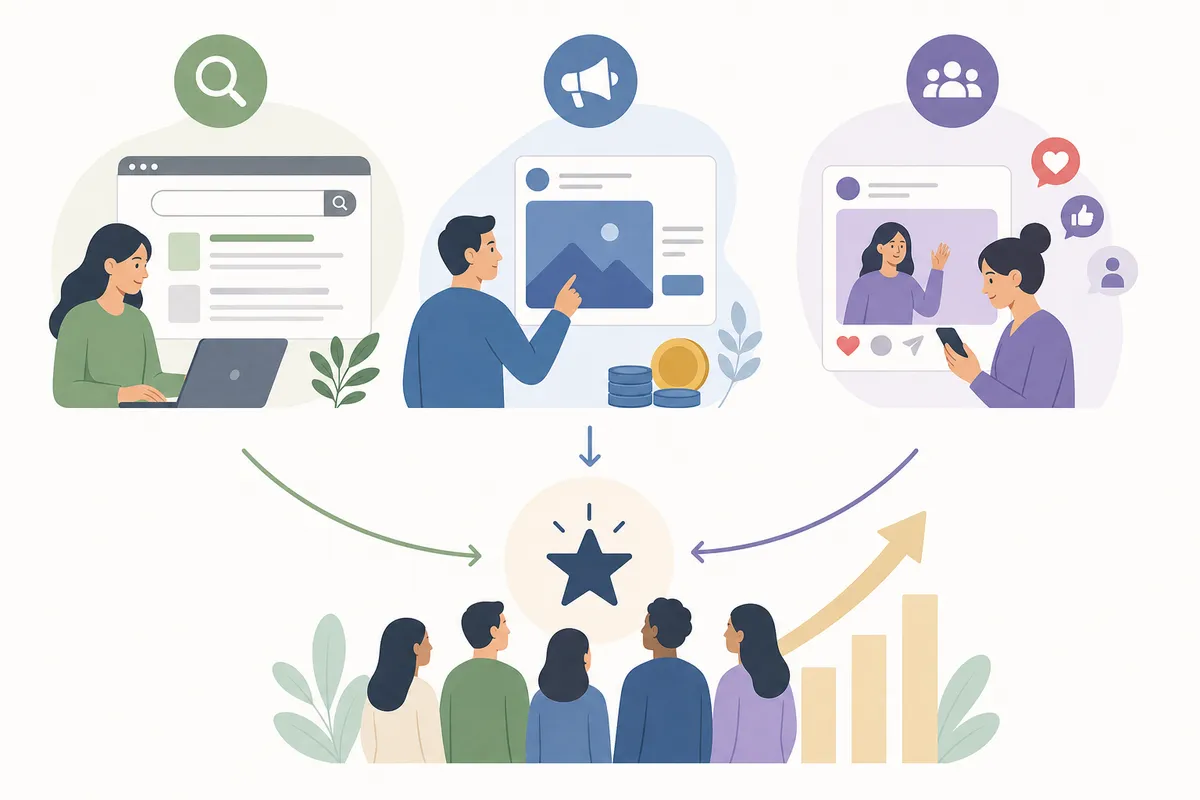
Every channel can build some form of recognition. The difference is what happens after you stop paying for it.
| Channel | Cost pattern | Awareness lifespan | Best for |
|---|---|---|---|
| SEO | Upfront investment, then near-zero marginal cost per visit once ranked | Long-lasting; a ranking page keeps working after publication | Buyers actively searching, evergreen questions |
| Paid search or social ads | Pay per click or impression, stops the moment budget stops | Ends when spend ends | Fast bursts, new launches, retargeting |
| Organic social | Time-intensive, reach depends on the algorithm | Short-lived per post, though community builds over time | Real-time conversation, engagement |
SEO is the slowest of the three to get moving. It's also the one most likely to still be paying off a year later. That trade-off is why most growth plans lean on it for the long game and use ads for the short one.
Measuring Whether SEO Is Actually Driving Growth
Rankings tell you where you show up. They don't tell you whether anyone remembers you afterward. Two other numbers do that job better.
Branded search volume
This is the count of people searching your exact business name, or a close variant of it, instead of a generic term. A rising trend here is one of the clearest proofs that your SEO and other visibility efforts are creating real awareness. Nobody types your business name by accident.
Direct traffic and share of voice
Direct visits, people typing your URL straight into the browser, tend to climb alongside branded search. Watching your share of voice against competitors for your core terms adds the comparative view. Are you gaining ground on them, or just holding steady while they pull ahead?
If you're not sure how to read your own numbers, what is organic traffic and how do you actually grow it can help. It breaks down which visits are genuinely new and which are just returning readers.
Turning Awareness Into Pipeline: The Handoff That Gets Missed
Awareness alone doesn't pay the bills. The businesses that get real growth from SEO build a deliberate handoff. It runs from the article that earned the click to the page that earns the sale. That means internal links from informational content to service pages, plus a clear next step at the end of every post. It also means calendar planning that mixes top-of-funnel questions with bottom-of-funnel comparisons.
A structured process for building that handoff is what how to create SEO content for lasting online growth in 6 steps walks through. It goes step by step, rather than leaving it to chance.
FAQs
Does SEO actually build brand awareness, or does it just bring traffic?
Both. Every ranking, snippet, and AI citation is also an impression, whether or not someone clicks. Traffic is the visible result; the repeated exposure behind it is what builds recognition over time.
How long does it take before SEO shows up as brand awareness?
New content typically needs weeks to a few months to gain traction, and backlinks or digital PR mentions build more gradually. The effect compounds after that, since older ranking pages keep working with no extra spend.
What is branded search volume, and why does it matter?
It's the number of people searching your exact business name, or a close variant, instead of a generic term. A rising trend here is one of the clearest signs that your visibility work is creating real awareness. Nobody types your name by accident.
Can a small business really use SEO to build a brand, or is this only for big names?
Small businesses often see it work faster in a narrow niche or local market. There's less competition for the specific terms their buyers use. The levers above, content, technical fixes, local SEO, apply at any size; only the scale of the terms you target changes.
Does AI search hurt the brand-awareness benefit of SEO?
Not necessarily. Being named inside an AI Overview or a chat answer is still an impression, arguably a stronger one. It carries an implied endorsement of expertise. The content that earns those citations is largely the content that earns rankings: clear, well-structured, and written by someone who knows the subject. Google's guidance backs this up: it rewards content made for people first, by someone with real, demonstrated experience (source: Google's helpful content guidelines).
Find Out How Much Awareness Your Own Site Is Already Building
You don't have to guess whether any of this is working for your business. A short look at your own rankings, branded search trend, and content gaps usually shows exactly where the fastest wins sit. See a sample SEO report to see the kind of detail that shows up once you look, then decide where to start. That single look is enough to show how SEO builds brand awareness and drives growth in your market, not just in theory.
Resources / References
About the author
SearchBlueprint researched, wrote and scored this article with the content pipeline our customers run on their own sites. The score in the byline is what our content engine gave this page before it published. Nothing here is reviewed by hand, which is the point: it is the product's output, published where anyone can check it.