Best Courses on SEO in 2026: 9 Picks Worth Your Time
By Toy Wen Da, Co-Founder · Updated · 9 min read · scored 97/100
The best courses on SEO depend on what you need next: a free, practical path if you run a small site yourself, or a university-backed certificate if you need proof of skill for a job search. SearchBlueprint Academy covers the first case at no cost. Coursera's Google SEO Fundamentals, built with UC Davis, covers the second.

How We Chose These Courses on SEO
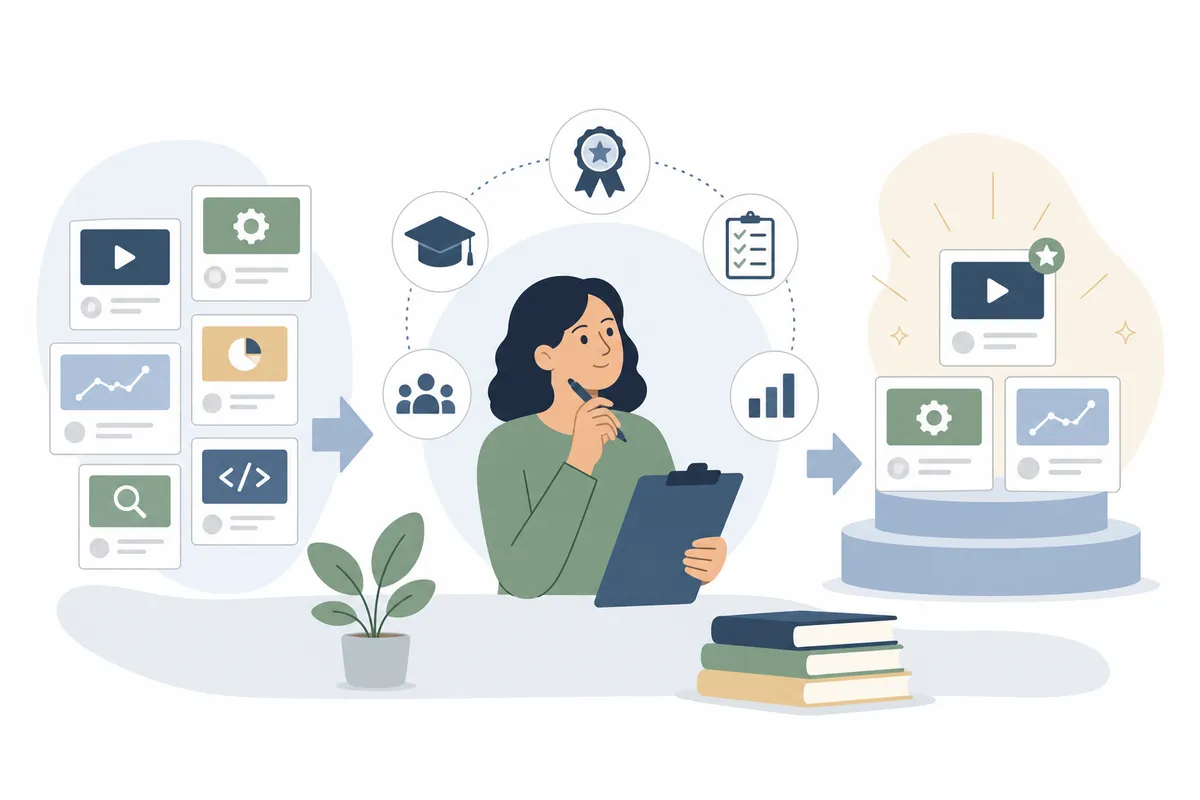
This list weighs four things: the price, whether a free plan exists, what the course actually teaches well, and where it falls short. We looked at course length, format (single course, Specialization or guided project), and who each one is built for, beginner, intermediate, or tool-specific.
This comparison is built from each provider's own website, course pages and documentation, not from hands-on testing of every lesson. Treat it as a shortlist to start your own research, not a verdict on teaching quality.
One more note before the list: on-page work (titles, headings, meta descriptions) comes up in nearly every course here, because it's foundational. If you want a deeper walkthrough of that piece alone, our practical guide to on-page SEO covers it in more depth than any single course module will.
9 Best Courses on SEO for Every Skill Level
1. SearchBlueprint Academy: best for small business owners and agencies who want free, task-based lessons
SearchBlueprint Academy is a free library of 111 lessons split into four tracks: SEO, local SEO, ecommerce SEO and agency SEO. Each track is built around the work you'd actually do, setting up pages, fixing technical issues, tracking rankings, rather than abstract theory. It's free, with no paid tier.
What it doesn't do: issue a graded certificate, run timed assessments, or offer the multi-month Specialization structure that some Coursera programs use for resume credentials. If you need proof-of-completion for a job application, pair it with one of the certificate options below.
Pick it if: you want free, applied lessons tied to real SEO tasks across general, local, ecommerce or agency work. Skip it if: you need a certificate to show an employer or client.
2. Google SEO Fundamentals (Coursera, UC Davis): best for beginners wanting a university-backed intro
This University of California, Davis course walks through keyword research, content optimization and basic site structure. It carries a 4.8-star rating from roughly 3,700 reviewers on Coursera and is pitched at an intermediate level over one to four weeks.
It's free to audit. The graded certificate sits behind a Coursera subscription, check Coursera's pricing page for the current rate.
Pick it if: you want a short, well-reviewed course with a recognizable university name attached. Skip it if: you need something free from end to end, including the certificate.
3. Semrush Academy: best for marketers who already use Semrush's tools
Semrush Academy states plainly that its courses and resources are "100% free, in-depth, and led by experts." Standouts include "Getting Started with Semrush" (20 lessons, about an hour), "On-Page SEO and AI Search Essentials with Semrush" (23 lessons, about an hour) and "Local SEO Essentials with Semrush" (16 lessons, about an hour), each ending in a certification.
Lessons lean heavily on Semrush's own dashboard, so you'll get the most value if you're using or planning to use the platform.
Pick it if: you want short, free, certified courses tied directly to a tool you already pay for. Skip it if: you're not using Semrush and want platform-neutral training instead.

4. Search Engine Optimization (SEO) Specialization, UC Davis: best for marketers building a long-term portfolio
This Coursera Specialization carries a 4.6-star rating from more than 13,000 reviewers, making it one of the most reviewed SEO programs available. It's a beginner-level program that runs three to six months and covers campaign planning, content strategy and competitive analysis across multiple courses.
It's free to audit each course; the full Specialization and certificate require a Coursera subscription, so check their pricing page for current terms.
Pick it if: you want a long-form credential with a large base of reviewer feedback behind it. Skip it if: you need results in weeks, not months.
5. IBM SEO Mastery: From Fundamentals to GenAI and GEO Strategies: best for marketers adding AI search skills
This IBM Specialization on Coursera holds a 4.7-star rating from 101 reviewers. It's an intermediate-level program spanning one to three months, and it specifically covers generative engine optimization (GEO) alongside traditional SEO fundamentals, a newer combination most legacy courses don't touch.
It's free to audit; see Coursera's pricing page for subscription and certificate costs.
Pick it if: you want one program that bridges classic SEO with how AI answer engines surface content. Skip it if: you want a course with a longer review history to judge it by.
6. Google Digital Marketing & E-commerce Professional Certificate: best for career changers wanting a broad credential
This Google-built Professional Certificate on Coursera has a 4.8-star rating from over 52,000 reviewers, by far the largest review base on this list. It's a beginner-level program running three to six months, but SEO is just one module inside a much wider digital marketing and e-commerce curriculum.
Free to audit; see Coursera's pricing page for subscription pricing.
Pick it if: you're changing careers and want a recognizable, broad marketing credential, not SEO specifically. Skip it if: you only want to learn SEO, this program spends most of its time elsewhere.
7. Search Engine Optimization (SEO) with Squarespace: best for Squarespace site owners wanting a fast, free intro
This Coursera guided project focuses on optimizing a Squarespace site specifically, covering blogs, content optimization and basic search visibility. It holds a 4.5-star rating from about 1,300 reviewers, runs under two hours, and is listed as free.
If you're deciding which platform to build on in the first place, our comparison of website builders for SEO is worth reading before you commit to a course tied to one.
Pick it if: you run a Squarespace site and want a quick, free, platform-specific primer. Skip it if: you're on WordPress, Shopify, Wix or another platform, this one won't transfer.
8. SEO Masterclass With AI SEO: Beginner to Advanced (Alex Genadinik): best for solo founders wanting one all-in-one course
This independently taught Coursera Specialization holds a 4.7-star rating from 25 reviewers. It's a beginner-level program running three to six months, covering everything from keyword research to AI SEO tools like Google Gemini and Anthropic Claude.
It's free to audit; see Coursera's pricing page for certificate costs.
Pick it if: you want one instructor's complete beginner-to-advanced path in a single Specialization. Skip it if: you prefer courses with a larger review base behind the rating.
9. AI SEO: Mastering Generative Engine Optimization (GEO) by SkillUp: best for marketers focused specifically on AI visibility
This SkillUp course on Coursera carries a 4.6-star rating from 57 reviewers. It's an intermediate course running one to four weeks, narrowly focused on how content gets surfaced inside AI-generated answers rather than traditional blue links.
Free to audit; see Coursera's pricing page for certificate pricing.
Pick it if: you already know core SEO and want a short, focused add-on covering AI search visibility. Skip it if: you're new to SEO, this course assumes the fundamentals are already in place.
Comparison Table: Best Courses on SEO at a Glance
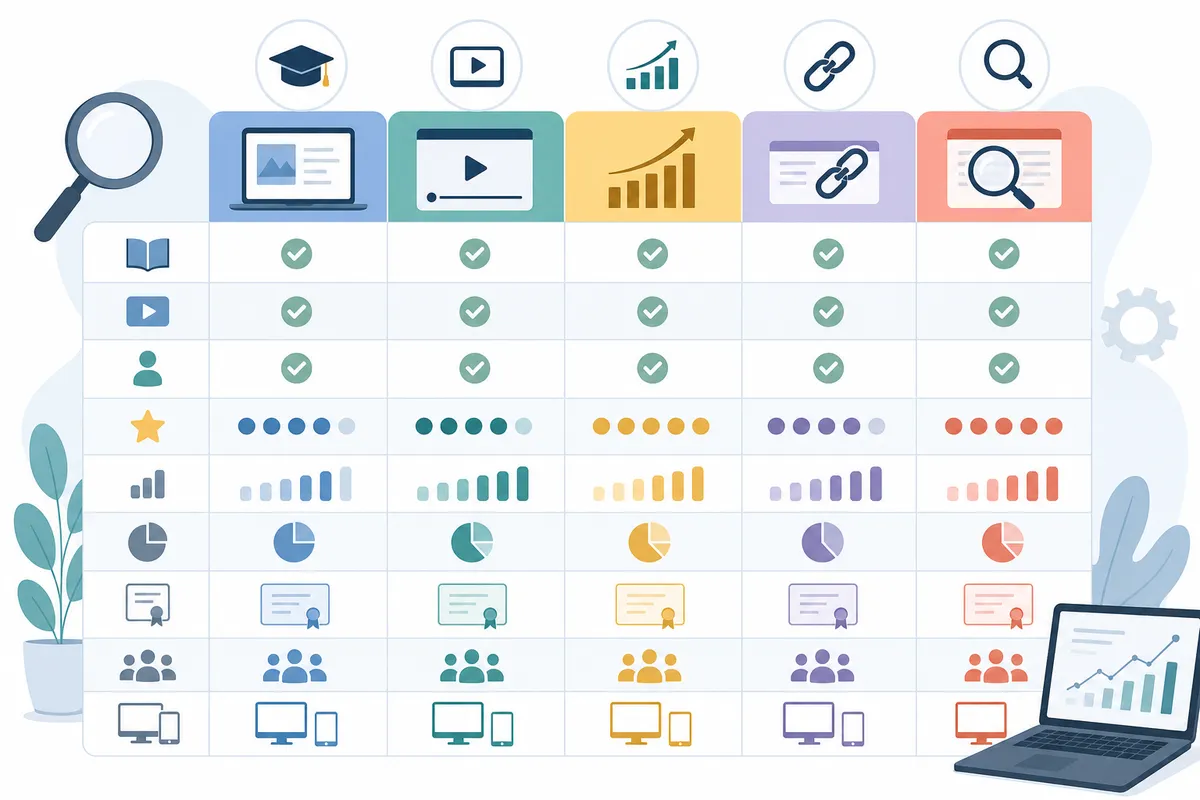
| Option | Best For | Free Plan | Starting Price | Main Limit |
|---|---|---|---|---|
| SearchBlueprint Academy | Business owners, agencies | Yes, fully free | Free | No certificate |
| Google SEO Fundamentals (UC Davis) | Beginners wanting credibility | Audit free | Free to audit; see Coursera's pricing page | Certificate costs extra |
| Semrush Academy | Semrush tool users | Yes, fully free | Free | Tied to one platform |
| SEO Specialization (UC Davis) | Long-term portfolio builders | Audit free | Free to audit; see Coursera's pricing page | 3–6 month commitment |
| IBM SEO Mastery: Fundamentals to GenAI/GEO | AI-focused marketers | Audit free | Free to audit; see Coursera's pricing page | Smaller review base |
| Google Digital Marketing & E-commerce | Career changers | Audit free | Free to audit; see Coursera's pricing page | SEO is a small part |
| SEO with Squarespace | Squarespace owners | Yes, free | Free | Platform-specific only |
| SEO Masterclass With AI SEO (Genadinik) | Solo founders | Audit free | Free to audit; see Coursera's pricing page | Fewer reviews |
| AI SEO: Mastering GEO (SkillUp) | Experienced marketers, AI focus | Audit free | Free to audit; see Coursera's pricing page | Assumes SEO basics |
When the Free Option Is Enough, and When It Isn't
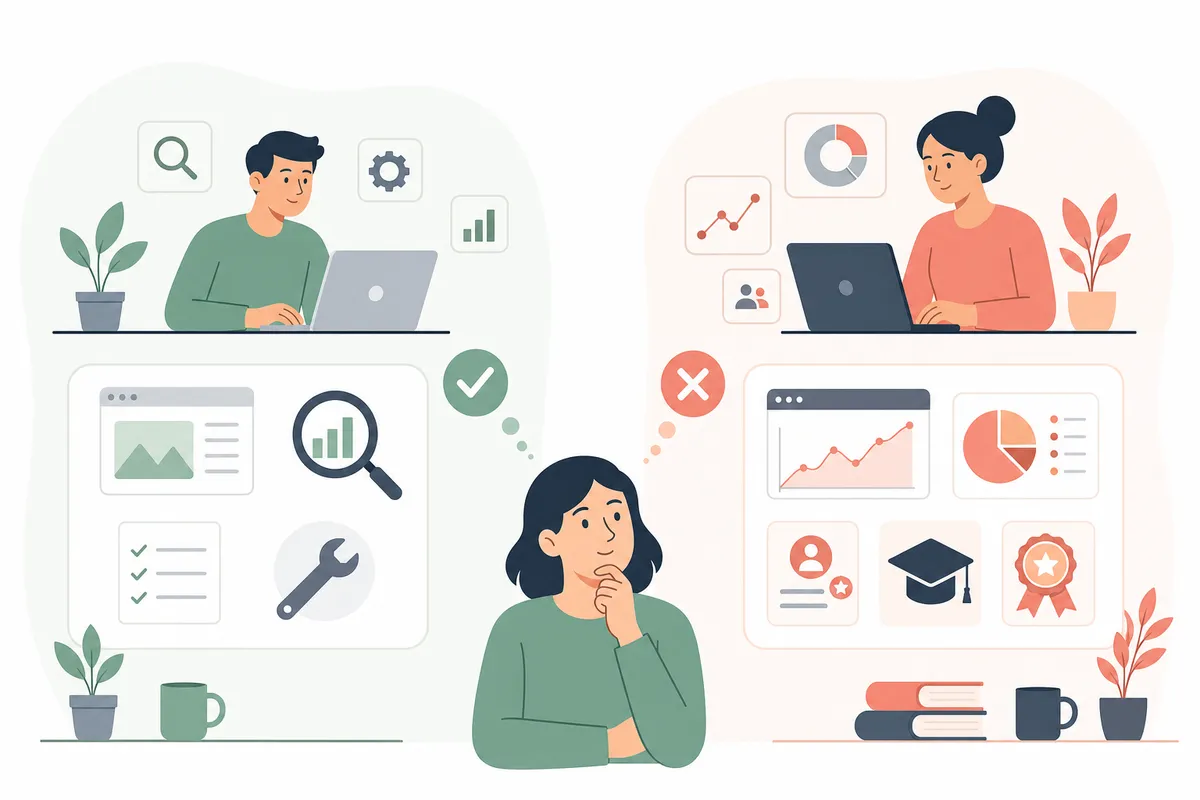
A free course on SEO, like SearchBlueprint Academy or Semrush Academy, covers you well if you're running your own site or a handful of client sites and need practical, repeatable steps. You'll get keyword research, on-page fixes and local or ecommerce-specific guidance without paying anything or waiting on a cohort schedule.
It stops being enough once you need a credential. If a job posting or client contract asks for a certificate, a free library won't satisfy that requirement, you'll need a paid Coursera Specialization or Professional Certificate instead. The same applies if you want graded assessments to track your own progress formally, or a named university or company attached to your resume.
Regardless of which course you take, the lessons only pay off once you apply them to a real page. Our on-page SEO feature breakdown shows what that looks like once you move from lesson to live page: titles, metas and headings done correctly, one page at a time.
FAQs
Are free SEO courses actually good, or should I pay?
Free courses from providers like SearchBlueprint Academy and Semrush Academy cover real, applicable skills, keyword research, on-page fixes, local SEO setup. Paid certificates add structure, grading and a credential to show employers, but the underlying SEO knowledge in a free course can be just as solid.
How long does it take to learn SEO?
It varies by course and depth. Single courses on Coursera run one to four weeks; Specializations and Professional Certificates typically run three to six months. A focused free course can be finished in under an hour, like several Semrush Academy lessons.
Do I need a certificate to get an SEO job?
Not always. Many employers care more about a portfolio, sites you've improved and results you can show, than a certificate. A credential helps when you're new to the field and have no track record yet to point to.
What's the difference between an SEO course and tool-specific training?
A general SEO course, like UC Davis's Google SEO Fundamentals, teaches concepts that apply anywhere. Tool-specific training, like Semrush Academy's courses, teaches those same concepts through one platform's interface. If you don't use that tool, some lessons won't transfer directly.
Should I take a course focused on AI search (GEO) specifically?
If you already understand core SEO, a focused course like IBM's SEO Mastery program or SkillUp's AI SEO course adds a useful, current layer on top. If you're still new to SEO fundamentals, start with a general course first, AI-focused training assumes you already know the basics.
As a reference point for the technical side of all this, Google's own Search Essentials documentation lays out what the company actually requires for a page to be eligible to rank, useful to read alongside any course, free or paid.
Pick One Course and Finish It This Month
Don't try to take all nine of the best courses on SEO at once, pick the one that matches what you need right now, whether that's a free, practical path or a certificate for your resume, and commit to finishing it. Once you've learned the fundamentals, the fastest way to see if they're working is to check how your own pages currently stack up. Talk to the team and get a sample SEO report to see exactly where to apply what you've learned.
Resources / References
Sources
- What's the best SEO course?
- 10 Best SEO Courses in 2026
- Best Free SEO Courses with Certification
- [Best SEO Courses & Certificates 2026)
- SEO Online Courses: Master Search Engine Optimization
Disclaimer: This article is general information about rules and figures that applied when it was written, not personalised financial, tax or investment advice. It does not take account of your income, obligations, risk tolerance or goals, and rates and thresholds change. Verify the current position with the relevant authority, and speak to a licensed adviser or a qualified accountant before acting.
About the author
SearchBlueprint researched, wrote and scored this article with the content pipeline our customers run on their own sites. The score in the byline is what our content engine gave this page before it published. Nothing here is reviewed by hand, which is the point: it is the product's output, published where anyone can check it.