What Is Automated Link Building? Safe vs. Risky in 2026
SearchBlueprint · · 13 min read · scored 89/100

What is automated link building? It's the use of software, APIs, and AI to handle the repetitive parts of earning backlinks, finding prospects, verifying contacts, sending follow-ups, and monitoring live links, while a human still decides which links are worth pursuing. Done right, it saves weeks of admin work. Done wrong, it risks your rankings.
That distinction is the whole subject. The phrase covers everything from a harmless broken-link scanner to a bot that blasts your URL across thousands of low-quality sites. One of those makes your SEO faster. The other makes it a liability. This guide explains where the line sits, what the workflow looks like in practice, and what the tools cost. It also shows how to automate link building without ending up on the wrong side of a manual action.
Key Takeaways
- Automated link building means using software to handle prospecting, outreach logistics, and link monitoring, not machine-generated link placement, which is what Google penalizes.
- The safe rule: automate the operations, keep the editorial judgment human. Process automation is fine; placement automation is the risk zone.
- The efficiency gap is real. Industry surveys cite that 73% of marketers doing manual link building earn fewer than 10 links per month, and a single link takes roughly 8 days from first email to live placement.
- A self-managed automation stack runs roughly $350/month, versus agency retainers that often top $3,000/month, one founder-focused analysis puts the cost per link at $80 versus $300.
- Links only pay off if your site is technically sound first. Automating outreach for a broken site is pouring water into a leaky bucket.
What Is Automated Link Building, Exactly?
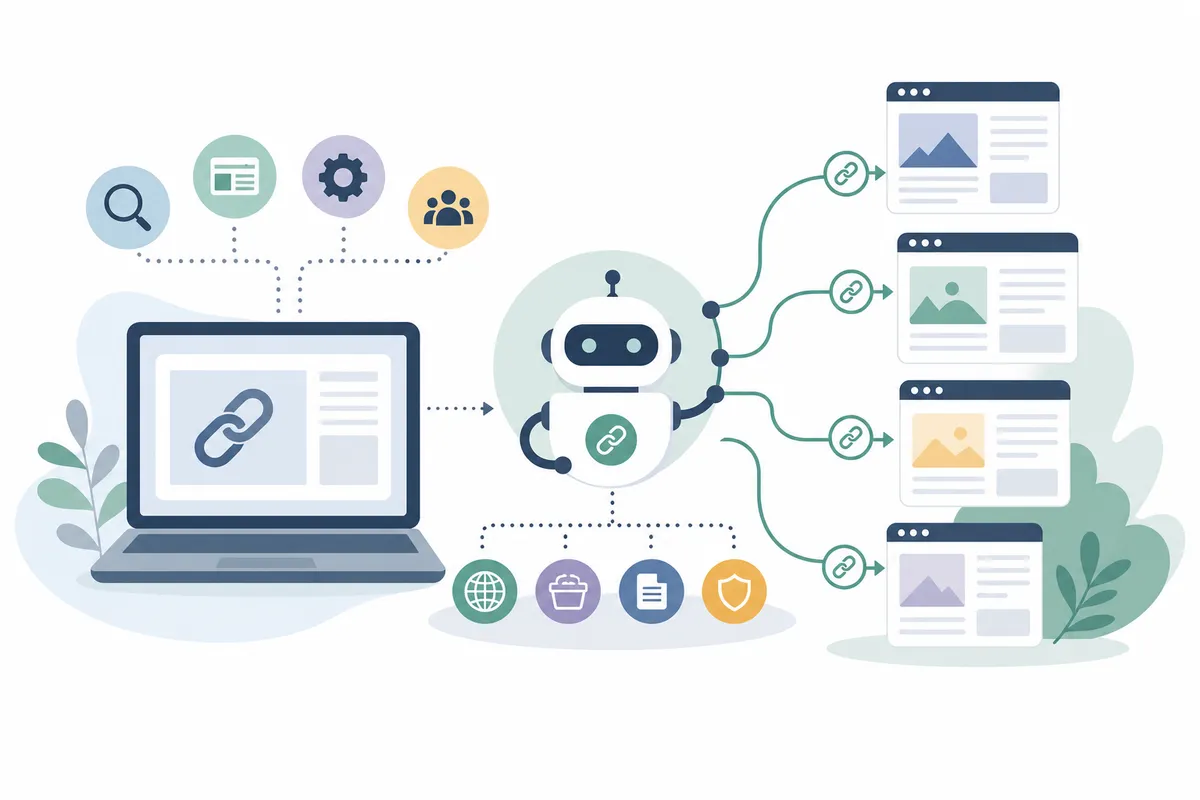
A normal link building funnel has seven stages: discover prospects, qualify them, reach out, negotiate, secure the placement, run quality checks, then monitor and report. Anyone who has run that funnel manually knows the honest truth, most of the time goes to "admin SEO." Building lists. Hunting email addresses. Chasing non-replies. Checking whether last month's links are still live.
Automated link building applies software to those administrative stages. It does not (or should not) mean a machine decides where your links appear. That decision, "yes, I'll cite you", always belongs to a third-party editor. No bot can make it for them.
The two types of automation
The term gets misused constantly, so it helps to split it into two camps:
Process automation is the safe kind. It covers prospect scraping, relevance scoring, contact enrichment, email sequencing, follow-up timing, link monitoring, QA alerts, and reporting. This is logistics. Google has no problem with logistics.
Placement automation is the risky kind. It covers auto-posting to link networks, automated link exchanges at scale, mass guest-post pipelines, and bots that inject your URL into comments, forums, and directories. This is the behavior Google's link spam policies were written to catch.
Every reputable framework for link building automation draws this same line: automate the movement of data, never the earning of trust. Trust is what a backlink actually represents. It cannot be scripted. If you want a broader map of which SEO tasks belong to machines and which don't, our guide to what you should and shouldn't automate in SEO covers the full picture beyond links.
What it looked like before vs. now
Old-school "automated link building" (mid-2000s vintage) meant software that submitted your site to thousands of directories and article farms overnight. Google's Penguin updates and later spam policy revisions made that approach not just useless but actively harmful.
The 2026 version is different in kind, not just degree. Modern systems use AI to read a prospect's actual page content, score topical relevance, draft a personalized opening line referencing something the author genuinely wrote, and time follow-ups based on behavior, for example, triggering a nudge when a prospect hasn't replied after 3–5 days. The machine handles pattern work; the human approves the pitch.
Why Marketers Are Automating Link Building
The short answer: manual outreach doesn't scale, and the numbers back that up.
SE Ranking's outreach research cites that Google still generates a staggering 93.05% of all site traffic, most of it through classic organic results. That means backlinks, one of the strongest authority signals, remain worth fighting for. The same research notes that link building is now considered the hardest part of SEO by just under half of practitioners. It also notes that more than 36% of businesses hire freelance outreachers just to keep pipelines moving.
Meanwhile the manual math is brutal:
- It takes around 8 days on average to go from an outreach email to a successfully acquired backlink, per SE Ranking's figures.
- 73% of marketers who engage in link building gain fewer than 10 links per month.
- By 2024, reports already showed 86% of SEO professionals had integrated AI into their strategy, and outreach is one of the first places it lands.
Backlinks also matter beyond the ten blue links now. AI answer engines lean heavily on well-cited, authoritative sources when deciding what to quote. So a stronger link profile feeds directly into whether ChatGPT or Perplexity mentions you. That connection is explored in our guide to answer engine optimization and getting cited by AI.
How Automated Link Building Works, Step by Step
A modern automated workflow has five stages. Software does the volume; humans do the judgment at two checkpoints.

Step 1: Automated prospect discovery
APIs and crawlers assemble your target list. Typical sources: SERP scrapes for resource pages and "best tools" roundups, competitor backlink exports (find every site linking to three rivals but not to you), unlinked brand mentions, and journalists writing on your topic. What would take a human weeks happens in minutes.
Discovery is also where you filter out junk. A quick footprint check matters: link farms often cluster on the same cheap infrastructure. Running a suspicious domain through a free hosting checker can reveal when a "network" of unrelated blogs all resolve to the same server, a classic PBN tell.
Step 2: Scoring and enrichment
Raw lists are useless. Automation scores each prospect on topical match, indexation health, outbound link patterns (does it look like a "write for us" mill?), content quality, and contactability. Enrichment tools then find the right human, the editor or content manager, not a dead support@ inbox. They verify the address before anything gets sent.
This is also where segmentation happens. A broken-link pitch goes to pages with dead links. A resource-inclusion pitch goes to curated lists. A data-story pitch goes to editorial blogs. Pitching the wrong thing to the wrong page type is why most outreach fails. Routing is exactly the kind of rule-based work machines do well.
Step 3: Human review (the first checkpoint)
Before outreach fires, a person samples the queue. You don't review every prospect, you review enough to catch drift. If the AI starts approving off-topic sites or drafting generic praise ("I loved your recent article!"), you fix the rubric before 500 bad emails go out, not after.
Step 4: Assisted outreach and follow-ups
Sequencing platforms handle delivery timing, rate limits, inbox warmup, reply detection, and automated follow-ups. AI drafts personalized openers referencing the prospect's actual content. The human contribution is small but decisive: the one sentence that proves genuine relevance, and the final send approval on any new campaign. Practitioners consistently advise never automating the send button for the first batch of a fresh campaign. Read the drafts, tune the prompts, then scale.
Step 5: Monitoring, reclamation, and reporting
Once links go live, monitoring bots run periodic checks. They flag links that get removed, pages that 404 after a migration, and mentions of your brand that never got linked. Each one is a low-friction recovery email away from a win. Reclamation is arguably the safest automation of all, because you're just keeping accurate citations intact.
The reporting layer matters too, especially if you answer to clients or a boss. Link acquisition data belongs alongside rankings and traffic in a coherent document; our SEO report template guide shows how to present it without drowning readers in raw exports.
One prerequisite before any of this: make sure the pages you're building links to are actually crawlable. A misconfigured robots.txt can quietly block the very URLs you're promoting. A two-minute pass through a robots.txt tester rules that out before you spend a dollar on outreach.
Is Automated Link Building Safe? What Google Actually Penalizes
Yes, parts of it are completely safe, and parts of it are a documented policy violation. Google's anti-spam systems don't evaluate your workflow's efficiency; they evaluate patterns that suggest links exist to manipulate rankings. Google's spam policies explicitly name link spam as behavior that can tank visibility. That includes large-scale link exchanges, automated programs that create links to your site, and paid links that pass ranking signals without proper rel qualification.
Here's how the common practices break down:
| Practice | Risk level | Why | Verdict |
|---|---|---|---|
| Automated prospect discovery and scoring | Safe | No links are created; you're just researching faster | Automate freely |
| Contact enrichment and email verification | Safe | Pure data hygiene, invisible to Google | Automate freely |
| Sequenced follow-ups with human-approved copy | Low risk | The human controls the pitch; the machine controls timing | Automate with a review step |
| Internal linking automation | Very safe | Google's own docs encourage crawlable, user-sensible internal links | Often the highest-ROI automation |
| Link monitoring and reclamation | Safe | You're restoring citations that already existed | Automate freely |
| Automated link exchanges at scale | High risk | "Excessive link exchanges" is named in Google's spam policies | Avoid or keep minimal and genuinely editorial |
| Auto-posting to networks / PBNs | Very high risk | Textbook link scheme; core updates have de-indexed these networks | Never |
| Mass AI guest-post pipelines | High risk | Falls under scaled content abuse when built to game rankings | Never |
The Red Lines: What Never to Automate
Three behaviors turn automation from an asset into a liability:
- Anything resembling a link scheme. If a link's primary purpose is to sway rankings, bought without disclosure, exchanged in bulk, injected by a bot, it's in the danger zone regardless of how sophisticated the tooling is.
- Undisclosed paid placements. Paying for links isn't itself the violation; hiding it is. Google's guidance is to qualify paid or user-generated outbound links with
rel="sponsored"orrel="ugc". The FTC's endorsement guides make the same demand from the consumer side: paid placements must be clearly disclosed. - Detectable footprints. Identical anchor text across dozens of placements, links dropped into irrelevant paragraphs, clusters of similar sites acquired in a burst. Automation makes these patterns easy to create and easy for Google to detect. Diversify anchors across branded, naked-URL, and contextual forms.
The mental model that keeps you safe: automate the operations, keep the editorial judgment human. Every penalized "automated link building" horror story broke that rule by automating the judgment.
Manual vs. Automated Link Building: The Real Efficiency Gap
The economics are the strongest argument for automation, and they're specific enough to run the math on.
A mid-tier agency retainer often tops $3,000/month for a handful of links, sometimes 5–10, frequently negotiated through opaque channels you never see. One founder-focused analysis prices a self-run automation stack (a backlink index, an outreach hub, and a sequencing tool) at roughly $350/month. Used to send around 100 genuinely personalized emails a month, that stack realistically lands 2–4 high-authority links. The analysis puts the resulting cost per link at about $80, down from $300. Just as importantly, you own the data, the relationships, and the process.
| Dimension | Manual / agency approach | Automated in-house approach |
|---|---|---|
| Monthly cost | Agency retainers often top $3,000/month | Self-run tool stack around $350/month |
| Effective cost per link | Cited at roughly $300 per link | Cited at roughly $80 per link |
| Time to a live link | Around 8 days per link, with prospecting adding weeks up front | Prospecting compressed to minutes; marketplace-style tools report first links within about 7 days |
| Monthly link volume | 73% of marketers report fewer than 10 links/month manually | 100 personalized emails/month can yield 2–4 high-authority links with better relevance |
| Ownership | Agency owns prospects, relationships, and methods | You own the data, the contact history, and the process |
| Risk visibility | You can't audit tactics used on your behalf | Every email and placement passes through your own review step |
One honest caveat: automation multiplies whatever strategy you already have. If your content isn't worth citing, faster outreach just gets you rejected faster. And if your site has technical problems, new links leak value on arrival, worth ruling out with a 60-minute SEO audit before you spend on link acquisition at all.
Automated Link Building Tools and What They Cost
No single tool automates the whole funnel well. Most teams assemble a small stack: one tool for prospecting data, one for outreach management, and one for monitoring. Here's how the frequently recommended options compare, with pricing as listed in current tool roundups:
| Tool | What it automates | Listed pricing | Best for |
|---|---|---|---|
| Semrush Link Building Tool | Prospecting from keywords/competitors, integrated email outreach, CRM-style pipeline | Roundups list plans from $129.95–$139.95/month | Teams that want one consolidated SEO suite |
| Ahrefs | Prospect discovery via a massive backlink index, Link Intersect, broken-link finding | From $99/month (free Webmaster Tools tier for your own sites) | Data-first teams that export prospects to a separate outreach tool |
| BuzzStream | Outreach CRM, contact discovery, automated follow-up sequences, relationship history | Starter at $24/month; Growth $124/month; Professional $299/month | PR and content teams managing relationships at scale |
| Pitchbox | High-volume prospecting, contact verification, multi-stage personalized sequences, white-label reporting | Custom quote; typically mid-to-high hundreds per month | Agencies running campaigns across many clients |
| BlazeHive | AI-matched, credit-based reciprocal link exchanges | From $39/month with a 14-day trial; users report a first link within about 7 days | Founders wanting hands-off volume, but exchange models carry the policy risk noted above |
| Broken Link Checker (WordPress) | Continuous broken-link scanning and dashboard fixes on your own site | Paid plans from $4.99/month | Site maintenance and reclamation opportunities |
| AIOSEO Link Assistant | AI-suggested internal links, bulk linking, orphan-page reports | Free; paid plans from $49.60/year | WordPress sites fixing internal linking, the safest "link building" there is |
A few buying notes. Prospecting data is where paying actually matters, the depth of a backlink index directly determines opportunity quality. Outreach tooling scales with team size, so start at the $24/month tier and upgrade when volume demands it. And several jobs on this list (rank checks, on-page verification, broken-link discovery) can be handled with free tools before you commit to anything; our breakdown of free vs. paid SEO tools maps which purchases are genuinely necessary.
One category deserves special caution: marketplace and exchange platforms. They're the fastest and cheapest route to links, but reciprocal exchange at scale sits closest to what Google's spam policies name explicitly. If you use one, keep it a small slice of a diverse profile, not the whole strategy.
Should You Automate Link Building Yourself?
Honest answer: it depends on what you're automating and how much attention you can give it.
DIY makes sense if you can commit roughly two hours a week to reviewing drafts and prospect queues, you have content genuinely worth citing, and your volume needs are modest, a few quality links per month. The $350/month stack plus disciplined human review beats most retainers on both cost and safety, because nothing goes out you haven't seen.
Get help if you're running link building across multiple sites or clients, you've previously bought links and might carry toxic-link baggage, or your team has no one who can judge prospect quality. Bad automation compounds: an unreviewed pipeline can send hundreds of embarrassing emails or acquire a penalty-shaped link cluster before anyone notices.
There's also a middle path worth naming. Automate the parts of SEO where machines carry zero policy risk: internal linking, content production with verification, rank tracking, technical monitoring. Keep external link earning as the deliberately human layer on top. That's the philosophy behind how SearchBlueprint approaches each SEO job: automation for the operations, checks and human oversight for anything Google judges.
FAQs
What is automated link building in simple terms?
It's using software to handle the repetitive parts of earning backlinks, finding relevant sites, locating contacts, sending and following up on emails, and monitoring live links. A human still writes the pitch angle and approves each placement. It is not software that creates links for you automatically; that's link spam.
Is automated link building against Google's guidelines?
Not inherently. Google's spam policies target links intended to manipulate rankings, automated placement programs, excessive exchanges, and undisclosed paid links. Automating research, outreach logistics, internal linking, and monitoring violates nothing. The line is between automating operations (fine) and automating placements (penalized).
Do automated backlinks actually work?
Low-quality automated links can occasionally nudge metrics, but the effect is brief and fragile: they're often discounted algorithmically and can trigger penalties when they resemble link schemes. Links earned through automated prospecting and human-approved outreach work the same as manually earned links, because editorially, they are manually earned.
How much does automated link building cost?
A self-managed stack runs roughly $350/month (backlink data from about $99/month, outreach CRM from $24/month, plus sequencing tools), compared with agency retainers that often top $3,000/month. One published analysis puts the effective cost per link at around $80 automated versus $300 through an agency.
How long until automated link building shows results?
Individual links come reasonably fast, industry data cites about 8 days from outreach email to live link, and some marketplace tools report a first link within 7 days. Ranking impact is slower: authority builds over months as links accumulate, get crawled, and compound with your content and technical health.
See the Process Before You Buy the Tools
So, what is automated link building at its best? Operations handled by software, judgment kept human. Before committing to any outreach stack, look at how link data, rankings, and on-page health fit together in one place. It's the fastest way to tell whether automation is your actual bottleneck or just the shiniest one. Browse a sample SEO report showing how we track links, rankings, and site health, and talk to the team about where automation would move the needle for your site first.
Resources / References
- Google's spam policies
- Google's own docs
- qualify paid or user-generated outbound links
- FTC's endorsement guides
Sources
- 11 Best Link Building Tools You Can't Afford to Miss for SEO
- 12 Best Automated Link Building Tools Compared (2026)
- Automated Link Building: Tools That Actually Work (And Don't ...
- AI & automation in outreach: Scaling link building with APIs ...
- Automated Link Building: Safe Strategies, Risks & Google ...
About the author
SearchBlueprint researched, wrote and scored this article with the content pipeline our customers run on their own sites. The score in the byline is what our content engine gave this page before it published. Nothing here is reviewed by hand, which is the point: it is the product's output, published where anyone can check it.