What Is Anchor Text Distribution? Safe Ratios That Still Rank
By Toy Wen Da, Co-Founder · Updated · 11 min read · scored 92/100
A healthy anchor text distribution keeps exact-match keyword anchors to a small minority. Big-brand studies put them under 10%, and even aggressive profiles top out around a third targeted. Spread the rest across branded, URL, partial-match and generic anchors, with roughly 7:3 non-targeted to targeted as a safe ratio.
That paragraph is the answer most people are after. The harder questions follow: where the ratios come from, why product pages tolerate more keyword anchors than category pages, why internal links play by different rules than backlinks, and what to do when your profile is already skewed.
What anchor text distribution means and why Google cares
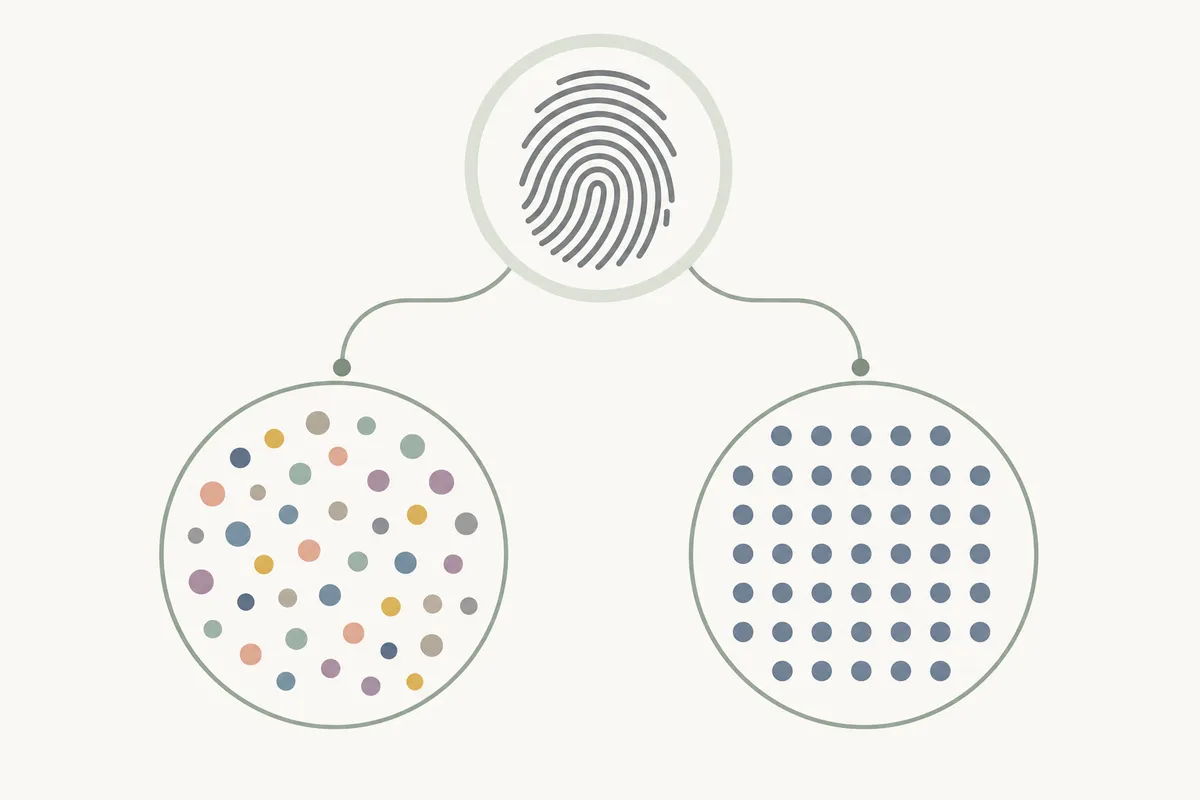
Anchor text distribution is the mix of anchor types (branded, exact match, partial match, naked URL, generic) across all the links pointing to a page or domain. Search engines read that mix as a fingerprint. Natural profiles are messy because thousands of independent people never link the same way twice, while engineered profiles are suspiciously tidy, with the same money keyword over and over.
That tidiness is one of the most common link building footprints, and it can get a site demoted or removed from search results entirely. Distribution matters at two levels: sitewide, which is what your whole domain's profile looks like, and per page, which is what the links to one URL look like. A clean sitewide average can hide a landing page where 80% of anchors are the target keyword, and Google evaluates both.
The short history behind today's rules
A few dates explain why the old tactics stopped working:
- 2001: PageRank shipped as part of the Google Toolbar, making links the visible currency of SEO.
- 2003: The Florida update targeted link spamming and keyword stuffing.
- 2004: The Brandy update focused on anchor text overuse, and sites with too many identical anchors lost rankings.
- 2012: The Penguin update changed everything. Before it, you could rank "red cars" simply by piling up exact-match links, and studies at the time found that sites with a high percentage of keyword anchors were hit hardest.
- September 2019: Google changed its stance on
rel="nofollow"to treat it as a hint rather than a directive, and introducedrel="sponsored"andrel="ugc"so the intent behind links could be read more precisely.
Every major update since has pushed anchor evaluation away from raw keyword counting and toward intent and relevance.
The anchor types that make up your profile
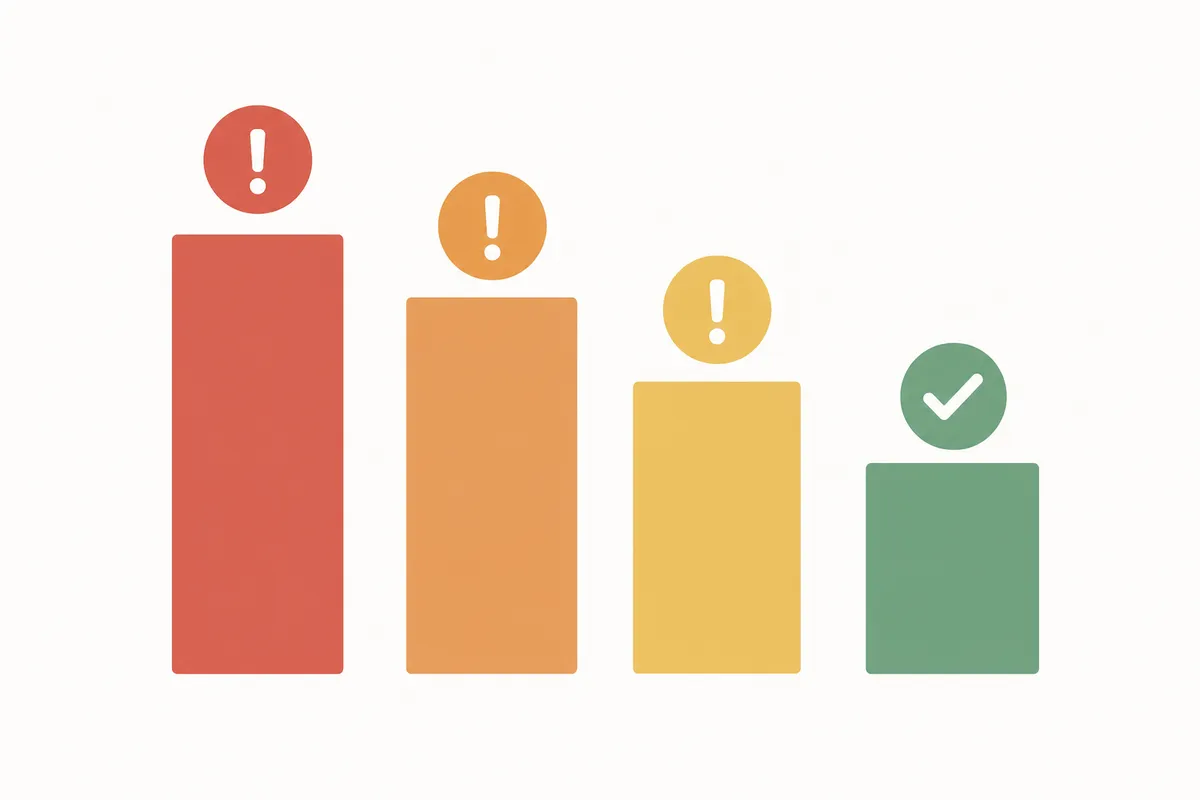
Before you can measure your distribution, you need to classify your anchors. These are the categories used in most audits:
| Anchor type | Example | Role in a natural profile | Risk if overused |
|---|---|---|---|
| Branded | "SearchBlueprint" | Usually the largest single bucket; signals brand recognition | Very low, hard to overdo |
| Exact match | "blue sneakers" linking to a blue-sneakers page | Passes strong relevance; the "money" anchor | High, the classic Penguin trigger |
| Partial / phrase match | "buy blue sneakers online" | Adds relevance with less footprint than exact match | Moderate if patterns repeat |
| Naked URL | "www.example.com" | Common in citations, directories, forums; looks organic | Low, but zero descriptive value for users |
| Generic | "click here", "read more" | Small natural share from casual linkers | Low SEO risk, but poor UX and no context |
| Image (alt text) | Alt text acts as the anchor | Normal byproduct of embedded logos and graphics | Low |
Targeted anchors (exact plus phrase match) are the ones that move rankings and the ones that trip filters. Everything else is non-targeted, and its job is to make the targeted minority believable.
What a healthy anchor text distribution looks like

Google publishes no single ratio, so the honest answer comes from studying sites that already rank. Three published benchmarks are worth knowing:
| Benchmark source | Targeted / exact share | What it measured | Practical takeaway |
|---|---|---|---|
| Moz study (Geoff Kenyon) | 34.6% targeted overall | 28 category + 31 product pages on ten large, well-linked brands | Even strong brands stay under ~35% targeted; Kenyon himself recommends a more conservative 7:3 non-targeted ratio |
| fatjoe big-brand analysis | Under 10% keyword anchors | Top anchors for Amazon, Wikipedia, Tripadvisor | The best-ranking sites on earth lean heavily on branded and URL anchors |
| Internal Link Juicer sample profile | Exact 18%, Phrase 17% | A model breakdown: Exact 18% / Phrase 17% / URL 23% / Brand 22% / Others 20% | No single anchor type should dominate; around 20% per type is a comfortable ceiling |
The spread is wide. Amazon ranks for nearly every product query with less than 10% keyword anchors, while the Moz sample tolerated 34.6%. No single number is the right one, but natural profiles are heavy on branded and URL anchors, and keyword anchors are always the minority. The original Moz study is worth reading in full for its methodology: Anchor Text Distribution: Avoiding Over Optimization.
Kenyon also counted only linking root domains rather than total links, because sitewide links in footers and sidebars can skew ratios dramatically. Do the same in your own analysis.
Why category and product pages differ
The Moz data revealed a split that most anchor guides skip. Only 25% of links to category pages were targeted, since people rarely link to a category with a neat keyword. Branded anchors ran 5% higher and URL anchors 7% higher for categories than the average. Product pages went the other way: exact-match anchors jumped about 7% and phrase match about 4%, which left targeted and non-targeted roughly equal.
Your tolerance for keyword anchors should therefore vary by page type. If you run a store, holding category pages to a stricter standard than product pages matches how the web actually links. A purpose-built e-commerce SEO workflow for Shopify and BigCommerce stores accounts for this, because collection pages and product pages need different link and anchor treatment.
Internal vs. external anchors: different rules
This distinction trips up more site owners than any ratio does.
External backlink anchors are largely outside your control, and Google expects them to look that way. When they don't, the profile looks bought. Any anchors you can influence, such as guest posts, outreach and directories, should skew toward branded, URL and partial match, with exact match used sparingly and only where it reads naturally in the sentence.
Internal anchors are yours to write. You can be more descriptive and more keyword-aligned here, because descriptive internal links help users find their way around and help Google understand page relationships. Google's own documentation on making links crawlable explicitly recommends concise, descriptive anchor text over generic phrases like "click here."
Even internally, avoid repeating one identical anchor on every page. "Keyword research guide" and "how to find keywords" can both point to the same URL. If phrasing the same idea five different ways feels forced, a free paraphrasing tool that preserves your meaning can generate natural variants faster than staring at the sentence.
Elite Strategies offers a useful example of scale. On a huge site like Slate, sitewide footer links to "Kindle" barely dent the profile. On a 20-page site where 80–90% of outbound anchors said "Kindle," Google would struggle to read the site's actual topic.
How to audit your anchor text distribution
An audit takes an afternoon.
Step 1: Pull your anchor data
Export the anchor text report from a backlink tool; Ahrefs, Semrush, Majestic and Moz all offer one. Google Search Console shows incoming anchor text too, though only for external links pointing at you. Pull data at the domain level and for your five most important money pages.
Step 2: Classify every anchor
Sort each anchor into the six buckets from the table above. Count linking root domains rather than raw link totals, so one sitewide footer link doesn't count 4,000 times.
Step 3: Calculate percentages per page
Divide each bucket by the total and compare against the benchmarks. Targeted anchors above about 35% on a single page are a warning light, and above 50–60% is a genuine problem. Pull the anchor reports for the pages actually ranking for your keyword as well, and treat their distribution as your industry's normal, because a legal-services SERP and a recipe SERP look nothing alike.
Step 4: Check the on-page side too
Over-optimized anchors usually travel with over-optimized pages: stuffed titles, repeated H1s, keyword-dense copy. Run your key URLs through a free on-page SEO scorer to see whether the page itself compounds the risk, and use a meta tag checker for titles and headings to confirm your title and heading structure isn't repeating the exact keyword the anchors already hammer. When on-page and off-page signals both push one phrase, the combined footprint is far worse than either alone.
How to fix an over-optimized anchor profile
If your audit found a skew, resist the urge to nuke everything. Work through the fixes in this order:
- Stop the bleeding by halting any link building that uses exact-match anchors. Every new link should be branded, URL or natural phrase match until the ratio recovers.
- Dilute rather than delete. The fastest safe fix is earning new links with diverse anchors, and if your target page has 40 exact-match linking domains, twenty new branded links moves the needle meaningfully.
- Rewrite internal anchors, which you control today, by swapping repetitive exact-match internal links for varied, descriptive phrasings.
- Reach out selectively for links you placed yourself, such as guest posts and partner sites, and ask the site owner to change the anchor to your brand name or URL.
- Disavow only when you have cause. Semrush's guidance matches Google's official disavow documentation: most low-quality links are simply ignored, so disavowing is usually unnecessary. Reserve it for a long list of manipulative anchors combined with a manual action in Search Console.
Recovery is gradual. Anchor ratios shift link by link, and Google recrawls linking pages on its own schedule, which means weeks and months rather than days.
Tracking progress without obsessing
Distribution isn't a set-and-forget metric, but it doesn't need weekly attention either. A quarterly re-pull of your anchor report is enough for most sites: recalculate the bucket percentages, compare them to last quarter, and flag any page where targeted anchors crept up by more than a few points. A sudden spike in exact-match anchors you didn't build can also signal negative SEO or scraper spam worth investigating.
If you're a business owner rather than an SEO, you don't need to run this yourself. You do need to know your provider is running it, and a quarterly line in your SEO report showing anchor bucket percentages is a reasonable thing to demand. The SEO roadmap for business owners covers what else belongs in that accountability loop, and you can read more about the team's approach on the SearchBlueprint about page.
FAQs
What is a good anchor text distribution ratio?
A commonly cited safe frame is 7:3 non-targeted to targeted anchors. One published sample of a balanced profile runs Exact 18%, Phrase 17%, URL 23%, Brand 22%, Others 20%. The biggest ranking brands are more conservative still, with keyword anchors under 10%.
How much exact-match anchor text is safe?
Google gives no official number, but the evidence points low. Moz's study of well-linked brands found 34.6% targeted anchors as the high end, and fatjoe's analysis of Amazon and Wikipedia, along with Tripadvisor, found exact-match keyword anchors made up less than 10%. Keeping any single anchor type at around 20% or under is a reasonable ceiling.
Does anchor text distribution apply to internal links?
Yes, with looser rules. You control internal anchors completely, so you can be more descriptive and keyword-aligned than with backlinks. Still vary the phrasing, because one identical anchor repeated across hundreds of internal links looks mechanical to search engines and gives users nothing extra.
Can a bad anchor profile get my site penalized?
It can. Unnatural anchor patterns have been a penalty trigger since the 2012 Penguin update, when sites with high keyword-anchor percentages were hit hardest. Today the consequences range from algorithmic devaluation of the links to manual actions that suppress or remove pages from results.
How often should I audit my anchor text?
Quarterly is sufficient for most sites. Audit more often if you're actively building links, recovering from over-optimization, or seeing unexplained ranking drops on pages that previously had heavy exact-match link building.
Put your own profile under the microscope
Pull your anchor report this week, classify the top 50 anchors into the six buckets above, and compare your percentages to the benchmarks in this guide. That one exercise tells you more about your profile than any theory. If you'd rather see the analysis packaged alongside rankings, on-page issues and link data, talk to the team and review a sample SEO report to see what a full audit covers.
Resources / References
- changed its stance on
rel="nofollow" - Anchor Text Distribution: Avoiding Over Optimization
- documentation on making links crawlable
- Google's official disavow documentation
Sources
- Anchor Text Distribution: Avoiding Over Optimization
- What Is Anchor Text? An Overview + Best Practices
- Anchor Text Distribution Guide for Link Building. fatjoe
- Anchor Text Optimization: A Modern SEO Guide
- Anchor Link Distribution: Here's Why You Need to Consider it
Disclaimer: This article is general information about rules and figures that applied when it was written, not personalised financial, tax or investment advice. It does not take account of your income, obligations, risk tolerance or goals, and rates and thresholds change. Verify the current position with the relevant authority, and speak to a licensed adviser or a qualified accountant before acting.
About the author
SearchBlueprint researched, wrote and scored this article with the content pipeline our customers run on their own sites. The score in the byline is what our content engine gave this page before it published. Nothing here is reviewed by hand, which is the point: it is the product's output, published where anyone can check it.