Top 6 SEO Automation Tools for Agencies: Costs & Limits
SearchBlueprint · · 17 min read · scored 93/100
The top 6 SEO automation tools for agencies right now are Semrush, SE Ranking, Gumloop, Surfer SEO, Search Atlas, and Screaming Frog. Between them, they automate the six jobs that eat agency margin fastest: client reporting, rank tracking, workflow orchestration, content optimization, on-page execution, and technical crawls.
That list is short on purpose. Most "best SEO tools" roundups run 13 to 16 entries, and half of those entries overlap. An agency does not need sixteen subscriptions. It needs one tool per job, chosen for how well it handles 5 clients today and 50 next year. This guide covers what each of the six actually automates, what it costs, where it breaks down, and which tools narrowly missed the cut, plus the parts of SEO no software should touch.
Key Takeaways
- Automation is now a margin issue, not a luxury. Industry coverage cites teams cutting labor costs by 35% through automated workflows and seeing 23% more organic impressions within 90 days.
- Monitoring and execution are different products. Semrush and Screaming Frog watch and report. Gumloop and Search Atlas actually do things. Buying one when you needed the other is the most common mistake in this category.
- Entry pricing is reasonable; sprawl is not. Gumloop starts at $37/month, entry suites run around $100/month, and Semrush starts at $139.95/month. Disconnected stacks that creep toward $2,000/month are where agencies bleed.
- Judgment stays human. Search intent calls, publish/don't-publish decisions, and brand voice cannot be automated, and Google's spam policies punish agencies that pretend otherwise.
Why SEO Automation Became Non-Negotiable for Agencies
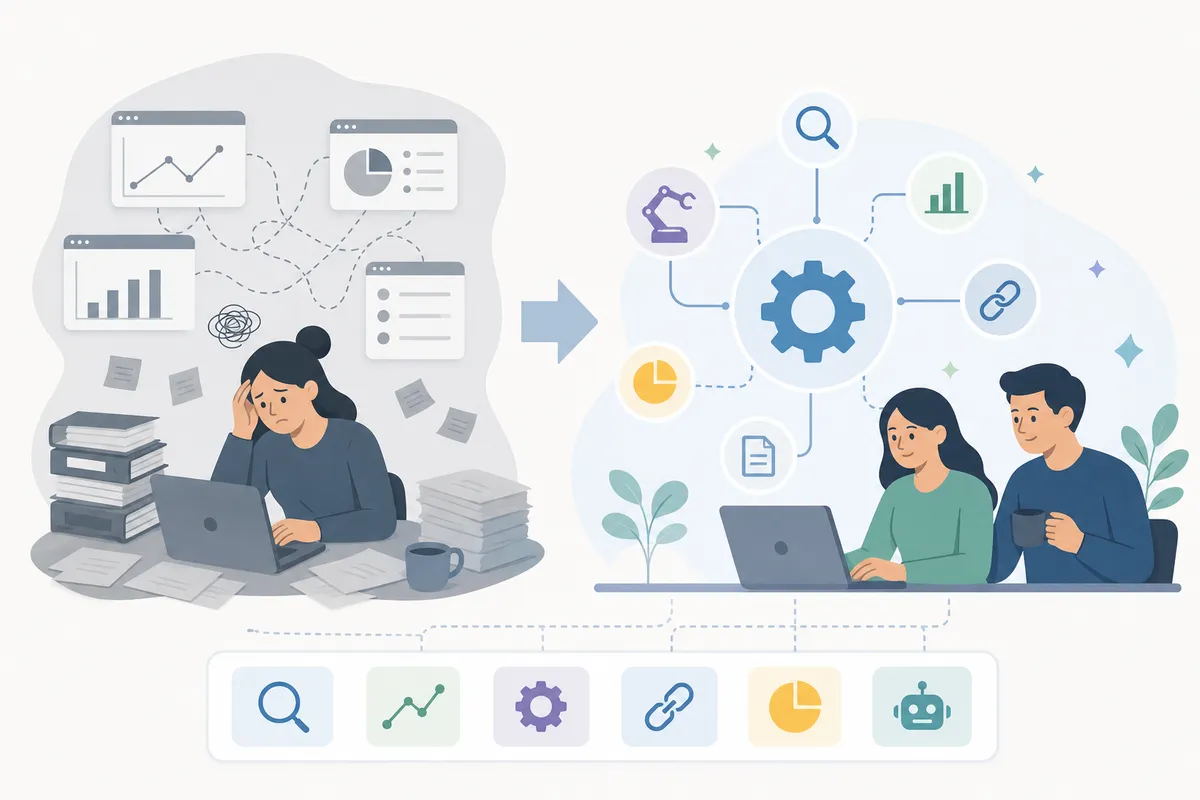
Agencies live and die on the gap between what a client pays and how many hours the account consumes. Every manual task, pulling rankings into a spreadsheet, rewriting meta descriptions one page at a time, assembling a monthly report by hand, narrows that gap.
The numbers behind the shift
The market data tells a blunt story. Siteimprove cites projections that enterprise SEO platforms will hit $58.3 billion by 2035, growing at 17.68% annually. The reason is simple: manual SEO does not scale past a handful of clients.
The same coverage reports that teams using SEO automation cut labor costs by 35% through automated workflows, improved performance with 23% more organic impressions in 90 days, and that 15.6% of teams save 10+ hours weekly by automating SEO tasks. Even conservative adopters report saving 1–5 hours a week on content creation and keyword research alone.
Individual practitioners echo it. One agency operator writing about his own stack reports that a full publish workflow, find a keyword, outline, write, format, publish, used to take him about 8 hours. With automation handling the repetitive steps, the same workflow now takes him a maximum of 3 hours, and he still writes every word himself.
The disconnected-stack tax
There is a second cost that rarely shows on an invoice. As Siteimprove frames it: your SEO tools cost $2,000 a month, rank tracking lives in one system, content analysis in another, and technical audits are scattered across three more, yet competitors with integrated systems still outrank you. Hours spent copying data between dashboards are hours not spent on strategy. That is why the strongest agency stacks are small and connected, and why platforms built around an agency workflow that turns audits into a strategy in minutes keep winning against sprawling toolkits nobody fully uses.
Monitoring vs. Execution: The Distinction That Saves You Money

"SEO automation" hides two very different product categories, and confusing them costs agencies real budget.
Monitoring automation crawls on a schedule, tracks rankings, flags issues, and emails a report. It is genuinely useful, and it leaves all the actual work with your team. Execution automation changes things: it writes drafts, pushes on-page fixes live, builds internal links, or runs multi-step workflows without a human touching each step.
| Category | What it does | Examples from this list | Risk level | Who needs it most |
|---|---|---|---|---|
| Monitoring automation | Scheduled crawls, rank tracking, alerts, automated reports | Semrush, SE Ranking, Screaming Frog | Low, nothing changes on the site | Agencies whose bottleneck is visibility and reporting time |
| Content automation | Briefs, optimization scores, draft assistance | Surfer SEO | Medium, output needs human editing | Agencies whose bottleneck is content throughput |
| Execution automation | Live on-page changes, autonomous fixes, published output | Search Atlas (OTTO) | Higher, requires review guardrails | Agencies blocked by dev queues or publishing capacity |
| Workflow automation | Custom multi-step AI agents connecting your existing tools | Gumloop | Depends on what you build | Agencies with repeatable processes across many clients |
Before you compare features, decide which category your bottleneck sits in. An agency drowning in report-building needs monitoring automation with white-label output. An agency with a six-week dev backlog needs execution. Buying a monitoring tool to solve an execution problem gets you better-documented problems, nothing more.
How We Chose the Top 6 SEO Automation Tools for Agencies
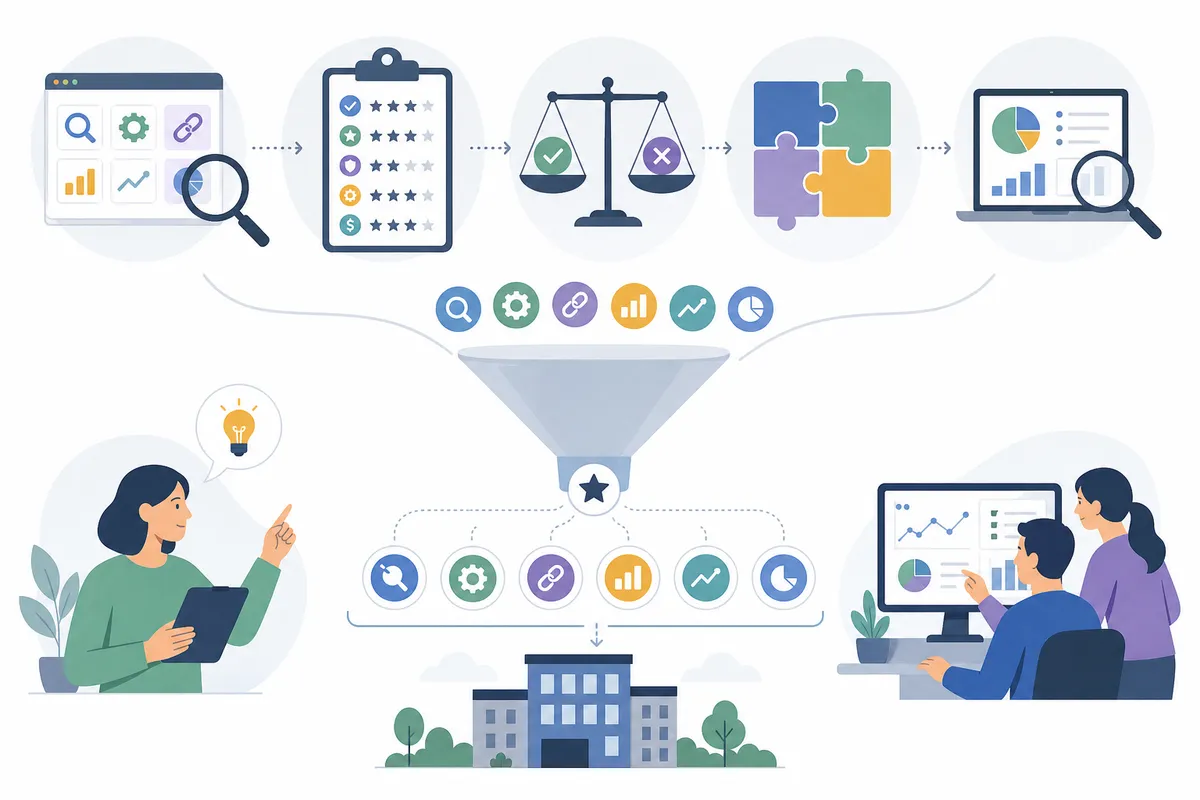
Agency needs differ from freelancer or in-house needs in one word: multiplication. Whatever the tool does, it must do it across 5, 10, or 50+ client projects at once without pricing or workflow collapse. These six criteria drove the selection:
- Scalability. Can it handle 5 clients today and 50 next year without a forced platform switch? Hard project limits are disqualifying.
- White-label capability. Clients should see your brand on reports and dashboards, not the vendor's.
- Genuine automation depth. Scheduled reports, automated audits, or actual execution, not just a dashboard you refresh manually.
- Integration. It must connect to Google Search Console, GA4, your CMS, and the rest of your stack. Isolated tools create data silos.
- Data accuracy. Stale rankings and hallucinated metrics lead to bad client recommendations. Fresh, reliable data is table stakes.
- Pricing that beats a hire. The tool should cost meaningfully less than paying a junior specialist to do the same task by hand.
Each of the six picks leads its category on these criteria. None of them leads on all six, which is exactly why you build a small stack rather than betting on one platform.
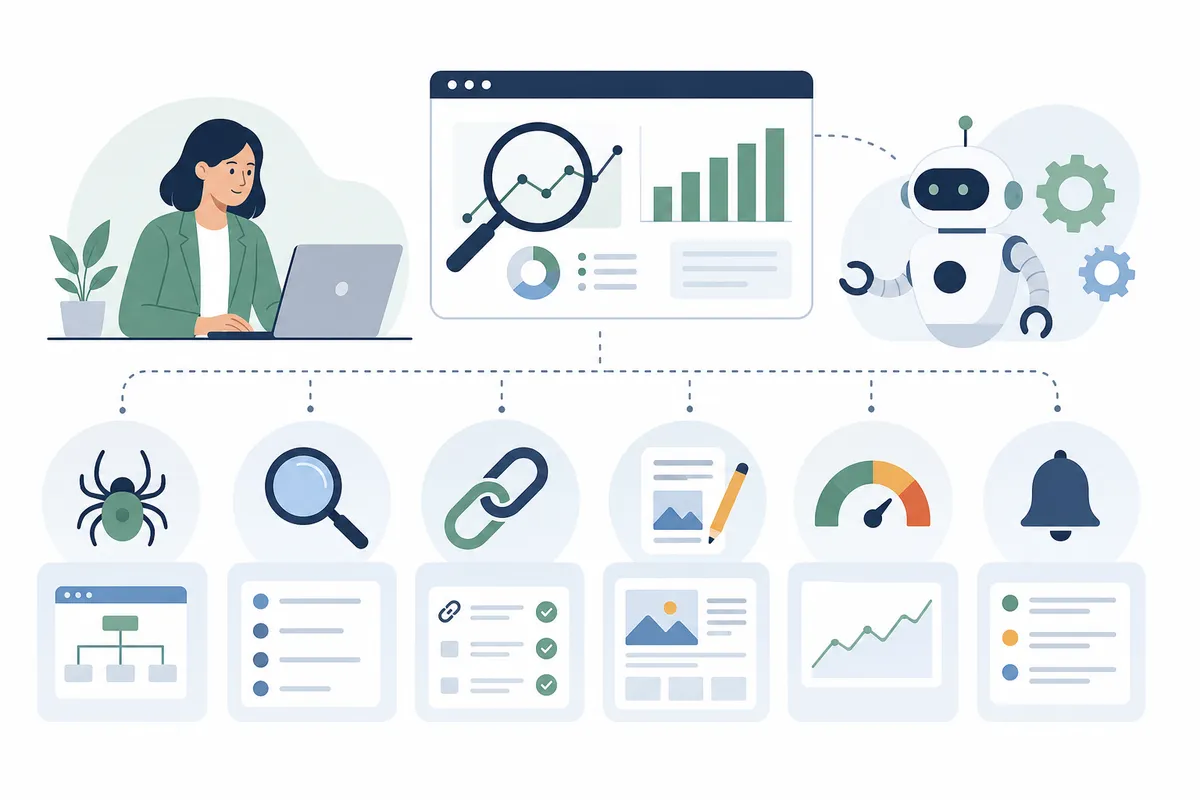
The Top 6 SEO Automation Tools for Agencies at a Glance
| Tool | Best for | Automation type | Listed starting price | Honest limit |
|---|---|---|---|---|
| Semrush | All-in-one suite with agency CRM and white-label reports | Monitoring, plus advisory content tools | $139.95/month | Steep learning curve; most teams use a fraction of it |
| SE Ranking | Enterprise-grade capability at small-agency prices | Monitoring, white-label reporting, AI visibility tracking | Entry-suite pricing (roughly $100/month tier) | Each module is good rather than category-leading |
| Gumloop | Custom AI-agent workflows across your existing tools | Workflow automation you design yourself | Free plan; Solo from $37/month | You must define the workflow, it won't strategize for you |
| Surfer SEO | Content optimization scoring for writer teams | Content automation to the draft stage | Paid only; sits in the $29–79/month specialized-tool bracket at entry | Stops at the draft; publishing is still yours |
| Search Atlas | AI-driven on-page execution via the OTTO agent | Execution, deploys changes directly | Mid-market pricing for enterprise-grade features | Requires trust in (and review of) autonomous changes |
| Screaming Frog | Deep technical audits on a schedule | Monitoring, scheduled crawls with exports | Free plan available | Desktop software, expert interface, no recommendations |
Now the detail on each.
1. Semrush, The All-in-One Suite With Agency DNA
Semrush is the industry-standard answer when an agency wants one login covering keyword research, technical audits, rank tracking, content, PPC, and competitor analysis. It has held that position since 2008, and its database, listed at 25+ billion keywords across 130 countries, supports both local and international client work.
What it automates for agencies
- Scheduled site audits crawling up to 1 million pages monthly on the Business plan, with recurring issue tracking.
- Daily position tracking across multiple locations per client.
- Automated competitor alerts when rivals gain keywords or shift strategy.
- White-label PDF reports and a client portal through the Agency Growth Kit, which also bundles a purpose-built CRM and lead-generation tools, agency-specific features most rivals lack.
Historical data back to 2012 (on Guru and Business plans) is quietly one of its best agency features. When a client asks "what happened in March 2023?", you can answer.
Where it falls short
Two honest caveats show up consistently in reviews. First, the learning curve: new team members face weeks of ramp-up before using it effectively. Second, price. At a $139.95/month minimum, it is expensive next to specialized tools in the $29–79/month range, and reviewers note report generation slows on large datasets. Most agencies use a fraction of the suite, which is fine if the fraction you use justifies the bill, and wasteful if it doesn't.
Verdict: the default choice for established agencies with diverse client needs. Smaller shops should read the SE Ranking section before committing.
2. SE Ranking, Enterprise Power Without Enterprise Pricing
SE Ranking has built its reputation on one claim: most of what the big suites do, at a fraction of the cost. Operating since 2013 and reporting a user base of over 1.5 million SEO professionals, it is the value pick on this list, and for many small and mid-size agencies, the smartest first purchase.
What it automates for agencies
The raw capacity is genuinely large. The platform is listed as tracking up to 15,000 keywords daily, monitoring 20 competitors per project, and drawing on databases of more than 7.2 billion keywords and 2.2 billion domain profiles. On top of that sit the agency-relevant automations:
- White-label reporting so clients see your brand, at a price point where white-labeling isn't a premium add-on.
- Automated dashboards via Looker Studio connectivity, removing the Friday-afternoon report grind.
- Full API access for custom automated workflows when your ops mature.
- AI search visibility tracking, increasingly important as clients ask "do we show up in AI answers?"
- Boundless rank tracking with JavaScript rendering and role-based access for cross-team collaboration.
Where it falls short
The fair criticism: each module is good rather than category-leading. Its backlink database is smaller than the giants'. If one specific capability, say, backlink analysis, is your agency's core deliverable, a specialist tool will beat it there.
Verdict: the best value all-rounder for growing agencies that need client reporting and broad coverage without enterprise costs.
3. Gumloop, Build the SEO Agents the Other Tools Don't Sell
Gumloop is the wildcard on this list, and arguably the most powerful entry. It is not an SEO tool. It is a no-code AI workflow builder, think Zapier with an LLM layer, that lets non-technical agency staff build custom SEO agents connecting the tools they already pay for.
What agencies build with it
The platform connects to DataForSEO, Ahrefs, Google Search Console, PageSpeed, spreadsheets, CMSs, and over 100 integrations, with models from OpenAI, Anthropic, and Google built in. Documented agency use cases include:
- Keyword clustering by SERP overlap, grouping keywords that share four or more of the same top-10 URLs into pillar topics, automatically.
- Bulk meta generation, learning brand voice from existing pages, then generating on-brand titles and descriptions in multiple languages, character limits respected, written back to the CMS.
- Prioritized audit tickets, crawling a URL, ranking issues by traffic impact, and bundling related fixes into one ticket per page.
- Scheduled reporting agents, branded weekly SEO digests delivered to Slack with top movers and recommended actions.
- Multi-agent handoffs, Gumloop's own example: an audit agent flags nine page issues, a content agent rewrites metas and briefs, and a reporting agent confirms a +47% traffic recovery.
The company raised a $50M Series B led by Benchmark and is SOC 2 Type II certified with zero-data-retention agreements for third-party models, relevant if you're connecting client Search Console accounts.
Gumloop pricing
| Plan | Listed price | Credits included | Best fit |
|---|---|---|---|
| Free | $0 | 2,000 credits | Testing one workflow before committing |
| Solo | From $37/month | 10,000 credits | Freelancers and one-person agency ops |
| Team | From $244/month | 60,000 credits | Agencies running agents across a client roster |
| Enterprise | Custom quote | Unlimited | VPC deployment, SSO, audit logging, spend controls |
Where it falls short
Gumloop automates whatever you can specify as steps. It will not tell you what those steps should be. Agencies without documented, repeatable processes get little from it; agencies with tight SOPs get compounding returns, because every refinement to an agent applies across every client instantly.
Verdict: the highest-ceiling tool here. Start on the free tier, automate one painful weekly task, and expand from there.
4. Surfer SEO, Content Scoring on Autopilot
Surfer answers a question every content-producing agency faces daily: is this draft actually competitive for its target keyword, or does it just feel good? It scores content against the pages currently ranking, and it does so automatically as writers work.
What it automates for agencies
- Real-time content scoring against live SERP data, terms to include, structure to match, gaps to fill, so writers have a concrete target instead of vibes.
- Automated brief generation, cutting the research phase of every article. Practitioners consistently describe AI-assisted tools like this as handling roughly 50% of the brief-creation work, with humans supplying insight and angle.
- AI-assisted drafting via Surfer AI for teams that want a starting draft rather than a blank page.
- AI visibility focus, the tool has repositioned around visibility in AI-driven search rather than keyword density alone, which matters as clients start asking about AI Overviews.
This human-plus-machine split is the pattern that works. Siteimprove's coverage notes that 67% of marketers report better content quality using AI, not because AI writes their content, but because it surfaces what audiences actually want before a human writes.
Where it falls short
Surfer stops at the draft. Publishing, internal linking, and distribution remain manual. It is also paid-only with no free tier, and it optimizes content, it will not fix technical issues or track rankings. It is a scalpel, not a suite.
Verdict: the right pick for agencies with in-house or freelance writers who need a measurable target for every piece.
5. Search Atlas, AI Execution, Not Just Recommendations
Every other monitoring tool tells you what to fix. Search Atlas's OTTO agent fixes it. That single difference puts it in a category most agencies have never bought before: autonomous on-page execution.
What it automates for agencies
- Direct on-page deployment, OTTO executes optimizations on client websites: automated title tags, meta descriptions, and image alt text, without the usual ticket-and-wait cycle with a client's developer.
- Autonomous technical SEO fixes, again without a dev release.
- Full article generation with topical mapping for agencies that want end-to-end content production inside one platform.
- Daily ranking updates and real-time SERP monitoring through OTTO Pixel, when an algorithm shifts or a competitor moves, you know that day, not at month-end.
- Direct Google Search Console integration rather than scraped data, feeding a keyword database listed at 5.2 billion terms.
Reviewers position it as offering enterprise features at mid-market pricing, which is exactly the gap most agencies sit in.
Where it falls short
Execution automation demands trust. Letting software change client sites is a genuine operational and reputational decision, and any agency using it should keep human review in the loop, especially early on. It is also a newer platform than the legacy suites, so processes around it are less battle-tested.
Verdict: the strongest choice when your bottleneck is implementation, recommendations that sit in a deck for months because the client's dev team never gets to them.
6. Screaming Frog, Scheduled Technical Crawls That Never Miss
Screaming Frog is the least glamorous tool on this list and the one most agency technical leads would give up last. It is the industry-standard site crawler, and its automation story is quietly excellent: scheduled crawls with automated exports and comparison against previous runs.
What it automates for agencies
Set a weekly crawl per client and the Frog surfaces every broken link, redirect chain, missing canonical, duplicate title, and orphaned page, then diffs the results against last week's crawl so regressions show up immediately instead of at the quarterly audit. For agencies, that diff is the killer feature: it turns technical SEO from a periodic project into continuous monitoring.
A free plan exists for small crawls, and the paid license is inexpensive relative to everything else here, sitting comfortably below the entry suites that start around $100/month.
Where it falls short
Three limits, stated plainly. It is desktop software, so scheduled crawls need a machine (or VM) left running. The interface assumes expertise, a junior account manager will drown in it. And it flags issues without prioritizing or explaining them; the judgment about what matters is entirely yours. Agencies wanting ranked, explained findings sometimes pair or replace it with Sitebulb, which prioritizes issues but runs slower on very large sites.
Verdict: essential technical infrastructure. Not a client-facing tool, the tool behind the tools.
Strong Tools That Didn't Make the Top 6
Several well-known platforms narrowly missed the cut. Knowing why tells you as much as the list itself.
| Tool | What it does well | Why it missed the top 6 |
|---|---|---|
| Ahrefs | The best backlink index available, plus scheduled audits and alerts | Pure monitoring by design, it will not change a thing on any site, and Semrush covers the suite role here |
| MarketMuse | Automated content-gap analysis; models your site against a topic and surfaces what's missing | Planning only, and priced for teams, a strategist's tool rather than an agency workhorse |
| Alli AI | Pushes on-page changes live via script or CMS integration, no dev release needed | Genuine execution, but on-page only and no content, Search Atlas covers the same job with more range |
| AccuRanker | Fast, accurate on-demand rank refreshes with automated reporting | Rank tracking only; worth it when ranking accuracy is disputed with a client, redundant otherwise |
| BrightEdge / Conductor | Enterprise pedigree; Conductor scored 4.4/5 in the 2025 Forrester Wave versus BrightEdge's 2.2 | BrightEdge is listed at $14,000+ per year for features other platforms include as standard; neither fits typical agency budgets |
| Scalenut / Frase | Research-to-draft content pipelines in one pass | Solid for small teams, but Surfer's scoring approach fits agency writer workflows better |
None of these are bad purchases. They are second purchases, tools you add once a specific gap appears, not tools you start with.
What SEO Automation Can't Do (and Shouldn't Try)
An honest guide has to draw this line, because vendors blur it constantly.
Judgment about search intent
A tool can tell you a keyword has volume. Whether the SERP wants a listicle, a product page, or a tutorial is a human decision, and getting it wrong wastes the entire article, however well the software optimized it. Automated content that merely restates what page one already says will not rank, no matter its score.
Deciding what not to publish
Publishing more is now trivially easy. Publishing less and better is the harder call, and no tool makes it. This matters beyond quality: Google's spam policies explicitly target scaled content produced primarily to manipulate rankings rather than help people, as documented in Google Search Essentials. An agency that lets automation publish unreviewed output at volume is gambling with client domains.
Brand voice, at first
Every tool that writes needs correction cycles before its output sounds like the client. Budget for that training period rather than being surprised by it, usually a few weeks of edits per client, front-loaded.
Being worth linking to
Automation can find link prospects and send follow-ups. It cannot make an editor want to link to a thin page. Link earning remains a quality problem, not a workflow problem.
The safe framing: automation removes the repetitive work, not the thinking. Automating your own workflow carries essentially no risk; automating decisions without human review is where penalties and client churn live.
Building Your Agency's Automation Stack: A 90-Day Rollout
Buying all six tools on day one is a mistake. Adoption fails when a team faces six new interfaces at once. A staged rollout works better.
Days 1–30: automate reporting first
Reporting is the highest-hours, lowest-judgment task in any agency, which makes it the ideal first automation. Stand up SE Ranking or Semrush, connect every client's Search Console and GA4, and template one white-label report. The payoff is immediate and visible to the whole team, the fastest way to convert automation skeptics.
Days 31–60: automate monitoring and content targets
Add scheduled Screaming Frog crawls per client with week-over-week diffs, and put Surfer scores into your writers' workflow. By day 60, technical regressions and under-optimized drafts should surface themselves rather than waiting for someone to look.
Days 61–90: automate one execution workflow
Now pick a single execution win: an OTTO deployment on one consenting client, or a Gumloop agent that clusters keywords or bulk-generates metas for review. One workflow, one client, human review on everything. Expand only after it runs clean for a month.
Two notes from the field. First, sequence beats speed, the 15.6% of teams saving 10+ hours weekly got there workflow by workflow, not overnight. Second, automation pays off fastest where your process is already documented. Agencies serving repeatable niches feel this most: the playbook for SEO in a vertical like staffing and employment agencies barely changes client to client, which means one well-built automation runs across the whole segment. The more your client roster clusters around a niche, the more each automated workflow is worth.
FAQs
What are the top 6 SEO automation tools for agencies?
Semrush (all-in-one suite with agency CRM), SE Ranking (value all-rounder with white-label reporting), Gumloop (custom AI-agent workflows, from $37/month), Surfer SEO (content optimization scoring), Search Atlas (autonomous on-page execution via OTTO), and Screaming Frog (scheduled technical crawls). Each leads a different job; most agencies combine two or three rather than buying all six.
How much do SEO automation tools cost for an agency?
Entry suites start around $100 a month, Semrush is listed at a $139.95/month minimum, and specialized tools run roughly $29–79/month. Workflow platforms like Gumloop start at $37/month for solo use and $244/month for teams. Enterprise platforms run into four figures monthly, BrightEdge is listed at $14,000+ per year, which is rarely justified below enterprise scale.
Can SEO be fully automated?
No. Research, monitoring, reporting, drafting, internal linking, and even some on-page deployment can be automated. Strategy, search-intent judgment, brand voice, and the decision of what not to publish cannot, and vendors claiming otherwise are overselling. Google's spam policies specifically target scaled, unreviewed content, so human review must stay in the loop.
How much time does SEO automation actually save?
Reported ranges vary by depth of adoption. Industry coverage cites 15.6% of teams saving 10+ hours weekly, with more typical adopters saving 1–5 hours a week on content and keyword research. One agency operator reports his idea-to-publish workflow dropping from about 8 hours to a maximum of 3 with automation handling the repetitive steps.
Should a small agency start with a suite or a specialized tool?
Start with one suite that includes white-label reporting, SE Ranking is the usual value pick, Semrush the premium one, because reporting is the biggest fixed time cost per client. Add specialized tools (Surfer for content, Screaming Frog for technical, Gumloop for custom workflows) only when a specific bottleneck appears. A $2,000/month stack of overlapping tools is a warning sign, not a strategy.
See What Automated Client Reporting Looks Like
The fastest proof of what the top 6 SEO automation tools for agencies can do for your margins is a finished artifact, not a feature list, so start where the hours go: reporting. Look at a sample automated SEO report built for agency clients, compare it against what your team assembles by hand each month, and then talk to the team about running it across your own roster.
Resources / References
Sources
- 13 best SEO automation tools I'm using in 2026
- Unlocking the Power of SEO Automation and Optimization ...
- 12 Best Automated SEO Software Tools for 2026 (Tested)
- SEO automation made simple with AI agents
- 16 Secret SEO Tools Top Agencies Use to Rank Fast
Disclaimer: This article is general legal information, not legal advice, and does not create a solicitor-client relationship. The law changes and its application depends on your particular facts. Speak to a qualified lawyer in the relevant jurisdiction before acting — some rights and claims are subject to strict time limits.
About the author
SearchBlueprint researched, wrote and scored this article with the content pipeline our customers run on their own sites. The score in the byline is what our content engine gave this page before it published. Nothing here is reviewed by hand, which is the point: it is the product's output, published where anyone can check it.