Thin Content: Why Google Skips Your Pages (And the Fix)
By Toy Wen Da, Co-Founder · · 7 min read · scored 96/100
Thin content is a page that gives readers little value, too short, too generic, duplicated, or built to rank instead of help. Google treats it as low quality, so it rarely ranks or gets cited by AI answer engines. The fix is usually to expand, merge, or rewrite the page around a clear answer.

What Counts as Thin Content?
Thin content is a page search engines see as offering little or no original value to the person reading it. It doesn't have to be short. A long page that recycles what ten other sites already say is just as thin as a stub page. It might have just two sentences and a buy button.
Google's guidance on spam policies describes several patterns it treats this way, including scaled content abuse and content with little added value. The common types show up across almost every site:
| Type | What it looks like | Why it's a problem |
|---|---|---|
| Doorway pages | Near-duplicate pages built around keyword variations, funneling users to one real page | No unique value; confuses which page should rank |
| Thin affiliate pages | Product blurbs copied from the manufacturer with an affiliate link attached | Offers nothing the original source doesn't already say |
| Scraped or spun content | Text copied or lightly reworded from another site | Search engines detect it and rank the original instead |
| Auto-generated filler | Pages built from templates with no editorial review | Lacks the specificity and structure AI and search systems look for |
| Duplicate category/product pages | Same copy across SKUs, cities, or variations | Splits ranking signals between pages competing for the same query |

Why Google Treats Thin Content as a Problem
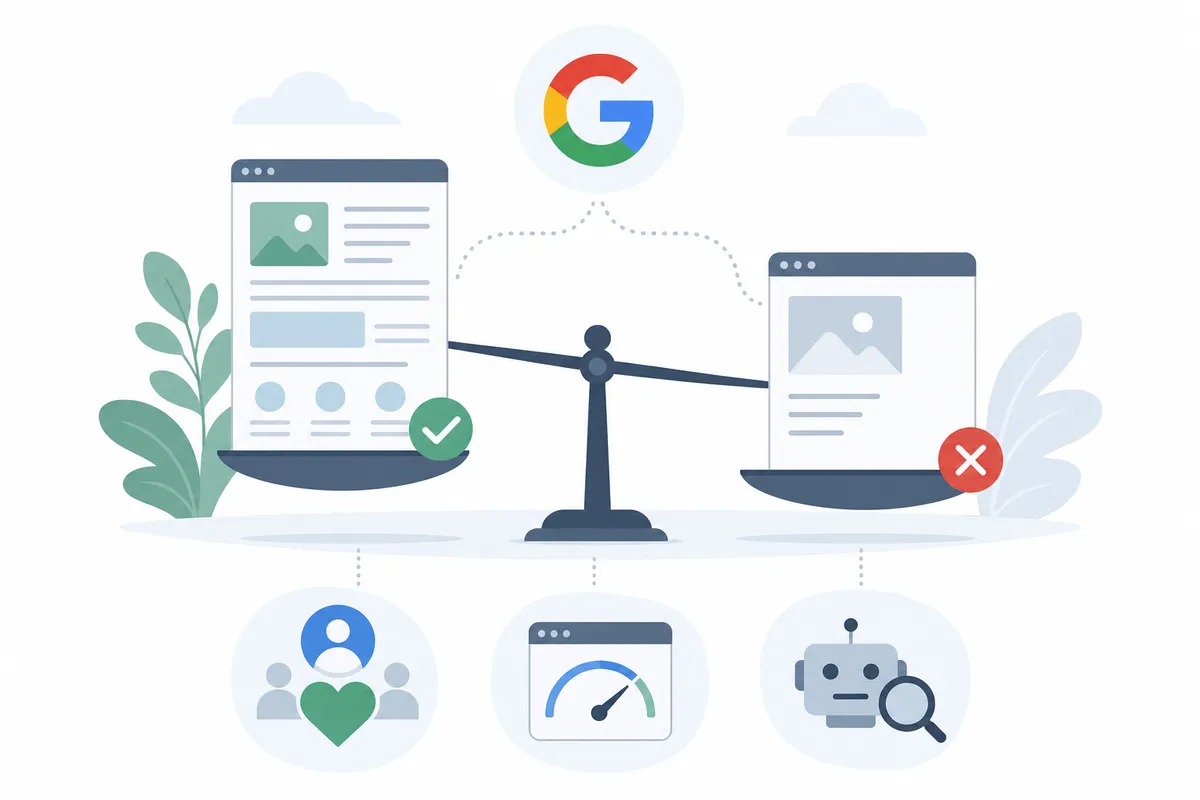
Google's ranking systems try to surface the page that best matches what someone actually searched for. This kind of page usually fails that test. There's not enough substance for a reader to find their answer. So Google has little reason to rank it above a page that actually resolves the question.
This isn't new. Google's 2011 Panda update specifically targeted sites with large volumes of low-quality content. More than a decade later its core values still show up in how Google evaluates pages, particularly through the Helpful Content signals. These signals are built into core updates. Some site owners noticed ranking drops after the March 2024 core update, which appeared to target spammy, low-quality pages. That's a reminder that this isn't a one-time cleanup but an ongoing standard.
The E-E-A-T Connection
Google's search rater guidelines use E-E-A-T, Experience, Expertise, Authoritativeness, and Trustworthiness, to judge whether a page is genuinely helpful. Pages like these almost always fail this test. They show no first-hand experience, no original analysis, and nothing a reader couldn't already find elsewhere.
Why It Also Hurts in AI Search
AI Overviews, ChatGPT, and similar tools extract specific passages they can confidently reuse. A paragraph that gestures at a topic without resolving it gives these systems nothing to pull from. Vague claims like "results may vary" or "there are many factors" don't get cited; precise, self-contained answers do.
How to Tell If a Page Is Thin

Word count alone is a weak signal, but a few checks together are reliable:
- Does the page answer the question it targets, fully? If a reader still has to search again, it's thin.
- Is there anything here you couldn't find on ten other pages? If not, there's no reason for Google or an AI system to prefer it.
- Does it have enough passage-level detail to quote? A direct, specific answer near the top of a section is more useful than the same idea spread across vague paragraphs.
- Are performance signals weak? High bounce rate, low time on page, and poor organic conversion often confirm what the qualitative check already suggested.
- Is it competing with your own pages? Multiple pages chasing the same keyword create cannibalization and confuse which one should rank.
How to Fix Thin Content
The right fix depends on why the page is thin, not a blanket rewrite.
Expand
If the topic genuinely has more to say, add real substance: specific numbers, examples, and first-hand detail rather than padding. This is the right move for pages that target relevant demand but stop short of answering it. Some teams use a content refresher to rebuild a slipping page around the facts it already has. That's often better than starting from a blank document.
Consolidate
When two or more pages cover the same ground, merge them into one stronger resource and redirect the rest. Trying to keep three thin pages alive to "cover more keywords" usually backfires, it splits authority instead of building it.
Reframe
Sometimes a page targets the right demand but answers it from the wrong angle. A product page written like a spec sheet, for example, might need to become a buying guide that matches how people search.
Remove or Noindex
Shopping carts, filtered category pages, and low-value tag archives often don't need to rank at all. A noindex tag is often the cleanest fix. It's better than trying to force value into a page that was never meant to compete in search.
Prevent It From Coming Back
The fastest way to stop producing thin pages is to plan content around real depth before writing starts. That beats bolting keywords onto a template. Mapping topics on a content calendar, alongside the keywords each page needs to fully answer, keeps new pages from starting out thin. Tools built around a content idea generator can help confirm a topic has enough ground to cover. Do that before committing a page to it.
Thin Content vs. Useful Content
| Signal | Thin pages | Useful pages |
|---|---|---|
| Depth | Gestures at the topic, stops short of resolving it | Explains how it works in practice, with specifics |
| Structure | Dense paragraphs, no clear answer up top | Headings lead with a direct answer, then detail |
| Originality | Matches ten other pages on the same query | Includes something a reader can't find elsewhere |
| AI extractability | Vague language, nothing to quote confidently | Self-contained passages an AI system can cite |
| Performance | High bounce rate, low time on page | Stronger engagement and return visits |
FAQs
Does thin content always mean a page is too short?
No. Word count is a weak signal on its own. A long page that repeats generic claims without original insight is just as thin as a short one. What matters is whether the page resolves the reader's question and adds something unique.
Can thin content get my whole site penalized?
Google can issue a manual action for sites with widespread low-quality content, scraped pages, or doorway pages. More often, though, the damage is algorithmic. Individual thin pages simply fail to rank and drag down how Google views the rest of the site.
Is 300 words enough to avoid thin content?
Some SEO tools use 300 words as a rough baseline check, but it's not a rule Google enforces. A 300-word page that fully answers a narrow question can outperform a 2,000-word page that never gets to the point.
Can product and category pages be thin too?
They can. E-commerce pages with just an image and a price, or near-identical copy across variations, often read as thin. Adding original introductory content per page, or using canonical tags for near-duplicates, usually resolves it.
How do I find thin pages across a large site?
Start with pages that have high bounce rates, low time on page, or weak organic conversion. Then check each one against intent: does it answer the question it targets, and does it say anything readers couldn't find elsewhere? A sample SEO report shows the kind of page-by-page breakdown that makes this audit faster than checking pages one at a time.
Get Your Thin Pages Found and Fixed
Auditing a site page by page for thin pages is slow. It's easy to miss pages that look fine on the surface but quietly fail to rank. If you want to see exactly which pages on your site need expanding, merging, or rewriting, talk to the team. Get a clear picture of where thin pages are costing you visibility.
## Resources / References

1. [scaled content abuse and content with little added value](https://developers.google.com/search/docs/essentials/spam-policies)

## Sources

- [What is thin content? • SEO for beginners](https://yoast.com/what-is-thin-content/)
- [Combating Thin Content: How to Identify and Fix It](https://www.semrush.com/blog/thin-content/)
- [Thin Content vs Useful Content: What Improves AI Search ...](https://www.siteimprove.com/blog/thin-content-vs-useful-content/)
- [What is Thin Content?](https://ahrefs.com/seo/glossary/thin-content)
- [Thin content with little or no added value](https://support.google.com/webmasters/thread/17669267/thin-content-with-little-or-no-added-value?hl=en)
About the author
SearchBlueprint researched, wrote and scored this article with the content pipeline our customers run on their own sites. The score in the byline is what our content engine gave this page before it published. Nothing here is reviewed by hand, which is the point: it is the product's output, published where anyone can check it.