Scalable automation: how to grow SEO without breaking it
By Toy Wen Da, Co-Founder · Updated · 10 min read · scored 89/100
Scalable automation means building workflows that handle 10x or 100x more work without more headcount, cost or quality problems. In SEO that covers research, drafting, internal linking and publishing that keep working as a site grows from 50 pages to 5,000, so the program grows with the business instead of collapsing under volume.

Most teams that try automation hit the same wall: the process worked for ten pages and broke at a hundred. This article explains what makes automation scalable rather than merely automated, where it fails, and how to build it without hurting content quality or drawing a search engine penalty.
What scalable automation actually means for SEO teams
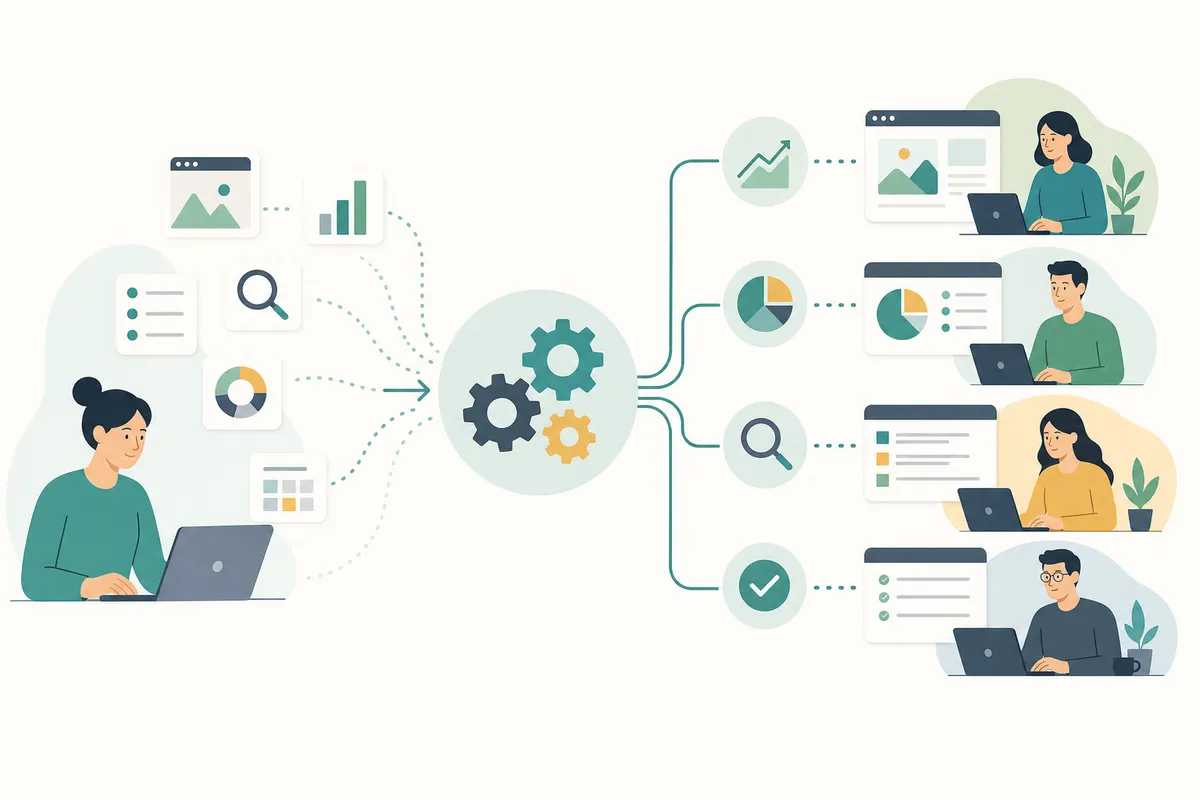
Automation on its own just means a task runs without a person doing it by hand. Scalable automation is a harder standard: the system keeps its speed, accuracy and cost per unit flat as volume rises. A script that drafts one blog post a week and a system that drafts fifty a week without extra editing hours per post are doing different jobs, even if both are technically "automated."
The gap shows up fastest in content and internal linking. One writer can hand-place links across ten articles and remember what points where. At 500 articles that manual process either stops happening or starts creating duplicate anchors and orphaned pages. A scalable approach replaces the manual tracking with a system that draws links from your own site's crawl data, so the linking stays accurate as the site grows instead of decaying.
Scalable versus non-scalable: the practical difference
| Attribute | Scalable automation | Non-scalable automation |
|---|---|---|
| Architecture | Modular; each step (research, draft, review, publish) runs independently | Monolithic; one script or person does everything end to end |
| Data handling | Content briefs, keywords, and settings are separated from the writing logic | Instructions and data are mixed into one prompt or spreadsheet |
| Environment | Works the same on 10 pages or 10,000 | Breaks or slows sharply past a fixed volume |
| Oversight | A defined human checkpoint before publish | Either fully manual or fully unattended, with no middle step |
| Failure mode | One broken step is isolated and fixable | One failure can cascade through the whole batch |
Why scalable automation is now a growth priority
This is no longer a niche IT trend. Gartner reported that over 80% of organizations self-reported increased or continued investment in hyperautomation initiatives in 2021, and 56% said they had an average of four or more running concurrently. The same research put combined venture capital and private equity investment in RPA, process mining, process discovery, NLP and virtual assistants at roughly $500 million by mid-2021, and the broader market opportunity at around $440 billion worldwide.
Pressure comes from inside companies too. In 2021, 50% of CEOs and 69% of boards of directors were demanding accelerated growth and operational excellence, goals automation is well suited to serve. On the execution side, 80% of executives expected to increase spending on digital business initiatives in 2022, 65% said they were speeding up their digital business, and 72% planned to shorten implementation timelines. Gartner also projected that by 2024, organizations would cut operational costs by 30% through scaling automation and redesigning operational processes.
For SEO the same arithmetic applies on a smaller scale. Content and technical work that once required output to grow in step with headcount can now grow without a matching rise in cost, but only if the automation was built to scale rather than to run once. This guide to SEO automation breaks down the math for content in more detail.
Key methodologies: from programmatic SEO to autonomous workflows
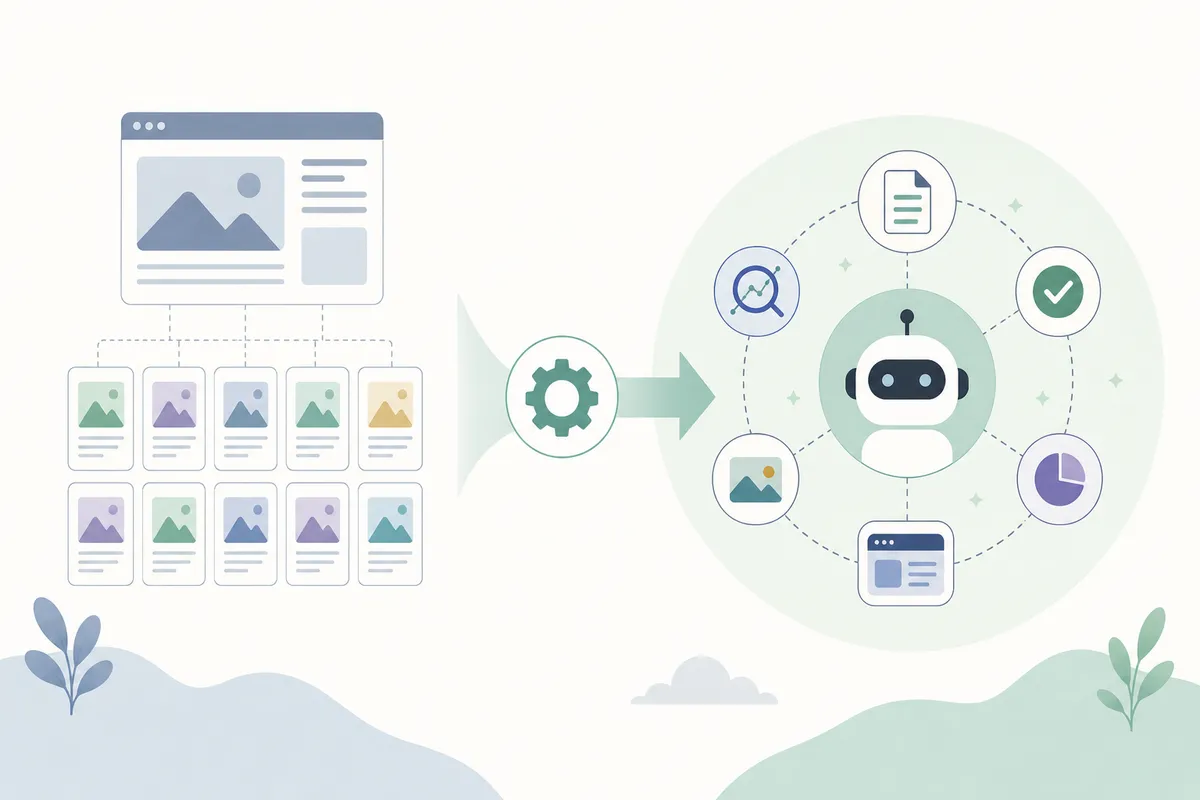
Not every automated approach scales the same way, and choosing the wrong one for your situation is a common early mistake. Three methodologies dominate SEO and content automation today, each with different tradeoffs.
Programmatic SEO generates large sets of similar pages, such as location pages or product variants, from a structured template and a data source. It scales extremely well for repetitive, well-defined page types, but it produces thin or duplicate-feeling pages fast if the template lacks real local or product-specific detail.
AI-assisted content pipelines use a model to draft full articles or pages from a brief, then route the draft through automated quality checks before a human reviews it. They suit blog content, guides and evergreen pages, where each piece needs its own research and structure.
Autonomous workflows chain several automated steps together (research, drafting, image placement, internal linking and publishing) with minimal manual intervention between them. On paper this is the most scalable option, and it is also the one most exposed to compounding errors when a single step in the chain is weak.
Comparing the three methodologies
| Methodology | Best for | Human oversight needed | Scales to |
|---|---|---|---|
| Programmatic SEO | Location pages, product variants, structured data pages | Template design and periodic data audits | Thousands of pages |
| AI-assisted content pipelines | Blog posts, guides, evergreen articles | Review before publish, every piece | Dozens to hundreds of pieces monthly |
| Autonomous workflows | Full content and linking cycles for established sites | Spot checks and exception handling | Full-site content operations |
Teams that succeed at scale usually layer the methodologies instead of choosing one. Programmatic templates handle structured pages, an AI-assisted pipeline handles original content, and autonomous steps cover the repetitive parts of both, such as internal linking. This article on optimizing SEO automation for traffic gains walks through how to combine them without diluting quality.
Where scalable automation breaks: quality, penalties, and AI's limits
Automation that scales the wrong thing scales the problem. The most common failure is a technical bug less often than it is full automation applied to a task that needs human judgment.
The quality risk
Automated content at volume tends to drift toward generic phrasing, repeated structures and claims that sound plausible but are not grounded in real data about the business. Readers, and increasingly the AI search assistants that summarize pages, can tell a specific, sourced claim from a filled-in template sentence. Thin content at scale underperforms on its own pages and can also drag down the credibility of the pages around it.
The penalty risk
Google's spam policies say that content produced primarily to manipulate search rankings violates them, whether a person or an automated system produced it. The policy targets intent and quality, not automation itself. Automated content that is useful, accurate and specific to the reader's need is treated like any other content, while content built to fill a keyword list at volume is the pattern that draws scrutiny.
Where AI still needs a person
AI systems are strong at pattern matching across large amounts of text, which is what drafting and structuring content require. They are weaker at knowing what is true about a specific business, what has changed since the source material was written, and when a claim needs a caveat. For that reason every scalable system needs a defined point where a person checks the output before it goes live, since this is the step that catches errors automation cannot see in itself. This automation guide covers which tasks are safe to fully automate and which still need a person in the loop.
The hybrid approach: why full automation alone loses
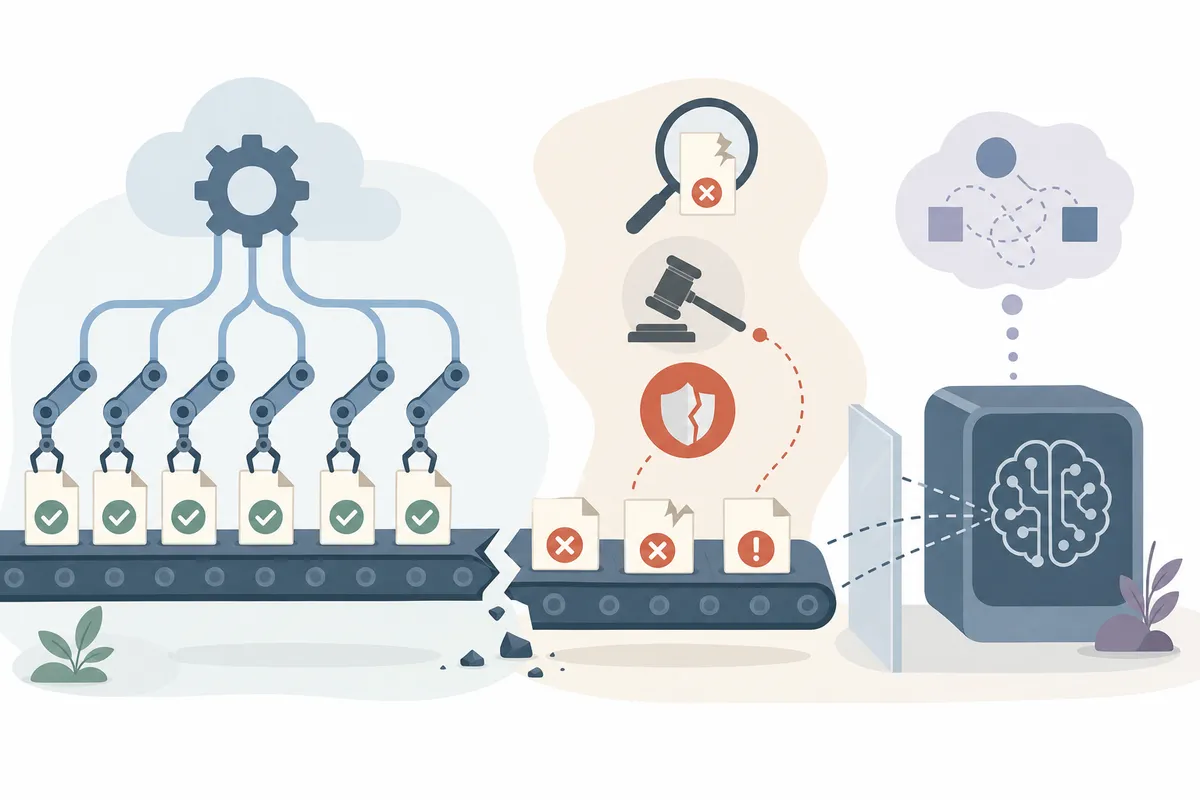
Fully manual SEO does not scale. Fully autonomous SEO with no review step scales the mistakes along with the output. What works in practice sits between the two: automation handles research, drafting, structure and the repetitive mechanics, and a defined checkpoint keeps a person deciding what publishes.
The same pattern shows up in other fields that scale automation. Modular steps, data kept separate from logic and regular review keep automated test suites reliable at scale, and they apply just as directly to content and SEO pipelines. A system built as one inseparable process breaks when volume increases, whereas one built from connected, checkable steps can grow without losing control.
SearchBlueprint's own AI article writer is built around this idea. It runs 36 checks per draft before a piece is considered ready, rather than treating "AI wrote it" as the finish line: machine speed for the volume and a defined gate for quality.
A practical roadmap for scalable automation
Automation that survives real growth follows a fairly consistent pattern, whether the process is testing software or publishing content. Five steps cover most of what decides whether a system scales or stalls.
- Choose tools built for scale, not just for the first task. A tool that is simple, fits your budget and supports growing volume beats one with more features but a hard ceiling. Weigh the learning curve and how well it integrates with what you already run.
- Design with scalability in mind from the start. Keep configurations, keyword lists and content rules separate from the logic that runs them. Avoid hardcoding anything you will need to change, because retrofitting scale into a rigid system costs far more than building for it upfront.
- Test before you trust it with real volume. Run the workflow against a range of inputs, including messy or unusual ones, before letting it run unattended. A system that only works on clean inputs will fail quietly the first time it meets a real one.
- Keep version control and backups. Track changes to your automation's configuration and content rules the way you would track code, so that when a change causes a problem you can revert it quickly instead of reconstructing it from memory.
- Review and optimize on a schedule. Automation is not set-and-forget. Revisit it regularly, check what is underperforming, and adjust as your site, your competitors and search engines change.
Skipping any of these is usually where "we automated it and it broke" stories begin. Teams that scale successfully treat automation as infrastructure that needs maintenance.
FAQs
What is scalable automation in SEO and marketing?
It is an automated workflow for research, content or linking that keeps its speed, accuracy and quality consistent as volume grows, unlike one that only works reliably at small scale.
Is scalable automation the same as programmatic SEO?
No. Programmatic SEO is one methodology under the scalable automation umbrella, useful for structured, repetitive pages such as location or product pages. The umbrella also covers AI-assisted content pipelines and autonomous workflows, which handle different kinds of content.
Can AI automation get a website penalized?
Yes, if it is used to produce content primarily to manipulate rankings rather than to help the reader. Google's spam policies apply to that intent whether a person or an automated system wrote the content, which is why a human review step before publish matters.
How much can scalable automation actually save?
No single figure applies to every business. Gartner projected that by 2024, organizations would cut operational costs by roughly 30% through scaling automation and redesigning their operational processes, and the actual savings for any one team depend on how much manual, repetitive work the automation replaces.
Do I need developers to build scalable automation?
Not necessarily. Low-code and managed platforms can cover most content and SEO automation needs, while custom development matters more for highly specific workflows or deep integrations with existing internal systems.
Start with the audit, not the automation
Scalable automation works best when it starts from real data about your own site instead of a generic template applied at volume. Before you commit a workflow to run unattended, see what a full audit finds. Talk to the team and look at a sample SEO report to see which pages, keywords and content gaps are worth automating first.
Sources
- Scalable Test Automation: Design, Optimize, and Scale
- What is Automation Scalability? Things You Should Know
- 10 Best Practices for Writing Scalable Test Automation ...
- Scaling automation: How to fast-track digital transformation
- What is Scalable Automation? And Why Most Systems Are ...
Disclaimer: This article is general information about rules and figures that applied when it was written, not personalised financial, tax or investment advice. It does not take account of your income, obligations, risk tolerance or goals, and rates and thresholds change. Verify the current position with the relevant authority, and speak to a licensed adviser or a qualified accountant before acting.
About the author
SearchBlueprint researched, wrote and scored this article with the content pipeline our customers run on their own sites. The score in the byline is what our content engine gave this page before it published. Nothing here is reviewed by hand, which is the point: it is the product's output, published where anyone can check it.