How to Increase Domain Authority Fast: A 90-Day Plan
SearchBlueprint · · 15 min read · scored 89/100

The fastest way to increase domain authority is to earn links from real, high-traffic websites, mainly through linkable assets like statistics pages, while pruning spammy links and tightening internal linking. There is no overnight trick: how to increase domain authority fast really means compressing 12 months of link earning into a focused 90-day sprint.
That sprint is what this guide lays out. You'll see what the score actually measures, how fast documented sites have moved it, which four levers do almost all the work, and which "fast" tactics quietly poison your link profile.
Key Takeaways
- Domain Authority is a third-party prediction of ranking potential, not a Google ranking factor. Chasing the number itself is a vanity exercise; chasing the inputs (quality links, organic traffic, clean link profile) moves both DA and rankings.
- Linkable assets are the highest-leverage tactic. Backlinko reports that 32.17% of the sites linking to it do so because of stats pages, even though those pages make up only 16% of its published content.
- Realistic speed, per public case studies: Exploding Topics moved its Authority Score from 53 to 60 in 12 months; CookUnity went from 44 to 48 in the same window. Low-DA sites can move faster in percentage terms.
- Buying cheap links, Moz has seen pitches literally selling DA 10 links for $1, DA 20 links for $2, and DA 30 links for $3, is the fastest way to lower your effective authority, because modern scores discount spam.
- Specialization beats breadth. Google's December 2025 update appears to reward focused, expert coverage of a niche over broad generalist content.
What Domain Authority Actually Measures (and What It Doesn't)
Domain Authority (DA) is a 0–100 score created by Moz that predicts how likely a website is to rank in search results, based largely on the quantity, quality, and diversity of its backlinks. It is not used by Google. Moz's own Dr. Peter J. Meyers is blunt about this in Moz's guide to improving DA: increasing DA solely to increase DA is "pointless vanity."
So why care? Because DA is an excellent comparative tool. Knowing your DA is 48 means little on its own. Knowing your DA is 48 while the sites ranking for your target keyword sit between 30 and 45 tells you the fight is winnable. Knowing your competitors sit at 80+ tells you to pick a different battle. That's the honest frame for this whole article, and it's the same logic behind measuring SEO performance without vanity metrics: track the number, but optimize the inputs.

The Three Scores, Compared
Every major tool has its own version of "authority," and the same site scores differently in each. Backlinko, for example, reports its own site scoring 62 in Semrush, 90 in Ahrefs, and 74 in Moz. None is "more correct", they use different data and different weightings.
| Metric | Tool | Main inputs | What makes it distinct |
|---|---|---|---|
| Domain Authority (DA) | Moz | Number of unique linking domains, total backlinks, authority and relevance of linking domains | Most focused on the diversity and strength of the backlink profile itself |
| Domain Rating (DR) | Ahrefs | Number of unique referring domains, DR of those domains, how many other sites each referrer links to | Rewards links from domains with few outgoing links, which pass more equity per link |
| Authority Score (AS) | Semrush | Link quality and quantity, estimated monthly organic traffic, spam/manipulation signals | The only one that directly bakes in organic traffic, making it the most holistic of the three |
The practical takeaway: pick one metric, benchmark against direct competitors in that same tool, and stop comparing scores across tools.
What Counts as a "Good" Score
A good score is entirely relative to your niche. Semrush's analysis of the top 10 organic rankings for 10 keywords across 10 industries found dramatic differences in the average Authority Score you're competing against:
| Industry | Avg. Authority Score (top 10 rankings) | What it means for your timeline |
|---|---|---|
| Finance | 75 | The hardest field in the study; expect years of sustained link earning to compete on head terms |
| Pets | 72.3 | Nearly finance-level competition; long-tail and local angles are the realistic entry point |
| Travel | 70.3 | Highly authoritative incumbents; original data and niche destinations are the openings |
| Real Estate | 68.2 | Strong national players, but local market pages face far weaker competition |
| Healthcare | 66.9 | High trust bar; credentials and citations matter as much as links |
| Ecommerce | 66.3 | Product-level pages can rank well below this average with strong relevance |
| Marketing | 65.7 | Crowded but fast-moving; fresh data and stats pages earn links quickly |
| Legal | 55 | A 30–40 score site can genuinely compete on many local and practice-area terms |
| Construction | 53.1 | The lowest bar in the study; a focused local site can reach parity within a year |
An Authority Score of 20 looks weak in the abstract. In an industry averaging 15, it's a lead. Benchmark first, then set a target.
How Fast Can You Increase Domain Authority?
If you're asking how to increase domain authority fast, here's the honest baseline: documented case studies show gains of roughly 4–7 points over 12 months for established mid-authority sites, and a focused 90-day sprint front-loads the work that produces them. Two public examples cited by Backlinko:
- Exploding Topics, a trends platform with over 1.7 million backlinks, grew its Authority Score from 53 to 60 in the last 12 months.
- CookUnity, a food delivery company, grew from 44 to 48 in 12 months, driven substantially by a single stats page (on the percentage of Americans who are vegan) that generated 658 backlinks.
Two things about speed are worth stating plainly. First, movement is easier at the bottom of the scale. Authority scores are logarithmic in practice: going from 10 to 20 is far faster than going from 60 to 70. A new or low-authority site running the plan below can see visible score movement within a quarter; a DA 60 site should think in years for the same point gain.
Second, links take time to be discovered, crawled, and weighted. Even a link you earn today may not register in a third-party score for weeks. That's why "fast" here means fast execution, with results compounding over the following two to four months. Anyone promising a specific score by a specific date is selling something.

The Four Levers That Actually Raise Domain Authority
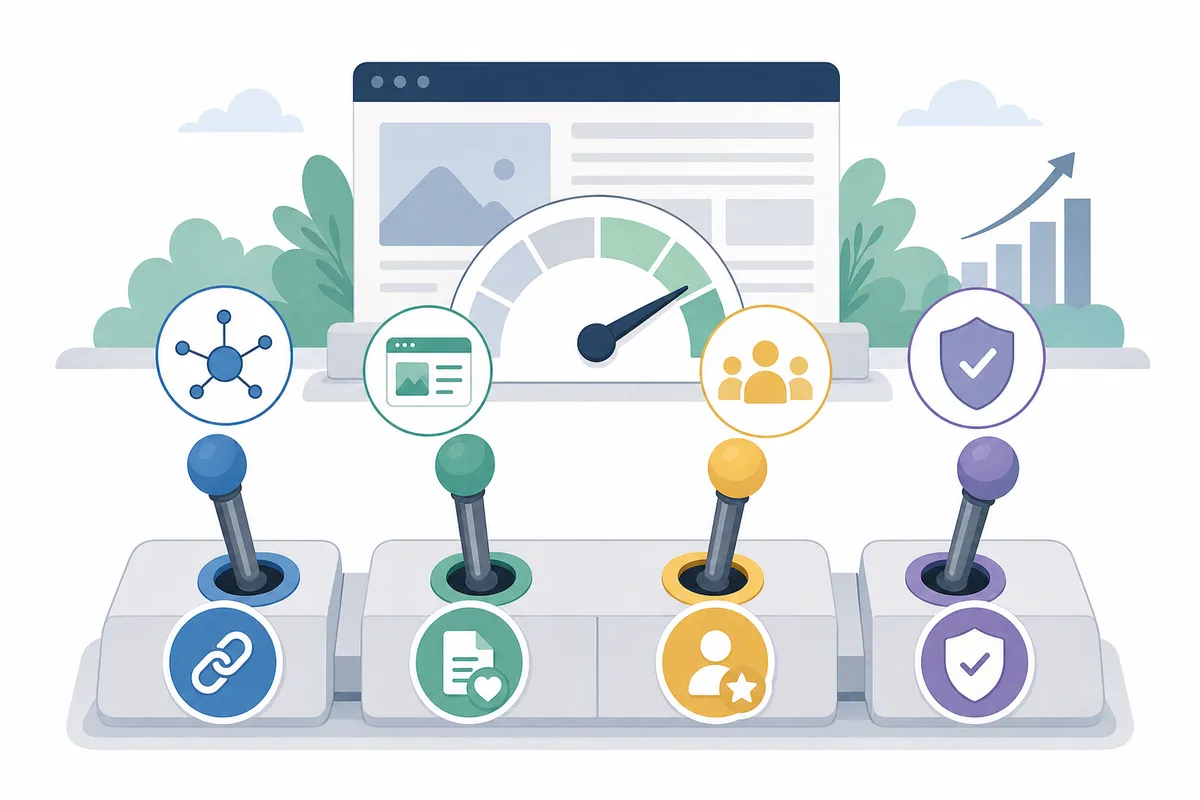
Everything that moves authority quickly falls under four levers: earn better links, publish specialized content, win real organic traffic, and clean up what you already have. Here's each one with the specifics.
Lever 1: Build Linkable Assets (the Highest ROI Move)
A linkable asset is a page other sites want to cite: statistics roundups, original research, free tools, calculators, and case studies with measurable outcomes. The numbers behind this tactic are striking:
- Backlinko reports that 32.17% of the websites linking to it with high-quality backlinks do so because of its stats pages, even though these pages make up only 16% of its published content.
- Its Twitch growth statistics page alone earned 1.3K backlinks from 457 domains, including a link from Forbes Home.
- A trend-timed TikTok statistics article earned 5.9K backlinks from 2.4K referring domains, many from high-authority sites like Forbes and Autoweek.
- Even a new stats article can move fast: Backlinko's affiliate marketing statistics piece earned 90 backlinks from 50 unique domains shortly after publication.
- At the extreme end, McKinsey's original research on the state of AI has attracted 125K backlinks from 22.4K domains.
The mechanism is simple: journalists and bloggers constantly need data to support their stories. If your page is the easiest credible source for "how many food delivery companies are there in the US" or "2024 trends in smart home devices," you earn citations without asking for them. You don't need original research every time, curating data from government agencies (the Census Bureau, the Bureau of Labor Statistics), industry associations, and research firms works, as long as you cite the original sources.
One execution detail matters more than most people realize: front-load the statistic. Put the headline number as high on the page as possible, then follow with context and related figures. A journalist scanning for a citation will not scroll through 800 words of preamble.
| Linkable asset type | Effort to produce | How links arrive | Evidence from public case studies |
|---|---|---|---|
| Curated statistics page | Low–medium: gather and cite existing data | Passively, from journalists and bloggers needing citations | 32.17% of Backlinko's quality links come from stats pages that are only 16% of its content |
| Trend-timed stats page | Medium: requires spotting a rising topic early | In bursts, when the topic hits the news cycle | Backlinko's TikTok stats article: 5.9K backlinks from 2.4K referring domains |
| Original research or survey | High: first-party data collection and analysis | Steadily and long-term, as the canonical source | McKinsey's AI research: 125K backlinks from 22.4K domains |
| Free tool or calculator | Medium–high: requires development work | From roundups, resource pages, and word of mouth | Widely cited by Semrush as a top link-earning format alongside original research |
| Case study with measurable outcomes | Low–medium: document what you already did | From practitioners referencing your methodology and results | CookUnity's single vegan-stats page: 658 backlinks, AS from 44 to 48 in 12 months |
Lever 2: Specialize With Topic Clusters
Google's December 2025 update appears to reward specialization and expertise over broad coverage. SEO expert Aleyda Solís analyzed the update's impact and found that in SaaS, generalist sites like Zapier, Adobe, and CNBC lost rankings for terms like "accounting software for small business," while specialized tools like FreshBooks and Xero gained visibility.
For authority building, this changes the content playbook. Instead of publishing broadly, build topic clusters: a pillar page covering your core topic, surrounded by cluster pages that go deep into specific subtopics, all interlinked. This concentrates relevance signals, and it's the structure that both search engines and AI systems reward. If you're starting from zero, map the clusters before you write anything, the process in our guide to building an SEO strategy from scratch walks through exactly that sequencing.
Depth also means volume, and volume is where most small teams stall. Publishing one deep cluster per quarter beats publishing one shallow post per week, but the sites that grow authority fastest do both, using systems that let them scale content production without losing quality.
Lever 3: Win Keywords You Can Actually Rank For
Semrush's Authority Score directly includes estimated organic traffic, which means ranking and traffic are not just outcomes of authority, they're inputs to it. The trap is targeting keywords above your weight class. Semrush's Personal Keyword Difficulty metric illustrates this: in their example, a site's personal difficulty for "dog bone" is 61%, meaning it's unlikely to crack the top 10. Their recommendation is to filter for keywords with a maximum personal difficulty score, with 50% as a good starting point.
The compounding loop looks like this:
- Target winnable keywords (long-tail, question-based, low competition for your site).
- Rank, and earn organic traffic.
- Traffic raises your authority score and gets your content seen by people who link.
- Higher authority makes harder keywords winnable next quarter.
Each cycle takes a couple of months, which is why site owners who want speed run multiple cycles in parallel across different clusters. For the traffic side of that loop, the tactics in 12 moves that reliably increase website traffic pair directly with this lever.
One more 2026-specific point: website authority is no longer just about backlinks and domain scores. AI systems evaluate how easy your content is to extract and quote, and whether your brand information is consistent across the web. Practically, that means question-based headings, a direct answer in the first one or two sentences of each section, and structured data, including FAQ markup, which you can now produce reliably with AI-generated FAQ schema that answer engines actually cite.
Lever 4: Clean Up and Redistribute What You Already Have
The fastest wins often come from your existing site, not new links:
- Prune spammy links. Modern authority scores explicitly discount manipulative links; Semrush includes "spam factors" as one of three core components. Audit your backlink profile and disavow only genuinely toxic patterns, some low-authority links are natural and fine.
- Fix internal linking. Internal links distribute the equity your existing backlinks already earned. Orphaned pages waste authority; a well-linked cluster concentrates it. This is usually the cheapest point gain available.
- Consolidate cannibalizing pages. Two thin pages competing for the same keyword split links and relevance. Merge them and 301 the weaker URL.
- Tighten technical health. Crawlability, site speed, and clean structure don't earn links directly, but they determine whether the links you earn translate into rankings and traffic, the signals authority scores actually measure.
Manual Grind vs. Tool-Assisted Speed
The competitor content on this keyword makes a fair point: the gap between sites that grow authority fast and those that don't is usually execution speed, not strategy knowledge. Everyone knows stats pages work. Few teams ship one per month.
| Task | Fully manual | Tool-assisted | Where the speed comes from |
|---|---|---|---|
| Finding linkable-asset topics | Reading competitor backlink profiles page by page | Filtering competitor indexed pages by referring-domain count in minutes | Automated backlink analysis surfaces the proven link magnets instantly |
| Keyword selection | Guessing difficulty from SERP eyeballing | Personal difficulty filters (e.g., max 50% KD) sized to your site's actual authority | You stop wasting quarters on keywords you were never going to win |
| Content production | One writer, one deep post per week at best | Briefs and drafts generated from cluster plans, human-edited before publishing | Volume and depth stop being a trade-off |
| Internal linking | Remembering which old posts to link from | Link suggestions drawn from a crawl of your own site | Every new page ships already wired into its cluster |
| Progress tracking | Spot-checking scores monthly by hand | Weekly rank and authority tracking with automated reporting | You see which lever is working within weeks, not quarters |
None of this replaces judgment. Automation compresses the mechanical 80% so the human 20%, picking the angle, verifying the data, editing for accuracy, gets done at all. Agencies feel this most acutely, which is why the same tooling logic shows up in our breakdown of scaling an SEO agency without hiring more staff.
The 90-Day Plan to Increase Domain Authority Fast
Here's the sequence, compressed into three 30-day blocks. It assumes a small team or a solo operator with a few hours per week, the same audience as our DIY plan for growing organic traffic without an agency.
Days 1–30: Baseline, Cleanup, and Cluster Design
- Benchmark. Record your DA/DR/AS in one tool, plus the scores of your five closest competitors. This is your honest starting line.
- Audit your link profile. Flag toxic patterns. Disavow sparingly.
- Fix internal linking and cannibalization. Merge duplicate-intent pages, link orphans into clusters, and add contextual links from your strongest pages to your money pages.
- Design two topic clusters around what you want your brand known for, using a personal-difficulty ceiling (around 50%) to pick target keywords you can realistically win.
- Pick your first linkable asset. Brainstorm the questions journalists ask about your industry, the "how many X companies are there" and "what percentage of Americans do Y" class of query, and choose the one with the clearest data gap.
Days 31–60: Ship the Assets
- Publish the stats page. Curate data from government agencies, industry bodies, and research firms; cite every original source; put the headline statistic in the first screen of the page.
- Publish 4–8 cluster pages, each answering one question directly in its opening lines, structured for both readers and AI retrieval.
- Start light outreach. You don't need mass cold email. Notify the sources you cited, share the asset where your industry congregates, and pitch it to two or three writers who've covered the topic before.
- Add structured data, FAQ schema on question pages, organization markup site-wide, so machines can identify who you are and what you cover.
Days 61–90: Compound and Measure
- Publish a second linkable asset, ideally timed to a rising trend in your niche, the timing effect is real, as the TikTok stats example (5.9K backlinks) shows.
- Refresh your best existing pages and add internal links from them to the new clusters.
- Review the data. Which pages earned referring domains? Which keywords entered the top 20? Reallocate the next quarter's effort accordingly. If reading the numbers feels opaque, our plain-English guide to understanding an SEO report without technical skills covers exactly what each metric means.
Expect the score itself to lag this work by one to three months. Judge the sprint by referring domains gained and rankings entered, not by the score on day 90.
Shortcuts That Backfire (and Waste Your Money)
Because "fast" is in the search query, half the results for it are selling shortcuts. Here's what to avoid, and why.
Buying Cheap DA Links
Moz's Dr. Pete has described receiving pitches almost verbatim offering DA 10 links for $1, DA 20 links for $2, and DA 30 links for $3, and his advice was to spend that money "on something more useful, like sandwiches." The reason isn't moral posturing. Buying links to manipulate rankings is explicitly classed as link spam in Google's spam policies, and modern authority scores likewise detect and discount manipulated links; Semrush's Authority Score includes spam factors as a core component. A profile stuffed with cheap directory and PBN links can raise your spam signals while adding zero effective equity. You pay to make your site look worse.
Chasing Every Link at Any Cost
A link nobody sees, that drives no traffic, that sits on a page with no real audience, is likely discounted by both third-party metrics and Google. Moz's newer DA model specifically factors in whether links come from legitimate sites with real traffic. The filter question for any link opportunity is simple: could this link plausibly send a human visitor? If not, skip it.
Publishing Broad, Shallow Content at Volume
Volume without specialization now works against you. The December 2025 update evidence, generalists like Zapier and CNBC losing SaaS rankings to specialists like FreshBooks and Xero, suggests fifty thin posts across ten topics build less authority than fifteen deep posts across two clusters. Scale production, but scale it within your clusters.
Measuring Progress Without Fooling Yourself
Track three layers, in this order of importance:
- Referring domains gained per month, the direct input. New unique linking domains matter more than raw backlink counts.
- Organic traffic and rankings on target keywords, the outcome that feeds back into authority scores and, more importantly, into your business.
- The authority score itself, a lagging, quarterly-scale indicator. Check it monthly at most.
Skip the metrics that flatter without informing: total backlink count (one spammy scraper can add thousands), impressions without clicks, and score comparisons across different tools. If you run a small business, tie the whole stack to revenue signals the way our guide to small business SEO tracking that moves revenue lays out, because a DA point that doesn't eventually show up as customers wasn't worth chasing.
FAQs
How long does it take to increase domain authority?
Documented case studies show established sites gaining 4–7 points over 12 months: Exploding Topics went from an Authority Score of 53 to 60, and CookUnity from 44 to 48, each in a 12-month window. Low-authority sites (under ~30) typically move faster in point terms because the scales are logarithmic. Expect your first visible movement two to four months after the underlying link work.
Does domain authority directly affect Google rankings?
No. DA is a third-party metric created by Moz and is not used by Google. However, it's calculated from signals that do influence rankings, backlink quality, linking-domain diversity, and (in Semrush's version) organic traffic, so improving the inputs improves both the score and your actual rankings.
What is a good domain authority score?
It depends entirely on your industry. Semrush's analysis of top-10 rankings found average Authority Scores ranging from 75 in finance down to 53.1 in construction. Compare your score against the sites actually ranking for your target keywords; a 20 can be strong in a niche that averages 15.
Can I increase domain authority without backlinks?
Only partially. You can gain some ground through internal linking, technical cleanup, structured data, and organic traffic growth from winnable keywords, traffic is a direct input to Semrush's Authority Score. But every major authority metric is dominated by referring domains, so sustained growth without earning any new links is unrealistic.
Is buying backlinks a fast way to raise DA?
It's a fast way to damage it. Cheap link schemes, the kind pitched at $1–$3 per link based on the seller's DA, are exactly what modern scores are built to discount, and spam signals are an explicit negative component of Semrush's Authority Score. The money is better spent producing one solid statistics page, which can earn hundreds of legitimate links on its own.
Run Your Baseline This Week
Before you build anything, get the honest starting picture: your current authority, your competitors' scores, your link profile's health, and which existing pages already pull weight. That baseline is what turns how to increase domain authority fast from a hopeful question into a measurable 90-day plan. See exactly what that picture looks like in a sample SEO report from SearchBlueprint, then talk to the team about running one for your own domain.
Resources / References
Sources
About the author
SearchBlueprint researched, wrote and scored this article with the content pipeline our customers run on their own sites. The score in the byline is what our content engine gave this page before it published. Nothing here is reviewed by hand, which is the point: it is the product's output, published where anyone can check it.