How to Use AI for FAQ Schema: Generate Markup AI Engines Actually Cite
SearchBlueprint · · 15 min read · scored 89/100
Using AI for FAQ schema means doing two jobs, not one: prompting a model to write self-contained question-and-answer content, then generating valid FAQPage JSON-LD that mirrors that content exactly. Do both and you raise your odds of being cited by ChatGPT, Perplexity, and Google AI Overviews. Do only the code, and you get almost nothing.
That distinction matters because the ground has shifted. Google restricted FAQ rich results back in August 2023, yet FAQ markup has become more valuable since, just for a different audience. AI answer engines now sit between your content and your customers, and question-answer structure is the format they extract most reliably. This guide walks through how AI engines actually use the markup, how to generate it with AI without producing invalid or spammy output, and how to validate and deploy it so the effort pays off.
Why FAQ Schema Matters More Now, Not Less
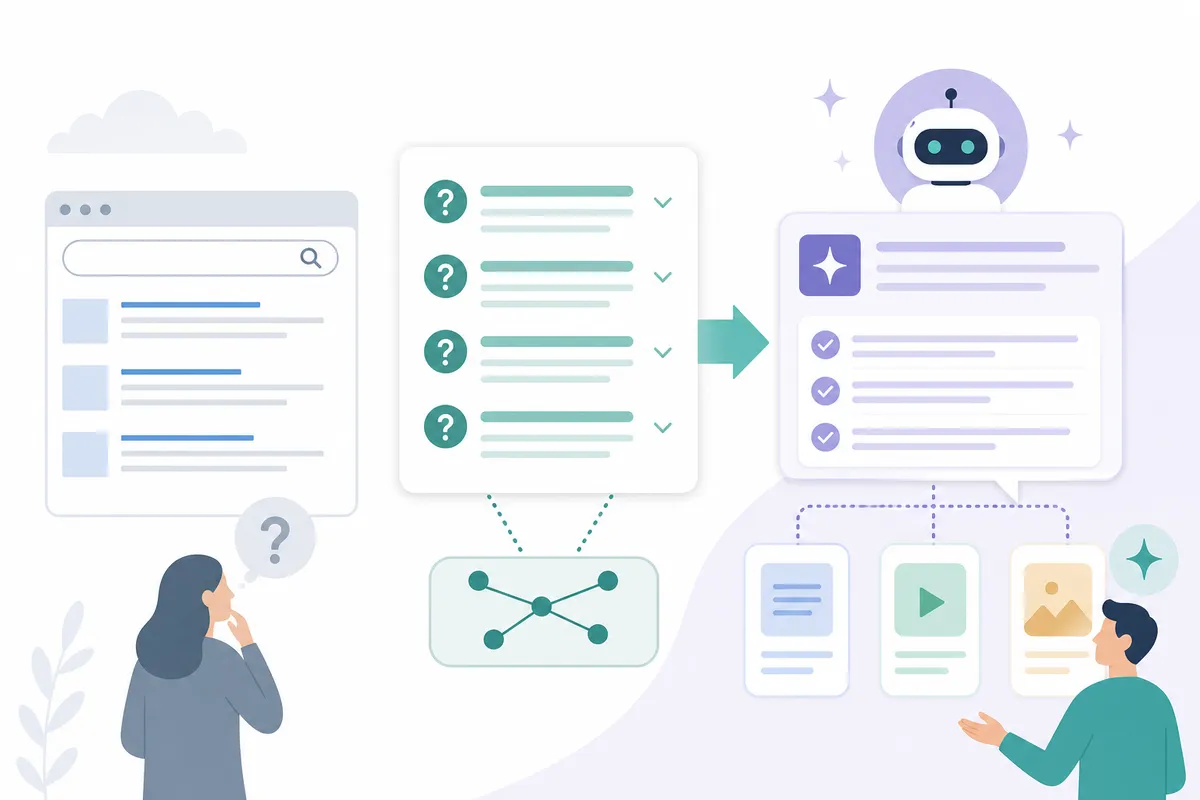
Here is the short version: Google took FAQ rich results away from most sites, and AI search gave the markup a second, larger life.
The 2023 restriction and the paradox it created
In August 2023, Google limited FAQ rich results to well-known, authoritative government and health websites. Google's FAQPage documentation still reflects that restriction. For most businesses, the expandable Q&A dropdowns in blue-link results are gone, and they are not coming back.
Many teams read that as "FAQ schema is dead" and stopped. That was the wrong lesson. The visibility moved rather than vanished. AI platforms, ChatGPT, Perplexity, Claude, Gemini, Google's AI Overviews, extract and cite question-answer content constantly, because their own output is question-answer content. Research cited across the industry shows 78% of AI-generated answers include list formats, which is exactly the shape a well-built FAQ takes.
Meanwhile, adoption stayed low. Per Schema.org data referenced in recent analyses, only about 12.4% of websites use structured data at all. If your competitors are in the other 87.6%, correct FAQ markup is one of the cheaper edges available to you.
The Numbers Behind the Urgency
The scale of the shift is easy to underestimate, so here are the figures the ranking studies report:
- 58–60% of all searches now end without a click to any website. When an AI Overview appears, that reportedly rises to 83%.
- AI platforms generated 1.13 billion referral visits in June 2025, a 357% increase from June 2024, and AI-referred sessions jumped 527% between January and May 2025.
- AI visitors convert 4.4 to 23x better than average web visitors, according to those same analyses.
- Google AI Overviews expanded from 6.49% of searches in January 2025 to roughly 18–20% by year's end, now reaching about 2 billion monthly users, while reducing clicks to websites by a reported 34.5%.
- ChatGPT processes over 1 billion queries daily and holds a reported 81% of the AI chatbot market.
- The global AI search engine market reached USD 15.23 billion in 2024 and is projected to grow at a 16.8% CAGR through 2032.
Being cited inside an AI answer is rapidly becoming as valuable as ranking in the traditional results, sometimes more, given how those clicks convert. If you want the broader picture of how these engines are reshaping strategy, our guide to what AI search engines mean for your SEO in 2026 covers the landscape end to end.

How AI Engines Actually Use Your FAQ Markup

Before you generate a single line of JSON-LD, it helps to understand the mechanism, because most guides get it wrong in one of two directions. Some oversell schema as a direct lever on ChatGPT citations. Others dismiss it entirely because "LLMs don't read JSON-LD." The evidence supports a two-pathway model.
Pathway 1: JSON-LD feeds Google's pipeline (indirect)
When Googlebot processes valid FAQPage markup, it extracts entities and topical relationships that feed the Knowledge Graph and inform ranking. Since a reported 76% of AI Overview citations come from top-10 organic results, the chain is: valid schema → clearer entity understanding → stronger organic position → higher AI Overview citation probability. A controlled experiment by Search Engine Land supports this: in its test group, the page with well-implemented schema was the only one to appear in a Google AI Overview, and it also earned the best organic ranking.
Pathway 2: Visible Q&A content feeds LLMs (direct)
Large language models tokenize your page as raw text. A February 2026 experiment by SEO practitioner Mark Williams-Cook demonstrated this vividly: he embedded a fake address exclusively inside invalid JSON-LD, and both ChatGPT and Perplexity extracted and repeated it. The models read the text inside the script tag, they just don't semantically parse or validate the structure.
What LLMs do reward is visible, self-contained Q&A formatting. Practitioner analysis suggests LLM retrieval chunks run roughly 150–300 words, and a tight FAQ answer fits inside a single chunk, unlike a narrative paragraph that gets split mid-thought. This is why the on-page FAQ section matters as much as the markup behind it, and why one of the 10 signs your content isn't AI-search ready is answers that only make sense in context.
How each platform weighs schema
The platforms behave differently, so treat them differently:
| Platform | Reported Schema Relationship | Primary Citation Driver | Practical Priority |
|---|---|---|---|
| Perplexity | An analysis of 650+ sites reported an 89% correlation between valid schema and citations | Structured content signals surfaced via retrieval | High, implement comprehensive, valid FAQPage markup |
| ChatGPT | SE Ranking found a slight negative correlation for FAQ schema (3.6 vs. 4.2 average citations); 67% of its citations reportedly include sites with Organization schema | Domain authority, weighted roughly 3.5:1 over schema | Medium, pair visible Q&A formatting with authority building |
| Google AI Overviews | 76% of citations reportedly come from top-10 organic results | Organic ranking, enhanced by Knowledge Graph signals | High, the indirect JSON-LD pathway runs through here |
| Voice assistants (Siri, Alexa, Google Assistant) | Pull concise answers from structured Q&A data | Short, self-contained answers matching spoken questions | Medium, a byproduct of doing FAQ content well |
One more platform quirk worth knowing: a reported 28% of ChatGPT's most-cited pages have zero Google organic visibility. ChatGPT and AI Overviews draw from different pools, so winning one does not guarantee the other.
Two Ways to Use AI for FAQ Schema: Prompts vs. Platforms
There are two workable approaches to using AI for FAQ schema, and the right one depends on how many pages you manage and who is doing the work.
The manual prompt workflow
You feed a general-purpose model (ChatGPT, Claude, Gemini) your page content and ask for FAQPage JSON-LD. It is free or cheap, flexible, and fine for a handful of pages. The catch: you own every step, question research, answer quality, JSON validity, matching markup to visible content, and re-checking it every time the page changes. Models frequently hallucinate schema properties that don't exist, drop commas, or invent answers not present on the page. Every output needs validation before deployment, no exceptions.
The automated platform workflow
Purpose-built SEO tools generate the schema as part of the publishing pipeline, keep it synced with page content, and validate before deployment. This matters at scale: hand-maintaining markup across 50 or 500 pages is where manual workflows quietly rot. An AI SEO agent that runs the whole loop from a single URL handles the content, the structure, and the publishing checks together, so the markup never drifts from the page it describes.
Side-by-side comparison
| Factor | Manual AI Prompts | Automated SEO Platform | Who Should Choose It |
|---|---|---|---|
| Cost | Free to low (a chat subscription) | Subscription pricing, varies by plan | Prompts for tight budgets; platforms once page count grows |
| Validity risk | High, models break JSON syntax and invent properties; every block needs manual validation | Low, schema is generated from templates and validated automatically | Anyone shipping schema on more than a few pages benefits from automation |
| Content–markup sync | Manual, you must regenerate markup whenever the page changes | Automatic, markup regenerates with the content | Sites that update FAQs often (pricing, policies) need sync |
| Scale | Practical up to ~10–20 pages | Practical across hundreds of pages | Agencies and multi-page sites should automate |
| Skill required | Comfort editing JSON-LD and reading validator errors | Low, the pipeline handles the technical layer | Non-technical owners should not hand-edit JSON-LD in production |
If you want to test the drafting side before committing to anything, a free AI content writer will show you what machine-drafted Q&A output looks like, and where it needs a human pass, without any setup.
Step by Step: Using AI for FAQ Schema That Validates
Here is the full workflow, from question research to deployed markup. Budget roughly 30–60 minutes per page the first time; it gets faster.
Step 1: Mine real questions, not invented ones
AI is genuinely good at generating plausible-sounding questions. That is the problem, plausible is not the same as asked. Start from real demand signals:
- Google Search Console: filter queries containing "how," "what," "why," "can," "does."
- People Also Ask boxes for your target keyword.
- Support tickets and sales emails: the questions customers ask before buying are the questions AI engines get asked too.
- AI platforms themselves: ask ChatGPT and Perplexity your topic questions and note what they currently answer, and who they cite. Our guide to answer engine optimization covers this reconnaissance in depth.
Wait, that link isn't on your list. Use this instead: understanding when AI content works and when a human needs to write it will tell you which of these questions AI can draft credibly and which need subject-matter input.
Pick 4–8 questions per page. More than about ten dilutes focus and starts looking like markup farming.
Step 2: Draft answers with AI, then edit like an editor
Prompt the model with your source content and constraints, not just a topic. A structure that works:
"Using only the facts in the text below, write answers to these questions. Each answer must be 40–80 words, self-contained (it must make sense with zero surrounding context), start with a direct answer in the first sentence, and contain no promotional language. Do not add facts that are not in the source text."
Then edit. Check every claim against reality, cut hedging, and make sure each answer stands alone, remember, retrieval systems lift these out individually. Answers stuffed with marketing copy are exactly what got FAQ rich results restricted in the first place, and AI engines are no more charitable. If you're worried about AI drafting hurting you more broadly, we've written a full playbook on using AI writers without tanking your rankings.
Step 3: Generate the JSON-LD
Once the visible Q&A content is final, generating the markup is the easy part. Prompt:
"Convert the following questions and answers into valid schema.org FAQPage JSON-LD. Use exactly this text — do not rephrase, shorten, or add anything. Output only the JSON-LD in a script tag."
The output should look like this:
{
  "@context": "https://schema.org",
  "@type": "FAQPage",
  "mainEntity": [
    {
      "@type": "Question",
      "name": "Does FAQ schema still work after Google's 2023 update?",
      "acceptedAnswer": {
        "@type": "Answer",
        "text": "Yes, but differently. Google restricted FAQ rich results to government and health sites in August 2023, so most sites no longer get the SERP dropdown. The markup now works indirectly, feeding Google's Knowledge Graph and helping AI platforms extract and cite your question-answer content."
      }
    }
  ]
}
Three rules that catch most AI mistakes:
- The markup must mirror visible content word for word. Content mismatch is the single most common implementation failure, and it violates Google's structured data guidelines outright.
- Only real properties, as defined in Schema.org's FAQPage specification.
FAQPage,Questionwithname, andacceptedAnswerwithAnswerandtext. Models sometimes invent fields likeanswerTextorfaqItem, delete them. - One FAQPage block per page. Multiple blocks confuse parsers and validators.
Step 4: Validate before anything ships
Never deploy AI-generated markup unvalidated. Run it through a free schema validator to catch syntax errors, missing required properties, and invented fields, and cross-check with the Schema Markup Validator at validator.schema.org. Common failures in AI output include trailing commas, unescaped quotation marks inside answer text, and truncated JSON when the model hit an output limit mid-block. Each takes seconds to fix once flagged, and silently breaks the whole block if it isn't.
Step 5: Deploy and verify at the live URL
Place the JSON-LD in a <script type="application/ld+json"> tag, ideally in the page head. On WordPress, plugins like Yoast or Rank Math can inject it; on Shopify, a JSON-LD app or theme edit does the job. Then verify at the live URL, themes, plugins, and caching layers mangle markup between editor and production more often than anyone expects. Fetch the published page and confirm the script tag survived intact.
If schema generation is part of every article you publish, it's worth building into the drafting stage instead of bolting on afterward. SearchBlueprint's AI article writer runs 36 checks per draft, including structure and extraction-readiness, so the FAQ section and its markup come out aligned from the start.
Common Mistakes That Block AI Citations
Most FAQ schema failures fall into a handful of patterns. Each row here stands on its own if you're skimming:
| Mistake | Why It Blocks Citations | The Fix |
|---|---|---|
| Markup doesn't match visible page content | Google treats hidden or mismatched FAQ markup as a guideline violation, and LLMs cite the visible text anyway, so the markup buys you nothing | Generate JSON-LD from the final published Q&A text, verbatim, and regenerate whenever the page changes |
| Promotional answers ("Why choose us?") | Marketing copy in FAQ markup is exactly what triggered Google's 2023 crackdown; AI engines skip answers that don't actually answer | Write factual, complete answers; keep the pitch elsewhere on the page |
| Answers that need surrounding context | LLM retrieval chunks run roughly 150–300 words and are lifted out individually; an answer that starts "As mentioned above…" fails on extraction | Make every answer self-contained: restate the subject, answer in the first sentence, keep it to 40–80 words |
| Deploying unvalidated AI output | A single trailing comma invalidates the entire JSON-LD block silently, no error on the page, no benefit either | Validate every block before deployment and re-test the live URL after publishing |
| Set-and-forget schema | FAQ content decays: prices change, policies change, and stale answers get cited stale, or stop being cited | Review FAQ pages quarterly; regenerate markup with every content update |
| Schema on pages AI crawlers can't use well | Markup can't rescue a page that blocks or confuses AI crawlers | Check crawler access and consider publishing an llms.txt file, you can build one with a free llms.txt generator |
One pattern deserves emphasis: teams either over-invest in schema (expecting LLMs to parse JSON-LD directly, which they don't) or dismiss it entirely (missing the Knowledge Graph pathway, which is real). The dual-pathway model resolves both errors, build the visible Q&A layer for LLMs and the JSON-LD layer for Google, always in sync.
What FAQ Schema Can't Fix
Honesty check: schema is a last-mile optimizer, not a substitute for authority or content quality.
A case study documented by Kitchen Remodeling SEO compared two competing sites in the same industry. Site A had perfect FAQ schema implementation and 420 referring domains; Site B had no FAQ schema and 3,200 referring domains. Site B captured 68% of AI citation share versus Site A's 12%. The same analysis put schema at roughly 10% weight in ChatGPT's citation evaluation, about a 3.5:1 authority-to-schema ratio.
The practical hierarchy for AI citations looks like this:
- Domain authority, backlinks and brand signals carry the most weight.
- Content quality and depth, topical coverage and genuine expertise.
- Visible content formatting, Q&A structure, lists, direct answers.
- Schema markup, real, but the smallest of the four levers.
So sequence your effort accordingly. If your site is thin on authority, FAQ schema alone will not put you in AI answers, but skipping it once the fundamentals are in place leaves a measurable edge on the table. Industry analyses report structured-data pages are up to 40% more likely to appear in AI summary positions, and one benchmark cited by Schema App found AI systems show 300% higher accuracy with structured content versus unstructured. Those gains are worth claiming; they just aren't a foundation on their own. If you're not sure where your site sits in that hierarchy, the SEO roadmap for business owners is a sensible place to orient.
Measuring Whether Your AI-Generated Schema Works
You can't manage what you don't measure, and the old metric, FAQ rich result impressions in Search Console, is dead for most sites. Track these instead:
- AI citation checks: periodically ask ChatGPT, Perplexity, and Gemini the questions your pages answer, and note whether your domain gets cited. Some practitioners report Perplexity and Gemini citing fresh, structured posts within hours of publishing.
- AI referral traffic: segment sessions from chatgpt.com, perplexity.ai, and gemini.google.com in your analytics. Given the reported 4.4–23x conversion advantage of AI visitors, even small referral numbers can matter commercially.
- Organic rankings for question queries: the indirect pathway shows up here first, since 76% of AI Overview citations reportedly come from top-10 results.
- Schema validity over time: re-validate quarterly and after any theme, plugin, or CMS change. Markup breaks silently.
For agencies running this across client portfolios, doing citation spot-checks by hand doesn't scale, building schema generation and verification into a repeatable delivery process is the difference between a one-off project and a retained service. That's the workflow our agency-focused SEO strategy tooling is built around.
FAQs
Does FAQ schema still work after Google's 2023 rich results change?
Yes, but its value moved. Google restricted FAQ rich results to government and health sites in August 2023, so most sites no longer get SERP dropdowns. The markup now works indirectly, feeding Google's Knowledge Graph and organic rankings, which drive AI Overview citations, while the visible Q&A content it mirrors is what ChatGPT and Perplexity extract directly.
Can ChatGPT actually read JSON-LD schema?
Not the way Google does. LLMs tokenize JSON-LD as raw text rather than parsing its structure, an experiment by Mark Williams-Cook showed ChatGPT and Perplexity extracting text even from invalid, made-up schema. That's why the visible question-and-answer content on your page matters as much as the markup: the markup serves Google's pipeline, the visible text serves the LLMs.
How many questions should an FAQ schema block include?
Four to eight well-researched questions per page is a practical range. Each answer should be self-contained, roughly 40–80 words, and answer the question in its first sentence. More than about ten questions dilutes topical focus and starts to resemble the markup farming that triggered Google's original crackdown.
How do I validate AI-generated FAQ schema before publishing?
Run the JSON-LD through a schema validator to catch syntax errors, missing required properties, and invented fields, then re-test the live URL after deployment. AI models commonly produce trailing commas, unescaped quotes inside answers, and truncated JSON, any of which silently invalidates the entire block without showing an error on the page.
Will AI-generated FAQ schema hurt my rankings?
Not if the markup matches visible, genuinely useful content. The risk isn't that AI generated it, it's shipping unvalidated code, marking up promotional copy, or letting the markup drift from the page text. Those violate Google's guidelines regardless of who wrote them. Validate everything, keep markup and content in sync, and review quarterly.
Audit Your Markup Before You Scale It
Before you roll AI-generated FAQ schema across your whole site, get a clear read on where your pages stand, structure, markup validity, and how AI-extractable your content already is. Talk to the team and look through a sample SEO report showing exactly what gets checked; it's the fastest way to see whether using AI for FAQ schema is your next lever or whether a more fundamental fix comes first.
Resources / References
- Google's FAQPage documentation
- Google's structured data guidelines
- Schema.org's FAQPage specification
- Schema Markup Validator at validator.schema.org
Sources
- Are FAQ Schemas Important for AI Search, GEO & AEO?
- FAQ Schema for AI Answers: Does It Actually Get You ...
- Does FAQ + Schema Still Help With AI Citations or Not ...
- FAQ Schema for AI Answers | Setup Guide & Examples
- FAQ Schema: A Beginner's Guide
Disclaimer: This article is general information about rules and figures that applied when it was written, not personalised financial, tax or investment advice. It does not take account of your income, obligations, risk tolerance or goals, and rates and thresholds change. Verify the current position with the relevant authority, and speak to a licensed adviser or a qualified accountant before acting.
About the author
SearchBlueprint researched, wrote and scored this article with the content pipeline our customers run on their own sites. The score in the byline is what our content engine gave this page before it published. Nothing here is reviewed by hand, which is the point: it is the product's output, published where anyone can check it.