Can You Buy Google Reviews? Why It Backfires Fast
By Toy Wen Da, Co-Founder · Updated · 7 min read · scored 98/100
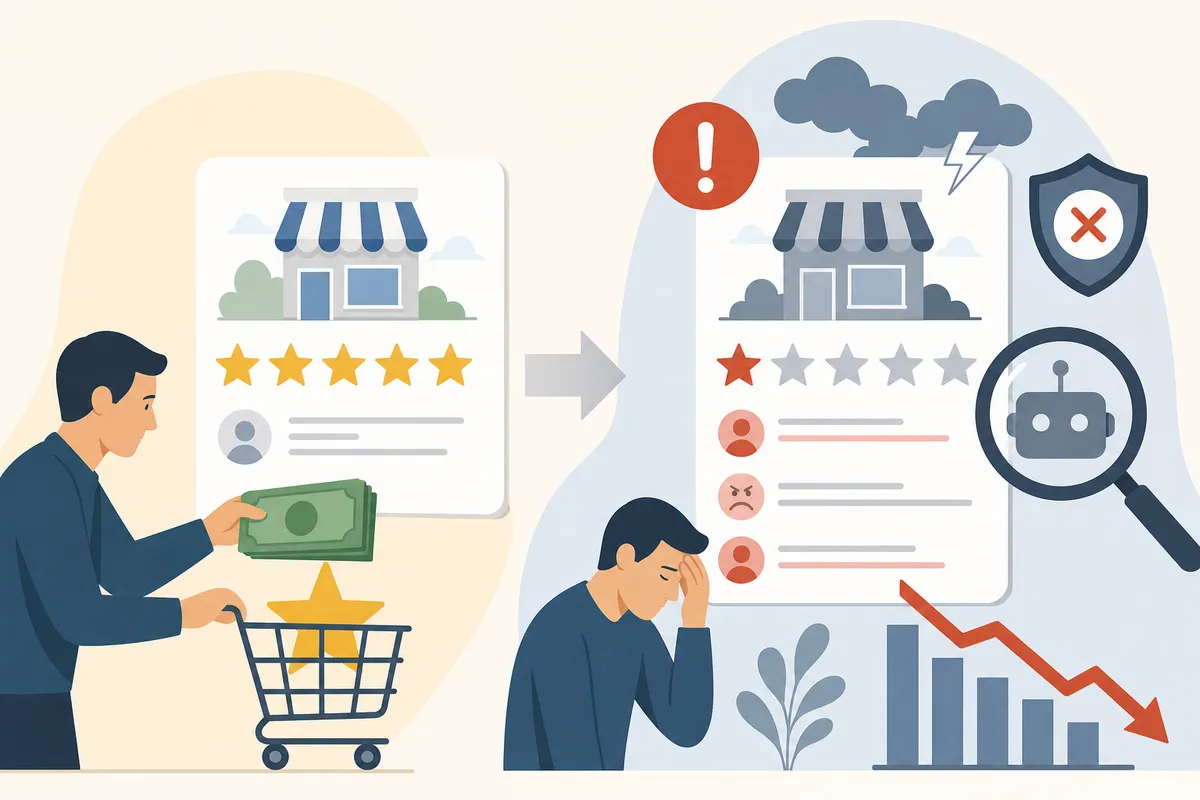
Yes, you can technically buy Google reviews, and dozens of sites sell them. But doing so violates Google's review policies, can get your whole Google Business Profile suspended, and has drawn real fines from the Federal Trade Commission. The smarter first move is to open your Google Business Profile and use its free review tools instead.
Key takeaways
- You can pay for Google reviews, but it breaks Google's content policies and the reviews can be removed at any time.
- Getting caught can mean lost reviews, a suspended listing, or lower local rankings, the opposite of what you paid for.
- The FTC has already fined a company $12.8 million over fake online reviews, so the legal risk is real.
- Google Business Profile gives you a free, shareable review link, the compliant way to get the same result.
- A steady stream of real reviews, tied to your local SEO work, beats a short-lived batch of purchased ones.
Before you decide either way, it helps to see what your review profile looks like next to competitors. SearchBlueprint's local SEO tracking shows review counts and ratings alongside your local rankings, so you can tell whether reviews or something else, like missing location pages or weak on-page content, is holding you back.
What "buying Google reviews" actually means
Buying Google reviews means paying a third-party seller to post reviews on your Google Business Profile that weren't left by real customers. You pick a package, hand over your listing details, and the seller posts reviews from accounts they control or recruit.
Search "buy Google reviews" and you'll find marketplaces selling exactly this. One site advertises tiered packages: a 5-review "Starter" bundle, a 10-review "Most Popular" bundle and a 15-review "Growth" bundle, each priced per review and delivered gradually over one to several weeks.
What a typical paid-review package looks like
| Package | Reviews Included | Listed Price | Price Per Review | Delivery Window |
|---|---|---|---|---|
| Starter | 5 | $100 | $20 | 7–14 days |
| Most Popular | 10 | $180 | $18 | 7–14 days |
| Growth | 15 | $270 | $18 | 7–14 days (some vendors claim 2–4 weeks) |
Vendors selling these packages often promise "verified" or "aged" Google accounts and claim delivery starts within 48–72 hours. Some offer a replacement guarantee if Google removes the reviews within 30 days, which is itself a tell, since the sellers expect takedowns.

Why you shouldn't buy Google reviews (even though you can)
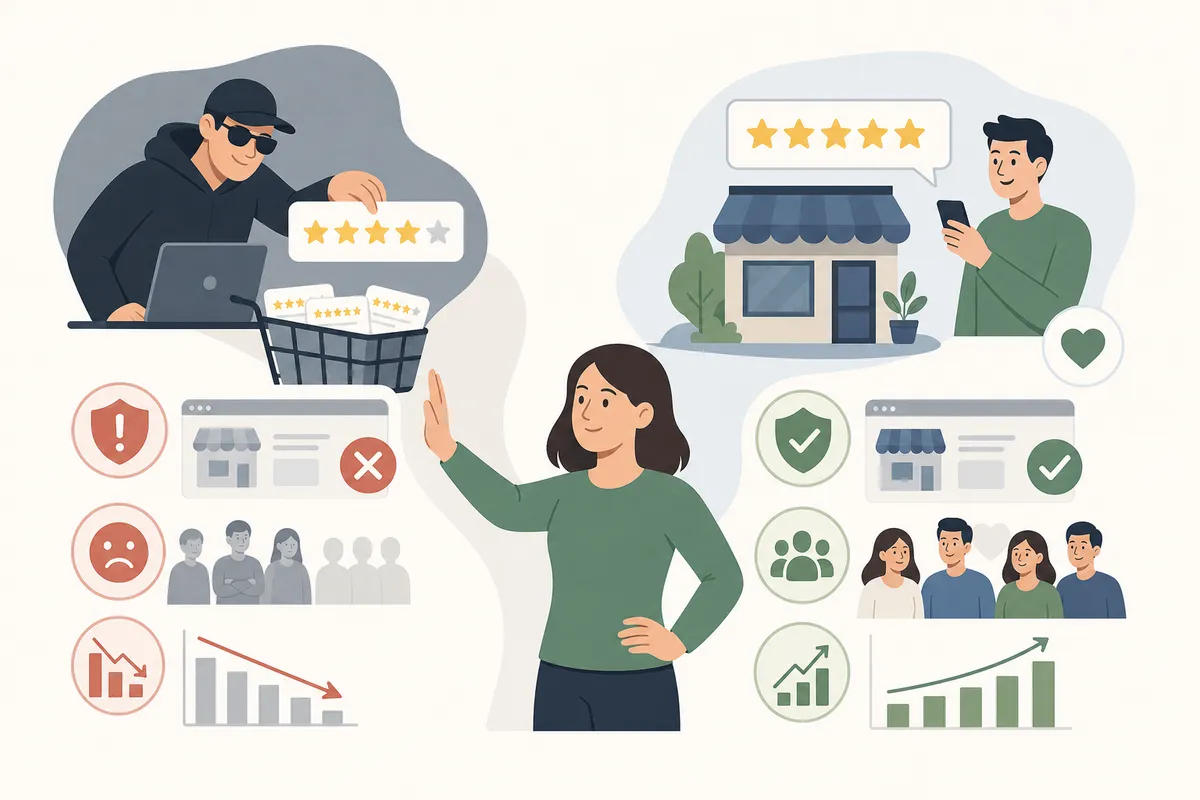
Whether you can buy reviews was never the real question; what matters is whether the upside justifies what you stand to lose, and for most businesses it doesn't.
It breaks Google's review policies
Google requires reviews to reflect a real customer's genuine experience. Google's own Search Essentials guidelines make clear that content designed to manipulate rankings, including fake engagement signals, violates its spam policies. Reviews bought from a third party fail that test by definition, because nobody involved actually used your business.
It can tank your local ranking instead of boosting it
Review volume and quality feed into local search visibility. A sudden spike of reviews from accounts with no history, all posted in a tight window, is a pattern Google's detection systems are built to catch. When that happens you lose more than the fake reviews: trust signals across the whole listing can erode, and your real rankings can drop with them. If your site has other problems too, like orphan pages that Google can't find, a review penalty compounds an existing visibility gap instead of fixing it.
It can bring legal and financial consequences
This isn't only a Google problem. In 2019, the FTC fined a weight-loss supplement retailer $12.8 million for using fake reviews on Amazon. The FTC treats paid or fabricated reviews as deceptive marketing and applies that standard across platforms, not just the one where the complaint started. A fine at that scale would cripple most small and mid-size businesses.
It doesn't last
Paid reviews get flagged and pulled, sometimes within days and sometimes months later. When they disappear, your rating often reverts to wherever it started, and you've also spent the money and possibly triggered a manual review of your profile.
| Risk | What Happens | Why It Matters |
|---|---|---|
| Policy violation | Reviews flagged and removed | You lose the reviews you paid for |
| Ranking impact | Local Pack visibility drops | Real customers stop finding you |
| Legal exposure | FTC enforcement, fines | Can run into six figures |
| Reputation damage | Customers or competitors call it out | Trust is hard to rebuild once lost |
The fix inside Google Business Profile itself
Instead of paying for reviews, use the review-collection tools Google already gives you for free.
- Sign in to your Google Business Profile at business.google.com and select the location you want to manage.
- Open the "Get more reviews" option on your profile home screen, or go to the "Reviews" tab in the left-hand menu.
- Copy your short review link. Google generates a unique link for your listing that takes customers directly to the review box without a search step.
- Share that link in follow-up emails, text messages, receipts, or a QR code at checkout. The fewer clicks a customer needs, the more likely they'll finish the review.
- Respond to every review you get, positive or negative, from the Reviews tab. Responding signals an active, trustworthy business to both customers and Google.
- Report suspicious reviews, including ones a competitor or an unhappy ex-employee might fake against you, with the flag option on the individual review. Google checks flagged content against its policies.
None of this requires paying anyone; it only requires asking consistently and making it easy to say yes.
When Google Business Profile's own tools are enough, and when they're not
Free tools solve some problems completely, while others need more than a review link and good intentions.
| Situation | Is the Free GBP Route Enough? | Why |
|---|---|---|
| Single location, steady foot traffic | Yes | A shared review link plus consistent asking usually builds volume over months |
| One bad review to dispute | Yes | Flagging it through GBP is the correct, compliant first step |
| Multi-location business needing review parity across cities | Often not alone | You need a system to track response rates and volume per location |
| Reviews dropping while rankings slide site-wide | Not alone | The cause may be broader, from weak site architecture to thin location pages, not just reviews |
| Recurring fake or competitor-posted reviews | Not alone | You may need ongoing monitoring and repeated flagging, not a one-off fix |
If it's a single, isolated issue, Google's own tools get you there. If reviews are one symptom of a bigger local visibility problem, look at the whole picture rather than only the Reviews tab.
Common mistakes businesses make chasing reviews
Buying a quick fix instead of building a request habit is the most common one, since a single purchased batch solves nothing once you stop asking real customers. A second is offering discounts explicitly for positive reviews, which counts as an incentivized review and which Google and the FTC both treat as manipulation even when no paid vendor is involved.
Some businesses leave negative reviews unanswered, though an unanswered bad review often does more damage than the review itself. Others assume reviews alone drive rankings. Reviews matter, but they sit alongside dozens of other local ranking factors, and chasing page one on reviews without fixing the rest of your SEO foundation rarely works. Page one brings more than just visibility when the rest of your site backs it up.
Finally, watch your review velocity. A business that jumps from 3 reviews to 40 in a week looks the same to Google's detection systems whether the jump was organic or manipulated.
FAQs
Is it illegal to buy Google reviews?
It depends on the jurisdiction, but in the U.S. the FTC treats paid or fake reviews as deceptive advertising, which can carry real financial penalties. It also violates Google's own terms, separate from any legal risk.
Can Google actually tell if reviews are fake?
Google uses automated detection plus human review to spot unusual patterns, like a burst of reviews from new or unrelated accounts. Detection isn't perfect, but it has improved enough that purchased reviews frequently get removed.
What happens if Google catches fake reviews on my profile?
Typically the fake reviews get deleted. In more serious cases, Google can restrict your profile's visibility or suspend it entirely, which affects your real, legitimate reviews too.
Can I offer a discount if someone leaves an honest review?
No. Offering any incentive tied to leaving a review, even one where you don't control the content, violates Google's policies. You can ask for honest feedback, but you can't pay or discount for it.
How many real reviews do I need to rank well locally?
There's no fixed number. What matters more is a steady pace of recent, genuine reviews relative to competitors in your area, rather than a one-time spike.
Get your reviews working with the rest of your SEO
So, can you buy Google reviews? Technically yes, but it's one shortcut that can cost you the listing you're trying to protect. Build your review volume the compliant way through your Google Business Profile's own tools, and pair it with the local SEO fundamentals that make those reviews count. If you want a clear picture of where your review profile and your wider SEO stand, talk to the team and request your sample SEO report.
Resources / References
Sources
About the author
SearchBlueprint researched, wrote and scored this article with the content pipeline our customers run on their own sites. The score in the byline is what our content engine gave this page before it published. Nothing here is reviewed by hand, which is the point: it is the product's output, published where anyone can check it.