Backlink Diversity in SaaS SEO: Why Variety Outranks Volume
SearchBlueprint · · 10 min read · scored 92/100

Backlink diversity in SaaS SEO means earning links from many different kinds of sources rather than piling up one link type. Think review platforms, partner pages, press coverage, communities, and niche blogs. A varied profile looks natural to Google and holds up better through algorithm updates. It also reaches buyers in more places than raw volume ever can.
This guide is written for SaaS founders and marketers who own their own link building. It also serves the agencies doing it on their behalf. It covers what a diverse backlink profile actually contains and how to measure yours. It also covers how to build variety without buying trouble, and the mistakes that make a profile look manufactured.
Key Takeaways
- A hundred links from a hundred different kinds of sources beat a thousand links that all look the same.
- Referring domains, anchor text spread, and link source mix are the three diversity signals worth checking first.
- Guest posts are fine as one ingredient. As the whole recipe, they are the most common SaaS link-building mistake.
- Nofollow links from communities and review sites still belong in a healthy profile. They also feed the AI answer engines your buyers now ask.
What backlink diversity means in SaaS SEO
A backlink profile is the full set of pages that link to your site. Diversity describes how varied that set is across several dimensions at once. Who links (referring domains) and what kind of site links (link source types) both matter. So do how they link (anchor text and follow status) and where the links point (which of your pages receive them).
Search engines read variety as evidence of a real company. Real products get reviewed on comparison sites, listed by integration partners, and discussed in forums. They get cited in industry press and linked by bloggers who actually used the tool. A profile built by one tactic, usually paid guest posts with keyword-rich anchors, has none of that texture. Google's spam policies treat links intended to manipulate rankings as link spam. The patterns they describe, such as large-scale article campaigns with optimized anchors, are exactly what a lopsided SaaS profile tends to look like. The Google Search Essentials documentation is worth reading in full before you brief any link vendor.

For SaaS specifically, diversity carries a second benefit that local businesses rarely think about: the sources themselves convert. A link from a review platform or a partner's integration directory sits directly in a buyer's evaluation path. The SEO value and the referral traffic come from the same placement.
Why a diverse backlink profile matters for SaaS rankings
Variety is the pattern of earned links
Ranking systems evaluate links in aggregate. One suspicious link means little. A profile-wide pattern means a lot. When most of your links share a template, the aggregate pattern reads as a campaign rather than a reputation. The tells are the same handful of anchor phrases, the same class of mid-tier blogs, and the same publishing cadence. Diverse profiles are harder to fake, which is precisely why they are trusted more.
Diversity spreads risk across updates
SaaS teams that built everything on one tactic have watched a single algorithm update or spam action erase years of work. If guest posts lose value, a guest-post-only profile loses value with them. A profile spread across editorial mentions, partner links, community discussion, and review platforms has no single point of failure. You do not need to predict which link type the next update will discount if no single type carries your rankings.
Diverse mentions feed AI answers, not just blue links
Your buyers increasingly ask ChatGPT, Perplexity, and voice assistants which tool to pick. Those systems build answers from the same sources a diverse link profile lives on: review sites, comparison posts, forum threads, and documentation. Being present across many source types is how you get named in those answers. The shift is the same one described in this breakdown of how voice search is changing modern SEO strategies. Assistants answer with one synthesized response, so brands cited across many sources win the mention.
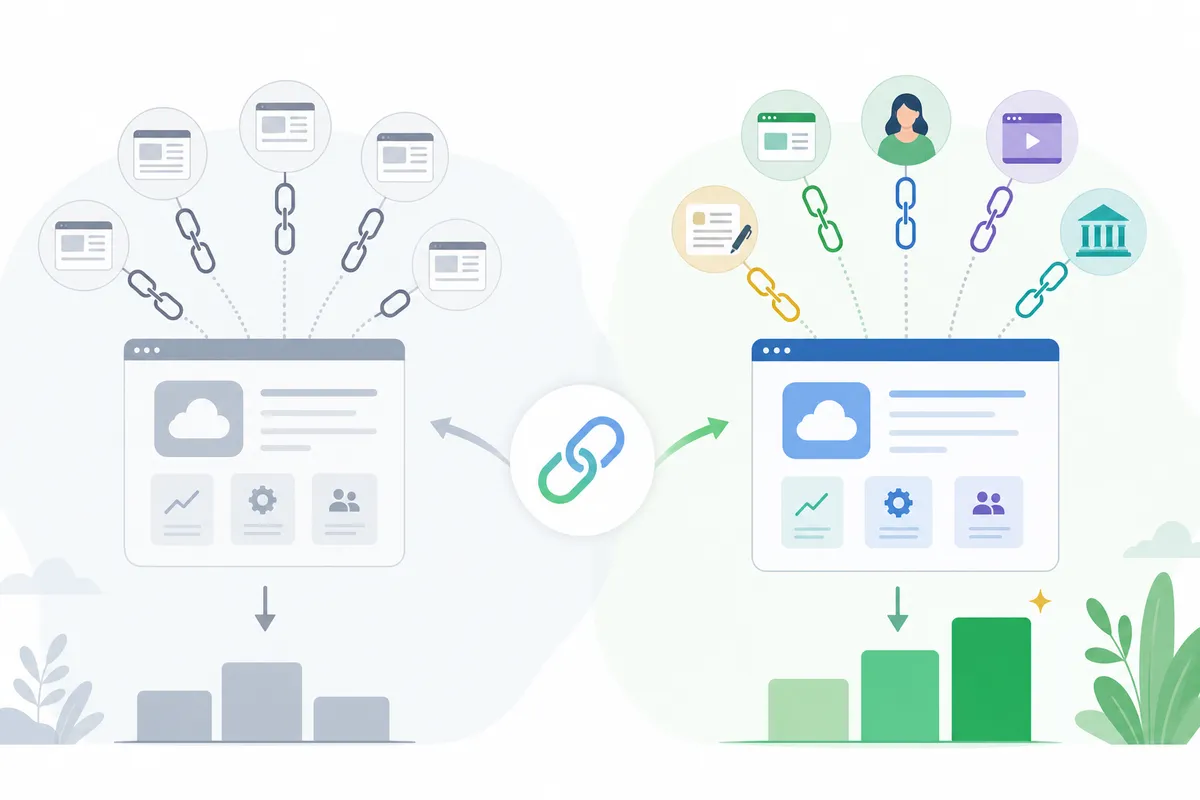
The link sources a healthy SaaS profile draws from
No two profiles should look identical, but strong SaaS profiles pull from most of the source types below. Each row stands on its own, so use the table as an inventory checklist against your current profile.
| Link source | How SaaS teams earn it | What it adds to the profile | Watch out for |
|---|---|---|---|
| Software review platforms | Claim and complete listings, then ask happy customers to review | High-relevance category links plus buyer-path traffic; often nofollow | Thin, unclaimed listings signal neglect rather than presence |
| Integration partner pages | Build real integrations and swap directory listings with partners | Deeply relevant dofollow links no competitor can replicate without the integration | Only works if the integration genuinely exists and ships |
| Editorial and press coverage | Founder commentary, original data, product launches pitched to industry publications | The highest-trust links in the profile, with natural branded anchors | Slow and unpredictable; treat as a channel, not a quota |
| Guest posts | Write genuinely useful pieces for niche publications | Contextual links and audience exposure in moderation | The tactic most associated with link spam when scaled with exact-match anchors |
| Communities and forums | Answer real questions where your buyers ask them | Nofollow diversity, brand mentions, and AI-answer visibility | Drive-by link dropping gets deleted and damages the brand |
| Free tools and linkable assets | Publish calculators, templates, benchmarks, or original research | Passive links that accumulate from many unrelated domains over time | An asset nobody searches for earns nothing; validate demand first |
| Podcasts and webinars | Founder or team appearances on industry shows | Show-notes links from varied domains plus authority by association | Pick shows your buyers actually hear, not the easiest bookings |
The pattern across every row: the link is a byproduct of something real, a review, an integration, an answer, an asset. That is what makes the resulting profile diverse without anyone forcing it.

How to audit backlink diversity in your own profile
You can check the essentials in an afternoon with any backlink tool that exports referring domains and anchors. Work through the checks in the same spirit as a 60-minute SEO audit. Find the biggest imbalance first rather than cataloguing everything.
The five checks that reveal a lopsided profile
- Referring domains against total backlinks. Thousands of links from a few dozen domains is concentration, not authority. New unique domains matter more than repeat links from the same ones.
- Anchor text distribution. Branded anchors and bare URLs should dominate a natural profile. Exact-match commercial anchors should be a small minority. When they lead, you are describing your own risk profile.
- Link source mix. Bucket your referring domains by type using the table above. If one bucket holds most of the profile, you have found your gap.
- Follow status. A profile with almost no nofollow links is a tell in itself. Organic popularity always includes forums, socials, and review platforms that nofollow by default.
- Target page spread. If nearly every link points at the homepage, your product, comparison, and content pages are competing without support.
Track it like any other SEO metric
Diversity drifts. A quarter of aggressive guest posting can quietly tip a healthy profile into imbalance. Put referring domain growth and anchor distribution into your regular reporting rather than auditing once and forgetting it. If you report to clients or executives, the link section of a well-built professional SEO report should show trends. That means new referring domains and anchor mix over time, not a single vanity total.

How to build link diversity without buying trouble
Start from assets, not outreach volume
The most durable diversity comes from publishing things that many different kinds of sites want to reference. Think original benchmarks from your product data, free tools, templates, and honest teardown-style comparisons. One strong asset can earn links from press, bloggers, forums, and newsletters at once. That is four source types from one piece of work. Producing those assets is where the split between machine drafting and human judgment matters most. This guide to when AI content works for SEO and when it does not covers where the line sits.
Sequence tactics by effort and payoff
A practical order for a SaaS team starting from a thin or lopsided profile:
- Claim and complete every relevant review platform and directory listing. Fast, free, and it fills the nofollow and category-relevance gaps right away.
- List every integration you already have and pursue the partner page for each one. These links are relevance-perfect and competitor-proof.
- Ship one linkable asset per quarter, promoted to the specific writers and communities who cover your category.
- Layer in editorial outreach and selective guest posting once the foundation exists, keeping anchors branded.
Keep the anchors boring
Whatever the tactic, resist specifying anchors. Ask for the link, let the linking site phrase it, and your anchor distribution stays natural without management. The moment you find yourself negotiating exact-match anchors, you are optimizing the one signal that most reliably marks a manipulated profile.
Common pitfalls that flatten SaaS link profiles
| Pitfall | What it looks like in the data | The fix |
|---|---|---|
| Guest posts as the whole strategy | One source type dominating referring domains, uniform mid-tier blogs | Cap guest posting and reallocate effort to partners, reviews, and assets |
| Exact-match anchor campaigns | Commercial keywords leading the anchor report | Shift all new links to branded anchors; the ratio dilutes over time |
| Buying from link farms or PBNs | Bursts of links from unrelated, low-traffic domains | Stop buying; document the vendor's placements in case cleanup is ever needed |
| Chasing domain rating alone | High-metric links from topically irrelevant sites | Filter prospects by audience relevance first, metrics second |
| Homepage-only linking | One URL holding nearly all referring domains | Point new campaigns at product, comparison, and guide pages |
| Dismissing nofollow sources | No community, social, or review links anywhere in the profile | Treat nofollow placements as diversity and AI-visibility investments |
Every pitfall in the table shares one root cause: optimizing a single number, whether link count, domain rating, or anchor relevance. Diversity is the antidote because it cannot be gamed through any single metric.
Can you fix this yourself, or do you need help?
Honestly, most of it is DIY territory. Claiming review listings, building partner pages from existing integrations, and answering community questions require founder time and product knowledge, not an agency. A solo marketer can run the five-check audit above with a free backlink checker and a spreadsheet.
Professional help earns its fee in three situations. The first is a profile carrying real spam that needs careful cleanup. The second is a category where editorial coverage decides the battle and you have no press relationships. The third is a team whose time is worth more than the coordination cost of outreach in-house. If you do hire, the table of source types above doubles as a vendor test. A provider whose plan is entirely guest posts is selling you the exact concentration problem this article exists to prevent.
FAQs
How many referring domains does a SaaS company need?
There is no universal number. What matters is trajectory and comparison. Your referring domain count should grow steadily. The gap between you and the competitors ranking above you tells you how much ground to make up. A smaller but more varied profile regularly outranks a larger, uniform one.
Are nofollow links worth anything for SaaS SEO?
Yes. They complete the natural shape of a profile and send real referral traffic from reviews and communities. They also place your brand in the sources AI answer engines draw from. Google itself treats nofollow as a hint rather than a directive, so the links are not simply ignored. A profile with zero nofollow links looks curated, which is not a compliment.
What is a good anchor text distribution?
Branded anchors and plain URLs should make up the clear majority. Topical phrases come next, and exact-match commercial anchors stay a small minority. If exact-match anchors lead your report, dilute them with branded links before building anything else.
Do directory and review-site links still count?
Relevant ones do. Software review platforms and integration directories are category-defining sources that buyers actually use. Their links carry topical relevance most blogs cannot match. Generic web directories with no audience are the kind Google's link spam policies were written about, so skip those.
How long does link building take to show results?
Typically months, not weeks. Links need to be discovered, crawled, and weighed against the rest of your profile. Rankings move on the aggregate. Review listings and partner pages tend to pay back fastest because they send referral traffic while the search impact compounds.
Get your link profile measured against this checklist
Backlink diversity in SaaS SEO is measurable, so measure yours before you commission another batch of links. Run the five checks above on your own domain. Want to see how referring domains, anchors, and link gaps look inside a full audit? Talk to the team and walk through a sample SEO report built from a real site. Bring your loudest competitor's domain with you. The gap analysis is usually the part that changes the plan.
Resources / References
Disclaimer: This article is general information about rules and figures that applied when it was written, not personalised financial, tax or investment advice. It does not take account of your income, obligations, risk tolerance or goals, and rates and thresholds change. Verify the current position with the relevant authority, and speak to a licensed adviser or a qualified accountant before acting.
About the author
SearchBlueprint researched, wrote and scored this article with the content pipeline our customers run on their own sites. The score in the byline is what our content engine gave this page before it published. Nothing here is reviewed by hand, which is the point: it is the product's output, published where anyone can check it.